

In This Article
There’s a very specific kind of disappointment that hits the moment you plug a four-string into a rehearsal room built for down-tuned riffage and realise you simply don’t have the note. The guitarist drops to C, the drummer’s kick is doing something percussive and unreasonable, and you’re stuck playing the wrong octave up just to stay in the room. This is the exact problem a 5-string bass guitar for metal is built to solve. That extra low B string isn’t a gimmick — it’s the difference between chasing a riff and actually anchoring it.

A 5-string bass guitar for metal is, put simply, a bass with a fifth string (typically a low B) tuned below the standard E, paired with pickups and electronics voiced to stay clear and punchy even when the amp is doing its angriest work. The best examples combine active electronics, a slim and speed-friendly neck, and enough output to cut through a wall of distorted guitars without turning to mush.
This guide covers seven genuinely available basses across budget, mid-range, and premium tiers, all researched for real specs, real availability, and honest analysis rather than recycled marketing copy — because heavy metal as a genre has always been built on amplified distortion and sheer volume, and your bass needs to survive that environment, not just look the part in a shop window. We’ll dig into active pickups for metal bass, what high output bass pickups actually change about your tone, why drop tuning behaves differently on five strings, and how fast neck profile claims hold up once you’re actually gigging. Prices below are UK ranges rather than fixed figures, since Amazon listings shift constantly — always check the current price before buying.
Quick Comparison: 7 Best 5-String Bass Guitars for Metal
| Bass | Price Range | Pickups | Best For |
|---|---|---|---|
| Ibanez GSR205B | Under £300 | Passive Dynamix H | Budget beginners |
| ESP LTD B-205SM | £500-£650 range | Passive SB-5 + active EQ | Looks + fast neck |
| Ibanez SR505E | £500-£650 range | Bartolini BH2, switchable | Tonal versatility |
| Schecter C-5 GT | £700-£900 range | Active EMG 40DC/40P5 | Aggressive metal tone |
| Jackson CBX V (Ellefson) | £700-£900 range | EMG HZ40 + active EQ | Thrash/signature pedigree |
| Spector NS Ethos HP 5 | £1,100-£1,400 range | Active EMG 40DC + Darkglass | Premium studio/stage |
| Ibanez SRMS805 | £800-£1,000 range | Bartolini BH2, multi-scale | Drop-tuned extended range |
Looking at this spread, the story isn’t really “expensive beats cheap” — it’s about what each design trades off. The Ibanez GSR205B proves you don’t need active electronics to get a usable metal tone, but you’re relying entirely on your amp’s EQ to shape it. The Schecter C-5 GT and Jackson CBX V both lean on EMG-style high output for that scooped, cutting metal voice, while the Ibanez SRMS805 is the only bass here built specifically around fanned frets for better low-B behaviour under drop tuning. If you’re brand new to five-string basses, that Best For column is worth reading twice before you read a single spec sheet.
Found a favourite already? Give it a thumbs up below and help other bassists find their match too! 💬😊
Top 7 5-String Bass Guitars for Metal: Expert Analysis
1. Ibanez GSR205B — best budget 5-string that won’t choke on distortion
The Ibanez GSR205B opens this list because it genuinely earns its spot rather than filling a token “cheap option” slot. It pairs a mahogany body with a maple GSR5 neck and a Jatoba fingerboard across 22 medium frets, and the Phat II EQ gives it an active bass boost even though the pickups themselves are passive.
Those Dynamix H humbuckers won’t compete with EMGs for raw output, but they’re voiced with enough midrange growl that palm-muted riffs don’t disappear into mush the way cheaper single-coil-loaded basses can. Based on the spec comparison with pricier options here, what most buyers overlook about this model is that the slim GSR5 neck profile is genuinely comparable to Ibanez’s much pricier SR range — you’re not paying a “beginner tax” on playability, only on electronics and finish quality.
Reviewers consistently note that for the price, the build quality punches above its weight, particularly the neck-to-body transition and fret levelling, though a few point out the stock strings are unremarkable and worth upgrading early. This is honestly the smart move for a first metal bass, a backup for gigging bassists worried about damaging a pricier instrument, or a practice-room bass for a student who isn’t ready to commit hundreds of pounds to a hobby that might not stick.
Pros:
- ✅ Genuinely playable slim neck at an entry-level price
- ✅ Phat II active EQ adds usable low-end punch
- ✅ Lightweight body reduces strap fatigue during long sessions
Cons:
- ❌ Passive pickups limit output compared to active rivals
- ❌ Stock hardware and strings feel budget compared to body/neck quality
At under £300, the Ibanez GSR205B is close to unbeatable value for anyone testing whether five strings and metal actually suit their playing before investing further.

2. ESP LTD B-205SM — eye-catching spalted maple with a genuinely fast neck
The ESP LTD B-205SM is the bass that photographs beautifully and then backs it up when you actually play it. Its spalted maple top over an ash body gives it a grain pattern no two instruments quite share, and the 5-piece maple/jatoba neck uses a thin U-shaped contour designed for exactly the kind of rapid fretting hand metal demands.
Here’s a detail worth clearing up honestly: the ESP LTD B-205SM‘s SB-5 pickups are passive, paired with an active ABQ-3 3-band EQ — not full active pickups the way EMGs work. What that means in practice is you get genuine tonal shaping through the EQ (bass, mid, treble boost/cut plus a neck/bridge balance knob) without quite the same raw output ceiling as a fully active EMG-loaded bass. The string-thru-body bridge design does meaningful work here too, adding sustain that helps notes bloom rather than die under a wall of distortion.
Reviewers on owner forums like TalkBass consistently describe the B-205SM as punching well above its price bracket, with several long-term owners noting the neck feel rivals basses costing twice as much; a recurring theme is surprise at how “un-cheap” it feels once you’ve actually spent time on the frets. It suits a gigging metal bassist who wants a distinctive look without sacrificing a genuinely fast neck profile, and it’s a strong pick for anyone playing a mix of clean and distorted tones live.
Pros:
- ✅ Distinctive spalted maple top stands out on stage
- ✅ Thin U-neck profile supports genuinely fast playing
- ✅ String-thru-body bridge adds real sustain
Cons:
- ❌ Passive pickups mean less raw output than active EMG rivals
- ❌ 24 frets on a 5-string neck can feel wide for smaller hands
Expect to pay somewhere in the £500-£650 range, and given the neck quality on offer, that feels like fair value rather than a premium tax for the looks.
3. Ibanez SR505E — switchable active-passive tone for metal versatility
The Ibanez SR505E takes a different approach entirely: rather than committing to one voice, it gives you both. Its Okoume body and jatoba/walnut neck deliver Ibanez’s signature lightweight, fast-playing feel, but the real story is the Bartolini BH2 pickup pairing combined with a 3-band EQ that includes a genuine passive bypass switch.
What most buyers overlook about this model is that Bartolini’s dual-coil BH2 design has a lower resonant frequency than a typical single-coil-style bass pickup, which in practice means a tighter bottom end and fuller midrange even before you touch the EQ. Flip the bypass switch and you get a warmer, more vintage-voiced passive tone with the treble knob acting as a simple tone control — genuinely useful if your band splits time between doom-adjacent grooves and faster technical passages. The 3-way mid-frequency switch (250Hz, 450Hz, 700Hz) is the kind of feature you won’t find explained on an Amazon listing but which matters enormously live, letting you carve out space in a dense mix without an outboard EQ pedal.
Aggregated reviewer sentiment across retailer listings and forums consistently praises the SR505E’s comfort and low weight (around 8lb), with several owners specifically highlighting how the adjustable B505 bridge saddles solved string-spacing complaints they’d had with other five-strings. On paper, this makes it an excellent fit for a bassist who genuinely can’t decide between an aggressive modern tone and something more traditional, or a session player who needs one bass to cover multiple genres in a single set.
Pros:
- ✅ Active/passive switch genuinely changes the character, not just volume
- ✅ Bartolini BH2 pickups deliver tight lows and full mids
- ✅ Adjustable bridge saddles fix common 5-string spacing gripes
Cons:
- ❌ Availability has varied as Ibanez updates the SR series lineup
- ❌ Less aggressive out-of-the-box than EMG-loaded metal specialists
At a similar £500-£650 range to the ESP, the choice between them really comes down to whether you want ESP’s distinctive looks or Ibanez’s tonal flexibility — check current stock, since Ibanez periodically refreshes SR series naming and specs.
4. Schecter C-5 GT — 35-inch scale and EMG fury built for pure aggression
If the previous two basses are about versatility, the Schecter C-5 GT exists for one job: sounding enormous under heavy distortion. Its mahogany body with a flamed maple top is paired with a 35-inch scale length — longer than the 34-inch standard — which adds string tension that genuinely helps the low B stay articulate rather than floppy.
The EMG 40DC bridge and EMG 40P5 neck pickup combination is where this bass earns its reputation among metal bassists specifically hunting for active pickups for metal bass. These are genuinely active, battery-powered pickups with a 2-band EMG EQ, and the practical result is a hotter signal hitting your amp’s front end with dramatically reduced noise floor compared to passive alternatives — useful when you’re standing three feet from a wall of guitar cabinets. The thin “C”-profile 3-piece maple neck, reinforced with carbon fibre rods, is built explicitly for speed, and the ebony fretboard with 24 extra-jumbo frets rewards fast alternate-picking technique rather than punishing it.
Reviewers consistently describe the tonal character as tight and aggressive with minimal unwanted noise, a common theme being that the EMG pairing produces a “scooped but punchy” voice that cuts through dense mixes without needing much post-EQ correction. This is squarely a bass for players committed to modern metal, metalcore, or technical death metal where clarity under heavy gain is non-negotiable, and it’s honestly less suited to a player chasing warm, vintage P-bass tones.
Pros:
- ✅ Active EMG 40DC/40P5 pickups deliver genuine high output bass pickups performance
- ✅ 35-inch scale length keeps the low B taut under drop tuning
- ✅ Carbon-fibre-reinforced neck built specifically for speed
Cons:
- ❌ Requires a 9V battery, which can die mid-set if you forget to check it
- ❌ Less tonally flexible for non-metal genres than switchable rivals
In the £700-£900 range and stocked by UK retailers including Andertons, this is one of the clearest “does exactly what it says” basses on this list.
5. Jackson X Series David Ellefson CBX V — Megadeth pedigree with punishing low-end clarity
Named after Megadeth’s David Ellefson, the Jackson X Series David Ellefson CBX V is a bass with genuine thrash metal DNA rather than borrowed cool. Its poplar body and quartersawn maple neck with graphite reinforcement are engineered for touring stability, while the 12″-16″ compound-radius laurel fingerboard flattens progressively as you move up the neck, easing the transition into faster upper-register runs.
Its EMG HZ40 pickups sit in an interesting middle ground worth explaining honestly: EMG’s HZ series are modern passive humbuckers, not battery-hungry actives, but they’re paired here with a genuinely active 3-band EQ. What this means in practice is you get much of the low-noise, high-output character associated with EMG’s active line, shaped through a proper onboard EQ, without the pickups themselves drawing constant battery current — a sensible compromise for players nervous about battery reliability mid-gig. The Jackson HiMass bridge adds meaningful sustain and attack, and the blend knob lets you dial from warm neck-heavy tone to cutting bridge-position bite without ever feeling like you’ve lost low-end weight.
Reviewer sentiment on this bass, including from owners discussing it on gear forums, consistently highlights surprise at how manageable the five-string weight distribution feels compared to expectations, alongside praise for how the EMG PJ-style voicing translates classic Jackson attitude onto five strings rather than diluting it. If you’re chasing that specific thrash and speed-metal low-end clarity — picking notes that stay defined even at breakneck tempo — this is one of the most purpose-built options here.
Pros:
- ✅ Signature pedigree from a genuine thrash metal legend
- ✅ Compound-radius fingerboard eases fast upper-fret runs
- ✅ EMG HZ40 pickups plus active EQ balance output and reliability
Cons:
- ❌ Aesthetic and voicing are quite genre-specific to thrash/classic metal
- ❌ Poplar body construction feels less premium than mahogany rivals at a similar price
Expect a similar £700-£900 range to the Schecter, with UK availability through retailers like Andertons — genuinely worth a shortlist spot if the Megadeth association means anything to your playing background.
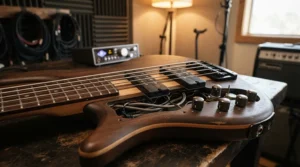
6. Spector NS Ethos HP 5 — neck-thru sustain with Darkglass-voiced EMGs
The Spector NS Ethos HP 5 is where this list moves properly into premium territory, and the neck-through-body construction is the headline reason why. A 3-piece maple neck runs the entire length of the instrument, joined by two sculpted alder wings, and that continuous piece of wood from headstock to strap button noticeably improves sustain and upper-fret access compared to bolt-on designs earlier on this list.
Electronically, this is arguably the most metal-specific pairing here: dual EMG 40DC active pickups feeding a Darkglass Tone Capsule preamp. Darkglass built its reputation on aggressive, high-gain bass tone for metal and progressive genres specifically, and baking that voicing into the onboard preamp — rather than relying on an external pedal — means you’re getting boutique-level tonal shaping without extra gear on your board. The controls (volume, blend, bass, mid, and hi-mid) give genuinely surgical control that most active EQs on cheaper basses simply don’t offer, particularly that hi-mid band, which is exactly the frequency range that determines whether a bass cuts through a metal mix or disappears behind rhythm guitars.
Aggregated sentiment from owners and demo reviewers consistently frames this as one of the more versatile “aggressive” basses available, capable of everything from tight, articulate metal tones to more open rock voicings depending on how the Tone Capsule is dialled in. Spector’s artist roster reportedly includes players like Rex Brown of Pantera, which speaks to the instrument’s credibility in exactly this genre space. This is the bass for a serious touring or studio metal bassist who has outgrown mid-range instruments and wants boutique-adjacent tone without commissioning a custom build.
Pros:
- ✅ Neck-thru construction genuinely improves sustain and access
- ✅ Darkglass Tone Capsule preamp adds metal-specific tonal depth
- ✅ Hi-mid EQ control offers genuinely surgical tone shaping
Cons:
- ❌ Premium price puts it out of reach for casual or beginner players
- ❌ Less forgiving for genres outside aggressive rock/metal territory
Pricing typically lands in the £1,100-£1,400 range in the UK, so treat this as an investment purchase rather than an impulse buy — always check current price, since Spector’s positioning shifts between markets.
7. Ibanez SRMS805 — fanned frets built specifically for punishing drop tunings
Closing the list is the bass most specifically engineered around the drop tuning problem this guide opened with. The Ibanez SRMS805 uses a multi-scale (fanned-fret) design spanning 34 inches on the high string up to 35.5 inches on the low B, and that’s not a gimmick — it’s a direct response to a real physics problem.
On a standard single-scale five-string, a low B tuned properly needs real string tension to stay articulate rather than floppy, but that same scale length makes the highest string feel unnecessarily stiff. A multi-scale fingerboard solves this by letting each string sit at its own effective length, so lower strings get tighter and higher strings stay comfortably playable. This matters directly if you’re chasing drop tuning below standard B, since the longer bass-side scale on the Ibanez SRMS805 keeps that already-loose low string from turning to mud. Paired with Bartolini BH2 pickups and Ibanez’s 3-band active EQ (complete with a mid-frequency switch and passive bypass, mirroring the flexibility of the SR505E higher up this list), the electronics are genuinely capable rather than an afterthought bolted onto a novelty neck shape.
Reviewer sentiment consistently flags an adjustment period for players new to fanned frets — the angled fret lines look intimidating on a shop wall — but just as consistently reports that muscle memory adapts within a few practice sessions, after which the improved intonation and string balance become obvious. This is the right choice for a technical or progressive metal bassist regularly working in drop C, drop B, or lower, who’s already comfortable on a standard five-string and ready to solve the low-B floppiness problem properly rather than compensating with heavier gauge strings alone.
Pros:
- ✅ Multi-scale design keeps the low B tight under drop tuning
- ✅ Bartolini BH2 pickups with switchable active/passive EQ
- ✅ Mono-Rail VS bridge allows per-string spacing adjustment
Cons:
- ❌ Fanned frets require a genuine adjustment period
- ❌ Higher price than similarly specced single-scale Ibanez models
Sitting in the £800-£1,000 range, the Ibanez SRMS805 rewards players who’ve identified drop tuning specifically as their priority rather than a nice-to-have.
Full Spec Comparison: Pickups, Necks & Scale Length
| Bass | Pickups | Neck | Scale | Price Range |
|---|---|---|---|---|
| Ibanez GSR205B | Passive Dynamix H | Maple GSR5, slim | 34″ | Under £300 |
| ESP LTD B-205SM | Passive SB-5 + active EQ | 5-pc maple/jatoba, thin U | 34″ | £500-£650 |
| Ibanez SR505E | Bartolini BH2, switchable | Jatoba/walnut SR5 | 34″ | £500-£650 |
| Schecter C-5 GT | Active EMG 40DC/40P5 | 3-pc maple, thin C | 35″ | £700-£900 |
| Jackson CBX V | EMG HZ40 + active EQ | Maple, graphite-reinforced | 34″ | £700-£900 |
| Spector NS Ethos HP 5 | Active EMG 40DC + Darkglass | 3-pc maple, neck-thru | 35″ | £1,100-£1,400 |
| Ibanez SRMS805 | Bartolini BH2, multi-scale | 5-pc jatoba/walnut | 34″-35.5″ | £800-£1,000 |
The clearest pattern in this table is scale length correlating with genre intent: basses built explicitly for aggressive, down-tuned metal (the Schecter C-5 GT, Spector NS Ethos HP 5, and the fanned Ibanez SRMS805) all push past the 34-inch standard, because that extra tension genuinely helps a low B string stay defined. Meanwhile, the more versatile options — the Ibanez SR505E and ESP LTD B-205SM — stick to 34 inches and lean on switchable electronics instead to cover multiple genres from one instrument.

Setting Up Your New 5-String Metal Bass: The First 30 Days
Getting a new five-string dialled in properly avoids most of the frustration new owners report in the first month. Start by having a tech check the truss rod relief and intonation specifically for the low B — it’s the string most setups get wrong, since shops often default to four-string tension calculations. Break in new strings by playing regularly for the first week; a fresh low B stretches more than you’d expect and will drift out of tune repeatedly until it settles.
If your bass has active electronics, replace the battery preemptively rather than waiting for it to die — a fresh 9V lasts many months of regular use, but a dying battery causes a specific, gradual volume and clarity drop that’s easy to mistake for a hardware fault. A common early mistake is cranking the active EQ’s bass and treble boosts to maximum immediately; instead, start flat and add gradually, since most active preamps offer more headroom than four-string players expect and it’s easy to introduce unwanted noise or clipping. Finally, budget for a proper setup within the first month even on a new instrument — humidity and shipping conditions shift neck relief more than most players assume, and a cheap setup now prevents buzzing frets later.
How to Choose a 5-String Bass Guitar for Metal
Picking the right instrument comes down to a handful of genuinely decisive factors, not marketing buzzwords.
- Decide on active or passive electronics first. Active pickups for metal bass generally offer more output and a lower noise floor, but they need battery maintenance — passive designs are simpler but rely more heavily on your amp’s EQ.
- Check the scale length against your tuning plans. Standard 34-inch scales suit standard-to-drop-D tunings; anything lower benefits from a 35-inch or multi-scale design.
- Try the neck profile in person if at all possible. A genuinely fast neck profile for one player’s hands can feel unwieldy for another, especially across five strings’ extra width.
- Weigh the bass, literally. Five-strings run heavier than four-strings, and a poorly balanced body causes neck-dive that fatigues your fretting hand over a long set.
- Match pickup output to your genre’s gain levels. Extreme, high-gain metal genres generally benefit from high output bass pickups like EMGs; more dynamic styles may prefer Bartolini-style balanced output.
- Budget for a proper setup, not just the instrument. Even a well-reviewed bass needs professional intonation and relief adjustment to perform as described.
- Consider battery access and reliability for gigging basses. A quick-access battery compartment matters more than it sounds once you’re changing one between sets.
Active Pickups for Metal Bass: Why High-Output Electronics Matter
There’s a persistent myth that “active” simply means “louder,” and it’s worth untangling honestly. Active pickups for metal bass, like the EMG 40DC units found in the Schecter C-5 GT and Spector NS Ethos HP 5, use an internal preamp powered by a 9V battery to boost signal strength before it ever reaches your cable. The practical benefit isn’t just volume — it’s a dramatically improved signal-to-noise ratio, meaning less 60-cycle hum and interference from nearby guitar amps and lighting rigs, which matters enormously in a loud metal live environment.
High output bass pickups also interact differently with your amp’s front end. A hotter signal can push a tube preamp into gentle saturation sooner, adding a subtle grit that many metal bassists actually want, whereas passive pickups generally need a boost pedal or a hotter amp gain stage to achieve the same effect. That said, active electronics aren’t automatically “better” — the honest trade-off is battery dependency and, for some players, a slightly more scooped, hi-fi character that can feel less organic than a good passive pickup driven hard. Basses like the Ibanez SR505E sidestep this debate entirely by offering a passive bypass switch, letting you choose per song rather than committing at the point of purchase.
5-String Bass and Drop Tuning: Getting the Low B Right
Drop tuning on a five-string bass behaves differently than most players expect coming from four strings, and getting it wrong is one of the more common sources of buyer’s remorse. Drop D tuning started as a guitar technique, lowering the bottom string a whole step to make power chords easier to play with one finger, and bassists following guitarists into drop C or lower are effectively asking their already-low B string to go even slacker — and slack strings lose clarity fast.
This is precisely why scale length matters so much on the products in this guide. A standard 34-inch scale keeps reasonable tension on a B string tuned to standard pitch, but push that same string down further and it can start to feel rubbery, buzzing against frets and losing note definition. The Schecter C-5 GT and Spector NS Ethos HP 5 address this with a 35-inch scale as standard, adding tension across all five strings uniformly. The Ibanez SRMS805 takes a more surgical approach with its multi-scale, fanned-fret design, extending only the bass-side scale length to 35.5 inches while keeping the treble side at a comfortable 34 inches — solving the low-end tension problem without stiffening your high G string unnecessarily.
If you’re set on drop tuning below standard and your current bass isn’t built for it, heavier gauge strings can help as a stopgap, but they’re a compromise rather than a fix; the fundamental physics of scale length and tension will always outperform a thicker string on the same short scale.
Fast Neck Profiles: Why Speed Matters for Metal Bassists
A fast neck profile gets thrown around loosely in bass marketing, so it’s worth being specific about what actually makes a neck feel quick under the hand. Thinner front-to-back depth (like the thin U-shape on the ESP LTD B-205SM or the thin C-profile on the Schecter C-5 GT) reduces how far your thumb has to travel to wrap around the neck, which directly benefits fast alternate-picking and tapping techniques common in technical metal.
Nut width matters just as much, and it’s genuinely under-discussed. Adding a fifth string necessarily widens the neck, and manufacturers handle that widening differently — some keep string spacing tight to preserve a familiar four-string feel, while others spread strings further apart for easier individual picking accuracy at the cost of overall neck width. The Ibanez SR505E‘s adjustable bridge saddles are a clever answer here, letting you fine-tune spacing after purchase rather than being locked into the factory setting. Fretboard radius also plays a role: a flatter radius, like the compound 12″-16″ board on the Jackson X Series David Ellefson CBX V, flattens out further up the neck specifically to ease the fast upper-register runs that thrash and speed metal demand.
The honest takeaway is that “fast neck” claims are genuinely meaningful but deeply personal — a neck one player calls fast, another with larger hands might call cramped, which is exactly why trying before buying, or at minimum checking nut width and depth specs carefully, matters more than trusting marketing copy alone.

Which 5-String Suits Your Style? Real Player Scenarios
If you’re a bedroom player working through death metal riffs on a tight budget, the Ibanez GSR205B gets you playing immediately without the anxiety of babying an expensive instrument, and its passive pickups paired with your amp’s distortion channel will handle most practice-room needs. If you’re gigging regularly in a thrash or classic metal covers band and want an instrument with genuine genre credibility, the Jackson X Series David Ellefson CBX V brings both the tone and the story behind it, and its EMG HZ40 pickups plus active EQ handle the fast palm-muted riffing that style demands.
If you’re a touring or session bassist working across modern metal, metalcore, and progressive styles who needs studio-grade tone without external pedals, the Spector NS Ethos HP 5‘s Darkglass-voiced preamp effectively puts a boutique pedal inside the instrument itself. And if drop tuning below standard B is your specific priority — think djent, progressive death metal, or anything regularly dipping into A or lower — the Ibanez SRMS805‘s multi-scale design is worth the adjustment period, because no amount of EQ tweaking on a standard-scale bass fully replicates what proper string tension does for low-end clarity.
Common Playing Problems on 5-String Basses (And How to Fix Them)
A muddy, undefined low B is the most frequent complaint from new five-string owners, and it’s usually a tension problem rather than a pickup problem — check scale length and consider a heavier gauge B string before assuming you need new electronics. Fret buzz specifically on the B and E strings, while the higher strings play cleanly, typically points to insufficient relief for the wider vibration arc of thicker strings, which a proper setup with slightly more neck relief usually resolves.
Unwanted hum or noise through distortion pedals is common with passive single-coil-style pickups; switching to a bass like the Ibanez SR505E or Schecter C-5 GT with humbucking or active designs largely solves this at the source. Finally, hand fatigue from an unfamiliar wider neck is genuinely common in the first few weeks — rather than assuming you bought the wrong bass, give it a proper adjustment period of consistent daily practice before judging the neck profile as unsuitable, since most reported discomfort fades within two to three weeks of regular playing.
Common Mistakes When Buying a 5-String Metal Bass
The single biggest mistake is buying based on pickup brand reputation alone without considering scale length, particularly for anyone planning to drop tune regularly — a fantastic pickup can’t fix a floppy, under-tensioned string. A close second is skipping a proper in-store or return-window trial of the neck profile, since nut width and depth genuinely vary more between five-string models than most buyers expect coming from four strings.
Buyers also frequently underestimate weight; a five-string with a dense body and headstock can cause real shoulder strain over a long set, so checking approximate weight (not just body wood) matters more than it might seem. Finally, a subtler mistake is assuming active electronics are strictly necessary for a metal tone — plenty of passive-pickup basses on this list, like the Ibanez GSR205B, handle aggressive tones perfectly well when paired with the right amp settings, and buying active electronics you don’t actually need just adds battery maintenance to your routine for no real tonal gain.
What to Expect: Real-World Metal Bass Tone
Specs on paper only tell part of the story, so here’s what these differences actually sound like once you’re standing in front of an amp. A passive-pickup bass like the Ibanez GSR205B, run through a decent bass amp with modest gain, produces a warmer, slightly rounder metal bass tone that sits comfortably underneath rhythm guitars without demanding much EQ correction — solid for mid-tempo groove metal, less ideal for razor-sharp technical passages. Step up to something like the Schecter C-5 GT or Jackson X Series David Ellefson CBX V, and the active EMG voicing produces a noticeably tighter, more scooped sound with pronounced attack — you’ll hear individual notes in fast runs more distinctly, which matters enormously for technical or thrash metal where the bass often doubles complex guitar riffs note-for-note.
At the premium end, the Spector NS Ethos HP 5‘s Darkglass-voiced preamp adds a genuinely different character again: an aggressive, slightly overdriven-sounding midrange push even at moderate gain settings, which is precisely the tone associated with modern progressive and djent-adjacent metal production. The Ibanez SRMS805‘s multi-scale design contributes something more subtle but equally real — a more even tonal balance across all five strings, since the low B isn’t fighting against an under-tensioned scale to produce the same clarity as the higher strings.
Long-Term Cost & Maintenance of Active Electronics
Active electronics add a small but real ongoing cost that’s worth factoring into your total budget beyond the sticker price. A standard 9V battery typically lasts anywhere from a few months to over a year depending on how often you unplug the instrument between uses (leaving a cable plugged in drains the battery even when you’re not playing, since it completes the circuit). Budget roughly £5-£10 annually for battery replacements on any of the active basses in this guide — genuinely negligible against the instrument’s overall cost, but worth building into your gig-bag habits so you’re never caught out mid-set.
Passive-pickup basses like the Ibanez GSR205B and the passive-bypass mode on the Ibanez SR505E avoid this cost entirely, which is a small but real point in favour of simplicity for a backup or practice instrument. Beyond batteries, active preamps are generally reliable and rarely fail outright, but a scratchy or intermittent EQ knob after a few years of use usually indicates it’s time for a contact cleaner spray rather than a full electronics replacement — a five-minute, low-cost fix rather than something requiring a tech visit.

Frequently Asked Questions
❓ What is a 5-string bass guitar used for in metal?
❓ Are active pickups better for metal bass?
❓ What is the best tuning for a 5-string bass in metal?
❓ Do I need a multi-scale bass for drop tuning?
❓ What neck profile is best for fast metal bass playing?
Conclusion
Choosing the right 5-string bass guitar for metal ultimately comes down to being honest with yourself about three things: your actual budget, how low you genuinely plan to tune, and whether you’ll maintain active electronics without resentment. The Ibanez GSR205B remains a brilliant, low-risk entry point if you’re still confirming that five strings and metal are your long-term path, while the ESP LTD B-205SM and Ibanez SR505E both offer genuine mid-range value with distinctly different tonal philosophies worth trying side by side if you can.
For players committed to aggressive, high-gain metal specifically, the Schecter C-5 GT and Jackson X Series David Ellefson CBX V deliver exactly the active, cutting tone the genre demands, and the Spector NS Ethos HP 5 exists for those ready to invest in boutique-adjacent tone without a custom order. If drop tuning below standard is genuinely your priority rather than a hypothetical, the Ibanez SRMS805‘s multi-scale design solves a real physics problem that no amount of EQ tweaking fully replicates on a standard-scale instrument.
Whichever you choose, remember that a proper professional setup and a little patience during the first month of ownership will do more for your tone than almost any single spec on a page — including the one you paid the most attention to when scrolling through comparison tables like the ones above.
Recommended for You
- 5-String Bass Guitar: 7 Brilliant Picks for Every Budget (2026)
- 4-String Bass Guitar for Beginners: 7 Top UK Picks (2026)
- Beginner Bass Guitar: 7 Brilliant Picks to Start Right (2026)
Disclaimer: This article contains affiliate links. As an Amazon Associate, I earn from qualifying purchases. If you purchase products through these links, we may earn a small commission at no additional cost to you.
✨ Found this helpful? Share it with your friends! 💬🤗
