
In This Article
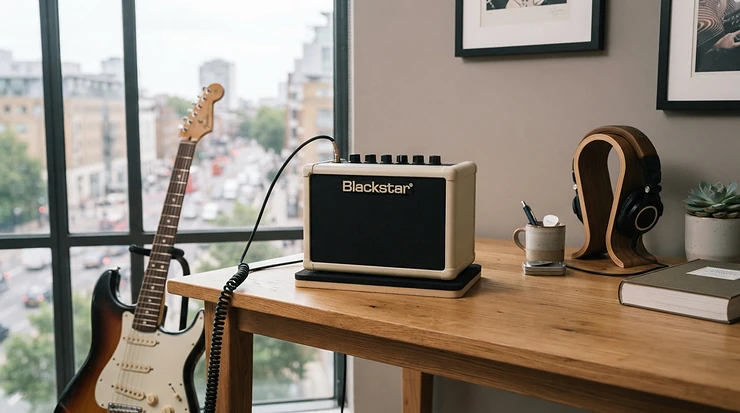
What is a valve amp for home practice? It’s a tube-powered guitar amplifier, usually rated somewhere between 0.1 and 15 watts, that lets its valves break up naturally at volumes a household can live with. Some models get there through a tiny power rating, others through built-in power reduction. You get the warmth and touch-sensitivity of a proper valve amp without needing to evacuate the street.
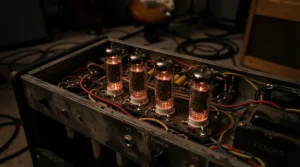
Here’s the problem. Valve amps are, by nature, drama queens. They sound their best when they’re working hard, and working hard means loud. A 50-watt head turned down to “polite” is a sports car stuck in a school zone: expensive, technically impressive, and deeply unsatisfying. As one UK retailer’s buying guide puts it, the lower the wattage, the less volume you need to saturate the power stage. That single fact explains the entire category.
The good news is that 2026 is a fine year to want a valve amp for home practice. Modern designs bolt on switchable power modes, attenuation circuits and even USB recording outputs. A power attenuator used to be a separate, slightly agricultural box you wired between amp and speaker. Now it’s often a little switch on the front panel.
I’ve researched seven real amps that suit tube amp home use, from budget lunchbox-style combos to premium British-designed favourites. Each is judged on what its specs mean in a small room, on what reviewers consistently say, and on who it actually suits. Prices below are ranges only, so check current listings before you buy.
Quick Comparison: Best Valve Amp for Home Practice at a Glance
Here’s the whole field on one screen. Wattage figures come from manufacturer and retailer descriptions, so double-check the exact power steps on the model you’re buying.
| Amp | Power settings | Key valve/speaker facts | Price range | Best For |
|---|---|---|---|---|
| Bugera V5 Infinium | 5W, with 1W and 0.1W attenuation | 1×8″ combo, tube-life indicator | £200-£250 | Tight budgets |
| Hiwatt Hi-5 | 5W (check for reduction options) | Single EL84, 12AX7 preamp, Celestion speaker | roughly £300-£400 | British Class A chime |
| Vox AC4TV | 4W / 1W / ¼W | EL84 power valve, 10″ Celestion | roughly £250-£350 | Cranked Vox breakup at night |
| Marshall DSL1CR | 1W, plus 0.1W mode | 2x ECC83, ECC82 power valve, 8″ speaker | £230-£270 | Small flats and desk setups |
| Blackstar HT-5R MkIII | 5W with reduced-power option | 12″ speaker, ISF control, USB-C output | £500-£550 | Recording and versatility |
| Fender Pro Junior IV | 15W (no attenuation) | Fender clean-tone classic | £530-£580 | Houses, not flats |
| Orange Rocker 15 | 15W / 7W / 1W / 0.5W | Valve effects loop, two channels | roughly £600-£700 | Gig-and-home flexibility |
Look at the table and one pattern jumps out. The Marshall DSL1CR and Bugera V5 Infinium deliver the most bedroom-safe valve tone per pound, while the Orange Rocker 15 and Fender Pro Junior IV cost more because they can also play a pub. If you’ll never leave the house with your amp, paying for gig-level output is paying for volume you can’t legally or socially use.
💬 Just one click — help others make better buying decisions too!😊
Top 7 Valve Amp for Home Practice Picks: Expert Analysis
Each pick below follows the same logic: what stands out, what the spec sheet means in a real room, who it suits, and what reviewers keep saying. Where I couldn’t verify meaningful review data, I say so rather than pad it.
1. Bugera V5 Infinium — best budget entry to real valves
The Bugera V5 Infinium earns its slot by being the cheapest way into genuine all-valve tone without being a toy.
It’s a 5-watt, 1×8″ all-tube combo, and it offers attenuation modes that drop it to around 1 watt and 0.1 watt. In practice, that low setting is the point: this is a low-wattage valve amp that can be pushed into breakup without shaking the skirting boards. The “Infinium” branding refers to a tube-life management system with an indicator, which is genuinely useful because it takes some guesswork out of when valves are tiring.
Based on the spec comparison, this suits beginners stepping up from a modelling amp and anyone needing valve amp for bedroom players duties on a strict budget. Reviewers commonly describe the tone as sitting somewhere between a Fender Deluxe Reverb and a Vox AC30 at low volumes. The recurring gripe is a lack of an effects loop, so pedals go in front.
Pros:
- ✅ Multiple attenuation steps down to a whisper
- ✅ Tube-life indicator removes guesswork
- ✅ Superb value for genuine valve tone
Cons:
- ❌ No effects loop for time-based pedals
- ❌ Small speaker thins out low end
Expect to pay in the £200-£250 range at the time of research. For a first valve amp, the value verdict is hard to argue with.
2. Hiwatt Hi-5 — best for British Class A chime
The Hiwatt Hi-5 trades on heritage: a touch-sensitive, cathode-biased Class A design with a single EL84 power valve.
Listings describe it as a 5-watt, two-channel combo with a 12AX7 preamp valve and a Celestion speaker, engineered in Britain. A single EL84 in Class A is the recipe behind a lot of classic chimey British tone, and on paper it means an amp that reacts strongly to your picking hand. Roll the guitar volume back and it cleans up; dig in and it growls.
Here’s the honest caveat. The listings I found don’t advertise a power-reduction switch, so treat this as a true 5-watt amp. That’s louder than it sounds, and pushing it into saturation will be audible through a wall. I also couldn’t verify enough independent review data to summarise reviewer sentiment fairly, so I won’t pretend otherwise.
Pros:
- ✅ Class A, EL84 voicing with real touch response
- ✅ Two channels for clean and crunch
- ✅ Celestion speaker included
Cons:
- ❌ No confirmed power-reduction option
- ❌ Independent review coverage is thin
Budget in the region of £300-£400 and verify the specification before buying. This one rewards players in detached houses or those pairing it with a soak.
3. Vox AC4TV — best for cranked Vox breakup at whisper level
The Vox AC4TV is a 4-watt Class A combo with three output modes: 4 watts, 1 watt and a quarter of a watt.
It runs an EL84 power valve and a 12AX7 preamp valve into a 10-inch Celestion. The quarter-watt mode is the party trick, because it means you can chase that jangly, edge-of-breakup sound in a spare room at night. Layout is beautifully simple: a Tone control, a Volume control and an output-level control.
Reviewers consistently praise its overdrive at low volumes and note it works well with pedals. The recurring complaint is limited clean headroom, since it wants to break up early. Some older owner discussions also say it can still feel loud with the volume near noon, even on lower settings. Availability of current stock varies, so check listings.
Pros:
- ✅ Three power modes, down to ¼ watt
- ✅ Authentic Vox EL84 character
- ✅ Takes overdrive pedals well
Cons:
- ❌ Limited clean headroom
- ❌ Single-channel, no built-in effects loop
Think roughly £250-£350. It’s the pick for anyone whose ideal practice sound is a gritty British crunch.
4. Marshall DSL1CR — best small-flat valve amp
The Marshall DSL1CR is the tiny tube amp built explicitly for the home.
It’s a 1-watt, all-valve combo running two ECC83 preamp valves and an ECC82 power valve into an 8-inch Celestion Eight 15 speaker. It also has a 0.1-watt mode, which is where it earns its flat-dweller credentials. Two channels (Classic Gain and Ultra Gain) cover everything from clean-ish rhythm to full crunch.
Reviewers consistently note it does exactly what it promises: delivers genuine valve character at home. One 2026 review credits it with “impressive versatility and smart modern features”. It doesn’t pretend to be a gigging amp, and the small speaker limits low-end weight, which the smaller cabinet size makes obvious.
Pros:
- ✅ True 1W all-valve design with 0.1W mode
- ✅ Two channels covering clean to crunch
- ✅ Compact enough for a desk or shelf
Cons:
- ❌ Small speaker limits bass depth
- ❌ Not loud enough for band rehearsals
Expect around £230-£270. For valve amp for bedroom players, this is arguably the value benchmark.
5. Blackstar HT-5R MkIII — best for recording and versatility
The Blackstar HT-5R MkIII is the do-everything option, and it costs more because it actually does.
Retailer descriptions cite a 12-inch speaker, four channel voices, the ISF tone control that morphs between British and American voicings, IR-based CabRig speaker simulation and a USB-C output for sending two channels to a computer. One review found it sounded great at around 2 watts, which is precisely bedroom territory. The push-pull power section is central to the pitch: valve dynamics at manageable volume.
Reviewers consistently call it the most flexible small valve amp in its class, and it works for blues through modern high gain. Interestingly, that flexibility is also the trade-off: more knobs, more menu-diving, and more temptation to tweak instead of play.
Pros:
- ✅ USB-C recording without an audio interface
- ✅ Wide tonal range across two channels
- ✅ Full-size 12-inch speaker
Cons:
- ❌ More complex than simpler rivals
- ❌ Priced well above entry-level amps
Budget around £500-£550. For anyone who wants to record their practice, the value verdict is strong.
6. Fender Pro Junior IV — best clean tone (with a volume warning)
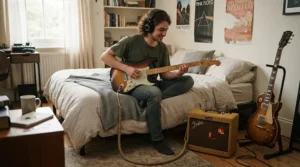
The Fender Pro Junior IV is a gorgeous little amp that’s honestly a bit big for most bedrooms.
It’s rated at 15 watts and has no built-in attenuation. That matters, because one review noted that by the time the volume reached noon, it exceeded comfortable bedroom levels. Reviewers often rank it among the best studio and practice amps for clean Fender tone, which is why it stays on this list.
Here’s what most buyers overlook. Fender’s cleans need headroom, and headroom means wattage, which means volume. So you get lovely sparkling clean tones at low levels, but if you want that creamy breakup, you’ll need either a pedal or an external power attenuator. That’s not a flaw, just physics.
Pros:
- ✅ Beautiful, sparkling Fender clean tones
- ✅ Well regarded for studio and practice
- ✅ Takes pedals brilliantly
Cons:
- ❌ No built-in power reduction
- ❌ Loud for flats and shared houses
Expect roughly £530-£580. It’s a top-tier pick for house-dwellers, and a poor one for flat-dwellers.
7. Orange Rocker 15 — best for gig-and-home flexibility
The Orange Rocker 15 is the amp for players who want one valve amp to do both jobs.
Its selectable power stages, commonly listed at 15, 7, 1 and 0.5 watts, are the headline. You can sit at half a watt in the evening, then flip to 15 watts for a rehearsal or small gig. It’s also described as having a valve-driven effects loop, which is rare and prized in this category.
Retailer commentary positions it as the choice if you want greater potential stage output alongside low-power settings. I couldn’t verify enough independent review sentiment on this exact model to summarise it fairly. Its brand reputation, and the low-power stages, are what justify it here.
Pros:
- ✅ Four power settings from 15W down to 0.5W
- ✅ Valve effects loop for pedal users
- ✅ Gig-capable when you need it
Cons:
- ❌ Most expensive on this list
- ❌ Overkill if you’ll never gig
Roughly £600-£700, so verify current pricing. It’s the premium pick, and worth it only if you’ll use that upper range.
How to Set Up Your Valve Amp for Home Practice: A First-30-Days Guide
Getting a valve amp for home practice home is the easy bit. Setting it up properly is where the magic happens, and where most beginners quietly ruin their first month.
Week one: placement and safety. Put the amp on a solid surface, away from curtains and damp walls, with breathing space around the valves. Never run a valve amp without a speaker or suitable load connected. Valve amps need a load on the output transformer, and running one unloaded risks expensive damage.
Week one: warm-up routine. Switch on with standby engaged, wait a minute or two, then flick to play. It’s cheap insurance for your valves.
Weeks two and three: find your sweet spot. Start on the lowest power mode and work up. With a low-wattage valve amp, the sweet spot is often surprisingly early on the volume dial. Write down the settings that sound best. Trust me, you’ll forget them.
Week four: pedals and refinement. Add a gentle overdrive in front and dial it back further than you’d expect. Amps like the Vox AC4TV and Bugera V5 Infinium reward restraint.
Common first-month mistakes:
- Turning the volume up “just to see” at 11pm
- Skipping standby
- Judging the tone in the first hour, before the valves settle
Some reviewers suggest valves take roughly 20 hours to settle in, so give it time before judging.
Real-World Scenarios: Which Valve Amp for Bedroom Players Fits Your Life?
Let’s match real situations to real amps, with budget and habits in mind.
Scenario 1: Shift worker in a rented flat. You play at odd hours, walls are thin, and budget is around £250. The Marshall DSL1CR is the logical fit, since its 0.1-watt mode was designed for exactly this. Pair it with a light gain pedal if you want more sustain.
Scenario 2: Student in a shared house, mostly weekends. Budget’s tight, but you want proper valve tone. The Bugera V5 Infinium wins on value, and its multi-step attenuation lets you play sensibly on weeknights and louder on Saturday afternoons.
Scenario 3: Home-studio player who records. You practise most days and record tracks. The Blackstar HT-5R MkIII makes sense because of its USB-C output and speaker simulation, so your practice tone becomes your recording tone without extra gear.
Scenario 4: Player with a house and a band. Practice at home, rehearse monthly. The Orange Rocker 15 or Fender Pro Junior IV give you the headroom, with the Rocker’s power settings making it the more home-friendly choice.
Notice the pattern: the right choice depends less on brand and more on how often you play, when, and how thin your walls are.
Low-Wattage Valve Amp: How Much Power Do You Actually Need?
The short answer? Less than you think, but not as little as the internet claims.
A commonly cited guide is that 5-10 watts is ideal for practising at home while keeping the valve experience, and once you’re into 20 watts and above, it’s more of a gigging amp. The logic is simple: lower wattage amps break up at lower volumes, so you reach tube tone without deafening anyone. The trade-off is headroom, because a low-wattage valve amp runs out of clean volume quickly. One review of a 5-watt Supro found getting useful cleans was hard because it wanted to break up at relatively low volumes.
There’s a genuine debate here, though. Some UK forum players argue 5 watts sits in a “nowhere man’s land”: too quiet to feel big, too loud to push at home. Their alternative is a 1-watt amp that you can really push, or a bigger amp with pedal-driven gain. It’s a fair point, and it explains why the Marshall DSL1CR (1W) and the Orange Rocker 15 (down to 0.5W) sell so well.
My practical rule: if you play clean or blues, prioritise 1-5 watts with attenuation. If you play high gain, 1 watt is plenty. And if you want both, buy something with switchable stages.
Tube Saturation Explained: Why “Loud” Is the Sweet Spot
Tube saturation is the reason valve amps exist as a category. When valves are pushed hard, they start to compress and distort softly, producing the sag, bloom and touch-sensitivity players chase.
There are two flavours. Preamp saturation happens in the small valves early in the signal chain and can occur at almost any volume. Power-stage saturation happens in the output valves and traditionally needs serious volume. One UK guide notes that when valves are saturated the sound breaks up and distorts, which is generally the desired effect from a valve amp, and that the lower the wattage, the lower the volume needed to reach it.
Here’s why that matters for your home. A 100-watt amp on volume 2 won’t saturate the power stage at all, so you’re paying for valves that aren’t doing their best work. A 1-watt amp on volume 6 will. Same tube saturation, radically different neighbour impact.
What does it sound like? Compression, bloom, and that lovely “the note keeps singing” feel. Players in the forums often say a power section won’t deliver its “thump” until it’s turned up to a certain point, which is exactly why built-in power reduction is so valuable.
Power Attenuation: Turning Down Volume Without Turning Down Tone
Power attenuation is the technique of reducing an amp’s output after the valves, so the amp works hard while the speaker hears less.
A power attenuator sits between the amp and the speaker, absorbing some of the power before it reaches the cone, typically turning it into heat. Early attenuators had a reputation for sounding harsh and lifeless, though modern designs are far better. Built-in versions, like the ones on the Vox AC4TV, Bugera V5 Infinium and Orange Rocker 15, do the same job with less fuss.
There’s a subtle catch. Some “power scaling” methods lower the voltage to the power valves rather than absorbing output, which can change how much distortion you get. It’s one reason two amps with the same wattage rating can feel quite different at the same volume.
The comparison table below shows how the main approaches stack up for tube amp home use.
| Approach | How it works | Tone impact | Cost | Best For |
|---|---|---|---|---|
| Built-in power reduction | Switches output stage to lower wattage | Very good, designed in | Included | Marshall DSL1CR, Orange Rocker 15 buyers |
| External attenuator | Absorbs power between amp and speaker | Good, varies by unit | Extra £100+ | Owners of Fender Pro Junior IV |
| Master volume control | Reduces level before power valves | Preamp-driven only | Included on many amps | Pedal-heavy players |
| Modelling amp | Digital emulation | Varies, no valves | Often cheaper | Silent practice |
Look at the table and the takeaway is clear. Built-in power reduction gives you the best balance for a valve amp for home practice, because it’s tuned to the amp. An external attenuator is a smart upgrade for the Fender Pro Junior IV, but it’s an added cost and another box to manage.
Master Volume Control: The Cheaper Compromise
A master volume control is a knob placed before the power valves, letting you crank the preamp gain and then trim the overall level. It’s the classic budget solution, and it’s useful, but it isn’t the same as power attenuation.
Forum discussions on the Marshall Amp Forum make the distinction plainly: a master volume comes before the power valves, so the power valves don’t work as hard, whereas an attenuator can capture the way the power valves and output transformer sound when cranked. That’s why some players prefer attenuation for feel.
But here’s the honest counter. If the amp was designed around a master volume control, an attenuator wouldn’t let you hear it “as it was designed” at lower volumes. For high-gain, pedal-driven styles, the preamp does most of the heavy lifting anyway, so a good master volume control is often plenty.
Which should you choose? If you play blues or classic rock and love feel, prioritise power attenuation. If you play modern rock or metal, a master volume control will likely do the job. Modern picks like the Marshall DSL1CR and Blackstar HT-5R MkIII blend both approaches.
How to Choose a Valve Amp for Home Practice
Here’s a quick, snippet-friendly way to choose the best valve amp for home practice without getting lost in specs.
- Decide your loudest realistic volume. If you live in a flat, aim for 1 watt or below. Houses can stretch to 5 watts with care.
- Check for built-in power reduction. Switchable stages matter more than raw wattage. The Vox AC4TV and Bugera V5 Infinium both offer them.
- Match the tone to your genre. Chimey British? Consider the Hiwatt Hi-5. Crunch? The Marshall DSL1CR. Clean Fender? The Fender Pro Junior IV.
- Think about recording. If you’ll capture your playing, USB and speaker simulation on the Blackstar HT-5R MkIII save money elsewhere.
- Plan for pedals. No effects loop? Pedals go in front. If you love delay, look for a loop like the Orange Rocker 15‘s.
- Budget for valve replacement. Valves are consumables, so factor in future costs.
- Read current reviews. Recent roundups of the best tube amps note that many modern models now feature power reduction, so you can run higher wattage when needed and switch down for home practice.
Tube Amp Home Use vs Modelling Amps
Modelling amps aren’t the enemy. For pure silent practice, they win outright, since headphones and zero valve maintenance beat any tube amp on convenience.
Where valves win is feel. A valve amp reacts to your picking dynamics, your guitar’s volume knob and even how you’re standing in the room. It’s an instrument in its own right, and for many players that’s the entire point of tube amp home use.
Consider your situation honestly. If you mostly play through headphones at midnight, a modelling amp probably makes more sense. If you play through a speaker in daylight hours and crave that living, breathing response, a valve amp for home practice is worth it.
One useful middle route: a valve amp with a recording output. The Blackstar HT-5R MkIII can send its sound straight to a computer, giving you the best of both worlds. And a good low-wattage valve amp at 0.1 watt is quieter than most people expect.
Bottom line? Valves give you feel; modellers give you silence. Choose based on the room, not the reputation.
Common Mistakes When Buying a Valve Amp for Home Practice
Most buyers make the same handful of errors, and most are avoidable.
Buying too much wattage. It’s tempting to think bigger is better. But a 50-watt amp at bedroom volume never gets its valves working. One forum player summed it up neatly: you can’t smash a 100-watter down to a watt with a soak and still get that glorious open tone, because dynamics are lost.
Ignoring the speaker. Small speakers thin out bass. The Marshall DSL1CR and Bugera V5 Infinium both use 8-inch speakers, which is a genuine compromise.
Forgetting about volume creep. Even 5 watts pushed to breakup is loud. Reviewers of the Fender Pro Junior IV noted noon on the dial exceeded comfortable bedroom levels.
Skipping the attenuation check. Always confirm power stages before buying. The Hiwatt Hi-5 listing I found didn’t advertise them.
Assuming valves last forever. They don’t. Plan ahead.
Neglecting your neighbours. Legal exposure matters, as the next section explains.
Valve Amp for Bedroom Players: Neighbour-Friendly Practice and UK Noise Rules
If you’re a valve amp for bedroom players shopper, noise rules deserve a moment of your attention.
Under UK guidance, councils must look into complaints about noise that could be a “statutory nuisance”, and the GOV.UK guidance on noise nuisances explains that councils can investigate at any time of day or night. Age UK notes the Noise Act 1996 defines night hours as 11pm to 7am. Crucially, one London council points out there are no legally defined times when you can play loud music, and it’s possible to cause a noise nuisance at any time.
So what does this mean for your amp? The Marshall DSL1CR at 0.1 watts and the Vox AC4TV at a quarter of a watt are the most considerate options. Position the speaker away from shared walls, angle it away from neighbours, and consider a rug or foam under the cabinet.
Practical tip: test your volume from the other side of a shared wall, or ask a neighbour for feedback. A friendly heads-up beats a formal notice every time. And if you play late at night, headphones or a silent recording output remain the safest choice.
Long-Term Cost & Maintenance
Valve amps cost more than the sticker price. Valves wear out, though home use is gentle, so replacements come less often than for a gigging amp.
Think in three tiers. Budget amps like the Bugera V5 Infinium keep running costs low, and its tube-life indicator helps you time replacements. Mid-range amps such as the Marshall DSL1CR and Vox AC4TV use common valve types. Premium amps, like the Orange Rocker 15, may need more specialist attention.
| Tier | Amps | Price range | Best For |
|---|---|---|---|
| Budget | Bugera V5 Infinium, Marshall DSL1CR | £200-£270 | First valve amp |
| Mid-range | Vox AC4TV, Hiwatt Hi-5, Blackstar HT-5R MkIII | £250-£550 | Character or recording |
| Premium | Fender Pro Junior IV, Orange Rocker 15 | £530-£700 | Long-term, gig-capable |
The analysis: Marshall DSL1CR and Bugera V5 Infinium deliver the lowest cost-per-hour for genuine valve tone. The Blackstar HT-5R MkIII offsets its higher price by replacing an audio interface. The premium pair only pays off if you’ll use their extra headroom.
Maintenance is simple: keep the amp dry, use standby, avoid moving it while hot, and have valves checked if the tone turns dull or noisy.
Frequently Asked Questions
❓ How much should I spend on a first valve amp for home practice?
❓ Can I use headphones with a valve amp?
❓ Is a 1 watt valve amp loud enough for playing with a drummer?
❓ Do I need to replace valves in a new amp?
❓ Is a 5 watt valve amp too loud for a flat?
Conclusion
Choosing a valve amp for home practice comes down to one question: how do you want to trade volume for feel?
If you want the cheapest genuine route, the Bugera V5 Infinium is the sensible entry. If your walls are thin, the Marshall DSL1CR and Vox AC4TV are the most considerate. If you record, the Blackstar HT-5R MkIII earns its price. And if you want one amp for home and rehearsals, the Orange Rocker 15 is the flexible choice, with the Fender Pro Junior IV best kept for players with a bit more space. The Hiwatt Hi-5 suits Class A chime lovers, provided you confirm the power options.
Remember the core ideas. Tube saturation is what you’re paying for, power attenuation and a good master volume control are how you reach it quietly, and a low-wattage valve amp gets you there with the least fuss. Check prices, confirm the specification, and buy the amp that fits your room rather than your wish list.
Recommended for You
- Modelling Amp Under £300: 7 Brilliant Buys Ranked (2026)
- Best Combo Amp Under £200: 7 Top Picks For UK Players (2026)
- Active vs Passive Bass Guitar: 7 Best Picks For UK Players (2026)
Disclaimer: This article contains affiliate links. As an Amazon Associate, I earn from qualifying purchases. If you purchase products through these links, we may earn a small commission at no additional cost to you.
✨ Found this helpful? Share it with your friends! 💬🤗
