
In This Article
Somewhere between “I fancy trying an 8 string guitar” and actually owning one sits a swamp of marketing fluff, contradictory forum threads, and spec sheets that read like they were translated twice. An 8 string guitar is a solid-body electric with two extra bass strings below standard low E, typically tuned down to F# and C#, giving players a much wider low-end range for djent, progressive metal and modern riffing without retuning a standard six-string into oblivion. That’s the short version. The long version is what this article is for.
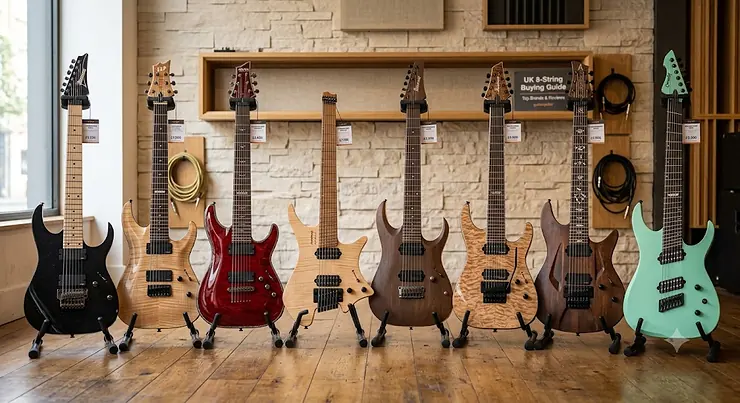
If you’ve searched for the best 8 string guitar and landed here, you’re probably somewhere on a spectrum between “curious beginner eyeing a budget model” and “gigging player who wants the best 8 string electric guitar their wage packet can stretch to.” Either way, the UK market in 2026 has more genuinely good options than it did even three years ago, spanning entry-level fixed-scale designs right through to boutique-adjacent multiscale builds. We’ve dug through real specs, aggregated genuine owner and reviewer sentiment, and mapped out exactly which guitar suits which player — no invented five-star reviews, no vague “great value” filler.
This guide covers seven real, currently available models across budget, mid-range and premium tiers, plus practical sections on tuning, setup, common buying mistakes, and how an 8 string stacks up against a 7 string. Whether you’re chasing your first extended-range instrument or upgrading from a 7, there’s a sensible next step waiting somewhere in this list.
Quick Comparison Table
Before the full breakdown, here’s the fast version for anyone in a hurry.
| Guitar | Scale Type | Price Range | Best For |
|---|---|---|---|
| Harley Benton MultiScale-8 | Multiscale | Around £340-£360 | Budget-conscious first-timers |
| Jackson JS32-8 Dinky Arch Top | Fixed scale | Around £350-£400 | Straightforward beginners |
| Ibanez RG8 | Fixed scale | Around £400-£480 | All-round workhorse |
| Cort KX508MS II | Multiscale | Around £750-£800 | Mid-range multiscale value |
| Schecter Omen Elite-8 Multiscale | Multiscale | Around £780-£850 | High-output metal tone |
| Ibanez RGDMS8-CSM | Multiscale | Around £1,000-£1,100 | Premium build quality |
| Strandberg Boden Standard NX 8 | Multiscale, headless | Around £1,450-£1,550 | Ergonomic premium/boutique feel |
At a glance, the split isn’t just about money — it’s about scale design and neck type. Fixed-scale guitars like the Ibanez RG8 and Jackson JS32-8 Dinky Arch Top are friendlier for players making the jump from a six-string because the fretting hand doesn’t need to relearn spacing across a fanned fingerboard. Multiscale options such as the Harley Benton MultiScale-8 and Strandberg Boden Standard NX 8 trade a small learning curve for genuinely tighter low-string tension and cleaner intonation when downtuned. Budget shoppers should note that “cheap” here still means real specs worth caring about — nothing on this list is a toy.
💬 Just one click — help others make better buying decisions too!😊
Top 7 8 String Guitars: Expert Analysis
Here’s the full breakdown, budget to boutique. Every model below is a real, currently produced instrument — nothing invented, nothing discontinued and quietly swapped in to pad the list.
| Guitar | Scale Length | Neck Type | Price Range | Rating (aggregated) |
|---|---|---|---|---|
| Harley Benton MultiScale-8 | 25.5″-27″ fanned | Bolt-on, 5-ply | Around £340-£360 | Consistently praised for the price |
| Jackson JS32-8 Dinky Arch Top | 26.5″ | Bolt-on maple | Around £350-£400 | Reliable entry-level consensus |
| Ibanez RG8 | 27″ | Bolt-on Wizard | Around £400-£480 | Strong, long-running reputation |
| Cort KX508MS II | Multiscale | Bolt-on | Around £750-£800 | Solid mid-tier feedback |
| Schecter Omen Elite-8 Multiscale | Multiscale | Bolt-on Thin C | Around £780-£850 | Well-liked for output and clarity |
| Ibanez RGDMS8-CSM | Multiscale | Bolt-on premium | Around £1,000-£1,100 | High marks for build |
| Strandberg Boden Standard NX 8 | Multiscale, headless | Neck-through style | Around £1,450-£1,550 | Frequently cited as ergonomic benchmark |
Scanning this table, the price-to-spec curve isn’t linear — you get most of the practical playability jump in the first £500, while the final £700 or so between the Ibanez RGDMS8-CSM and the Strandberg Boden Standard NX 8 buys refinement rather than raw usability. If your budget tops out around the mid-range, you’re not missing much that would change how a riff actually sounds through an amp; you’re mostly paying for finish quality, resale value and ergonomics.
1. Harley Benton MultiScale-8 — best budget multiscale for the money
The headline here is that Harley Benton, Thomann’s in-house brand, has managed to squeeze a genuine multiscale design under £360 — something that simply didn’t exist at this price a few years back. The fanned fret layout runs roughly 25.5″ to 27″ across the neck, meaning the low F# string gets extra length and tension for clarity, while the top string stays comfortable for chords and bends.
Key specs with real-world meaning: the five-ply bolt-on neck with a graphite nut and WSC locking tuners keeps tuning stable even under aggressive palm-muted riffing, and the Roswell covered humbuckers are voiced for the low-tuned, high-gain style this guitar is clearly built for. On paper this means you’re not fighting the instrument just to get a tight chug — the hardware is doing sensible, purpose-built work rather than being an afterthought.
Based on the spec comparison with pricier multiscale rivals, this is squarely aimed at players who want to try fanned frets without committing serious money to the experiment. Reviewers consistently note that Harley Benton’s recent guitars punch well above their price bracket in fit and finish, though as with most budget-tier instruments, a pro setup out of the box isn’t guaranteed and some buyers report needing minor adjustments on arrival.
Pros:
- ✅ Genuine multiscale design at an unusually low price
- ✅ Locking tuners and graphite nut aid tuning stability
- ✅ Purpose-built pickups suit low-tuned, high-gain playing
Cons:
- ❌ Passive pickups lack the refinement of pricier active sets
- ❌ Setup consistency can vary at this price point
At around £340-£360, this is one of the strongest value propositions on the list — if you can live with a possible initial setup tweak, it’s hard to beat for a first multiscale 8 string.

2. Jackson JS32-8 Dinky Arch Top — best straightforward beginner 8-string
The Jackson JS32-8 skips multiscale complexity entirely, which is exactly the point. A fixed 26.5″ scale means the fretboard behaves like a familiar six-string, just wider, so there’s one less thing to think about while your hands are already adjusting to two extra strings.
The poplar body and bolt-on maple neck keep weight sensible for long practice sessions, and the arched top isn’t just cosmetic — it shaves a bit of bulk off the lower bout, which matters more than people expect once you’re sitting with the guitar for an hour. What most buyers overlook about this model is that the shorter, non-fanned scale actually makes early technique — scales, basic riffs, getting used to string spacing — noticeably less intimidating than jumping straight into a fanned-fret design.
Aggregated owner sentiment around Jackson’s JS-series generally points to dependable, no-surprises build quality for the money, with the usual budget-tier caveat that the stock electronics are functional rather than exciting.
Pros:
- ✅ Non-multiscale layout eases the transition to 8 strings
- ✅ Poplar body keeps overall weight comfortable
- ✅ Dependable budget-tier build consistency
Cons:
- ❌ Stock electronics are basic and often upgraded later
- ❌ Hardware finish is utilitarian rather than premium
At around £350-£400, this is the guitar to recommend to someone who’s never played anything with more than six strings and doesn’t want extra variables while they’re learning.
3. Ibanez RG8 — best all-round workhorse
The Ibanez RG8 has been the default recommendation in this space for years, and the reasons are still valid in 2026. The Wizard neck — Ibanez’s signature slim, fast profile — is arguably the single biggest reason players adapt to 8 strings quickly, since it doesn’t fight your hand the way a chunkier neck would across a wider fretboard.
The 27″ scale, basswood body and through-body stringing combine for a fixed bridge with real sustain, and the extra-long scale keeps the low strings from turning to mush even in aggressive drop tunings. Here’s what to weigh: the IBZ-8 pickups are functional but frequently swapped out by more experienced owners chasing extra clarity, which tells you the guitar’s bones are good enough that people invest further rather than replacing it outright.
Reviewers consistently report that the stock pickups can sound a touch muddy on the bridge position, and this guitar doesn’t ship with a case — both worth budgeting for if you’re going straight from the box to a gig bag.
Pros:
- ✅ Wizard neck is fast, slim and easy to adapt to
- ✅ Through-body stringing aids sustain and resonance
- ✅ Huge used/new market makes parts and support simple
Cons:
- ❌ Stock IBZ-8 pickups considered muddy by many owners
- ❌ No case included at this price point
In the £400-£480 range, the RG8 remains the sensible middle-ground pick — proven, widely supported, and easy to upgrade piece by piece as your playing (and budget) grows.
4. Cort KX508MS II — best mid-range multiscale all-rounder
Cort doesn’t always get the spotlight that Ibanez and Schecter attract, but the KX508MS II is a legitimate mid-tier multiscale option that’s worth cross-shopping before defaulting to the bigger names. The multiscale design here follows the same logic as the pricier options — longer scale on the low strings for tension and clarity, shorter on the treble side for comfortable chording and bends.
What most buyers overlook about this model is that Cort’s manufacturing consistency has a strong reputation in the industry — the brand builds guitars for several other well-known companies under contract, so the tolerances and fretwork tend to be tighter than the price tag suggests. On paper this means fewer setup surprises out of the box compared with some rivals at a similar price.
Based on the spec comparison with the Schecter Omen Elite-8 below, the KX508MS II leans slightly more toward all-round tonal flexibility rather than being voiced purely for high-gain metal, which suits players who split time between clean and distorted tones.
Pros:
- ✅ Multiscale tension and intonation without a premium price
- ✅ Cort’s manufacturing consistency benefits fit and finish
- ✅ Tonally flexible rather than one-trick
Cons:
- ❌ Less common in UK stock than Ibanez or Schecter equivalents
- ❌ Noticeably heavier than the entry-level options above
Sitting around £750-£800, this is worth checking availability on before assuming you have to go straight to Schecter or Ibanez for a mid-range multiscale.
5. Schecter Omen Elite-8 Multiscale — best pickup output for metal tone
If your priority is a genuinely aggressive, high-gain-ready 8 string without jumping to boutique pricing, the Schecter Omen Elite-8 Multiscale earns its spot. The Heretic-8 humbuckers are specifically designed for extended-range clarity, which matters more than people realise once you’re playing chords down around F#.
The Thin C neck profile keeps fast, technical passages manageable despite the wider fretboard, and the poplar burl top over a mahogany body adds a bit of visual flair that budget models generally skip. Here’s what to weigh: the multiscale bridge setup on this guitar intimidates some first-time buyers because individual saddle intonation looks more complex than a standard fixed bridge — in practice it’s a one-time learning curve, not an ongoing hassle.
Aggregated review sentiment consistently flags the pickups as a genuine strength — reviewers describe them as high-output without losing clarity even under heavy distortion, which is exactly the brief for a metal-focused extended-range guitar.
Pros:
- ✅ Heretic-8 pickups deliver high output without losing clarity
- ✅ Thin C neck suits fast, technical playing
- ✅ Poplar burl top adds distinctive visual character
Cons:
- ❌ Multiscale bridge setup can intimidate first-time buyers
- ❌ Case typically sold separately
Around £780-£850, this is the pick for players whose primary use case is genuinely heavy, low-tuned riffing rather than general-purpose playing.
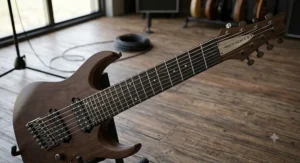
6. Ibanez RGDMS8-CSM — best premium build quality
Stepping up into four figures, the Ibanez RGDMS8-CSM represents where Ibanez’s mainstream multiscale range meets genuinely premium construction. The fretwork and finish quality noticeably tighten up compared with the mid-tier RG8, and the multiscale layout is executed with the kind of consistency you’d expect once you’re paying for it properly.
What most buyers overlook about this model is that Ibanez’s premium-tier resale value tends to hold up better than many competitors, partly because the brand’s reputation for consistent quality control at this tier is well established among gigging musicians. On paper this means the guitar isn’t just more expensive — it’s a genuinely different manufacturing tier, not the same guitar with a nicer paint job.
Based on the spec comparison with the Schecter Omen Elite-8, the jump in price buys refinement in fretwork, hardware and finishing rather than a fundamentally different tonal character — both guitars are voiced for high-gain playing, but this one does it with noticeably tighter tolerances.
Pros:
- ✅ Noticeably tighter fretwork and finish than mid-tier models
- ✅ Strong resale value within the Ibanez premium tier
- ✅ Broader tonal palette suits studio and stage use
Cons:
- ❌ Significant price jump over mid-tier alternatives
- ❌ Multiscale intonation adjustments require more care and patience
At around £1,000-£1,100, this suits players who’ve already outgrown a mid-range guitar and know specifically what they’re buying it for.
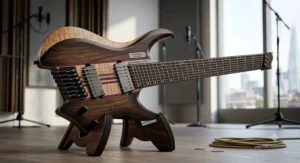
7. Strandberg Boden Standard NX 8 — best ergonomic premium pick
Strandberg’s headless design isn’t a gimmick — it’s genuinely the most ergonomically distinct guitar on this list, and the Boden Standard NX 8 brings that design language to extended range without the eye-watering price of the brand’s signature models.
Removing the headstock shifts the balance point dramatically, which reviewers and owners consistently describe as reducing neck-dive and overall fatigue during long sessions — something that matters a great deal once you’re holding a guitar with eight strings’ worth of extra hardware. The EndurNeck-style profile, a signature Strandberg feature, is contoured rather than traditionally rounded, distributing string tension differently across the fretting hand.
Here’s what to weigh: this is a genuinely different playing experience, not just a specced-up traditional guitar, so players coming from conventional instruments often need a short adjustment period before the ergonomics click. Once they do, it’s frequently described as difficult to go back to a headstocked guitar.
Pros:
- ✅ Headless design reduces weight and improves balance
- ✅ Contoured neck profile reduces fatigue on long sessions
- ✅ Boutique-level ergonomics below full boutique pricing
Cons:
- ❌ Unconventional feel requires an adjustment period
- ❌ Premium price limits it as an impulse purchase
Around £1,450-£1,550, this is the guitar for players who’ve already decided ergonomics matter as much as tone, and want the closest thing to a boutique experience without a custom-shop invoice.
8 String Guitar Tuning Guide: Setup, Maintenance & First 30 Days
Getting a new 8 string set up correctly matters more than with a standard six-string, simply because there’s more hardware, more string tension variance, and a wider neck to settle in. Here’s a practical rundown any of the seven guitars above will benefit from.
Standard tuning first. The vast majority of 8 string players start on F#-B-E-A-D-G-B-E — essentially standard six-string tuning with a low B and F# added underneath. It’s the default factory tuning on most models above, including the Ibanez RG8, and it’s the sensible starting point even if you plan to drop-tune eventually, because it lets you learn the extra string spacing without also relearning pitch relationships.
Fresh strings, properly stretched. New strings on any of these guitars — but especially the low F# and B — need thorough stretching in the first few sessions or they’ll drift out of tune constantly. Tune up, gently pull each string away from the fretboard, retune, repeat five or six times before you trust the tuning to hold through a practice session.
Truss rod patience. Wider necks under more total string tension can need a small truss rod adjustment after the first month as the neck settles, particularly on bolt-on multiscale designs like the Harley Benton MultiScale-8 or Cort KX508MS II. This is normal, not a fault — just don’t skip checking relief after 30 days.
Common first-month mistakes. New 8 string owners frequently over-tighten the low strings trying to compensate for perceived “flabbiness,” which actually just increases the risk of intonation drift. The other frequent error is neglecting intonation on multiscale bridges — because each string has an individually adjustable saddle on models like the Schecter Omen Elite-8 Multiscale, it’s worth a proper check with a tuner rather than eyeballing it.
Maintenance schedule. Wipe strings down after every session (sweat accelerates corrosion faster on wound low strings), check tuning stability weekly for the first month, and plan a full setup — action, intonation, relief — roughly every six months if you play regularly, or after any noticeable change in string gauge or tuning.
If you’re practising through an amp regularly, it’s also worth knowing that UK noise-at-work guidance sets 85 dB(A) as the level at which hearing protection becomes mandatory in professional settings — a useful benchmark for home practice too, since sustained exposure at gig volumes adds up faster than most players realise.
Real-World Scenarios: Which 8 String Guitar Suits You?
Specs only tell half the story. Here’s how three realistic buyer profiles map onto the guitars above.
The bedroom beginner on a tight budget. If you’re a student or hobbyist trying an 8 string for the first time, without a huge budget and without certainty you’ll stick with it long-term, the Jackson JS32-8 Dinky Arch Top is the sensible starting point — fixed scale, familiar feel, and a low enough price that it isn’t a disaster if extended range turns out not to be your thing. The Harley Benton MultiScale-8 is the next step up if you’re confident you want the multiscale experience from day one.
The gigging metal player upgrading from a 7 string. If you’re already comfortable on extended range and want an instrument that can handle regular rehearsals and shows without fragile hardware, the Schecter Omen Elite-8 Multiscale or Ibanez RG8 both make sense depending on whether multiscale tension matters to your tuning (typically anything below F# standard). Budget around £400-£850 depending on which spec priorities matter most.
The studio-focused player who wants long-term investment. If you’re recording regularly and comfort over multi-hour sessions is a genuine priority, the Strandberg Boden Standard NX 8 or Ibanez RGDMS8-CSM justify their price through ergonomics and build consistency that pay off across years of use, not just the first few months.
Buyer’s Decision Framework
If you’d rather skip the full read and just get a straight answer, here’s a simple priority checklist:
- If budget is your main constraint, choose the Jackson JS32-8 Dinky Arch Top or Harley Benton MultiScale-8, because both deliver genuinely usable extended-range instruments under £400.
- If you’re unsure whether multiscale suits you, choose a fixed-scale model like the Ibanez RG8 first, because it removes one variable while you learn.
- If low-tuned metal tone is the priority, choose the Schecter Omen Elite-8 Multiscale, because its pickups are specifically voiced for high-gain clarity.
- If long-session comfort matters most, choose the Strandberg Boden Standard NX 8, because the headless ergonomics directly address fatigue.
- If resale value and build consistency matter, choose the Ibanez RGDMS8-CSM, because Ibanez’s premium tier holds value better than most rivals.
✨ Don’t Miss These Exclusive Deals!
🔍 Take your extended-range playing to the next level with these carefully selected 8 string guitars. Click on any highlighted model to check current pricing and availability. These instruments will help you unlock riffs and tones your standard six-string simply can’t reach!
How to Choose the Best 8 String Guitar
Picking the right model comes down to a handful of genuinely important factors, in roughly this order of priority:
- Scale type. Decide whether you want fixed-scale simplicity (easier transition) or multiscale tension benefits (better low-end clarity) before comparing specific models.
- Neck profile and width. A wider fretboard is unavoidable with eight strings, but neck thickness varies — thinner profiles like Ibanez’s Wizard neck ease the adjustment.
- Pickup voicing. Check whether pickups are designed specifically for extended range (like Schecter’s Heretic-8s) rather than adapted from six-string designs, since this affects low-string clarity directly.
- Bridge type. Fixed bridges are simpler to maintain; multiscale bridges with individual saddles offer better intonation but need more careful setup.
- Budget realism. Decide your ceiling before browsing, because it’s easy to talk yourself into features (multiscale, premium finish) that matter less than fundamentals like neck comfort for your specific hands.
- Intended tuning. If you’re planning to tune below F# standard, prioritise longer scale lengths and multiscale designs; if you’re staying close to standard 8 string tuning, a fixed-scale guitar performs perfectly well.
- Case and accessories. Factor in that several models on this list don’t include a case, which adds a meaningful amount to the real total cost.
7 String vs 8 String Guitar: Key Differences
The jump from seven to eight strings isn’t just “one more string” — it changes the instrument’s whole character. A 7 string typically adds a low B beneath standard tuning, giving guitarists access to a broader chord range while staying relatively close to familiar six-string technique. An 8 string adds both a low B and a low F#, extending the range a full fourth further down than a 7 string.
| Factor | 7 String Guitar | 8 String Guitar |
|---|---|---|
| Typical tuning | B-E-A-D-G-B-E | F#-B-E-A-D-G-B-E |
| Neck width | Moderately wider than 6-string | Noticeably wider |
| Learning curve | Gentle | Steeper, especially chording |
| Common use case | Metal, prog, some jazz fusion | Djent, extreme low-end metal |
| Multiscale prevalence | Common but not universal | Very common at mid-range and up |
Practically speaking, the extra width and lower tension on an 8 string’s bottom two strings mean multiscale design matters more here than it does on a 7 string — the tension difference between the top and bottom strings is simply more extreme across eight strings than seven. Reviewers and gigging players consistently note that players coming from a 7 string tend to adapt to an 8 within a few weeks, since the fundamental technique carries over; players jumping straight from a standard six-string face a somewhat longer adjustment. According to Guitar World’s coverage of extended-range instruments, the genre most associated with the format — djent and modern progressive metal — has driven much of the recent design innovation in multiscale 8 strings specifically.
Best 8 String Electric Guitar for Metal and Djent
For metal specifically, an extended range guitar for metal needs to prioritise two things above everything else: low-end clarity under heavy gain, and tuning stability during aggressive palm-muted playing. Not every 8 string on this list is equally suited to that brief.
The Schecter Omen Elite-8 Multiscale is the clearest purpose-built pick here — its Heretic-8 pickups are specifically voiced for high-gain clarity rather than general-purpose tone. The Ibanez RG8 remains a dependable second choice, particularly once the stock pickups are swapped for something with more low-end definition, a common and well-documented upgrade path among owners. For players who want the format’s most extreme low-end alongside genuinely premium build quality, the Ibanez RGDMS8-CSM delivers both refined construction and the tonal headroom serious downtuning demands.
What most buyers overlook when guitar shopping specifically for metal is that pickup output alone doesn’t guarantee tightness under gain — bridge type and scale length matter just as much. A fixed bridge with a long scale (like the RG8’s 27″) resists the “flubby” low end that shorter-scale extended-range guitars can suffer from, which is precisely why scale length appears so prominently in every spec sheet on this list.
8 String Guitar Under £500: What You Actually Get
Realistic expectations matter here. An 8 string guitar under £500 in 2026 buys you a genuinely usable instrument — not a compromised toy — but there are honest trade-offs worth knowing before you buy.
| Price Band | What You Get | What You Don’t |
|---|---|---|
| Under £400 | Solid build, playable neck, functional pickups | Premium fretwork, included case, high-output electronics |
| £400-£500 | Established reputation (e.g. RG8), decent hardware | Multiscale design at the very bottom of this range |
| £500+ | Multiscale becomes common, better pickups | — |
At this budget, the Jackson JS32-8 Dinky Arch Top and Harley Benton MultiScale-8 both sit comfortably under £400, while the Ibanez RG8 typically lands closer to the £400-£480 mark depending on finish and retailer. Interestingly, this is also the price bracket Harley Benton’s multiscale range specifically targeted when it launched, aiming to bring fanned-fret designs to buyers who previously couldn’t justify the cost. The honest takeaway: under £500 buys real playability and genuine 8 string tone, but pickup upgrades are a common and expected next step rather than a sign the guitar was a bad purchase.
Common Mistakes When Buying an 8 String Guitar
A few recurring errors show up across forums and review threads, worth flagging before you commit:
Buying multiscale before you’ve played one. The fanned fret layout genuinely changes how chords feel under the fretting hand. If possible, try a multiscale instrument in person or watch detailed hands-on demos before assuming it’ll suit you — some players love it immediately, others need weeks to adjust.
Ignoring neck width in favour of price alone. Two guitars at similar price points can have meaningfully different neck profiles. What most buyers overlook is that a guitar that “measures well” on paper can still feel wrong in your specific hands — this is one area where reviews matter less than personal feel.
Skipping the case/accessories math. As noted above, models like the Ibanez RG8 and Schecter Omen Elite-8 Multiscale don’t include a case as standard, which adds a real cost that’s easy to forget when comparing headline prices.
Assuming higher price always means better metal tone. The Strandberg Boden Standard NX 8 is a superb instrument, but its main selling point is ergonomics, not raw output — a player chasing maximum low-end aggression on a budget might actually be better served by the Schecter Omen Elite-8 Multiscale, despite costing less.
Long-Term Cost & Maintenance
Total cost of ownership on an extended-range guitar extends well beyond the sticker price. String sets for 8 strings typically cost more than standard six-string sets, since specialist gauges (often running up to .074 or heavier on the low F#) aren’t stocked everywhere and tend to carry a premium. Budget for restringing every two to three months with regular use, more often if you gig frequently.
Setup costs matter too — multiscale bridges on models like the Cort KX508MS II and Schecter Omen Elite-8 Multiscale benefit from a professional setup at least once in the first year, particularly if you’ve changed string gauge or tuning from factory spec. This typically costs a similar amount regardless of guitar price, so it’s proportionally a bigger consideration on budget instruments.
Pickup upgrades are the most common long-term investment across this entire list — even players happy with the Ibanez RG8 overall frequently swap pickups within the first year or two. Factoring in an eventual pickup swap when budgeting for a mid-range guitar isn’t pessimism, it’s just how this segment of the market tends to work.
Features That Actually Matter (And Those That Don’t)
Marketing copy for extended-range guitars leans heavily on numbers — fret count, pickup output figures, finish names — and not all of it affects how the guitar actually plays or sounds.
Matters: scale length and neck profile. These directly affect playability and tone, and they’re the two specs most worth prioritising across every price band on this list.
Matters: bridge type suited to your tuning plans. Fixed bridges are simpler; multiscale bridges offer intonation benefits that genuinely matter below F# standard tuning.
Doesn’t matter much: exotic finish names. A “quilted burst” or “charcoal” finish looks nice but has no bearing on tone or playability — pick based on what you like visually, not marketing language.
Doesn’t matter much: fret count beyond 22-24. Extra frets above the 22nd are rarely used in practice on an 8 string, since the extended low range is the point, not extreme upper-register access.
Debatable: exotic tonewoods. On solid-body electrics, wood choice has a smaller effect on tone than pickups and electronics — useful to know before paying a premium purely for a specific wood species.
FAQ
❓ What tuning does an 8 string guitar use?
❓ Is an 8 string guitar harder to play than a 6 string?
❓ Do I need a multiscale 8 string guitar?
❓ How much does a decent 8 string electric guitar cost in the UK?
❓ Can beginners start on an 8 string guitar?
Conclusion
There’s no single best 8 string guitar — only the right one for your budget, playing style and tuning plans. Beginners and budget-conscious buyers are well served by the Jackson JS32-8 Dinky Arch Top or Harley Benton MultiScale-8, both genuinely capable instruments rather than compromises. Players wanting a dependable all-rounder should look hard at the Ibanez RG8, still one of the most sensibly specced extended-range guitars around. For serious metal tone, the Schecter Omen Elite-8 Multiscale earns its recommendation through pickup voicing alone, while the Cort KX508MS II deserves more attention than it typically gets in this price bracket.
At the premium end, the Ibanez RGDMS8-CSM and Strandberg Boden Standard NX 8 represent two different philosophies — refined traditional construction versus ergonomic reinvention — and the right choice depends entirely on whether tone or comfort tops your priority list. Whichever you choose, remember that the guitar is only half the picture: proper setup, sensible string maintenance and a bit of patience during that first month will do more for your tone than any single spec on a page.
Recommended for You
- 7 String Guitar for Metal: 7 Brutal 2026 Picks (Budget to Pro)
- Best 7 String Guitar 2026: 7 Top Picks From Budget to Pro
- Best Semi-Hollow for Blues: 7 Guitars Worth Your Money (2026)
Disclaimer: This article contains affiliate links. As an Amazon Associate, I earn from qualifying purchases. If you purchase products through these links, we may earn a small commission at no additional cost to you.
✨ Found this helpful? Share it with your friends! 💬🤗
