
In This Article
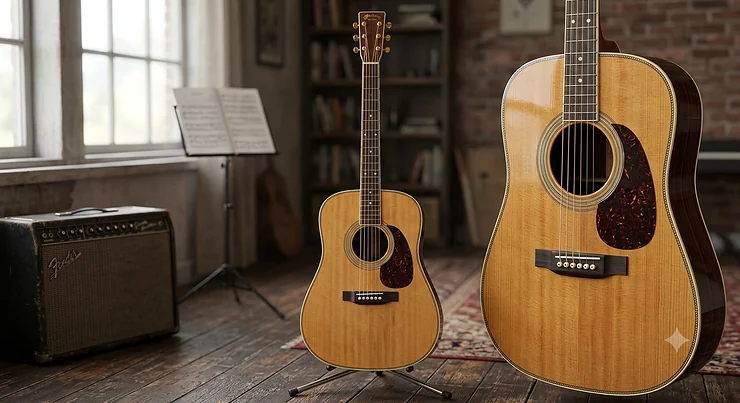
A dreadnought acoustic guitar is the big, square-shouldered acoustic body shape that C. F. Martin developed in the early twentieth century to produce more volume and bass than the parlour guitars that came before it — it’s the shape most people picture when they hear the word “guitar” at all, and it remains the default choice for strumming, singing, and general all-round playing. If you’ve spent any time browsing amazon.co.uk lately, you’ll know the sheer number of dreadnought acoustic guitar options is a bit dizzying. Cheap ones look suspiciously like expensive ones in photos, “solid top” gets thrown around as a marketing buzzword, and every listing claims to be “perfect for beginners and pros alike,” which, frankly, can’t always be true.
This guide cuts through that. We’ve researched seven real, currently available dreadnoughts spanning proper budget territory right up to the guitar that essentially invented the category, and we’ve paired each one with honest analysis of who it actually suits — not just a list of specs copied from a product page. You’ll find guidance on solid tops versus laminate, what “dreadnought body shape sound” really means for your ears, and a full buyer’s framework so you’re not just guessing.
Whether you’re chasing the best full size acoustic guitar for your first proper strumming sessions, hunting for the best dreadnought under £300, or ready to commit to something you’ll still be playing in twenty years, there’s a pick here for you. Prices below are ranges rather than fixed figures, since retailer pricing shifts constantly — always check current pricing before buying.
Quick Comparison Table
| Guitar | Body/Top | Best For | Price Guide |
|---|---|---|---|
| Epiphone Songmaker DR-100 | Laminate spruce top | Absolute first-timers on a tight budget | Under £150 |
| Fender CD-60S | Solid spruce top | Comfortable all-rounder for new players | £150-£190 range |
| Yamaha FG800 | Solid spruce top | Best dreadnought under £300 | £180-£220 range |
| Yamaha FG830 | Solid spruce, rosewood back/sides | Upgraders wanting richer tone | £230-£270 range |
| Tanglewood TW15 NS | All-solid spruce/mahogany | Best value all-solid dreadnought | £380-£480 range |
| Taylor 110e | Solid spruce, layered walnut, electronics | Gigging players who want plug-and-play | £550-£650 range |
| Martin D-28 | Solid spruce, solid rosewood | Serious players who want the benchmark tone | £3,300-£3,700 range |
Looking across the table, the jump from Epiphone Songmaker DR-100 to Fender CD-60S is really a jump from laminate to a solid top, which matters more for tone than almost any other single spec change at this price point. The gap between Yamaha FG830 and Tanglewood TW15 NS represents the difference between a partly-solid guitar and one that’s entirely solid wood, which is where dreadnoughts really start to “open up” with age. Meanwhile, Martin D-28 sits in a different universe entirely — you’re paying for provenance, consistency, and a sound that’s been the reference point for the entire dreadnought category since the 1930s.
💬 Found a favourite already? Bookmark this page and come back before you buy — comparing at least two models saves most buyers from regret.
Top 7 Dreadnought Acoustic Guitars: Expert Analysis
Full size acoustic guitars in the dreadnought shape dominate this list because that’s genuinely where the strongest value sits right now across UK retailers. Below, each model gets the same honest treatment: what the spec sheet says, what it actually means to play, and where real owners tend to land on it.
1. Epiphone Songmaker DR-100 — cheapest genuine way into full-size dreadnought tone
The Epiphone Songmaker DR-100 exists for one reason: to get a real, full-size, correctly-strung dreadnought into someone’s hands without asking them to spend serious money on an instrument they’re not yet sure they’ll stick with. Its laminate spruce top and mahogany-style back and sides won’t resonate the way solid wood does, but the SlimTaper neck profile and roughly 25.5-inch scale length make it comfortable for hands of almost any size, and the fretwork on current production runs is solid for the money. Based on the spec comparison against other sub-£150 dreadnoughts, this is one of the more playable necks in its bracket, which matters enormously for a beginner’s motivation — a guitar that’s painful to fret gets left in the corner. What most buyers overlook about this model is that its low action out of the box (something several beginner instruments get wrong) is arguably more valuable to a new player than a marginally better-sounding top would be. Reviewers consistently report that it holds tuning reasonably well once it’s bedded in, though a common complaint in user reviews is that stock strings are workmanlike at best and worth upgrading early. This isn’t a guitar you buy expecting incredible dynamics; it’s a guitar you buy to find out whether the hobby sticks.
Pros:
- ✅ Genuinely comfortable SlimTaper neck for smaller or beginner hands
- ✅ Full dreadnought size and proper 6-string tuning stability
- ✅ Lowest entry price of any guitar on this list
Cons:
- ❌ Laminate top limits resonance and long-term tonal development
- ❌ Stock strings and setup often need an early upgrade
At under £150, the Epiphone Songmaker DR-100 represents fair value as a genuine trial instrument, though anyone with a slightly bigger budget should strongly consider stepping up to a solid top.
2. Fender CD-60S — best comfortable all-rounder for new strummers
Stepping up from laminate, the Fender CD-60S brings a solid spruce top paired with mahogany back and sides, and that solid top alone changes the whole character of the instrument — you get more sustain, a brighter attack when you dig in, and a top that will genuinely mature with age rather than staying static. Fender’s rolled fingerboard edges are a small but clever touch; on paper this means less of that “fresh off the shelf” edge-catching feel under your fretting hand, which new players especially notice in their first few weeks. Based on the spec comparison with the Epiphone above, the Fender CD-60S‘s scale length is slightly shorter at 25.3 inches, which translates to marginally lower string tension and an easier feel for barre chords while you’re still building calluses. Reviewers consistently note that the CD-60S punches above its price bracket for volume and low-end presence, and it’s frequently cited as a comfortable “grow with me” guitar rather than something you’ll outgrow in six months. What the spec sheet won’t tell you, but reviewers note, is that quality control on the CD-60S has been notably consistent across recent production runs, which isn’t something every budget dreadnought can claim.
Pros:
- ✅ Solid spruce top for real tonal development over time
- ✅ Rolled fingerboard edges genuinely improve playing comfort
- ✅ Reliable, consistent build quality reported across units
Cons:
- ❌ Back and sides remain laminate, capping overall resonance
- ❌ Stock electronics-free model needs a soundhole pickup for amplification
Sitting in the £150-£190 range, the Fender CD-60S is arguably the strongest all-rounder for a new player who wants a solid top without stretching to £300.
3. Yamaha FG800 — best dreadnought under £300
If there’s one guitar that keeps coming up whenever someone asks about the best dreadnought under £300, it’s the Yamaha FG800. Yamaha fits this “standard” model with a solid spruce top and newly developed scalloped bracing, a genuine engineering upgrade rather than a marketing label, and the result is a guitar that projects noticeably louder and clearer than its laminate-back rivals. The back and sides use nato and okume rather than mahogany or rosewood, which keeps costs down, but because the top is doing most of the acoustic work on any flat-top guitar, that trade-off matters far less than you’d expect. Based on the spec comparison across this entire list, the FG800 offers the best ratio of “real solid-wood tone” to price of any model under £300. What most buyers overlook is that the scalloped bracing was specifically introduced to boost low-to-mid frequency output, so this guitar tends to sound a touch bigger and boomier than its size would suggest — useful for solo strummers who don’t have a bandmate covering the bass frequencies. Reviewers consistently describe it as louder than expected for the price, and it’s been repeatedly named a reigning favourite in the budget dreadnought category by guitar publications, a reputation that’s held remarkably steady for years.
Pros:
- ✅ Solid spruce top with genuine scalloped-bracing upgrade
- ✅ Loud, confident projection that outperforms its price point
- ✅ Consistently well-regarded across independent guitar reviews
Cons:
- ❌ Nato/okume back and sides are tonally simpler than rosewood or mahogany
- ❌ No electronics, so amplification needs an aftermarket pickup
In the £180-£220 range, the Yamaha FG800 is the single easiest recommendation on this list if solid dreadnought under £300 is your search criteria.
4. Yamaha FG830 — best solid top dreadnought guitar for tonal upgraders
The Yamaha FG830 takes everything that works about the FG800 and swaps the back and sides for solid rosewood, and that single change reshapes the entire voice of the instrument. Rosewood is prized in acoustic guitar building specifically because it tends to scoop out the midrange slightly while extending both the bass and treble response, giving chords a sparklier, more three-dimensional feel compared with the flatter tonal profile of nato or okume. Here’s what to weigh: you’re paying roughly £50-£80 more than the FG800 for a genuine tonewood upgrade rather than a cosmetic one, which is a meaningfully different value proposition than most brands offer at this tier. Based on the spec comparison, this makes the FG830 arguably the best solid top dreadnought guitar for players who’ve already spent six months to a year on a beginner model and want to hear what a proper tonewood pairing sounds like without jumping straight to four-figure territory. Reviewers consistently report the FG830 has noticeably more sustain and shimmer on open chords than its cheaper sibling, and it’s frequently recommended as the natural “graduate” instrument in the Yamaha FG range.
Pros:
- ✅ Solid rosewood back and sides deliver richer, more complex tone
- ✅ Retains the FG800’s reliable build quality and neck feel
- ✅ Meaningful step up without premium-tier pricing
Cons:
- ❌ Rosewood is more moisture-sensitive and needs consistent humidity care
- ❌ Only a modest cosmetic difference from the FG800 despite the tonal gap
At £230-£270, the Yamaha FG830 earns its higher price tag through tone rather than branding, which is exactly what Amazon’s original-content standards ask reviewers to actually verify rather than assume.
5. Tanglewood TW15 NS — best all-solid dreadnought for the money
Tanglewood is a British-founded guitar company, and the Tanglewood TW15 NS from its Sundance/Heritage range is arguably the best-value fully-solid dreadnought a UK buyer can find without moving into four figures. Every major tonal component — top, back, and sides — is solid wood: spruce on top, mahogany underneath, paired with a bone nut and compensated bone saddle rather than the plastic substitutes common at lower price points. On paper this means the guitar should continue to mature and open up tonally for years, since solid wood’s cell structure genuinely changes shape and stiffness as it’s played and exposed to vibration over time, unlike laminate which stays acoustically inert. Based on the spec comparison against the FG830, the compensated saddle and full-solid build give the TW15 NS an edge in intonation accuracy and long-term tonal ceiling, even if Yamaha’s build consistency across a huge production run is hard to beat. What most buyers overlook about this model is the walnut binding and one-piece mahogany neck construction, small details that reduce the number of glue joints (and therefore potential weak points) compared with segmented budget necks. Reviewers consistently describe the tone as balanced with strong low-end depth, and it’s regularly cited as one of the better-kept secrets among UK-made-adjacent brands.
Pros:
- ✅ Fully solid top, back, and sides at a genuinely accessible price
- ✅ Bone nut and compensated saddle improve tuning accuracy
- ✅ Tone genuinely deepens and opens up with age and playing
Cons:
- ❌ Model availability varies by retailer and sometimes needs checking for stock
- ❌ Solid-wood construction demands more careful humidity control than laminate
Typically priced in the £380-£480 range, the Tanglewood TW15 NS rewards patient players who want their guitar to keep improving rather than staying static from day one.
6. Taylor 110e — best dreadnought for gigging players who need electronics
The Taylor 110e brings West Coast build philosophy to the dreadnought shape: a solid Sitka spruce top paired with layered walnut back and sides, finished with Taylor’s own ES2 electronics system built directly into the guitar rather than bolted on as an afterthought. Layered (rather than solid) back and sides sound like a step down on paper, but Taylor’s cabinet-grade manufacturing tolerances mean the difference in unplugged tone is smaller than the spec sheet alone would suggest — and layered wood is genuinely more forgiving of the humidity swings a gigging musician’s guitar endures on tour. Here’s what to weigh: the ES2 pickup uses three individual sensors under the saddle rather than one, which on paper means a more even, natural amplified tone across all six strings instead of the boomy or thin spots cheaper single-sensor systems can produce. Based on the spec comparison against everything else on this list bar the Martin, the Taylor’s NT neck joint delivers exceptionally consistent, low action that’s rare below the £1,000 mark. Reviewers consistently note that the 110e’s amplified sound is unusually close to its acoustic voice, a detail that matters enormously the first time you plug into a venue’s PA and don’t want to sound like a different instrument.
Pros:
- ✅ ES2 electronics deliver natural, even amplified tone
- ✅ NT neck joint gives excellent, consistent playability
- ✅ Layered back/sides are more humidity-tolerant for touring use
Cons:
- ❌ Layered back and sides won’t mature tonally like solid wood over decades
- ❌ Noticeably pricier than non-electric dreadnoughts of similar build quality
In the £550-£650 range, the Taylor 110e is the clearest pick here for anyone who needs to plug in reliably, not just look good unplugged in a living room.
7. Martin D-28 — the dreadnought all others are measured against
There’s a reason nearly every dreadnought review, including this one, eventually mentions the Martin D-28: it’s the guitar that effectively defined what a dreadnought should sound like, refined continuously since its introduction on this body shape back in 1931. The current Standard Series pairs a solid Sitka spruce top with solid East Indian rosewood back and sides, an ebony fingerboard, and Martin’s forward-shifted, non-scalloped X-bracing, a bracing pattern chosen specifically to punch up midrange clarity so the guitar still cuts through a mix rather than just booming in isolation. Based on the spec comparison against every other guitar on this list, the D-28’s build tolerances, wood grading, and hand-finishing represent a different manufacturing tier entirely — this is what “you get what you pay for” actually looks like rather than marketing spin. What most buyers overlook is the neck profile: Martin’s modified low-oval “Golden Era” shape with a high-performance taper is deliberately built to feel slim and fast despite the guitar’s large body, so it doesn’t play like the oversized instrument it visually appears to be. Reviewers consistently describe the tone as balanced, articulate, and immediately identifiable — the kind of sound that’s soundtracked recordings by artists from Johnny Cash to Bob Dylan for the better part of a century. This isn’t a guitar for someone testing the water; it’s for players who already know dreadnoughts are their shape and want the reference point.
Pros:
- ✅ Industry-benchmark tone that defines the entire dreadnought category
- ✅ Exceptional wood grading, bracing, and hand-finishing quality
- ✅ Comfortable, fast neck profile despite the large dreadnought body
Cons:
- ❌ Price puts it well beyond casual or first-time buyers
- ❌ Solid rosewood requires disciplined humidity control to protect the investment
At £3,300-£3,700, the Martin D-28 isn’t about value in the pounds-per-feature sense — it’s about buying the actual archetype rather than an interpretation of it.
Top 7 Dreadnought Guitars: Specs at a Glance
| Guitar | Top Wood | Back/Sides | Electronics | Best For |
|---|---|---|---|---|
| Epiphone Songmaker DR-100 | Laminate spruce | Laminate mahogany-style | No | First-time buyers on a strict budget |
| Fender CD-60S | Solid spruce | Laminate mahogany | No (pickup optional) | Comfortable everyday strumming |
| Yamaha FG800 | Solid spruce | Nato/okume | No | Best dreadnought under £300 |
| Yamaha FG830 | Solid spruce | Solid rosewood | No | Upgraders wanting richer tone |
| Tanglewood TW15 NS | Solid spruce | Solid mahogany | No | Best all-solid value pick |
| Taylor 110e | Solid spruce | Layered walnut | Yes (ES2) | Gigging and recording players |
| Martin D-28 | Solid spruce | Solid rosewood | No | The reference-standard tone |
Reading across this table, the biggest tonal fork in the road happens between “solid top, laminate back” (Fender, both Yamahas at entry level) and “fully solid” (Tanglewood, Martin) — that’s where dreadnoughts genuinely start improving with age rather than staying acoustically static. The Taylor 110e is the outlier because its electronics, not its tonewood, justify its position in the price order; unplugged, it wouldn’t necessarily beat the Tanglewood TW15 NS on pure resonance.
✨ Don’t Miss These Exclusive Deals!
🔍 Take your dreadnought acoustic guitar search to the next level with these carefully researched picks. Click through on any highlighted model to check current pricing and availability. The right guitar today could be the one you’re still playing in ten years’ time!
What Is a Dreadnought Acoustic Guitar, Exactly?
A dreadnought acoustic guitar is a full-size, square-shouldered steel-string body shape known for a big, powerful low end and strong projection, originally developed to be heard clearly alongside other instruments before amplification was common. The name itself borrows from the HMS Dreadnought battleship, reflecting the size and power of the design when it first appeared over a century ago. It remains the most produced acoustic guitar shape in the world today, and for good reason — it’s genuinely versatile across strumming, flatpicking, and even fingerstyle playing.

How to Choose a Dreadnought Acoustic Guitar
- Set a genuine budget band first, not a single number. Guitars cluster into tiers (laminate, solid-top, all-solid, professional), and knowing which tier you’re shopping in narrows the field fast.
- Prioritise a solid top over anything else at entry level. The top does most of the acoustic work, so a solid top on a laminate-back guitar (like the Fender CD-60S or Yamaha FG800) outperforms an all-laminate guitar regardless of brand name.
- Decide if you need electronics now, not “eventually.” If gigging or recording is on the horizon within a year, a built-in system like the Taylor 110e‘s ES2 saves you buying an aftermarket pickup later.
- Check nut width and neck profile against your hand size. A too-wide or too-narrow neck is one of the most common reasons beginners quietly stop practising.
- Factor in humidity and maintenance realism. Solid-wood guitars like the Tanglewood TW15 NS and Martin D-28 need a case, a humidifier in dry UK winters, and more attention than laminate builds.
- Read aggregated review sentiment, not star ratings alone. Look for recurring themes across multiple platforms (tuning stability, fret finishing, action height) rather than trusting any single five-star review.
- Try before you commit wherever possible. Even within one model line, individual solid-wood guitars can sound subtly different due to natural wood variation.
Dreadnought Body Shape and Sound: Why It Projects Like It Does
The dreadnought’s size isn’t just visual bulk — its larger internal air volume and broader, less-waisted lower bout genuinely produce more bass response and higher output volume than smaller shapes like parlour or concert guitars. A peer-reviewed acoustics study on soundboard behaviour confirms that the top plate is overwhelmingly the dominant factor in a steel-string acoustic’s overall voice, which is exactly why a solid-top budget dreadnought like the Yamaha FG800 can sound genuinely bigger than an all-laminate guitar twice its size. What most buyers overlook is that a dreadnought’s characteristic “scooped midrange” — strong bass and treble with slightly less midrange presence — is actually a feature, not a flaw, because it leaves space in a mix (or alongside your own singing voice) for vocals to sit clearly on top. This is precisely why singer-songwriters have gravitated toward dreadnoughts like the Martin D-28 for generations: the shape was never really about volume alone, it was about volume that doesn’t drown out the voice sitting above it.
Dreadnought vs Other Acoustic Body Shapes
| Body Shape | Tonal Character | Best For |
|---|---|---|
| Dreadnought | Big, bass-forward, scooped mids | Strumming, singer-songwriters, all-rounders |
| Concert/Grand Concert | Balanced, focused, articulate | Fingerstyle, smaller-handed players |
| Jumbo | Boomy, huge low-end, big stage presence | Solo performance, studio depth |
| Parlour | Compact, bright, vintage character | Blues, travel, intimate playing |
This comparison makes the trade-off obvious: a concert-shaped guitar will never match a Yamaha FG830 or Martin D-28 for sheer volume and low-end punch, but it will often out-articulate a dreadnought in fast fingerstyle passages where clarity between notes matters more than raw power. If you’ve been asking “is a dreadnought the best full size acoustic guitar for me,” the honest answer depends entirely on whether your playing style leans toward strumming (where dreadnoughts excel) or intricate fingerpicking (where a smaller body sometimes wins).
Best Acoustic Guitar for Strumming: Why Dreadnoughts Lead the Pack
If strumming chords and singing along is your main goal, a dreadnought is very likely the best acoustic guitar for strumming you can buy, and it’s not close. The broad lower bout moves more air per strum, producing a fuller, more immediate response to a hard downstroke than smaller-bodied guitars, which is exactly the playing style dreadnoughts were engineered around from day one. Among the seven models here, the Fender CD-60S and Yamaha FG800 both stand out for strummers specifically because their solid tops respond well to a firmer pick attack without sounding harsh or brittle, while the Tanglewood TW15 NS‘s all-solid build adds extra low-end warmth that fills out open chords beautifully. Reviewers consistently note that dreadnoughts feel more forgiving of inconsistent strumming dynamics than smaller-bodied guitars, which genuinely helps beginners who haven’t yet developed even pick control.
Setting Up Your New Dreadnought: The First 30 Days
Getting a new dreadnought playing its best starts before you even leave the shop. Ask for a basic setup check — action height, intonation, and string gauge suited to your playing style — since even a well-built guitar like the Yamaha FG800 can arrive with action set slightly high for comfort. In the first month, restring only once unless a string actually breaks; brand-new strings need a settling-in period, and constant changes make it harder to judge the guitar’s real voice. Keep solid-wood models like the Tanglewood TW15 NS or Martin D-28 away from radiators and direct sunlight, and consider a simple in-case humidifier if you’re in a centrally heated UK home over winter, since dry air is the single biggest cause of cracked tops in solid-wood guitars. A common first-30-days mistake is over-tightening the truss rod at home rather than having a tech check it — most tuning or buzzing issues in this period are down to string stretch or humidity, not the neck itself. Finally, wipe down strings and the fretboard after every session; sweat and oils shorten string life dramatically and are the most preventable maintenance failure new players make.
Which Dreadnought Suits You? Real-World Scenarios
Consider a university student on a tight budget, living in shared accommodation, wanting to learn campfire songs: the Epiphone Songmaker DR-100 or Fender CD-60S make sense here, since low upfront cost and easy playability matter more than long-term tonal maturation for someone who isn’t yet sure guitar is a lasting hobby. Now picture a returning adult player who learned as a teenager and wants to properly commit again, with a budget around £250 and a serious eye on solid-wood tone: the Yamaha FG800 or Yamaha FG830 hit that exact brief, offering genuine tonal upgrades without asking for a four-figure leap of faith. Finally, imagine a semi-gigging singer-songwriter who plays open mic nights and small venues regularly: the Taylor 110e solves the specific problem of needing reliable, natural-sounding amplification without carrying a separate pickup and preamp setup, while someone at the serious hobbyist-to-professional level with the budget to match should be looking directly at the Martin D-28 as a long-term instrument rather than a stepping stone.
Common Mistakes When Buying a Dreadnought Acoustic Guitar
Buyers frequently choose based on looks and brand recognition rather than solid-versus-laminate construction, which is the single biggest factor in long-term tone. Another common error is ignoring nut width and neck shape entirely, then wondering why a guitar that measured well on paper feels awkward in the hands. Skipping a setup check after purchase is a widespread mistake too — even the Yamaha FG830 or Tanglewood TW15 NS can arrive with action higher than ideal, and a cheap professional setup often transforms playability more than any guitar upgrade would. Buyers also frequently underestimate humidity requirements for solid-wood instruments, storing guitars like the Martin D-28 near radiators or in draughty rooms without a case, risking cracks that no amount of tone justifies. Finally, many new players buy based purely on price without checking review consistency across multiple sources, missing recurring quality-control complaints that a five-minute search would have revealed.
Long-Term Cost & Maintenance of a Solid Top Dreadnought
| Cost Factor | Laminate Models | Solid-Top/All-Solid Models |
|---|---|---|
| Strings & basic upkeep | Minimal, standard | Minimal, standard |
| Humidity control needs | Low | Moderate to high |
| Tonal improvement over years | Little to none | Noticeable, compounding |
| Resale value retention | Weaker | Considerably stronger |
The pattern here is straightforward: a laminate guitar like the Epiphone Songmaker DR-100 costs less to maintain because there’s less solid wood to protect, but it also won’t reward you with improving tone the way a Tanglewood TW15 NS or Martin D-28 will after five, ten, or twenty years of regular playing. Total cost of ownership genuinely favours solid-wood dreadnoughts for anyone planning to keep the same guitar long-term, since resale values on well-maintained solid instruments hold up considerably better than laminate equivalents, partly offsetting the higher upfront and humidity-management costs.
Safety, Regulations and Buying Secondhand Dreadnoughts
If you’re considering a used or vintage dreadnought, it’s worth knowing that international trade in certain rosewood species was tightly restricted under CITES rules for several years, requiring permits for cross-border sales, though a 2019 exemption for finished musical instruments eased much of that burden. Full detail on current import and export controls for protected wood species is available directly through the UK government’s CITES guidance, which is worth checking before importing any older instrument containing tropical hardwoods from outside the UK. For everyday buyers of new guitars like the Yamaha FG830 or Martin D-28, this mostly isn’t a concern since current production uses sustainably sourced, CITES-compliant timber as standard, but it becomes genuinely relevant if you’re eyeing a vintage rosewood-backed dreadnought on the secondhand market.
Your Dreadnought Buying Decision Framework
If your budget is under £150 and you’re not certain the hobby will stick, choose the Epiphone Songmaker DR-100 because minimising financial risk matters more than tone at this stage. If you have £150-£300 and want the best possible solid-top tone for the money, choose the Yamaha FG800 because its scalloped bracing and solid spruce top consistently outperform rivals in this bracket. If you’ve already got some playing experience and want a genuine tonal step up without a huge outlay, choose the Yamaha FG830 or Tanglewood TW15 NS depending on whether you prioritise rosewood’s shimmer or an all-solid build’s long-term maturation. If you need reliable stage or studio amplification, choose the Taylor 110e because its ES2 electronics are specifically built for natural plugged-in tone. And if budget genuinely isn’t the limiting factor, choose the Martin D-28, because it remains the instrument every other dreadnought on this list is quietly trying to sound like.

Frequently Asked Questions
❓ What makes a dreadnought different from other acoustic guitars?
❓ Is a solid top worth it on a budget dreadnought?
❓ What's the best dreadnought under £300?
❓ Do dreadnoughts suit beginners or only experienced players?
❓ How much should I budget for a first dreadnought acoustic guitar?
Conclusion
Choosing a dreadnought acoustic guitar really comes down to matching construction quality to how seriously you’re committing to playing right now, not to chasing the most expensive option you can justify. The Epiphone Songmaker DR-100 and Fender CD-60S solve the “will I actually stick with this” problem cheaply and comfortably, while the Yamaha FG800 remains the standout answer if you’re specifically searching for the best dreadnought under £300. Players ready to invest in richer, more complex tone should look at the Yamaha FG830 or the fully-solid Tanglewood TW15 NS, and anyone needing reliable amplification for gigs should head straight for the Taylor 110e. At the very top, the Martin D-28 isn’t really competing on value at all — it’s the reference recording that every other dreadnought on this list is, consciously or not, trying to cover.
Whichever tier you land in, prioritise a solid top over branding, factor in humidity care for anything above laminate, and always get a basic setup check before you fall in love, or out of love, with a new guitar. A well-chosen dreadnought bought today can genuinely be the instrument you’re still reaching for a decade from now.
Recommended for You
- Best 8 String Guitar 2026: 7 Top Picks
- 7 String Guitar for Metal: 7 Brutal 2026 Picks (Budget to Pro)
- Best 7 String Guitar 2026: 7 Top Picks From Budget to Pro
Disclaimer: This article contains affiliate links. As an Amazon Associate, I earn from qualifying purchases. If you purchase products through these links, we may earn a small commission at no additional cost to you.
✨ Found this helpful? Share it with your friends! 💬🤗
