

In This Article
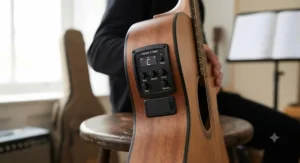
Plug in, count yourself in, and suddenly a bedroom acoustic can fill a working men’s club, a wedding marquee, or a festival side-stage without a microphone stand in sight. That’s the entire promise of an electro acoustic guitar: the warmth of a wooden box married to a pickup and preamp that let you go straight into an amp, a PA, or an audio interface whenever you need volume on tap. In plain terms, an electro acoustic guitar is a steel-string (or occasionally nylon-string) acoustic guitar fitted with an onboard pickup, typically a piezo element under the saddle, and a small preamp that shapes and boosts the signal before it leaves the guitar.
Whether you’re a singer-songwriter graduating from open mic nights to proper gigs, a worship musician who needs reliability week after week, or simply someone who’s fed up wrestling a microphone stand every time they want to be heard, this guide has been built from real research: actual products sold in the UK, genuine specification sheets, and the honest, aggregated sentiment reported by owners and reviewers. We’re not going to pretend we’ve gigged with all seven of these instruments ourselves — instead, we’ve done the legwork of comparing specs, electronics, and real-world reputation so you don’t have to.
Below you’ll find seven genuine electro acoustic guitar options spanning budget, mid-range and premium territory, a breakdown of pickup and preamp technology, a look at which models handle tuning best on stage, and practical advice on everything from plugging in for the first time to busking in the rain. If you’ve searched for the best electro acoustic under £300, wondered what separates one electro acoustic preamp system from another, or just want a straightforward shortlist, you’re in the right place.
What Is an Electro Acoustic Guitar?
An electro acoustic guitar is an acoustic guitar built with an internal pickup and preamp so it can be plugged directly into an amplifier, PA system, or recording interface without a microphone. Most use an under-saddle piezo transducer, which senses the physical vibration of the strings through the bridge, as detailed on Wikipedia’s overview of the technology. Unlike a purely acoustic guitar, it stays gig-ready at a moment’s notice.
That single sentence covers the mechanics, but not the trade-offs, and this is where honest analysis earns its keep. Adding electronics to an acoustic body means extra weight, a battery compartment, and — depending on the pickup — a tone that can sound noticeably different from the same guitar played unplugged. What most first-time buyers overlook is that you’re really buying two instruments in one: the acoustic voice you hear in the room, and the amplified voice everyone else hears through the speakers. A brilliant-sounding electro acoustic guitar gets both right, not just one.
Quick Comparison Table
| Model | Body Type | Electronics | Price Range | Best For |
|---|---|---|---|---|
| Fender CD-60SCE | Dreadnought, all-mahogany | Onboard preamp with tuner | around £220–£260 | Beginners wanting a bold, punchy sound |
| Tanglewood TW4E Winterleaf | Super Folk, spruce/mahogany | Preamp with 3-band EQ and tuner | around £180–£230 | Best value under £300 |
| Yamaha APX600 | Thinline cutaway | System65 preamp, 3-band EQ, tuner | around £280–£340 | Stage comfort and feedback rejection |
| Ibanez AEG50 | Compact single-cutaway | AEQ-TTS 2-knob preamp, tuner | around £250–£300 | Beginners who want simple tone control |
| Epiphone J-15 EC | Slope-shoulder, mahogany | Onboard preamp with tuner | around £300–£360 | Warm, all-mahogany tone on a budget |
| Martin LX1E Little Martin | Travel-size, solid spruce top | Fishman electronics, no tuner | around £400–£480 | Travel and practice with real Martin tone |
| Taylor 214ce | Grand Auditorium, solid spruce top | Expression System 2 preamp | around £900–£1,050 | Gigging players who want premium tone |
Looking across the table, the clearest split is between guitars built primarily to be affordable and dependable — the Fender CD-60SCE, Tanglewood TW4E Winterleaf, Ibanez AEG50 and Epiphone J-15 EC — and instruments like the Taylor 214ce that are built to compete with what a working musician might use every weekend. The Yamaha APX600 and Martin LX1E sit in an interesting middle ground: neither is the cheapest, but both solve a specific problem (stage comfort, and portability, respectively) rather than just chasing a lower price tag. Before choosing, it’s worth deciding whether your priority is unplugged practice tone, amplified stage tone, or genuine portability, because as you’ll see below, no single guitar here wins on all three fronts.
💬 Just one click — help others make better buying decisions too!😊
Top 7 Electro Acoustic Guitars: Expert Analysis
Every model below has been chosen to represent a genuine buying scenario — first guitar, gigging upgrade, travel companion, or long-term investment — rather than to pad out a list. Prices reflect ranges seen during research and will shift over time, so always check current pricing before you buy.
1. Fender CD-60SCE — best all-mahogany tone under £300
The Fender CD-60SCE opens this list because it’s one of the most consistently recommended first electro acoustic guitar purchases in the UK, and the spec sheet explains why. Its all-mahogany dreadnought body — top, back and sides — trades a little of the brightness you’d get from a spruce top for a warmer, more compressed midrange that’s forgiving through cheap amps and PA systems, which matters enormously for beginners plugging into whatever’s available at an open mic.
Under the hood sits an onboard preamp with a built-in digital tuner, so there’s no need to buy a clip-on tuner separately, and the walnut fingerboard and bridge give a smooth, slightly darker feel underhand than the rosewood used on cheaper rivals. Based on the spec comparison with similarly priced guitars, the Fender CD-60SCE punches above its price bracket mainly because Fender’s electronics package, rather than the wood, is doing a lot of the heavy lifting when it’s plugged in. It suits absolute beginners and anyone who wants a dependable strummer without fussing over tone-shaping controls.
Reviewers consistently report that the neck feels comfortable for players with smaller hands, and that the built-in tuner is accurate enough for daily use, though a handful note the stock strings are unremarkable and worth upgrading early.
Pros:
- ✅ Warm, forgiving all-mahogany tone for beginners
- ✅ Built-in tuner saves buying one separately
- ✅ Comfortable neck profile for smaller hands
Cons:
- ❌ Stock strings are budget-grade and need replacing
- ❌ Less tonal sparkle than spruce-topped rivals
At around £220–£260, the Fender CD-60SCE represents strong value for a first proper electro acoustic guitar, and it remains a sensible benchmark against which pricier options have to justify themselves.
2. Tanglewood TW4E Winterleaf — best British-brand value pick
British-designed and built to a genuinely competitive spec, the Tanglewood TW4E Winterleaf pairs a solid spruce top with a mahogany body, giving it a livelier, more resonant unplugged tone than fully laminate guitars in the same bracket. That solid top matters more than it might seem: solid wood continues to open up and resonate more richly as it ages, whereas laminate tops are tonally static from day one.
Its preamp, built around Tanglewood’s own EQ system (with some variants using a B-Band or Fishman-derived circuit depending on finish), includes a 3-band EQ and an onboard tuner, giving genuinely usable tone-shaping rather than a single volume knob. What most buyers overlook about British-designed budget guitars like this one is that the company’s UK-focused setup and support network can matter as much as the timber — Tanglewood guitars are commonly pre-checked by UK retailers before dispatch, which reduces the odds of receiving an instrument with a poor factory setup.
Aggregated owner sentiment across retailer listings consistently praises the “sounds better than it should” value proposition, with the honest caveat that hardware such as tuning pegs feels a notch below what you’d find on a Yamaha or Fender at a similar price.
Pros:
- ✅ Solid spruce top improves with age
- ✅ Genuine 3-band EQ, not just a volume knob
- ✅ Strong value-for-money reputation among UK buyers
Cons:
- ❌ Tuning hardware feels slightly less premium
- ❌ Less brand recognition may affect resale value
For best electro acoustic under £300 shoppers specifically, the Tanglewood TW4E Winterleaf is arguably the strongest single pick on this list — it’s usually the cheapest guitar here with a solid (not laminate) top.
3. Yamaha APX600 — best for stage comfort and feedback resistance
The Yamaha APX600 is the direct descendant of a guitar Yamaha essentially invented the category for back in the late 1980s, when a solo performer wanting to plug an acoustic straight into a PA without howling feedback had almost no options. That heritage still shows: the thinline, shallow-depth body is noticeably slimmer than a standard dreadnought, which reduces the air volume inside the guitar that would otherwise resonate uncontrollably at stage volume and cause feedback.
Specs-wise, you get a spruce top with nato back and sides, a shorter 25-inch scale with narrower string spacing that electric guitarists switching to acoustic will find familiar, and Yamaha’s System65 preamp with a 3-band EQ and built-in tuner. What the spec sheet won’t tell you, but reviewers note repeatedly, is how much easier the slim body makes long stage sets — sitting or standing, the guitar simply doesn’t dig into the ribs the way a full-depth dreadnought does after ninety minutes.
That comfort and feedback rejection make the Yamaha APX600 the natural choice for anyone doing regular live work where you’re standing close to monitors or a PA. It’s not the loudest or boomiest guitar unplugged, but plugged in is where it’s designed to shine.
Pros:
- ✅ Thinline body resists on-stage feedback
- ✅ Comfortable for long sets, sitting or standing
- ✅ Reliable, decades-proven preamp and tuner combo
Cons:
- ❌ Thinner body means less bass resonance unplugged
- ❌ Sits toward the top of the sub-£300 bracket
Between £280 and £340 depending on colour and retailer, the Yamaha APX600 is priced to compete directly with the Fender CD-60SCE and Ibanez AEG50, but wins on stage-specific engineering rather than raw unplugged tone.
4. Ibanez AEG50 — best for beginners who want simple tone control
Where some preamps overwhelm beginners with bass, mid, treble, presence and phase switches, the Ibanez AEG50 takes the opposite approach. Its AEQ-TTS preamp has exactly two controls: volume and “shape,” a single knob that sweeps from a low, fat tone through to a bright, crisp one, with natural acoustic voicing sitting in the centre position. For anyone who’s never touched an onboard EQ before, that’s a genuinely useful simplification rather than a missing feature.
Construction-wise, the compact, slender single-cutaway body uses a spruce top over sapele back and sides, with a nyatoh neck and walnut fingerboard and bridge — a mid-tier tonewood combination that leans slightly brighter and snappier than the all-mahogany Fender CD-60SCE. Here’s what to weigh: the AEG50’s slim neck and compact body make it genuinely easy to hold for smaller players or anyone coming from an electric guitar with a slimmer profile, but that same compact body trades away some of the bass depth you’d get from a full-size dreadnought.
Independent beginner-friendliness assessments consistently rate the AEG50 highly for its scale length, fret size and neck profile, and owners frequently mention the onboard LCD tuner as clear and easy to read even in dim stage lighting.
Pros:
- ✅ Simplified two-knob preamp is genuinely beginner-friendly
- ✅ Slim, compact body suits smaller players
- ✅ Clear, easy-to-read onboard LCD tuner
Cons:
- ❌ Compact body means less low-end than a dreadnought
- ❌ Fewer tone-shaping options for advanced players
Sitting around £250–£300, the Ibanez AEG50 is a genuine electro acoustic guitar with pickup control designed to be idiot-proof, which is exactly what a lot of first-time buyers actually need.
5. Epiphone J-15 EC — warmest tone under £400
The Epiphone J-15 EC takes Gibson’s slope-shoulder body shape and reworks it as an affordable, electronics-equipped acoustic that punches noticeably above its price point on paper. A solid spruce top over mahogany back, sides and neck gives a tonal profile that’s warmer and rounder than the brighter, more scooped sound typical of dreadnoughts, which makes it a strong pick for fingerstyle players and anyone who sings while they play, since the midrange doesn’t fight with vocal frequencies as much.
Its onboard preamp includes a built-in tuner and straightforward EQ, and the slim taper neck — closer in feel to an electric guitar neck than many acoustic necks — makes fast chord changes and barre chords noticeably easier for players transitioning from electric. Based on the spec comparison with the pricier Martin LX1E, the Epiphone J-15 EC actually offers a fuller-sized, more traditionally voiced acoustic experience for less money, at the cost of Martin’s brand cachet and resale value.
Reviewers highlight the guitar as “great high-end tone at a low price point,” a sentiment echoed consistently enough across owner discussions to be treated as a genuine trend rather than an outlier, though a minority flag the factory setup as slightly high-action out of the box.
Pros:
- ✅ Warm, rounded slope-shoulder tone suits vocalists
- ✅ Electric-style slim neck speeds up chord changes
- ✅ Strong perceived value versus similarly specced rivals
Cons:
- ❌ Factory action can run high before a setup
- ❌ Less brand recognition than Fender or Yamaha
At roughly £300–£360, the Epiphone J-15 EC is the pick for players who’ve outgrown a first guitar but aren’t ready to spend Martin or Taylor money yet.
6. Martin LX1E Little Martin — best travel electro acoustic guitar
The Martin LX1E Little Martin solves a problem none of the other six guitars on this list even attempt to: what do you do when you want genuine Martin construction and tone but need something small enough for hand luggage, a small flat, or a child’s first proper instrument? Its downsized “modified 0” body and shortened 23-inch scale length shrink the footprint considerably, while a solid Sitka spruce top keeps the tonal core authentically Martin rather than feeling like a toy.
The back and sides use Martin’s high-pressure laminate (HPL), a durable, humidity-resistant material rather than solid wood, which is precisely the point for a travel guitar — HPL shrugs off the temperature and humidity swings that can crack a solid-wood guitar in a car boot or an aeroplane hold. Fishman electronics (specification varies slightly by production year, typically a Fishman Sonitone or Isys T system) provide amplification, though notably this model skips a built-in tuner, so budget for a clip-on tuner alongside it.
What most buyers overlook about small-bodied travel guitars is that scale length affects string tension and feel as much as body size does — the LX1E’s shorter scale makes bends and fretting noticeably easier, which is why owner discussions repeatedly mention it as forgiving for smaller hands and younger players, alongside honest acknowledgement that its bass response can’t match a full-size dreadnought.
Pros:
- ✅ Genuine solid spruce top with real Martin tone
- ✅ HPL back and sides resist humidity and knocks
- ✅ Shorter scale is comfortable for smaller hands
Cons:
- ❌ No built-in tuner included as standard
- ❌ Reduced bass response versus full-size guitars
Priced around £400–£480, the Martin LX1E costs more than several full-size guitars on this list, and that premium buys you the Martin name and genuine travel-specific engineering rather than raw size or volume.
7. Taylor 214ce — best premium electro acoustic for gigging players
If budget genuinely isn’t the constraint, the Taylor 214ce is where this list’s ceiling sits. Its Grand Auditorium body shape — Taylor’s most versatile silhouette — pairs a solid, torrefied Sitka spruce top with layered walnut or rosewood back and sides depending on the variant, and the torrefaction process (essentially controlled roasting of the wood) is designed to mimic the tonal maturity of a guitar that’s been played in for years, straight out of the factory.
Where this guitar genuinely separates itself is the electronics: Taylor’s Expression System 2 (ES2) doesn’t use a conventional under-saddle piezo at all. Instead, three individually calibrated sensors sit behind the saddle, which avoids the slightly “quacky,” compressed character that under-saddle piezos are known for and delivers a noticeably more natural, dynamic amplified tone — the kind of difference that becomes obvious the moment you A/B it against any other guitar on this list through the same PA.
Here’s what to weigh: none of that innovation is cheap, and the 214ce sits at roughly three to four times the price of the budget picks here. On paper, that’s a hard sell for a casual player, but for anyone gigging regularly, the ES2’s more natural amplified voice can genuinely reduce or eliminate the need for outboard EQ pedals and DI boxes, which arguably claws back some of that price difference in gear you no longer need to buy.
Pros:
- ✅ ES2 electronics sound noticeably more natural amplified
- ✅ Torrefied top adds mature tone from day one
- ✅ Versatile Grand Auditorium shape suits most playing styles
Cons:
- ❌ Significant price step up from the rest of this list
- ❌ Arguably more guitar than an occasional strummer needs
At around £900–£1,050, the Taylor 214ce isn’t for everyone reading this article, but for gigging musicians who plug in every week, it’s frequently cited as the point where spending more starts delivering diminishing but still meaningful returns.
Top 7 Electro Acoustic Guitars: Full Comparison
| Model | Top Wood | Electronics | Tuner Included | Price Range |
|---|---|---|---|---|
| Fender CD-60SCE | Mahogany | Onboard preamp | Yes | around £220–£260 |
| Tanglewood TW4E Winterleaf | Solid spruce | 3-band EQ preamp | Yes | around £180–£230 |
| Yamaha APX600 | Spruce | System65 preamp | Yes | around £280–£340 |
| Ibanez AEG50 | Spruce | AEQ-TTS preamp | Yes | around £250–£300 |
| Epiphone J-15 EC | Solid spruce | Onboard preamp | Yes | around £300–£360 |
| Martin LX1E | Solid spruce | Fishman electronics | No | around £400–£480 |
| Taylor 214ce | Solid torrefied spruce | Expression System 2 | No | around £900–£1,050 |
The clearest pattern here is that built-in tuners are the norm at every price point except the two guitars aimed at experienced players who likely already own a good clip-on or pedal tuner. It’s also worth noting that “solid top” appears on five of the seven models, which tells you solid wood is achievable well under £300 these days, so it’s a reasonable minimum bar to set yourself when shopping rather than a luxury reserved for expensive guitars.
Best Electro Acoustic Under £300
If your budget is capped at £300, four guitars from this list qualify outright: the Fender CD-60SCE, Tanglewood TW4E Winterleaf, Yamaha APX600 (at the very top of the range) and Ibanez AEG50. Choosing between them comes down to what you value most rather than which is objectively “best,” because each solves a slightly different problem.
For pure value and a solid top, the Tanglewood TW4E Winterleaf is hard to beat — it’s typically the cheapest of the four and still avoids an all-laminate build. For sheer dependability and beginner-friendliness, the Fender CD-60SCE‘s all-mahogany warmth and simple controls make it the safest first purchase. If stage feedback resistance matters more than raw price, stretch to the Yamaha APX600. And if you want the simplest possible amplified tone control while you learn, the Ibanez AEG50‘s two-knob preamp removes the guesswork.
✨ Don’t Miss These Exclusive Deals!
🔍 Take your electro acoustic guitar shopping to the next level with these carefully selected picks. Click on any highlighted model above to check current pricing and availability, and find the sound that will have you gigging with confidence.
Electro Acoustic Guitar With Pickup: Types Explained
Every electro acoustic guitar with pickup relies on one of a small handful of pickup technologies, and understanding the difference genuinely changes how you shop, because it affects tone, price, and reliability far more than most spec sheets let on.
The overwhelming majority of the guitars on this list, including the Fender CD-60SCE, Tanglewood TW4E Winterleaf, Yamaha APX600, Ibanez AEG50 and Epiphone J-15 EC, use an under-saddle piezo pickup. A piezoelectric crystal sits beneath the saddle and generates a tiny electrical signal whenever it’s physically compressed by string vibration transmitted through the bridge, a phenomenon rooted in the same piezoelectric effect explained on Wikipedia’s piezoelectricity page. It’s cheap to manufacture, reliable, and resistant to feedback, which is exactly why it dominates the budget and mid-range market.
The trade-off, and something budget shoppers rarely hear until after they’ve bought, is that under-saddle piezos can sound slightly compressed, “quacky,” or brittle compared to the guitar’s natural acoustic voice, particularly when strummed hard. That’s precisely the gap Taylor’s Expression System 2, fitted to the Taylor 214ce, was engineered to close, using multiple sensors positioned behind rather than under the saddle to capture a more three-dimensional, less compressed signal. Meanwhile, the Martin LX1E‘s Fishman system sits somewhere in between: still piezo-based, but tuned by Fishman’s engineers specifically for smaller-bodied guitars.
Electro Acoustic Preamp Systems Compared
A pickup only captures the raw signal; the electro acoustic preamp systems built into these guitars are what actually shape it into something usable through an amp or PA, and the differences between them are bigger than most buyers expect. At the simplest end, the Ibanez AEG50‘s AEQ-TTS offers just volume and a single tone-shaping “shape” knob, ideal for beginners who don’t want to think about EQ at all. One step up, the Fender CD-60SCE, Tanglewood TW4E Winterleaf, Yamaha APX600 and Epiphone J-15 EC all include some version of a 3-band EQ (bass, mid, treble) plus a built-in tuner, giving you genuine control to cut boominess in a small room or add brightness through a dull PA.
At the top end, Taylor’s ES2 system on the Taylor 214ce strips things back to just volume, bass and treble, deliberately avoiding a mid control because its three-sensor pickup array is designed to need less correction in the first place — fewer knobs here is a sign of confidence in the underlying pickup design, not a missing feature. The practical takeaway: more knobs aren’t automatically better. What most buyers overlook is that a simple, well-voiced preamp paired with a good pickup will usually sound better in a real room than a complicated preamp fighting a mediocre pickup.
Best Built-In Tuner Acoustic Guitar Picks
For anyone hunting a best built-in tuner acoustic guitar specifically, five of the seven models here qualify: the Fender CD-60SCE, Tanglewood TW4E Winterleaf, Yamaha APX600, Ibanez AEG50 and Epiphone J-15 EC all include an onboard chromatic tuner as standard, usually built into the same preamp unit as the volume and EQ controls. Reviewers of the Ibanez AEG50 and Yamaha APX600 in particular note that their tuner displays remain readable in dim stage lighting, which matters more than it sounds on a badly lit pub stage.
The two exceptions are worth understanding rather than treating as flaws. Neither the Martin LX1E nor the Taylor 214ce includes an onboard tuner, and that’s a deliberate design choice rather than an oversight — both brands assume buyers at this price point already own, or will buy, a dedicated clip-on or pedal tuner, and prefer to keep the preamp circuitry focused purely on tone rather than adding tuner circuitry that could subtly colour the signal. If a built-in tuner is a genuine priority for you, it’s a legitimate reason to favour the sub-£400 options on this list.

How to Choose an Electro Acoustic Guitar
Picking between seven genuinely different instruments is easier with a structured process rather than gut instinct alone. Here’s the framework worth working through in order:
- Set your real budget first. Decide what you can spend before you start comparing tone, because it narrows the field from seven options to two or three immediately.
- Decide where you’ll play it most. A bedroom-only guitar can prioritise unplugged tone; a gigging guitar should prioritise how it sounds through a PA.
- Check the body size against your frame and travel needs. A dreadnought like the Fender CD-60SCE suits larger players; a travel body like the Martin LX1E suits commuting or air travel.
- Test the preamp controls, not just the pickup. A guitar that sounds great acoustically can still sound thin or harsh through a bad preamp — the electronics matter as much as the wood.
- Confirm whether you need a built-in tuner. If you’ll gig regularly without a pedal tuner, this becomes a genuine deciding factor, not a nice-to-have.
- Factor in resale and brand support. Established brands like Fender, Yamaha, Martin and Taylor tend to hold value and have wider UK repair networks than lesser-known imports.
- Play it plugged in before you commit, wherever possible. Specs only tell half the story; the amplified tone is the other half, and it varies more between models than most buyers expect.
Common Mistakes When Buying an Electro Acoustic Guitar
Even careful shoppers fall into a handful of predictable traps, and naming them plainly is more useful than another generic buying checklist.
The single most common mistake is judging a guitar entirely on its unplugged tone in a quiet shop, then being disappointed by how it sounds through a PA at a gig weeks later. Unplugged and amplified tone are related but genuinely different things, and a guitar like the Taylor 214ce is specifically engineered to close that gap, while cheaper piezo-only guitars generally show a bigger difference between the two.
A second frequent error is ignoring neck width and scale length in favour of body looks. Players moving from electric guitar in particular often struggle with a standard acoustic neck’s extra width, which is exactly why models like the Ibanez AEG50 and Yamaha APX600 deliberately narrow the string spacing. Third, buyers regularly skip checking whether a built-in tuner is included, then discover mid-gig that they need to fumble for a phone app to tune up. Finally, it’s common to overspend on a first guitar before knowing whether the habit sticks — starting with a genuinely capable sub-£300 option like the Tanglewood TW4E Winterleaf is a far lower-risk way to test commitment than jumping straight to premium territory.
Electro Acoustic vs Traditional Acoustic Guitar
The core question worth answering honestly: do you actually need the “electro” part? A traditional, unamplified acoustic guitar is generally lighter, simpler, and often slightly cheaper than an equivalent electro acoustic guitar, because you’re not paying for a preamp, battery compartment, or pickup. For bedroom practice, songwriting, or campfire playing, that simplicity is genuinely appealing, and it removes one more thing (a dead 9V battery) that can ruin a session.
| Factor | Electro Acoustic | Traditional Acoustic |
|---|---|---|
| Amplification | Plug straight into an amp or PA | Requires a separate microphone |
| Weight | Slightly heavier (preamp, battery) | Lighter overall |
| Price at entry level | Comparable, slightly higher | Comparable, slightly lower |
| Best for | Gigging, recording, busking | Home practice, songwriting |
The table makes the trade-off look tidier than it really is in practice, though. Once you factor in the cost of a decent microphone, stand, and cable to mic up a traditional acoustic properly for a gig, an electro acoustic guitar like the Fender CD-60SCE often works out cheaper overall for anyone who performs even occasionally, since the electronics are already built in rather than bought separately. The honest advice: if there’s any realistic chance you’ll play outside your bedroom in the next year or two, an electro acoustic guitar is the safer long-term buy.
Plugging In Acoustic Guitar Tips: A Practical Guide
Buying the guitar is only step one; using its electronics correctly, safely and effectively is where a surprising number of new owners stumble, so here are the plugging in acoustic guitar tips that actually matter in practice.
Start by checking the battery before every gig, not just when it dies mid-song. Most preamps, including those on the Fender CD-60SCE, Ibanez AEG50 and Epiphone J-15 EC, run on a single 9V battery housed in a compartment near the strap button or inside the soundhole, and a fresh spare in your gig bag costs almost nothing compared to the embarrassment of losing power on stage. Second, always use a proper 1/4-inch instrument cable rather than a cheap unshielded lead — a poor-quality cable is one of the most common causes of hum and crackle, and it’s frequently mistaken for a faulty pickup when the guitar itself is perfectly fine.
Third, set your onboard EQ flat (all controls centred) as your starting point at any new venue, then adjust in small steps rather than cranking bass or treble immediately; a flat starting point makes it far easier to diagnose whether an odd sound is coming from the guitar, the amp, or the room. Fourth, if you’re plugging into mains-powered equipment such as a PA or amplifier, it’s worth being aware of basic electrical safety around portable equipment, an area covered in detail by the Health and Safety Executive’s guidance on maintaining electrical equipment — a damaged cable or lead is a real, if often overlooked, risk at DIY gigs and open mics. Finally, resist the urge to leave the cable plugged in when the guitar is in its case; on many preamps this keeps drawing a trickle of battery power even when silent, which is why guitars mysteriously arrive at gigs with a dead battery despite barely being used.
Real-World Scenarios: Which Electro Acoustic Suits You?
Specs only mean so much in the abstract, so here are three genuine buyer profiles matched to the guitars above.
The commuting singer-songwriter. You live in a small flat, take public transport to open mics, and occasionally fly to see family. Portability and durability beat raw volume every time. The Martin LX1E Little Martin, with its HPL back and sides and downsized body, is built for exactly this life, though budget for a separate clip-on tuner since it doesn’t include one.
The weekly pub and function gigger. You’re plugging into unfamiliar PA systems every week, sometimes with only minutes to soundcheck. Reliability, a built-in tuner, and forgiving electronics matter more than tonal nuance. The Yamaha APX600‘s feedback-resistant thinline body and dependable System65 preamp were engineered precisely for this scenario, with the Fender CD-60SCE as a lower-cost alternative if budget is tighter.
The recording-focused hobbyist upgrading their first guitar. You’ve been playing a year or two, your first cheap acoustic is starting to feel limiting, and you’re recording demos at home through an audio interface. The Epiphone J-15 EC‘s warmer, fuller tone and easier neck profile represent a meaningful step up without Taylor-level spending, while anyone with a genuinely open budget for recorded tone should audition the Taylor 214ce‘s ES2 electronics, which are widely regarded as translating especially well direct into an interface.
Long-Term Cost & Maintenance
The sticker price is only part of what an electro acoustic guitar costs over its lifetime, and factoring this in properly changes the value equation between budget and premium options. Strings need replacing roughly every one to three months with regular playing, at a modest but recurring cost regardless of which guitar you own. Preamp batteries are a smaller but easily forgotten expense — budget musicians who gig weekly should expect to replace a 9V battery every few months depending on preamp design and how diligently the cable is unplugged between uses.
Where the guitars genuinely diverge is setup and repair costs. Budget guitars, including several on this list, sometimes arrive with a factory setup that’s slightly higher-action than ideal, and a one-off professional setup (typically £30–£60 in the UK) can transform playability more dramatically than most owners expect. Premium instruments like the Taylor 214ce tend to arrive better set up out of the box and are built with more repair-friendly, better-documented construction, which can matter if a neck reset or fret job is ever needed years down the line. Over a five-year ownership window, the total cost gap between a well-maintained Tanglewood TW4E Winterleaf and a Taylor 214ce narrows somewhat once you account for this, though the Taylor’s higher purchase price still dominates the calculation for most casual players.
Electro Acoustic Guitars for Gigging and Busking
Busking and casual gigging bring their own practical demands that don’t always show up in a spec sheet. Battery-powered portable amps are the standard rig for UK buskers, and pairing one with a reliable built-in tuner matters enormously when you’re tuning up on a windy high street between songs rather than in a quiet rehearsal room — which is exactly where guitars like the Fender CD-60SCE, Yamaha APX600 and Ibanez AEG50 earn their keep. It’s also worth remembering that busking in the UK is generally legal without a licence in most areas, though local councils frequently set volume and pitch-spacing rules, as outlined in guidance such as this local council busking and street entertainment advice leaflet — checking your specific city’s rules before you set up avoids an awkward conversation with a warden mid-set.
For pub and function gigging specifically, a guitar’s feedback resistance under stage volume, rather than home volume, becomes the deciding factor, which is precisely why the Yamaha APX600‘s thinline body was engineered the way it was. Whichever guitar you choose, a soft gig bag at minimum, and ideally a hard case for anything travelling by car boot or train regularly, will do more for the instrument’s long-term health than almost any other single purchase you make alongside it.

FAQ
❓ What is the difference between an acoustic and an electro acoustic guitar?
❓ Can you play an electro acoustic guitar without plugging it in?
❓ Do electro acoustic guitars need a special amp?
❓ How long does an electro acoustic guitar preamp battery last?
❓ Is a built-in tuner necessary on an electro acoustic guitar?
Conclusion
Choosing the right electro acoustic guitar really comes down to being honest about how you’ll actually use it, not which specification sheet looks most impressive. For a first instrument or a low-risk way to test whether gigging is genuinely for you, the Tanglewood TW4E Winterleaf and Fender CD-60SCE deliver real value without cutting corners on the fundamentals like a solid top or working electronics. If stage comfort and feedback resistance are the priority, the Yamaha APX600‘s thinline body earns its slightly higher price. Players wanting the simplest possible learning curve should look hard at the Ibanez AEG50, while anyone stepping up from a first guitar will likely find the Epiphone J-15 EC‘s warmer tone a genuine improvement worth the extra outlay.
For travel-specific needs, nothing here matches the Martin LX1E Little Martin‘s combination of genuine Martin tone and a genuinely portable build. And for players who gig often enough that tone quality directly affects how a paying audience perceives them, the Taylor 214ce‘s ES2 electronics represent the clearest jump in amplified sound quality on this entire list, even if the price reflects that.
Whichever you choose, remember that specs only tell half the story — plugging in and hearing a guitar through a real amp or PA, even briefly in a shop, will tell you more in thirty seconds than another hour of reading spec sheets ever will.
Recommended for You
- Left Handed Acoustic Guitar: 7 Best UK Picks for 2026
- 12 String vs 6 String Guitar: 7 Real Models Compared (2026)
- 12 String Acoustic Guitar: 7 Brilliant Picks for 2026
Disclaimer: This article contains affiliate links to amazon.co.uk. As an Amazon Associate, I earn from qualifying purchases, at no additional cost to you. Prices and availability are correct at the time of research but may change; always check current pricing before purchasing.
✨ Found this helpful? Share it with your friends! 💬🤗
