

In This Article
Walk into most high-street music shops and you’ll find rows of guitars all facing the same way — and none of them facing yours. If you’re left-handed, the search for a proper left handed acoustic guitar can feel less like shopping and more like a scavenger hunt through a world that simply forgot you exist. That’s not an exaggeration; stock levels for lefty instruments are still a fraction of what’s available for right-handed players, which is exactly why a rushed purchase so often ends in a guitar that fights you at every fret.

A left handed acoustic guitar is a steel- or nylon-string instrument built as a genuine mirror image of a standard model — the low E string sits on top, the bracing pattern inside the body is flipped, and the neck, nut and bridge are all constructed specifically for a left-hand-dominant player, rather than simply restrung.
That distinction matters more than most first-time buyers realise, and it’s one that hasn’t stopped some of the most influential guitarists in history from carving out entire careers on left-handed or mirrored instruments. This guide pulls together seven real, currently available models spanning budget cutaways to travel-sized premium instruments, breaks down what each one actually does well (and where it falls short), and answers the buying questions that come up again and again — from whether you should even bother going lefty in the first place, to which brands consistently get it right. Everything below is grounded in genuine specifications and aggregated review sentiment rather than guesswork, because a guitar you’ll actually enjoy practising on beats a hyped-up “best seller” every time.
What Is a Left Handed Acoustic Guitar?
A left handed acoustic guitar is an acoustic instrument purpose-built with a mirrored body, neck and internal bracing so the bass strings sit on top and the guitar rests naturally against a left-dominant player’s body — not a right-handed guitar with the strings simply swapped around.
That last part trips up a lot of new buyers. A “restrung” right-handed guitar still has bracing designed for the opposite string tension distribution, an asymmetric neck profile, and often a pickguard on the wrong side. It’ll work in a pinch, but it won’t feel — or sound — quite right. A true left handed acoustic guitar fixes all of that from the factory.
Quick Comparison Table
Before diving into the full write-ups, here’s a snapshot of how the seven guitars stack up on the essentials that actually influence a buying decision — body style, tonewoods, and who each one suits best.
| Guitar | Body Type | Top Wood | Price Range | Best For |
|---|---|---|---|---|
| Donner DAG-1CL | Cutaway Dreadnought | Spruce | Around £130-£160 | First-time buyers on a tight budget |
| Fender CD-60S LH | Dreadnought | Solid Spruce | £180-£230 range | Beginners wanting real solid-top tone |
| Yamaha FG820L | Dreadnought | Solid Spruce | £220-£260 range | Steady, dependable all-rounder |
| Ibanez AW54L | Dreadnought | Solid Mahogany | £220-£260 range | Fingerstyle and folk players |
| Ibanez AEG50L | Cutaway Electro-Acoustic | Spruce | £260-£320 range | Gigging beginners who need to plug in |
| Sigma 000M-15L | 000 (Auditorium) | Solid Mahogany | £350-£420 range | Intermediate players wanting a “grown-up” tone |
| Martin LX1 Little Martin LH | Travel/Modified O | Solid Sitka Spruce | £350-£450 range | Travel, students, and Martin fans on a budget |
Look closely and a pattern emerges: body size and tonewood matter far more to how a guitar actually feels in your hands than price alone. The Donner DAG-1CL and Fender CD-60S LH both use full-sized dreadnought bodies, which project well but can feel bulky for smaller players, while the Martin LX1 Little Martin LH trades some volume for a genuinely more comfortable travel-friendly shape. Meanwhile the jump from laminate to solid tonewood — visible once you cross into the Yamaha, Ibanez and Sigma territory — is where most players start to hear a real difference in resonance and sustain, not just in the marketing copy.
💬 Bookmark this comparison — it’ll save you from scrolling back up once you’ve fallen down the rabbit hole of guitar specs below!🤗
Top 7 Left Handed Acoustic Guitars: Expert Analysis
Choosing a left handed acoustic guitar for beginners or upgraders alike comes down to matching real specifications to how and where you’ll actually play. Below are seven genuine, currently sold models — spanning budget, mid-range and premium — each broken down on tone, build, who it suits, and where it falls short.
1. Donner DAG-1CL — most affordable genuine lefty cutaway
The standout here is the price: this is one of the few sub-£200 acoustic guitars built specifically for left-handed players rather than adapted after the fact. The Donner DAG-1CL pairs a spruce top with mahogany back and sides, and the cutaway body shape means upper-fret access is noticeably easier than on a traditional dreadnought — useful once you start reaching past the twelfth fret.
On paper, this is a fairly standard laminate-top beginner build, and that’s exactly what it delivers: a bright, slightly thin tone that’s entirely serviceable for learning chords and strumming patterns but won’t compete with solid-top guitars for depth or sustain. What most buyers overlook about a guitar at this price point is that neck comfort and fret finishing matter just as much as tonewood for a total beginner — sore fingers and buzzing frets kill motivation faster than a slightly flat-sounding top ever will, and the DAG-1CL’s C-shaped neck profile is genuinely comfortable for smaller or first-time hands.
Reviewers consistently report that the factory setup arrives playable out of the box, with several buyers specifically noting they were pleasantly surprised given the price point; a recurring complaint centres on the stock strings, which several owners replaced within the first few weeks. Based on the spec comparison against similarly priced right-handed beginner guitars, the DAG-1CL doesn’t cut corners specifically because it’s a lefty model — it’s simply a budget guitar, with budget-guitar trade-offs.
Pros:
- ✅ One of the cheapest genuine left handed acoustic guitars available
- ✅ Cutaway body improves access to higher frets
- ✅ Comfortable neck profile for smaller hands
Cons:
- ❌ Laminate top limits long-term tonal development
- ❌ Stock strings often need early replacement
Sitting around £130-£160, this is a sensible starter buy for anyone unsure whether they’ll stick with the instrument — just budget a little extra for a proper set of strings and a decent gig bag.
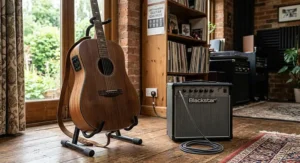
2. Fender CD-60S LH — best all-round beginner value
The standout feature is the solid spruce top — a genuine step up from laminate construction at a price that still counts as entry-level. The Fender CD-60S LH pairs that top with mahogany back and sides and a walnut fingerboard, in Fender’s familiar dreadnought shape.
A solid top means the wood is allowed to vibrate as a single piece rather than as bonded layers, and in practice that translates to noticeably more volume, sustain and tonal complexity than a laminate-top guitar at the same price — the sound will also continue opening up the more the guitar is played, unlike laminate tops which are largely fixed from day one. The scalloped “X”-bracing inside the body is doing real work here too, flexing more freely to let the top resonate rather than choking it.
Here’s what to weigh: the rolled fingerboard edges make the Fender CD-60S LH genuinely comfortable for extended practice sessions, and this is consistently the detail beginners mention first when comparing it to cheaper alternatives. Aggregated review sentiment across major retailers is strongly positive, with recurring praise for the balanced tone and beginner-friendly neck shape; a smaller but consistent thread of feedback flags the factory action as slightly high on some units, meaning a professional setup is worth budgeting for if buying new.
Pros:
- ✅ Solid spruce top improves tone as it ages
- ✅ Rolled fingerboard edges reduce hand fatigue
- ✅ Reputable brand with strong parts and warranty support
Cons:
- ❌ Some units arrive with higher factory action
- ❌ Dreadnought body can feel large for smaller players
At around £180-£230, this is arguably the sweet spot for anyone wanting real acoustic tone without stepping into intermediate pricing — it’s a guitar that can realistically be a first and only instrument for several years.
3. Yamaha FG820L — most dependable long-term beginner guitar
The standout advantage is consistency: Yamaha’s FG line has a decades-long reputation for reliable factory quality control, and the Yamaha FG820L brings that pedigree to a left-handed dreadnought.
Specwise, it shares the same solid spruce top and mahogany back-and-sides combination as several rivals here, but Yamaha’s “scalloped bracing” design — refined across generations of the FG series — is specifically tuned to maximise projection without sacrificing warmth in the low end. In practice, that means strummed chords ring out with more authority than you’d expect from a guitar in this price bracket, while fingerpicked passages retain clarity rather than turning muddy.
Based on the spec comparison against the Fender and Ibanez dreadnoughts on this list, the Yamaha FG820L doesn’t dramatically outperform either — but what most buyers overlook is that Yamaha’s quality consistency across production runs is unusually high, meaning the guitar you order online is far more likely to match its factory specification than with smaller manufacturers. Reviewers consistently note strong value for money and describe the tone as “balanced” rather than bass-heavy or overly bright, which suits a wide range of playing styles.
Pros:
- ✅ Excellent build consistency across production units
- ✅ Balanced tone suited to strumming and fingerstyle alike
- ✅ Backed by Yamaha’s long-standing UK dealer network
Cons:
- ❌ Standard finish options are limited compared with rivals
- ❌ No electronics — acoustic only, unlike some alternatives here
Priced around £220-£260, this is the guitar to buy if you’d rather not gamble on a lesser-known brand — a genuinely low-risk choice for anyone serious about sticking with lessons.
4. Ibanez AW54L — richest tone for fingerstyle players
The standout feature is the all-mahogany construction — top, back and sides — which is unusual at this price point and gives the Ibanez AW54L a noticeably warmer, more midrange-focused voice than the spruce-topped guitars on this list.
Mahogany tops tend to emphasise the fundamental note over shimmering overtones, producing a tone that’s often described as “woody” or “focused” rather than bright and jangly. What this means in practice is that fingerpicked arrangements and folk-style playing sound particularly rich on the Ibanez AW54L, while aggressive strumming can feel slightly compressed compared with a spruce-top dreadnought pushing more high-end sparkle.
Here’s what the spec sheet won’t tell you, but reviewers note: the AW54L’s neck is noticeably slimmer than Ibanez’s other acoustic ranges, which players transitioning from electric guitar tend to find easier to adapt to. Aggregated review sentiment is consistently positive on build quality and finish for the price, with several owners specifically comparing it favourably against pricier all-mahogany alternatives; the main recurring criticism is a comparatively thin factory-supplied gig bag that several buyers replaced.
Pros:
- ✅ All-mahogany body gives a distinctive warm, focused tone
- ✅ Slim neck profile suits players coming from electric guitar
- ✅ Strong value relative to similarly specced rivals
Cons:
- ❌ Less bright and projecting than spruce-top equivalents
- ❌ Included gig bag is thin and offers minimal protection
Expect to pay in the £220-£260 range — genuinely excellent value if a warmer, mellower tone is what you’re after rather than maximum volume.
5. Ibanez AEG50L — best for gigging and home recording
The standout advantage is built-in electronics: the Ibanez AEG50L is a genuine electro-acoustic, meaning it can be plugged straight into an amp or PA without needing an external pickup retrofitted later.
The onboard preamp includes a basic tone-shaping EQ and a built-in tuner, which on paper sounds like a minor convenience but in practice removes one of the biggest headaches lefty players face — sourcing a soundhole pickup that actually fits a mirrored body cavity. The cutaway design also opens up the upper frets considerably more than the dreadnoughts elsewhere on this list, which matters if lead lines or solo sections are part of your playing.
Based on the spec comparison, the trade-off for those electronics is a slightly less resonant unplugged tone than the Yamaha or Sigma models here — acoustic-electrics generally sacrifice a touch of natural projection to accommodate the internal pickup system and preamp cavity. Reviewers consistently note that the onboard tuner is a genuine time-saver for beginners still learning to tune by ear, though a handful mention the preamp’s EQ controls feel basic compared with higher-end acoustic-electric systems.
Pros:
- ✅ Genuine plug-and-play electronics, no retrofitting needed
- ✅ Built-in tuner speeds up practice sessions
- ✅ Cutaway body improves upper-fret access
Cons:
- ❌ Slightly less resonant unplugged compared with rivals here
- ❌ Basic onboard EQ compared with premium preamp systems
At roughly £260-£320, this is the obvious pick for anyone planning to gig, record, or simply wants the flexibility of going electric without buying a second instrument.

6. Sigma 000M-15L — best “grown-up” tone below premium pricing
The standout feature is the solid mahogany 000 (auditorium-shaped) body — a genuinely more sophisticated build than anything else on this list at a price that still sits below the premium brands.
The 000 body shape splits the difference between a dreadnought’s boom and a parlour guitar’s intimacy, producing a tone that’s balanced across the frequency range without the boxiness some smaller-bodied guitars suffer from. Combined with the all-solid-mahogany construction, the Sigma 000M-15L produces a genuinely mature, complex tone that punches noticeably above its price bracket — this is where the jump from “beginner guitar” to “intermediate instrument” really starts to show.
What most buyers overlook about the Sigma brand specifically is its direct design lineage from C.F. Martin & Co, whose engineers helped establish the Sigma line — meaning the bracing patterns and build philosophy borrow heavily from genuinely premium instrument design, just without the premium price tag. Aggregated review sentiment consistently praises the tonal maturity and projection for the price, with the main recurring caveat being that the satin finish shows fingerprints and light scuffing more readily than a gloss finish would.
Pros:
- ✅ Auditorium body delivers a balanced, mature tone
- ✅ All-solid mahogany construction rare at this price
- ✅ Design lineage connected to Martin’s engineering heritage
Cons:
- ❌ Satin finish marks more easily than gloss alternatives
- ❌ Heavier investment than the beginner-tier options here
Priced around £350-£420, this is the guitar for a player who’s already committed to the instrument and wants meaningfully better tone without jumping straight to premium-brand pricing.
7. Martin LX1 Little Martin LH — best travel-size premium option
The standout feature is the name on the headstock combined with genuine portability: the Martin LX1 Little Martin LH brings authentic Martin build quality into a compact, travel-friendly body roughly three-quarters the size of a standard dreadnought.
Don’t mistake “small” for “compromised,” though — the solid Sitka spruce top delivers surprisingly full projection for the body size, while the mahogany-pattern HPL (high-pressure laminate) back and sides are specifically chosen for durability against temperature and humidity swings rather than as a cost-cutting measure. The Richlite fingerboard and bridge — a dense composite material — are similarly built to resist the kind of warping that solid wood can suffer on a guitar that’s regularly thrown in a car boot or overhead locker.
Based on the spec comparison against full-size dreadnoughts on this list, what most buyers overlook is that the shorter 23-inch scale length also means slightly lower string tension, which can genuinely ease finger strain for players with smaller hands or early-stage calluses — not just travellers. Reviewers consistently describe the tone as “surprisingly big” for the size, with the recurring caveat that dedicated strummers chasing maximum dreadnought-style volume may find it a step down in raw projection.
Pros:
- ✅ Genuine Martin build quality in a compact body
- ✅ HPL back and sides resist humidity and temperature damage
- ✅ Shorter scale length eases finger strain for smaller hands
Cons:
- ❌ Less raw volume than a full-size dreadnought
- ❌ Premium pricing for a guitar without full body size
Expect to pay in the £350-£450 range for the standard LX1, with the electro-acoustic LX1E version (added Fishman pickup) typically running higher — a genuinely excellent choice if portability and brand pedigree both matter to you.
Top 7 Left Handed Acoustic Guitars: Full Spec Comparison
| Guitar | Neck Material | Electronics | Body Size | Skill Level | Best For |
|---|---|---|---|---|---|
| Donner DAG-1CL | Mahogany | None | Dreadnought (cutaway) | Absolute beginner | Tight budgets |
| Fender CD-60S LH | Mahogany | None | Dreadnought | Beginner | All-round value |
| Yamaha FG820L | Nato | None | Dreadnought | Beginner-intermediate | Long-term reliability |
| Ibanez AW54L | Mahogany | None | Dreadnought | Beginner-intermediate | Fingerstyle/folk |
| Ibanez AEG50L | Mahogany | Onboard preamp + tuner | Cutaway | Beginner-intermediate | Gigging/recording |
| Sigma 000M-15L | Mahogany | None | 000/Auditorium | Intermediate | Tonal upgrade |
| Martin LX1 LH | Mahogany-pattern HPL | None (LX1E adds Fishman) | Travel/Modified O | Beginner-intermediate | Travel and portability |
Read across the “Electronics” column and the decision narrows fast for anyone planning to perform: the Ibanez AEG50L is the only guitar here built to plug in without modification, while every other model would need an aftermarket pickup fitted by a specialist familiar with mirrored bracing. Skill level is worth taking seriously too — the Sigma 000M-15L rewards a player who already has some technique to bring out its tonal complexity, whereas the Donner DAG-1CL and Fender CD-60S LH are specifically forgiving of the inconsistent pressure and technique a total beginner brings to the fretboard.
🎸 Ready to narrow it down? Check current availability and pricing on the model that matches your budget above.🤗
Left Handed Guitar for Beginners: What Actually Matters
Choosing a left handed guitar for beginners isn’t just about picking the cheapest lefty model in stock — the same fundamentals that matter for any beginner guitar apply, just with a smaller pool of instruments to choose from. Action height (how far the strings sit above the fretboard) matters enormously in the first few weeks, because high action makes every chord physically harder to fret cleanly, and that’s often what makes new players quit before their fingertips even toughen up.
Body size deserves more attention than most first-time buyers give it. A full-size dreadnought like the Fender CD-60S LH or Yamaha FG820L projects beautifully but can feel unwieldy for a smaller-framed adult or a younger teenager, in which case a travel-sized option like the Martin LX1 Little Martin LH or a cutaway model like the Donner DAG-1CL is often more encouraging to actually pick up and practise on daily.
Reviewers consistently flag factory setup quality as the single biggest predictor of whether a beginner sticks with an instrument — a guitar that buzzes, goes out of tune constantly, or has strings sitting too high above the neck will frustrate even a motivated learner within days. If you’re ordering online rather than trying before buying, budget for a professional setup by a local guitar tech regardless of which model you choose; it typically costs far less than the guitar itself and transforms the playing experience.
According to a large-scale genetic study using UK Biobank data, roughly 10% of people are left-handed, so if you’re a beginner wondering whether you’re somehow the odd one out in a guitar shop — you’re not, you’re just part of a consistent minority the industry has been slow to properly cater for.

Best Left Hand Acoustic Under £200: Budget Buying Guide
If your budget caps out around £200, the realistic choice among genuine left handed instruments narrows to the Donner DAG-1CL, which sits comfortably in that range, and occasionally the Fender CD-60S LH when it dips toward the lower end of its price band during sales periods.
At this price tier, the honest trade-off is laminate versus solid tonewood construction. A laminate top is more resistant to cracking from humidity changes and generally more forgiving for a first guitar that might get knocked around, but it won’t develop the same tonal richness over years of playing that a solid top will. Here’s what to weigh: if you’re genuinely unsure whether the instrument or left-handed guitar in general is right for you long-term, a sub-£200 laminate-top model is the lower-risk entry point — you can always upgrade to a solid-top guitar like the Fender or Yamaha once you know you’re committed.
| Price Band | What You Typically Get | Example |
|---|---|---|
| Under £160 | Laminate top, basic hardware | Donner DAG-1CL |
| £180-£230 | Solid top, better fret finishing | Fender CD-60S LH |
| £220-£320 | Solid tonewoods, sometimes electronics | Yamaha FG820L, Ibanez AW54L, Ibanez AEG50L |
The jump between price bands correlates most closely with tonewood quality and fret-work precision rather than flashy features, which is exactly why the analysis above kept circling back to solid versus laminate tops. Budget buyers should also factor in roughly £15-£30 for a proper set-up and possibly a string change immediately after purchase, since guitars in this bracket are rarely optimised out of the box.
✨ Ready to compare current prices on a budget-friendly lefty?
🔍 Check availability on the models above before they sell out — sub-£200 left handed acoustics move fast given how limited UK stock levels typically are.
Should a Left Handed Person Learn Guitar Normally?
This is genuinely one of the most debated questions among new left-handed players, and there’s no single correct answer — but there is a reasoned way to think it through.
The case for learning “normally” (right-handed, like Mark Knopfler or Jimi Hendrix’s occasional right-handed sessions) rests on availability: right-handed guitars, lessons, tutorials and secondhand instruments vastly outnumber left-handed equivalents, so learning conventionally removes a genuine practical barrier. Some teachers also argue that your fretting hand (typically the dominant, more dexterous hand in a right-handed setup) benefits from doing the more intricate work of forming chords and playing individual notes.
The case against it — and the reasoning most left-handed guitar teachers actually favour — is that strumming and picking (the dominant hand’s job on a left handed acoustic guitar) demands more nuanced rhythmic control and dynamic touch than fretting does, so it makes sense for your naturally dominant hand to handle it. Famous left-handed players like Paul McCartney and Kurt Cobain reinforce this instinctively: both switched to genuinely left-handed instruments rather than persisting with a right-handed setup, reportedly finding the mirrored orientation felt more natural once they tried it.
On paper, this means there’s no universally “correct” choice — what most buyers overlook is that the real deciding factor should simply be comfort during your very first few sessions. If picking up a right-handed guitar and strumming with your left hand while fretting with your right feels instinctively awkward and effortful, that’s a meaningful signal, not something to push through out of convenience. Try both orientations, if you possibly can, before committing to buy.
Best Brands for Left Handed Guitars
Not every guitar brand takes left-handed players seriously, and that inconsistency is worth knowing about before you start browsing. Some manufacturers offer a genuine mirrored build across most of their range, while others treat left-handed models as a rare, limited-run afterthought.
Yamaha, Fender and Martin — all featured in the product round-up above — have consistently maintained left-handed options across multiple guitar tiers for years, which typically means better long-term parts availability and more predictable stock. Ibanez has expanded its left-handed acoustic range meaningfully in recent years too, with the AW54L and AEG50L both genuine examples of that commitment rather than one-off models.
Sigma, meanwhile, occupies an interesting niche: as a brand with genuine design lineage from Martin’s engineering team, it offers left-handed models that punch well above their price bracket, though the overall range of lefty options is narrower than the bigger brands. Based on the spec comparison across brands, the practical takeaway is this: sticking with a manufacturer that has an established left-handed lineup — rather than a single obscure left-handed model buried in an otherwise right-handed catalogue — generally means better resale value, easier replacement parts, and more confidence that the guitar wasn’t a rushed, poorly tested afterthought.
Lefty Acoustic Guitar Amazon: What to Check Before You Buy
Buying a lefty acoustic guitar on Amazon comes with a few UK-specific quirks worth knowing before you click “buy now,” starting with the fact that “left-handed” filters on Amazon’s search aren’t always fully reliable — some listings are miscategorised, and a small but real number of “left-handed” guitar listings are actually right-handed guitars with a left-handed-friendly case or strap included, not the guitar itself.
Always check the product title and bullet points explicitly state “left-handed body” or “LH” model codes (as with the Fender CD-60S LH or Yamaha FG820L), rather than relying on the thumbnail image alone, since stock photography is sometimes reused incorrectly across listings. Check the seller information too — third-party sellers fulfilling their own orders (rather than “Dispatched from and sold by Amazon”) can have inconsistent return policies, which matters enormously for an instrument you can’t try before buying.
Given the limited UK stock levels for genuine lefty models, it’s also worth checking whether a listing is “Amazon Prime” eligible specifically, since third-party stock can occasionally sit in overseas warehouses with considerably longer delivery windows than the default estimate suggests. Finally, always photograph the guitar on arrival before restringing or adjusting anything — this protects you if a return becomes necessary due to shipping damage, which is somewhat more common with guitars than with smaller items given their size and fragility in transit.
Left Handed Guitarist Buying Guide: Common Mistakes to Avoid
Even experienced players second-guess themselves when shopping for a left handed acoustic guitar, and a handful of mistakes come up again and again.
- Assuming “left-handed friendly” means genuinely left-handed. Some listings use vague language that actually describes an ambidextrous or symmetrical body shape rather than a true mirrored build — always confirm the neck, nut and bracing are specifically built for left-hand playing.
- Skipping the body-size question entirely. A dreadnought that projects beautifully in a shop demo can feel oversized during a 45-minute daily practice session at home — think about where and how often you’ll actually play.
- Ignoring return policies. Given how few UK retailers stock left-handed guitars in physical showrooms, most buyers are purchasing sight-unseen — a generous return window isn’t a nice-to-have, it’s essential.
- Buying based on brand name alone. A premium brand’s entry-level lefty model can sometimes be outperformed on tone by a mid-range specialist brand — the spec comparison earlier in this guide is worth revisiting before assuming price equals quality.
- Forgetting the setup cost. Nearly every guitar in this price range benefits from a professional setup after purchase — budget for it rather than treating it as an optional extra.
Practical Usage Guide: Setting Up and Caring for Your New Lefty Guitar
Getting a new left handed acoustic guitar dialled in properly during the first month makes an enormous difference to how quickly you progress, and to how much you actually enjoy picking it up.
Start with a proper setup, even on a brand-new guitar: action height, intonation and neck relief are rarely perfect straight out of the box, and a local guitar tech can typically adjust all three for a modest fee. Next, commit to a string-stretching routine for the first week — new strings go out of tune constantly until they’ve been played in, and gently stretching each string by hand after tuning speeds this process up considerably.
Humidity control matters more than most beginners expect, particularly for solid-top guitars like the Yamaha FG820L, Ibanez AW54L or Sigma 000M-15L — UK homes swing between damp winters and dry, centrally heated conditions, and a basic soundhole humidifier (or simply avoiding radiators and direct sunlight) protects against cracking over time. Wipe the strings and fretboard down after each session to prevent corrosion from finger oils, and re-check tuning before every practice, since even small pitch drift trains your ear incorrectly.
A common first-30-days mistake is over-tightening the truss rod or attempting DIY neck adjustments without proper tools — if the action feels wrong after the initial professional setup, take it back to a tech rather than experimenting, since an incorrectly adjusted truss rod can cause lasting damage.
Real-World Scenarios: Which Lefty Guitar Fits Your Life?
The university student on a tight budget, living in shared halls: compact storage and durability against knocks matter here more than raw tone. The Martin LX1 Little Martin LH or the budget Donner DAG-1CL both suit cramped shared spaces, with the Martin’s HPL construction handling the inevitable bumps of student life better than a solid-wood equivalent.
The commuting professional squeezing in evening practice after work: comfort and quick playability without a lengthy setup ritual matter most. The Fender CD-60S LH, with its rolled fingerboard edges and forgiving action, suits short, frequent practice sessions where fatigue-free playing keeps motivation high.
The intermediate player finally ready to gig or record: electronics and tonal maturity take priority over price. The Ibanez AEG50L covers the plug-and-play need directly, while the Sigma 000M-15L suits a player prioritising acoustic tone for open mics and unplugged recording over amplification.
Left Handed Acoustic vs Restrung Right-Handed Guitar
One of the most persistent debates among new lefty players is whether to buy a genuine left handed acoustic guitar at all, or simply restring a cheap right-handed model. Both approaches have real trade-offs worth weighing honestly rather than dismissing either outright.
| Factor | Genuine Left Handed Guitar | Restrung Right-Handed Guitar |
|---|---|---|
| Bracing | Correctly mirrored for tone | Often unbalanced, slightly compromised tone |
| Nut and neck | Cut and shaped for left-hand playing | Nut usually needs re-cutting for correct string spacing |
| Cost | Sometimes a premium over right-handed equivalents | Cheaper upfront, but conversion costs add up |
| Availability | Narrower model range | Wide range of donor guitars available |
| Long-term comfort | Built specifically for the player | Compromised ergonomics (pickguard, strap button position) |
Restringing works as a genuine stopgap — several famous left-handed guitarists, including Jimi Hendrix, built entire careers on flipped right-handed instruments — but it’s rarely a like-for-like substitute for a purpose-built guitar. What most buyers overlook is the nut: a right-handed guitar’s nut is cut with string slots sized and spaced for the opposite string order, so a proper conversion needs a replacement nut, not just flipped strings, or intonation and playability both suffer. For anyone planning to play regularly rather than experimenting short-term, a genuine left handed acoustic guitar remains the more reliable long-term investment.
Long-Term Cost & Maintenance of a Left Handed Acoustic
The sticker price of a left handed acoustic guitar is only part of the total cost of ownership, and it’s worth thinking through the full picture before comparing models purely on their upfront price range.
Strings need replacing every 3-6 months with regular playing, typically costing £6-£12 per set for a decent phosphor bronze set. Annual setups (recommended even for guitars that feel fine, since seasonal humidity shifts affect neck relief) generally run £30-£50 at an independent tech. A padded gig bag or hard case — genuinely worth budgeting for given how few left-handed loaner or replacement instruments exist locally if something goes wrong in transit or storage — adds another £20-£60 depending on quality.
Factoring all of this in, a budget instrument like the Donner DAG-1CL carries a lower upfront cost but may need string and hardware replacements sooner given its laminate construction, while a solid-wood guitar like the Sigma 000M-15L or Yamaha FG820L represents a higher initial outlay that tends to pay off over several years through better tonal longevity and durability. Reviewers consistently note that solid-top guitars, properly cared for, can last decades — making the total cost per year of ownership considerably lower than the upfront price difference might suggest.
FAQ: Left Handed Acoustic Guitars
❓ Are left handed acoustic guitars more expensive than right-handed ones?
❓ Can a left handed person just play a right handed guitar instead?
❓ What's the difference between left handed and left-handed friendly guitars?
❓ Do left handed guitars sound different from right handed ones?
❓ Where can I try a left handed acoustic guitar before buying in the UK?
Conclusion
Finding the right left handed acoustic guitar doesn’t have to mean settling for whatever happens to be in stock. As this guide has laid out, the seven models covered here — from the budget-friendly Donner DAG-1CL through to the travel-ready Martin LX1 Little Martin LH — each solve a genuinely different problem, whether that’s tight funds, gigging flexibility, or simply wanting a dependable first instrument that won’t fight you at every chord change.
The honest throughline across every section above is that body size, tonewood and factory setup quality matter more to your actual playing experience than brand prestige alone. A £150 guitar with a proper setup and comfortable action will get you further in your first year than a £400 instrument that arrives poorly adjusted and unloved in a corner. Whichever model from this list matches your budget and playing goals, prioritise trying before buying wherever genuinely possible, and don’t skip that first professional setup — it’s the single change most likely to keep you practising past the first few frustrating weeks.
Left-handed players have shaped some of the most influential guitar music ever recorded, and handedness itself remains a genuinely fascinating area of ongoing research — but you don’t need to understand the science to know that a properly built instrument makes learning easier. With the improved lefty options now genuinely available on the UK market, there’s never been a better moment to find an instrument built the right way round — for you.
✨ Found the right lefty guitar for you?
Check current pricing and availability on your top pick before stock runs out — genuine left handed models sell through faster than their right-handed equivalents given the smaller production runs.
Recommended for You
- 12 String vs 6 String Guitar: 7 Real Models Compared (2026)
- 12 String Acoustic Guitar: 7 Brilliant Picks for 2026
- Mini Acoustic Guitar: 7 Brilliant Small-Bodied Picks for 2026
Disclaimer: This article contains affiliate links. As an Amazon Associate, I earn from qualifying purchases. If you purchase products through these links, we may earn a small commission at no additional cost to you.
✨ Found this helpful? Share it with your friends! 💬🤗
