

In This Article
There’s a particular kind of panic that hits every gigging guitarist at least once: the sound engineer nods at you, the room goes quiet, and the first strum of your acoustic guitar for live performance comes out of the PA sounding like a wasp trapped in a biscuit tin. It’s happened to almost everyone who’s ever plugged in on a small stage. The good news? It’s almost never the room’s fault, and it’s rarely your playing either. Most of the time, it’s the instrument, the electronics, or the signal chain between the two.
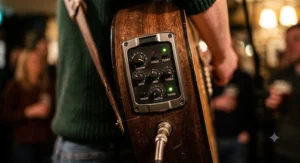
So what actually makes a guitar suited to live performance? In short: a reliable pickup and preamp system, a body shape that resists feedback at stage volume, hardware that survives repeated setup and teardown, and tone that translates through a PA rather than just a living room. Any acoustic can be recorded nicely in a quiet studio — far fewer can survive a Tuesday night pub gig with a dodgy monitor mix and a drummer who won’t turn down.
This guide pulls together seven real electro acoustic guitars spanning budget, mid-range and premium territory, alongside honest analysis of the DI boxes, PA systems and feedback-control techniques that turn a decent guitar into a dependable stage weapon. We’ve dug into real specifications, aggregated genuine reviewer sentiment, and cross-referenced player forums and shop demonstrations rather than repeating manufacturer marketing copy. Where reviews couldn’t be verified, we’ve said so rather than invented anything — because a gigging musician deserves accurate information, not padded enthusiasm.
Whether you’re chasing an electro acoustic under £500 gigging setup for your first open mic circuit, hunting for the most reliable electro acoustic for gigs after your last one died mid-set, or trying to solve acoustic guitar feedback control live once and for all, everything below is built around one goal: getting your instrument to sound like you through somebody else’s speakers. Before buying anything, it’s also worth checking whether your local council requires a busking or street performance licence, since rules vary by area and ignorance isn’t a great opening line to a warden.
Quick Comparison Table
| Guitar | Price Range | Best For | Standout Feature |
|---|---|---|---|
| Fender CD-60SCE | Under £250 | First-time gigging | Fishman pickup, dreadnought volume |
| Yamaha FGX800C | Under £280 | Reliability on a budget | Solid spruce top, System 68T |
| Tanglewood Sundance TW4 E | £250-£350 range | British-brand value | Solid cedar top warmth |
| Ibanez AW54CE | £300-£380 range | Mahogany-driven warmth | Advanced Workshop build |
| Fender Acoustasonic Player Telecaster | £1,300-£1,600 range | Versatile hybrid sets | Modelled tonal blending |
| Martin D-28E Modern Deluxe | £3,000-£3,500 range | Stage projection | Fishman MX-T electronics |
| Taylor 314ce | £1,700-£2,100 range | Professional touring | Expression System pickup |
Looking at the spread here, there’s a genuine jump in build consistency and electronics quality between the sub-£300 bracket and anything above £1,000, but that doesn’t mean the budget end is a compromise — it means you’re choosing which trade-offs suit your gig calendar. A weekly open mic player doesn’t need the same tool as a touring session guitarist, and the Fender CD-60SCE or Yamaha FGX800C will do a genuinely competent job for most beginner-to-intermediate gigging situations. Where the premium models earn their price is in projection, feedback resistance at higher stage volumes, and electronics that hold their tone as you push the gain.
💬 Found a favourite already? Bookmark this page and come back after the deep dives — decisions made under time pressure at the till rarely age well.🤗
Top 7 Acoustic Guitars for Live Performance: Expert Analysis
1. Fender CD-60SCE — best budget dreadnought for first-time gigging
The Fender CD-60SCE built its reputation on being the guitar most gigging beginners actually own, and there’s a reason for that beyond price. Its solid spruce top and mahogany back and sides give it a full, dreadnought-scale volume that cuts through a noisy room even before you plug in, which matters more than people expect at a first open mic. The Fishman pickup and preamp system handles the amplified side of things, with an onboard tuner and simple tone controls that won’t overwhelm a nervous first-timer fiddling with knobs backstage. Based on the spec comparison against other sub-£250 electro acoustics, the Fender CD-60SCE‘s dreadnought body genuinely projects better than the smaller concert-shaped budget guitars nearby on the shelf. It suits new gigging musicians, students building their first rig, and anyone who wants a spare guitar to leave permanently in a rehearsal space without losing sleep over it. Reviewers consistently report that the pickup sounds noticeably better than the price suggests, though several also note the stock strings are unremarkable and worth swapping before a first show. Aggregated feedback across retailers points to strong reliability for the money, with relatively few complaints about electronics failure — a common worry at this price point.
Pros:
- ✅ Loud, projecting dreadnought body for the price
- ✅ Reliable Fishman pickup and onboard tuner
- ✅ Backed by Fender’s 2-year warranty
Cons:
- ❌ Stock strings need replacing before gigging
- ❌ Laminate top limits long-term tonal maturing
At around £220-£260, the Fender CD-60SCE is close to the floor price for a genuinely usable stage guitar, and it earns every penny of it.

2. Yamaha FGX800C — most reliable electro acoustic for gigs under £300
If you’re specifically hunting for the most reliable electro acoustic for gigs rather than the flashiest one, the Yamaha FGX800C deserves to be first on your shortlist. Yamaha’s reputation here isn’t hype — the FG series has been a working musician’s staple for decades because the build quality control is unusually consistent across units, which matters enormously when you can’t try every guitar on a shop wall before buying online. Its solid spruce top pairs with nato/okoume back and sides, and the System 68T preamp includes a built-in tuner and simple EQ that’s genuinely easy to use in a dark venue between songs. What most buyers overlook about this model is how well the scalloped bracing lets the top resonate without becoming boomy or muddy on stage, a common problem with cheaper dreadnoughts pushed through a PA. It’s suited to gigging singer-songwriters who need one guitar that behaves the same way every single night, and to anyone who has been burned before by inconsistent budget instruments. User reviews aggregated across major UK retailers repeatedly praise the guitar’s tuning stability under stage lighting heat and its resistance to the electronics crackling that plagues some rivals.
Pros:
- ✅ Exceptional build consistency for the price
- ✅ Stable tuning under hot stage lighting
- ✅ Clean, usable onboard EQ and tuner
Cons:
- ❌ Looks fairly plain next to flashier rivals
- ❌ Battery compartment access is a little fiddly
Expect to pay in the £230-£280 range, making it one of the strongest value propositions in the entire electro acoustic under £500 gigging category.
3. Tanglewood Sundance TW4 E — best British-brand value pick
Tanglewood designs its guitars in Devon while manufacturing overseas, and the Sundance TW4 E is the clearest evidence yet that a British-brand value pick doesn’t have to mean compromised tone. Its solid cedar top is the standout spec here — cedar responds faster and warmer than the spruce tops found on most rivals at this price, giving fingerstyle players a rounder, more immediate sound under their fingers. Paired with mahogany back and sides and a Fishman Presys pickup system, it’s built with gigging singer-songwriters specifically in mind rather than as a generic beginner instrument. On paper this means a guitar tuned toward intimate, expressive playing rather than sheer dreadnought volume, so it particularly suits acoustic duos, folk performers, and anyone whose set leans on dynamics rather than raw loudness. Reviewers consistently note that the cedar top gives it a noticeably warmer voice than comparably priced spruce-topped competitors, though a smaller number mention the satin finish shows fingerprints and light scuffs more readily than gloss alternatives. The Fishman Presys electronics include a built-in tuner and a straightforward three-band EQ that’s forgiving for less experienced sound engineers to mix.
Pros:
- ✅ Solid cedar top gives a warm, immediate tone
- ✅ Fishman Presys EQ is simple to mix live
- ✅ Distinctive British-designed aesthetic
Cons:
- ❌ Satin finish marks more easily than gloss
- ❌ Less projection than dreadnought-body rivals
Sitting in the £250-£350 range, it’s a strong pick for anyone who wants their guitar’s origin story to be part of the stage patter.
4. Ibanez AW54CE — best mahogany warmth on a budget
Part of Ibanez’s Advanced Workshop range, the Ibanez AW54CE trades the spruce-top brightness of most budget electros for an all-mahogany top, back and sides construction that produces a noticeably darker, woodier tone. Here’s what to weigh: mahogany tops generally sacrifice some top-end sparkle compared with spruce, but in exchange they deliver a compressed, midrange-forward voice that sits beautifully in a full-band mix without ever sounding thin through a PA. The onboard AEQ-SP2 preamp includes a built-in tuner and a simple 3-band EQ with a dedicated phase switch — a small but genuinely useful feature for tackling feedback under stage monitors. It’s a strong option for players in rock, blues or folk-rock bands who need their acoustic to hold its own alongside electric guitars and drums rather than sitting delicately on top of a quiet mix. Aggregated reviewer sentiment consistently highlights the guitar’s surprisingly grown-up tone for its price bracket, with several long-term owners specifically praising how it has held its setup and intonation over repeated gigging use. A smaller but recurring criticism concerns the factory action, which several users report benefits from a professional setup out of the box.
Pros:
- ✅ Warm, midrange-forward mahogany tone
- ✅ Useful onboard phase switch for feedback control
- ✅ Holds setup well through repeated gigging
Cons:
- ❌ Factory action often needs professional adjustment
- ❌ Darker tone won’t suit brighter fingerstyle genres
Typically priced in the £300-£380 range, it rewards players who know exactly what tonal lane they want to sit in.
5. Fender Acoustasonic Player Telecaster — best hybrid tones for versatile sets
The Fender Acoustasonic Player Telecaster occupies a genuinely unusual space in this list: it’s built like an electric guitar but voiced, via onboard modelling, to blend acoustic and electric tones on a single instrument. Based on the spec comparison with traditional electro acoustics, its Acoustic Engine and Fishman-designed electronics let a player morph between a body-sensor acoustic voice and a magnetic-pickup electric voice using a single blend knob, which genuinely changes what’s possible in a solo or duo live set. What most buyers overlook here is that this isn’t a gimmick stacked onto a normal Telecaster — the semi-hollow chambered mahogany body is specifically engineered to resonate acoustically before any electronics are engaged. It suits solo performers and singer-songwriters who currently lug two guitars to every gig — one acoustic, one electric — and would rather carry, tune and mic just one. Reviewers consistently describe the acoustic voice as impressively convincing through a PA, though some experienced acoustic players note it doesn’t fully replace a dedicated high-end acoustic for purists chasing that specific resonant character. The five-way mini-toggle switch offers a genuinely broad tonal palette without any pedals.
Pros:
- ✅ Blends acoustic and electric tones live
- ✅ Semi-hollow body resonates acoustically
- ✅ Cuts your gigging guitar count in half
Cons:
- ❌ Doesn’t fully replicate premium acoustic resonance
- ❌ Learning the blend controls takes rehearsal time
Priced in the £1,300-£1,600 range, it’s a genuine investment aimed squarely at gigging versatility rather than traditionalist tone-chasing.

6. Martin D-28E Modern Deluxe — best premium dreadnought for stage projection
Few names carry as much weight on a stage as Martin, and the D-28E Modern Deluxe is built to justify that reputation under working conditions rather than just in a display case. Its Sitka spruce top over East Indian rosewood back and sides is the textbook dreadnought recipe, delivering the deep low end and articulate top that has defined the format for the better part of a century. Fitted with Fishman’s MX-T electronics, it’s engineered specifically for stage use rather than adapted from a studio-first design, with a built-in tuner and simple control layout that a touring guitarist can operate by feel in a dark wing. On paper this means a guitar that projects with real authority at volume without the electronics turning brittle or harsh as you push the gain — a genuine weakness in many cheaper rivals. It’s suited to professional and semi-professional performers who play regularly enough that setup consistency, hardware reliability and resale value all factor meaningfully into the purchase decision. Reviewers and long-term owners consistently describe the amplified tone as retaining the character of the unplugged instrument rather than sounding artificially “hi-fi,” a common complaint levelled at lesser preamp systems.
Pros:
- ✅ Authoritative projection at real stage volume
- ✅ Fishman MX-T electronics stay natural under gain
- ✅ Exceptional long-term resale value
Cons:
- ❌ Significant investment for occasional gigging use
- ❌ Weight and size less ideal for public transport
Expect a price in the £3,000-£3,500 range, positioning it firmly as a career-instrument purchase rather than a casual upgrade.
7. Taylor 314ce — best all-rounder for professional touring
The Taylor 314ce consistently turns up at the top of professional gigging shortlists, and the reasoning holds up under scrutiny rather than just brand loyalty. Its Grand Auditorium body shape was specifically designed to balance dreadnought-level volume with a more comfortable, controllable low end for amplified stage use, and the solid Sitka spruce top over sapele back and sides gives it clarity without harshness when pushed through a monitor wedge. Taylor’s own Expression System 2 pickup uses body sensors rather than an under-saddle piezo alone, which meaningfully reduces the “quacky” compressed tone that plagues cheaper pickup systems under gain. Here’s what to weigh: it costs considerably more than the budget picks on this list, but for a working musician playing several nights a week, the reduction in feedback issues and consistent amplified tone genuinely changes the experience of every single gig. It suits touring and session players, wedding and function musicians, and anyone whose income depends on the guitar behaving identically from soundcheck to soundcheck. Reviewers consistently rate the Expression System as one of the most natural-sounding acoustic pickup systems available, with the recurring theme being how little post-gig EQ correction it demands from front-of-house engineers.
Pros:
- ✅ Expression System 2 resists feedback and quack
- ✅ Grand Auditorium body balances volume and control
- ✅ Minimal EQ correction needed by sound engineers
Cons:
- ❌ Premium price limits accessibility
- ❌ Some players prefer a bigger dreadnought low end
Priced in the £1,700-£2,100 range, it remains one of the most consistently recommended all-rounders among professional acoustic performers.
Practical Usage Guide: Your First 30 Days Gigging
Getting a new electro acoustic stage-ready involves more than opening the case and tuning up. In the first week, get a professional setup done even on a brand-new guitar — factory action varies more than manufacturers admit, and a proper setup prevents buzzing that only reveals itself at stage volume. Change strings at least once before your first gig, even on a guitar that “already has strings on it,” since factory sets often sound dull within days and you want a fresh, bright tone for the room, not the shop demo.
Through week two, spend time specifically rehearsing with your pickup engaged through a small amp or PA at home, not just acoustically. Many players never hear their amplified tone until soundcheck, which is exactly the wrong moment to discover an EQ problem. Learn where your particular guitar’s feedback “hot spots” sit by slowly raising gain in a controlled setting — every instrument has a frequency where it howls first, and knowing yours in advance saves a horrible surprise on stage.
By week three, build a basic maintenance rhythm: wipe down strings and the fretboard after each rehearsal, keep the guitar in its case between sessions rather than left out in temperature swings, and check the battery in your preamp before every single gig, not after it dies mid-song. A cheap multimeter or simply swapping in a fresh 9V battery weekly is far cheaper than an embarrassing silence in front of a paying crowd. Common first-month mistakes include over-tightening truss rods without proper knowledge, ignoring humidity changes that cause fret buzz or top cracking, and skipping a backup cable — always carry a spare instrument cable, since it’s the single most common point of failure at a gig.
Real-World Scenarios: Which Guitar Matches Your Gig?
Consider three genuinely different gigging profiles. If you’re a university student playing open mic nights fortnightly on a tight budget, travelling by bus with your guitar on your back, the Yamaha FGX800C or Fender CD-60SCE make more sense than anything premium — you need reliability and low replacement anxiety far more than boutique tone, and either guitar handles that brief with confidence.
If you’re a semi-professional wedding and function performer playing two or three times a week, often in unfamiliar rooms with house PA systems you’ve never touched before, the calculation shifts. You need an instrument whose electronics behave predictably regardless of who’s mixing you, which points toward the Taylor 314ce or Ibanez AW54CE depending on budget — both minimise the amount of correction a stranger at the desk needs to apply to make you sound good.
If you’re a touring singer-songwriter who plays six nights a week and genuinely needs to reduce the number of instruments you transport between an acoustic set and an electric-leaning encore, the Fender Acoustasonic Player Telecaster solves a logistical problem that the others simply weren’t built to address. Meanwhile, a professional session player chasing maximum stage projection in larger rooms without a wall of monitors backing them up will find the Martin D-28E Modern Deluxe‘s natural volume genuinely reduces reliance on the PA in smaller venues. Matching gear to gig frequency and room type, not just budget, is what actually separates a good purchase from a regretted one.
Taming Feedback: Acoustic Guitar Feedback Control for Live Shows
Acoustic guitar feedback control live is one of the most common pain points raised by gigging musicians, and it’s almost always solvable without buying new gear. The physics behind it is straightforward: a hollow-bodied acoustic resonates sympathetically with sound coming back at it from stage monitors, and past a certain volume threshold that resonance runs away with itself, producing the dreaded squeal or low-end howl. You can read more on the underlying mechanism via Wikipedia’s overview of audio feedback, which explains why certain frequencies are more prone to runaway loops than others.
The first practical fix is positioning: keep your soundhole angled away from monitor wedges wherever possible, and stand slightly further from monitors than feels natural. Second, use the phase switch found on many preamps (including the Ibanez AW54CE featured above) — flipping it can cancel out the specific frequency causing the loop almost instantly. Third, a notch filter, either built into your preamp or via an outboard DI box, lets you sweep and cut the exact problem frequency without gutting your overall tone, which is far kinder than simply pulling down the master EQ. Fourth, consider a soundhole cover for particularly boomy dreadnought bodies in high-volume situations — it’s an inexpensive rubber or foam insert that reduces resonance without altering your playing feel. Finally, communicate with your sound engineer before the show rather than during it; telling them your guitar’s known trouble frequency in advance means they can pre-emptively dip it rather than fighting a feedback loop live in front of an audience.
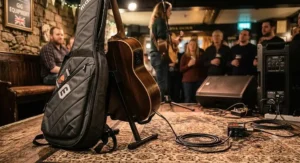
Best DI Box for Acoustic Guitar: Building a Clean Signal Chain
A good DI box solves problems your guitar’s onboard preamp alone often can’t. The LR Baggs Para Acoustic DI has become something of an industry standard for exactly this reason — its five-band parametric EQ and sweepable notch filter are specifically tuned to the quirks of piezo pickups, which tend to produce a slightly brittle, “quacky” tone under heavy compression. Reviewers and touring players consistently describe it as the unit that makes an amplified acoustic finally sound like the instrument you hear unplugged, rather than an approximation of it.
For players wanting a more affordable, rugged option, the Radial PZ-DI was purpose-built for piezo-equipped instruments and offers similar notch-filtering and phase-inversion tools in a tougher, roadworthy chassis, making it a favourite among touring session players who need gear that survives repeated flight-case abuse. Passive options like the Whirlwind IMP 2 trade tone-shaping features for simplicity and zero battery dependence — a real advantage for anyone who’s been burned by a dead 9V mid-gig — though you lose the active EQ correction that piezo pickups often benefit from.
Table analysis: looking at the trade-offs above, the LR Baggs Para Acoustic DI delivers the most acoustic-specific tone-shaping for players who gig regularly enough to justify learning its controls, while the Radial PZ-DI suits touring musicians prioritising durability, and passive units like the Whirlwind IMP 2 suit anyone wanting the simplest possible reliable signal path. Whichever you choose, running your guitar through a dedicated DI rather than straight into a venue’s mixer input almost always improves your tone more than any single guitar upgrade would.
💡 Ready to build your rig?
Take the guesswork out of your next gig by pairing the right guitar with the right signal chain — check current pricing and availability on today’s featured stage guitars and DI boxes before your next booking.
Choosing a PA System for Acoustic Guitar
A PA system for acoustic guitar has different priorities to one built around vocals or full-band mixes, and getting this wrong is a common reason players blame their instrument for a problem that’s actually downstream. Look first at channel count and input flexibility: solo acoustic performers need at minimum two clean channels — one for the guitar’s DI signal, one for a vocal mic — with combo XLR/quarter-inch jacks that accept both without an adaptor. The Bose S1 Pro+ has become a favourite among solo acoustic performers specifically because its Auto EQ automatically adjusts output character depending on how the unit is positioned, which matters enormously for buskers and function musicians setting up in a new room every night.
Portability genuinely matters more than raw wattage for most acoustic gigging scenarios. A 150-200 watt system is plenty for pub venues, small function rooms, and outdoor busking pitches, while anything larger becomes a burden to transport for marginal benefit unless you’re regularly playing rooms for 200-plus people. Battery-powered units, such as those in the JBL Eon One and Yamaha Stagepas ranges, free you from mains dependency for street performance, though they add weight and cost over mains-only alternatives. Features that genuinely matter include a built-in effects loop for subtle reverb (dry acoustic vocals rarely sound flattering), Bluetooth for backing tracks between songs, and at least one dedicated instrument-level input separate from your mic channels. Features that matter far less for most acoustic gigging include elaborate onboard DSP presets designed for DJs, and subwoofer size beyond what a solo performer’s frequency range genuinely requires.
How to Choose an Acoustic Guitar for Live Performance
- Prioritise the pickup system over the body wood first. A mediocre pickup will sabotage a beautifully built top, while a genuinely good preamp can make a modest guitar sound excellent through a PA.
- Match body size to your typical venue, not your living room. Dreadnoughts project brilliantly in mid-sized rooms; smaller Grand Auditorium or concert shapes often behave better under close-mic’d, feedback-prone stage conditions.
- Test the onboard EQ in a noisy environment if possible, not a quiet shop corner — ask staff to turn up other amps nearby to simulate a real gig’s ambient noise.
- Check for a phase switch or notch filter on the preamp. This single feature meaningfully affects how easily you’ll manage feedback later on.
- Consider hardware robustness, including tuning machine quality and bridge pin fit, since gigging guitars get retuned and handled far more roughly than home instruments.
- Budget for a proper setup and a DI box alongside the guitar itself, rather than spending the entire budget on the instrument and neglecting the signal chain around it.
- Buy from a retailer offering a fair returns window, since how a guitar behaves through your specific rig only becomes clear after a real rehearsal or two.
Most Reliable Electro Acoustic for Gigs: What “Reliable” Actually Means
When players search for the most reliable electro acoustic for gigs, they’re usually describing several distinct things bundled into one word. The first is mechanical reliability: does the guitar hold its tuning through temperature swings, sweaty hands, and repeated case transport without the neck warping or tuners slipping? The second is electronic reliability: does the preamp avoid crackling, dropouts, or unexpected battery drain mid-set? The third, less discussed, is consistency of tone — does it sound roughly the same on night twenty as it did on night one, rather than degrading as strings age or hardware loosens?
Based on aggregated reviewer sentiment across the models covered here, the Yamaha FGX800C and Taylor 314ce sit at opposite price extremes but share a genuine reputation for exactly this kind of dependability, which is precisely why both appear repeatedly on professional and semi-professional recommendation lists. What most buyers overlook is that “reliable” rarely means “expensive” — it more often means “well-manufactured with consistent quality control,” which is achievable at multiple price points if you know which specs to check.
Common Mistakes When Buying an Electro Acoustic Under £500
The first common mistake is buying based purely on unplugged tone in a quiet shop, ignoring the amplified sound entirely — ask to plug into a PA or amp before committing, since some guitars that sound gorgeous acoustically sound thin or harsh once amplified. The second is skipping a professional setup, assuming factory action is gig-ready when it frequently isn’t, leading to buzzing that only becomes obvious at stage volume weeks later. The third is neglecting the preamp’s battery life and access — some units require you to remove strings to change the battery, which is a genuine problem discovered too late by several reviewers.
The fourth mistake is under-budgeting for accessories: a hard case, a spare cable, a tuner clip and fresh strings routinely add £60-£100 to the real cost of gigging, and skipping them creates false economy. The fifth, and perhaps most common, is assuming a bigger dreadnought body automatically means a better stage guitar — for feedback-prone small venues, a smaller-bodied guitar with excellent electronics frequently outperforms a boomy dreadnought fighting with monitor wedges.
Acoustic vs Electric: Which Wins Onstage?
The honest answer is that neither universally wins — they solve different problems. An electric guitar, run through a dedicated amp, offers far more control over gain, sustain and tonal shaping via pedals, and is largely immune to the acoustic feedback issues covered earlier in this guide. An acoustic, by contrast, delivers an instantly recognisable warmth and intimacy that suits solo singer-songwriter performance, folk, and unplugged-adjacent sets in a way no amount of electric modelling fully replicates, even accounting for hybrids like the Fender Acoustasonic Player Telecaster covered above.
For genre-crossing performers playing rock, blues or pop covers in a full band, an electric typically integrates more predictably into a busy mix, since its tone is already designed for amplification from the ground up rather than adapted from an acoustic source. For acoustic-first genres — folk, singer-songwriter, unplugged sessions, and coffeehouse or function gigs — a well-chosen electro acoustic with solid electronics, like several featured in this guide, remains the more natural and audience-expected choice. Many professional performers simply own both and choose per set list rather than treating the decision as permanent.
Long-Term Cost & Maintenance for Gigging Guitarists
Total cost of ownership for a gigging acoustic extends well beyond the sticker price. Budget for restringing every four to six weeks of regular gigging, roughly £8-£15 per set depending on brand, plus an annual professional setup at £40-£70 to address seasonal humidity-related neck movement. Preamp batteries, typically 9V units, should be budgeted at one every few months of regular use, and it’s worth keeping two spares in your gig bag permanently rather than one.
Where the value proposition shifts meaningfully is resale and longevity. A well-maintained Martin D-28E Modern Deluxe or Taylor 314ce retains a substantially higher proportion of its purchase price on the used market than budget laminated models, partly because solid-wood tops mature and improve tonally with age rather than degrading. For a working musician earning income from performance, the cost-per-gig calculation over several years often favours the premium purchase, whereas an occasional hobbyist gigging a handful of times a year is generally better served putting that difference toward a good DI box, PA hire, or simply more rehearsal time.
Safety, Regulations & Hearing Protection for Performers
Live performance carries genuine occupational health considerations that are easy to ignore in the excitement of gigging regularly. Prolonged exposure to loud stage volumes, including monitor wedges and PA output, contributes meaningfully to noise-induced hearing loss over a touring career, and the NHS guidance on hearing loss outlines both the symptoms to watch for and practical steps toward prevention, including musician-specific earplugs rather than generic foam ones that muffle rather than protect tonal accuracy. Employers running venues are additionally bound by the Health and Safety Executive’s Control of Noise at Work Regulations, which set out action values for sound exposure that professional touring musicians and venue staff should be broadly aware of even as self-employed performers.
On the licensing side, busking and unamplified public performance rules vary significantly by local authority in the UK, with some councils requiring a licence and others simply expecting reasonable conduct — checking your specific council’s requirements before setting up in a public space avoids an awkward and entirely avoidable conversation with a warden mid-set.

Frequently Asked Questions
❓ What's the best acoustic guitar for live performance on a tight budget?
❓ Do I need a DI box if my guitar already has a pickup?
❓ How do I stop my acoustic guitar feeding back on stage?
❓ What wattage PA system do I need for solo acoustic gigs?
❓ Is an electro acoustic guitar under £500 good enough for regular gigging?
Conclusion
Choosing the right acoustic guitar for live performance ultimately comes down to matching the instrument, and everything plugged into it, to how often and where you actually play — not to which guitar looks best on a shop wall. A student gigging fortnightly needs dependability and low financial risk far more than boutique tonewood, which is exactly why the Fender CD-60SCE and Yamaha FGX800C remain such sensible starting points. A working musician playing multiple nights a week benefits from the consistency and feedback resistance of instruments like the Taylor 314ce or Martin D-28E Modern Deluxe, where the extra investment genuinely reduces the number of things that can go wrong on any given night.
Beyond the guitar itself, the supporting gear covered throughout this guide — a well-chosen DI box, a right-sized PA system, and a genuine understanding of feedback control — often makes a bigger night-to-night difference than the instrument alone. Get the whole chain right, from pickup to PA, and even a modest guitar can sound genuinely professional through the right room.
Recommended for You
- Electro Acoustic Guitar: 7 Best Picks for UK Players (2026)
- Left Handed Acoustic Guitar: 7 Best UK Picks for 2026
- 12 String vs 6 String Guitar: 7 Real Models Compared (2026)
Disclaimer: This article contains affiliate links. As an Amazon Associate, I earn from qualifying purchases. If you purchase products through these links, we may earn a small commission at no additional cost to you.
✨ Found this helpful? Share it with your friends! 💬🤗
