
In This Article
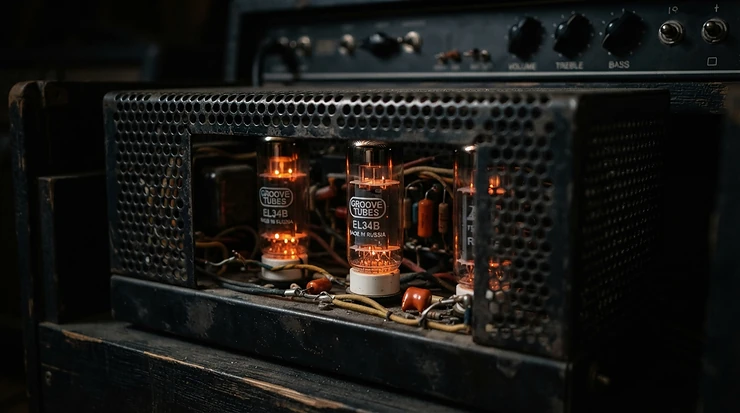
An amp head and cabinet for metal is a two-box guitar rig. The head holds the preamp and power amp that create the distortion, while the cabinet houses the speakers that turn it into moving air. Splitting them lets you pair a high-gain voicing with the speaker setup that keeps detuned riffs tight, loud and easy to upgrade.
Metal is merciless like that. Palm-muted chugs on a detuned seven-string expose every flaw. A preamp turns to fizz as the gain goes up, a power stage flaps when the low string hits, and a cheap speaker smears the lot into soup. Pedals can’t fix that. It’s why serious players still build their tone around an amp head and cabinet for metal, where voicing and speakers are chosen, and upgraded, independently. For the fundamentals of how a guitar amplifier splits into preamp, power stage and speaker, that primer is a solid start. This guide is about what to actually buy.
A quick word on method. Everything below is research-led: manufacturer specifications, UK retailer listings, published reviewer verdicts and owner feedback in aggregate. Nobody here is claiming to have gigged these rigs for a year. Where a review pool was too thin to trust, I say so. Prices are ranges only, because they move constantly, so check the current price before you commit.
The seven picks run from a pocket-sized high-gain amp head to a boutique-priced Rectifier, plus two metal guitar cabinet heavyweights. Along the way you’ll see how to plan a modular amp rig, which cabinet speaker configuration suits your gigs, and how to build a stack setup without frying anything expensive.
Quick Comparison: Amp Head and Cabinet for Metal at a Glance
| Product | Type | Key Spec | Price Range | Best For |
|---|---|---|---|---|
| Orange Micro Dark | Hybrid head | 20W, valve preamp, three knobs | Around £190–£230 | Bedrooms, first rigs |
| Orange Super Crush 100 | Solid-state head | 100W, two channels, XLR CabSim | Around £350–£550 | Budget gigging |
| Peavey 6505 MH | Valve head | 20W/5W/1W, 2x EL84 | Around £530–£725 | Compact 6505-style tone |
| EVH 5150 Iconic 80W | Valve head | 80W, 4x 6L6, noise gate | Around £650–£900 | Serious gigging |
| Mesa Boogie 90s Dual Rectifier | Valve head | 100W, 4x 6L6, 3 modes per channel | Around £3,100–£3,600 | Rectifier grind |
| Orange PPC412 | 4×12 straight cab | 240W at 16Ω, 4x Vintage 30 | Around £830–£1,000 (RRPs higher) | Detuned tightness |
| Marshall 1960A | 4×12 angled cab | 300W, classic stack styling | Roughly £800–£1,100 | The classic look |
The table shows a clear price ladder: the Orange Micro Dark and Orange Super Crush 100 are the cheap entry points, while the EVH 5150 Iconic 80W is the sweet spot for gigging valve power. The Mesa Boogie 90s Dual Rectifier costs more than most complete rigs. Budget buyers should note that the cabinets can cost as much as the heads, so plan the whole stack setup before you spend a penny.
💬 Just one click — help others make better buying decisions too!😊
Top 7 Picks: Amp Head and Cabinet for Metal, Analysed
1. Orange Micro Dark — tiny head, enormous gain
The standout is gain per kilo: a hybrid head just over 1kg that behaves like a much bigger high-gain amp head at bedroom volumes.
It pairs a valve preamp with a 20W solid-state power section, and the controls are just Gain, Shape and Volume. The Shape knob is the clever bit. It moves the voicing between thick, mid-heavy doom and a more scooped, modern sound, so one knob does the job of a full EQ. Because the power stage is solid-state, you won’t get the sag of a valve amp, but you also won’t be replacing power tubes.
Based on the spec sheet, this is a first-rig or practice-and-recording head, ideal if you want a taste of a modular amp rig without remortgaging. Pair it with a compact cab such as the Orange PPC108 for the flat, or any 8Ω 1×12 for more bass. Check the impedance rating before connecting anything.
Published round-ups consistently rank it the best budget metal head. Guides also advise running the gain lower than your instinct suggests, especially with a boost pedal in front, because the tightest sound lives below full tilt.
Pros:
- ✅ Huge gain for the money
- ✅ Genuinely pocket-portable
- ✅ Simple three-knob operation
Cons:
- ❌ Too small for gigging with a drummer
- ❌ No channel switching or effects loop
Price: around £190–£230, which is exceptional value as a starter high-gain amp head.
2. Orange Super Crush 100 — 100 watts for modest outlay
The standout is 100 watts of stage-ready power at a price that undercuts most valve heads by hundreds.
It’s a solid-state head with two independent channels. The Natural channel covers cleans, and the Dirty channel has Gain plus a three-band EQ. Output is rated at 100W into 8Ω and 70W into 16Ω, which matters: if you pair it with a 16Ω 4×12, expect a little less power than the headline number. The balanced XLR output with 2×12 speaker emulation is the feature that earns its keep, because it lets you record or feed a PA without miking a cab. At roughly 11kg, it’s also easy to carry.
On paper, this suits budget-conscious gigging players who want volume and reliability more than valve feel. Solid-state power stays tight at loud levels, which helps palm-muted riffing, but it won’t give you the compression of a valve head.
I couldn’t verify a large pool of independent UK owner reviews at the time of research, so treat claims of “valve-like” tone with caution and demo one if you can.
Pros:
- ✅ 100W without a valve-head price tag
- ✅ XLR CabSim output for silent recording
- ✅ Valve-buffered effects loop
Cons:
- ❌ Lacks valve sag and touch response
- ❌ One dirty channel limits tonal range
Price: around £350–£550, which makes it a smart budget stage head.
3. Peavey 6505 MH — the legendary circuit in a lunchbox
The standout is a full-blooded 6505-style voicing in a head that weighs about 8kg.
It’s an all-valve design with three 12AX7 preamp valves and two EL84 power valves, running 20W with a switchable attenuator that drops to 5W or 1W. That attenuator is the real story. It lets you push the power valves hard at flat-friendly volumes, which is where valve amps sound their best. There’s also reverb, a buffered effects loop, a USB output, an XLR speaker-simulated output, a headphone socket and a footswitch in the box. The catch is shared EQ across both channels, so you can’t voice rhythm and lead separately the way you can on the full-size Peavey 6505+.
Based on the feature list, this is a home-recording and small-gig head. A 1×12 or 2×12 is the natural partner for a modular amp rig at this size.
Round-ups frequently rate it the best compact tube head for metal, and the shared-EQ limitation is the most common caveat. Review volume for individual UK retailers varied, so check recent buyer feedback on the exact listing.
Pros:
- ✅ Authentic 6505-style voicing in compact form
- ✅ Attenuator, USB and XLR for home recording
- ✅ Footswitch included
Cons:
- ❌ Shared EQ across both channels
- ❌ Needs mic or PA help at loud gigs
Price: around £530–£725. Good value for a real valve high-gain amp head.
4. EVH 5150 Iconic 80W — 80 watts with a quarter-power switch
The standout is a gig-capable valve head that also behaves in a bedroom, thanks to a quarter-power switch.
It uses four power valves (6L6 in most listings, with an EL34 variant sold in some shops) and two ECC83 preamp valves. There are two channels, each with an extra voicing: an overdrive option on Green and a “burn” option on Red. The built-in noise gate tames high-gain hiss, a 10dB solo boost gets leads over the band, and selectable 4, 8 or 16Ω outputs make speaker matching easy. A two-button footswitch is included.
On paper, this is the most complete package here for the price. The noise gate and solo boost are the sort of features you’d otherwise buy as pedals, and the impedance selector means you can pair it with almost any metal guitar cabinet.
Reviewers keep returning to one theme: whether it delivers the famous brown sound on a budget. The general verdict is that it gets remarkably close for the money. Guitar World’s round-up names the wider 5150 range its best overall.
Pros:
- ✅ Noise gate, solo boost and footswitch included
- ✅ Quarter-power switch for home volumes
- ✅ Selectable 4, 8 and 16Ω impedance
Cons:
- ❌ Modern voicing less suited to vintage crunch
- ❌ 6L6 and EL34 versions cause shopping confusion
Price: around £650–£900. Excellent value as a gigging high-gain amp head.
5. Mesa Boogie 90s Dual Rectifier — the 90s sound, rebuilt
The standout is the scooped, thunderous Rectifier voicing that soundtracked a generation of heavy music.
It’s a 100W all-valve head with four 6L6 power valves, five 12AX7 preamp valves and a pair of 5U4GB rectifier valves. You can select tube or silicon-diode rectification, which sounds like a nerdy detail but changes the feel substantially. Tube rectification gives bouncier sag for chunky rhythm; silicon is tighter and faster. Two channels each offer three modes (Clean, Vintage High Gain and Modern High Gain), plus a Bold/Spongy feel switch.
Based on the spec comparison, this is the premium choice for players who know they want the Rectifier sound. Mesa’s own 4×12 pairing uses Vintage 30 speakers, and a 100W head deserves a properly rated cab.
Guitar World’s round-up names a 90s Dual Rectifier its pick for 90s metal and associates the sound with bands such as Tool, Slipknot and Korn. UK retailers describe the new reissue as faithful to the original two-channel design with improved cleans.
Pros:
- ✅ Selectable tube or silicon rectification
- ✅ Bold/Spongy feel switch for tailoring response
- ✅ Rugged Baltic birch construction
Cons:
- ❌ Premium price tag
- ❌ 100W output is hard to enjoy at low volume
Price: around £3,100–£3,600. Only worth it if the Rectifier voicing is your sound.
6. Orange PPC412 — tank-built 4×12 with tight lows
The standout is a straight-front, closed-back 4×12 with four Celestion Vintage 30 speakers and a reputation for locked-down low end.
The rating is 240W at 16Ω, which comfortably handles 100W valve heads. The Baltic birch cabinet is built like furniture, and that’s both the selling point and the warning label: weight is around 45–50kg, and listings show no casters. Vintage 30 speakers emphasise the upper midrange, which is exactly what helps riffs cut through bass and drums.
Based on the specs, this is a smart match for detuned or extended-range guitars. Owners and forum users repeatedly point to its beefier, tighter response, with some recommending it for drop A tunings. One forum comparison found it physically lower, wider and much heavier than a Marshall, so measure your boot before buying.
Retailer reviews from owners describe it as built like a tank, praise note clarity for grind and death metal, and mention the weight constantly.
Pros:
- ✅ Four Vintage 30s give focused midrange
- ✅ 240W rating copes with 100W valve heads
- ✅ Heavy-duty Baltic birch construction
Cons:
- ❌ Around 45–50kg to move
- ❌ Premium price for the size
Price: around £830–£1,000 from some UK retailers, with RRPs higher. A great investment in a metal guitar cabinet.
7. Marshall 1960A — the stack look everyone pictures
The standout is the angled 4×12 that defined the visual and sonic idea of a stack setup.
It’s a 300W cabinet, and retailer copy calls it the best-selling 4×12 ever made. Guitar World also names the 1960AV variant its overall pick for a huge variety of styles. Speaker complements vary by version, with the 1960AV using Marshall G12 Vintage speakers, so confirm the exact variant. The angled front tilts sound towards ear level when the cab sits on a straight cab beneath it.
On paper, it pairs naturally with a Marshall JCM800 2203 for classic metal and works with most heads here. For ultra-tight detuned riffing, Vintage 30 straight cabs often get the nod. Some forum comparisons also describe the Orange PPC412 as beefier by comparison.
Because the Marshall 1960A exists in many variants and eras, I couldn’t verify a clean, single review pool. Look at owner feedback on the exact model you’re buying.
Pros:
- ✅ Instantly recognisable stack styling
- ✅ 300W rating handles any head here
- ✅ Huge second-hand and accessory market
Cons:
- ❌ Looser voicing than Vintage 30 rivals
- ❌ Heavy and bulky to transport
Price: roughly £800–£1,100. Check current price, as variants differ.
Practical Usage Guide: Setting Up Your Stack Setup Safely
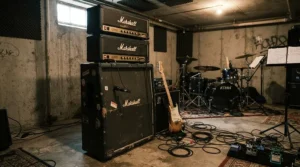
A stack setup is only impressive until you cook a transformer. These steps matter more than any tone tweak.
- Never power up a valve head without a speaker load. Always connect the cabinet first. Running without a load can damage the output transformer.
- Match impedance. Set the head’s selector to your cabinet’s rating: 4, 8 or 16Ω. The EVH 5150 Iconic 80W and Peavey 6505 MH both have selectors.
- Use a proper speaker cable. An instrument cable is the wrong cable for a head-to-cab connection.
- Respect standby. Power on, wait a minute, then flip standby. Reverse the order when switching off.
- Raise the cab. A cab on bare floorboards boomily excites the room. Lifting it onto a stand or casters tightens the low end.
In the first 30 days, expect to retune your ears. Most beginners over-dial gain, so back it off until chugs are crisp, then add it back slowly. Set the noise gate just above the point where hiss disappears. If you’ve bought a valve head, book a bias check once the tubes have settled in.
Real-World Scenarios: Matching Rigs to Players
The student in a rented room. Budget is tight and neighbours are close. The Orange Micro Dark with a small closed-back cab, used at low volume or through headphones, gives a high-gain sound without a noise complaint.
The weekend gigging band. Rehearsals twice a week, small venues monthly. The EVH 5150 Iconic 80W with an Orange PPC412 is a stage-ready modular amp rig. The quarter-power switch handles rehearsals at lower volume, and the noise gate keeps hiss under control.
The home recorder. If you track at night, the Peavey 6505 MH is the standout. The USB output, XLR speaker-simulated output and attenuator mean you can capture valve-amp tone without cranking a cab.
The touring player. If you’ve got a roadie or a van and a budget, the Mesa Boogie 90s Dual Rectifier with a Marshall 1960A is a classic high-end stack setup. Both are built to take years of abuse.
Buyer’s Decision Framework: If This, Choose That
Keep it simple. Pick the situation closest to yours.
- If you only play at home, choose the Orange Micro Dark or Peavey 6505 MH, because low wattage and recording outputs matter more than headroom.
- If you need to be heard over a drummer, choose the EVH 5150 Iconic 80W or the Orange Super Crush 100, because 80–100W is the practical minimum for loud stages.
- If you play detuned seven- or eight-string, choose the Orange PPC412, because Vintage 30 speakers and a heavy cab keep low notes defined.
- If you want classic stack styling, choose the Marshall 1960A, because the angled front and iconic look are part of the appeal.
- If your budget is unlimited and Rectifier is your sound, choose the Mesa Boogie 90s Dual Rectifier, because nothing else sounds exactly like it.
✨ Ready to Build Your Rig?
🔍 Take your tone to the next level with these carefully selected heads and cabinets. Click any highlighted product to check current pricing and availability. They’ll help you build a stack setup that sounds crushing and stays tight in every riff!
How to Choose an Amp Head and Cabinet for Metal
- Set your volume reality first. If you can’t play loud, a 100W head is wasted. Low-wattage heads with attenuators, like the Peavey 6505 MH, give valve sound at bedroom volume.
- Decide valve or solid-state. Valve amps offer sag and touch response, while solid-state models like the Orange Super Crush 100 are lighter, cheaper and more consistent.
- Check the features you’d otherwise buy as pedals. A built-in noise gate, effects loop and solo boost, as on the EVH 5150 Iconic 80W, save pedalboard space.
- Match wattage and impedance. A cab rated well above the head’s power is safe. Make sure the impedance selector and cabinet ohms agree.
- Pick your cabinet size for your gigs. Four speakers move more air but weigh a lot; two or one are friendlier to transport.
- Plan for weight and transport. A 45–50kg cab like the Orange PPC412 needs a plan: casters, a trolley or a mate.
Cabinet Speaker Configuration: 1×12, 2×12 or 4×12?
The cabinet speaker configuration changes more than loudness. It changes tightness, projection and how the rig feels under your hands.
1×12 cabs are portable, cheap and ideal for low-wattage heads. A single Vintage 30 gives a focused, midrange-forward sound that’s tough to beat for practice and recording.
2×12 cabs are the compromise most players don’t consider early enough. They move noticeably more air than a 1×12, they’re easier to lift than a 4×12, and they pair well with 50–100W heads.
4×12 cabs like the Orange PPC412 and Marshall 1960A have more cone area, which gives thicker low end and a bigger stage presence. They also demand more power and more muscle.
How speakers are wired matters too. Check whether your cab is 16Ω mono or switchable; for a deeper look at what a guitar speaker actually does and how drivers differ, that article is worth a read. If you’re unsure, pick a straight cab for tightness and an angled one for projection. Many players stack an angled cab on a straight one, giving you both.
High-Gain Distortion: Features That Actually Matter (And Those That Don’t)
High-gain distortion isn’t about maxing the knob. It’s about how much gain stays usable.
What matters:
- Gain structure. Cascaded preamp stages create harmonic saturation. More valves in the preamp usually means a richer, thicker distortion, as in the Mesa Boogie 90s Dual Rectifier.
- A noise gate. Hiss comes with the territory. The EVH 5150 Iconic 80W includes one, which saves buying a pedal.
- An effects loop. Time-based effects sound muddy in front of a high-gain preamp, so put them in the loop.
- Power-valve choice. Generally, 6L6 valves sound tighter and cleaner, while EL34 valves lean towards a more aggressive midrange. The EVH 5150 Iconic 80W exists in both variants.
- A boost pedal. Guides repeatedly suggest keeping the amp’s gain lower and using a boost to tighten the attack.
What doesn’t matter as much: wattage on its own, unless you play loud; reverb on a metal head; and the number of channels beyond two. A simple amp that nails high-gain distortion beats a complicated one that doesn’t.
Modular Amp Rig vs All-in-One Combo
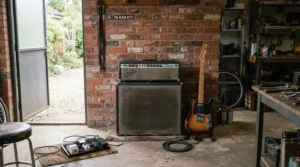
A modular amp rig splits head and cabinet. A combo bundles them. Both have their place.
| Option | Strength | Weakness | Best For |
|---|---|---|---|
| Head + cab (e.g. EVH 5150 Iconic 80W + Orange PPC412) | Mix and match, upgrade independently | Two boxes, more cost | Gigging and serious metal |
| Combo (single box) | One-piece, easy to transport | Fixed speaker, harder to upgrade | Practice and small gigs |
| Compact head + small cab (e.g. Orange Micro Dark + 1×8 or 1×12) | Cheap, portable | Limited volume | Beginners and home use |
A modular amp rig wins on flexibility. You can swap a head and keep the cab, or the other way round, and cabinet choice shapes your tone as much as the amp. The cost is portability and price. If you’re unsure, a compact head with a decent 1×12 is a low-risk way to start a modular amp rig and grow into a bigger stack setup later.
One technical point: head and cab must agree on electrical impedance, measured in ohms. Mismatching can strain the output transformer, so use the selector or buy the right cab.
Common Mistakes When Buying a Metal Guitar Cabinet and Head
Buying the head first and ignoring the cab. A thin or cheap cab undermines an expensive head. Budget roughly equal money for both when going for a full stack setup.
Ignoring weight. A 45–50kg cabinet is a commitment. Plan the stairs, the car boot and the venue loading bay.
Chasing wattage you can’t use. A 100W head in a bedroom is a waste. Attenuators and quarter-power switches help, but they aren’t magic.
Buying the wrong voltage or plug. Check the listing says UK 230V, as some imports are sold in other variants.
Over-gaining. More gain often sounds worse. Back it off and let a boost pedal tighten the attack.
Forgetting the foundation. A cab on a bare floor flaps. Raise it.
Skipping the second-hand market. Used cabs like the Marshall 1960A are plentiful and often a good value, but inspect speaker cones and check the impedance rating.
Long-Term Cost & Maintenance
The sticker price is only part of the story. Valve heads need bias checks and replacement tubes every couple of years, depending on use. Solid-state heads like the Orange Super Crush 100 are cheaper to run. Cabinets are nearly maintenance-free apart from the occasional speaker re-cone or replacement.
| Tier | Typical Combination | Combined Range | Best For |
|---|---|---|---|
| Starter | Orange Micro Dark + budget 1×12 | Typically under £500 | Home practice |
| Budget gigging | Orange Super Crush 100 + Marshall 1960A | Around £1,150–£1,650 | Cheap stage power |
| Mid-range gigging | EVH 5150 Iconic 80W + Orange PPC412 | Around £1,500–£1,900 | Serious bands |
| Premium | Mesa Boogie 90s Dual Rectifier + Marshall 1960A | Around £3,900–£4,700 | Pros and tourers |
The mid-range pairing offers the best cost-per-gig value, because the head’s built-in features save pedal spend and the cab will likely outlast three amps. If you’re budget-conscious, spend more on the cab than you think you need: it’s the part that holds its value. Prices vary, so check current prices before you buy.
Safety, Hearing and UK Regulations
Loud music is fun until your ears pay the bill. The HSE’s Sound Advice guidance on noise at work in music and entertainment explains how the Control of Noise at Work Regulations 2005 apply to live-music workplaces. While those rules cover employers, the advice is just as useful for rehearsal rooms and home studios.
Practical steps:
- Use the attenuator or quarter-power switch on heads such as the Peavey 6505 MH and EVH 5150 Iconic 80W for rehearsals.
- Wear musician’s earplugs. They reduce level without wrecking clarity.
- Don’t stand directly in front of a 4×12.
- Check the plug, voltage and condition of cables before every gig.
- Look for CE or UKCA marking on new electrical equipment and buy UK-spec 230V units from reputable retailers.
FAQ
❓ What is the cheapest amp head and cabinet for metal that still sounds good?
❓ How many watts do I need for a high-gain amp head at gigs?
❓ Can I plug a 16 ohm cabinet into an 8 ohm output?
❓ Is a 4x12 too big for a home modular amp rig?
❓ Are Vintage 30 speakers good for metal?
Conclusion
The best amp head and cabinet for metal is the one that fits your volume, your budget and your boot. If you’re starting out, the Orange Micro Dark is a tiny, ferocious gateway into high-gain tone, and the Peavey 6505 MH gives you a proper valve amp with recording outputs. If you gig, the EVH 5150 Iconic 80W is the best all-rounder here, and the Orange Super Crush 100 is the cheapest route to real stage volume. If money is no object, the Mesa Boogie 90s Dual Rectifier is the sound of a generation.
On the cabinet side, the Orange PPC412 is the tight, heavy-duty choice for detuned riffing, while the Marshall 1960A delivers the classic stack look and a huge range of tones. Whatever you pick, plan the whole metal guitar cabinet and head together, match your impedance, protect your hearing, and build your stack setup in stages if you need to.
Prices and availability change constantly, so check current prices on Amazon before you buy.
Recommended for You
- Modelling Amp For Gigging: 7 Best Stage-Ready Picks (2026)
- Solid-State Amp For Beginners: 7 Proven Picks For UK Players (2026)
- Valve Combo Amp For Blues: 7 Best Proven Picks (2026)
Disclaimer: This article contains affiliate links. As an Amazon Associate, I earn from qualifying purchases. If you purchase products through these links, we may earn a small commission at no additional cost to you.
✨ Found this helpful? Share it with your friends! 💬🤗
