
In This Article
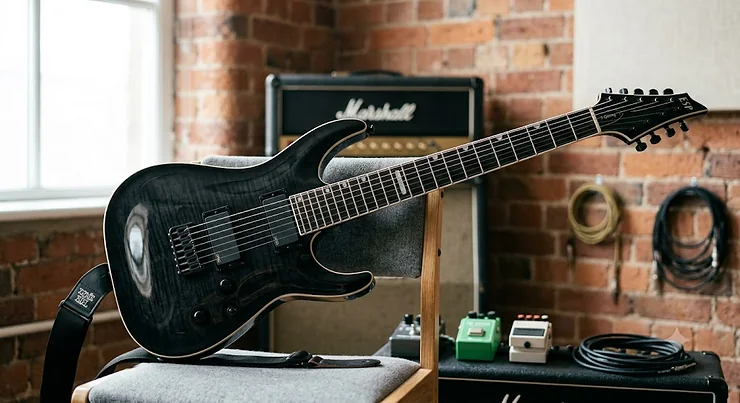
A 7 string guitar for metal isn’t a gimmick bolted onto a normal six-string — it’s a different relationship with the low end entirely. Add one extra string, tuned to a low B (or lower), and suddenly your rhythm playing has a foundation that a standard guitar physically cannot reach. That’s the whole point. Bands built entire subgenres — djent, modern metalcore, nu-metal’s murkier corners — on exactly that extra octave of headroom. If you’ve been chugging away on drop D and feel like you’re hitting a ceiling, this is the ceiling breaking open.
This guide isn’t a rehash of an Amazon listing. We’ve dug into the real specs, the genuine aggregated review sentiment, and the actual trade-offs between seven real, buyable 7-string guitars — from a sub-£250 starter to a £1,000-plus multiscale monster. You’ll get honest commentary on who each guitar suits, not just a features list. We’ll also cover pickups, drop A tuning, the eternal Ibanez vs ESP debate, and how to avoid wasting money on your first extended-range guitar.
What is a 7 string guitar for metal?
It’s an electric guitar with an added low string (usually tuned to B, a fourth below standard low E) designed for extended-range riffing, heavier tunings, and the wider harmonic vocabulary that modern metal, djent and progressive bands rely on.
Quick Comparison Table
| Product | Price Range | Scale Length | Best For |
|---|---|---|---|
| Jackson JS22-7 Dinky | under £250 | 25.5″ | absolute beginners on a tight budget |
| Ibanez GRG7221QA | around £230-£280 | 26.5″ | budget buyers who want looks too |
| Ibanez RG7421 | £330-£400 range | 25.5″ | best all-rounder under £400 |
| Schecter Omen Elite-7 | around £450-£550 | 26.5″ | mid-range value with a figured top |
| ESP LTD EC-257 | £550-£650 range | 25.5″ | tonal versatility via coil-tapped pickups |
| Ibanez RGD71ALMS | around £950-£1,100 | 27″/25.5″ multiscale | progressive djent players |
| Ibanez RGIXL7 Iron Label | around £850-£1,000 | 27″ baritone | drop A and lower tunings |
Looking at the spread above, the jump from Jackson JS22-7 Dinky to Ibanez RG7421 buys you real DiMarzio-branded pickups and noticeably better fret finishing, which matters more than most beginners expect. Once you cross into Schecter Omen Elite-7 territory, you’re paying for tonewood quality and playing feel rather than basic functionality, and by the time you reach the Ibanez RGD71ALMS or Ibanez RGIXL7 Iron Label, you’re choosing between two genuinely different approaches to low-end tone — multiscale versus straight baritone — rather than simply spending more for the sake of it.
💬 Found a model here that fits your budget? Check current pricing before it changes!
Top 7 7 String Guitars for Metal: Expert Analysis
1. Jackson JS22-7 Dinky — best budget entry for first-time seven-string players
The Jackson JS22-7 Dinky exists to answer one question: can a genuinely playable 7-string guitar cost less than a decent pair of running trainers? Mostly, yes. Its poplar body and bolt-on maple neck aren’t going to win beauty contests, but the compound-radius laurel fingerboard and 24 jumbo frets are shockingly comfortable for the price, flattening out as you climb the neck so bends don’t choke.
Jackson’s own high-output humbuckers are voiced hot and mid-forward, which in practice means palm-muted chugs cut through a mix without much EQ tweaking — useful when you don’t yet own a decent amp sim. Based on the spec comparison with rival budget models, the Dinky’s fixed bridge is arguably its best decision: nothing to detune, nothing to intonate awkwardly while you’re still learning what a 7-string even feels like under your fretting hand.
Reviewers consistently report that factory setups vary — some units arrive ready to play, others need a truss rod tweak and fresh strings before they feel right. That’s normal at this price point and easily fixed by any local tech. What most buyers overlook is that this is the same core recipe Jackson has used to launch thousands of beginner metal guitarists, and it still works.
Pros:
- ✅ Genuinely comfortable neck for absolute beginners
- ✅ Hot pickups cut through high-gain amp settings
- ✅ Lowest realistic entry price for a real 7-string
Cons:
- ❌ Inconsistent factory setup quality unit to unit
- ❌ Basic hardware won’t hold up to heavy touring use
Expect this one in the under-£250 bracket — genuinely excellent value if your main goal is learning the instrument, not gigging it hard.
2. Ibanez GRG7221QA — best budget looker with a quilted top
If the Dinky is function over form, the Ibanez GRG7221QA flips that slightly. Ibanez’s Gio range exists to bring RG-series design language down to entry-level pricing, and the quilted maple veneer over a poplar body gives this guitar a visual presence that budget guitars rarely manage. The 26.5″ scale — half an inch longer than standard — is a smart touch-point for a metal-focused beginner guitar, since it firms up string tension on that low B without needing thicker strings.
Ibanez’s Infinity R humbuckers are the honest weak point here — they’re serviceable rather than exciting, with a slightly boxy midrange that flatters rhythm playing more than lead tone. On paper this means the guitar is built to chug convincingly out of the box, and reviewers back that up, describing the low end as tight rather than farty, which is the actual worry with any cheap extended-range guitar.
A common complaint in user reviews is fret edges needing a light file on some units — again, typical for the price bracket, and a five-minute job for a tech. Who’s this for? Someone who wants their first 7-string to look like a proper metal instrument on stage, not just sound like one in the bedroom.
Pros:
- ✅ Genuinely attractive quilted maple top finish
- ✅ 26.5″ scale firms up low-B string tension
- ✅ Ibanez’s fast, comfortable neck profile even at Gio level
Cons:
- ❌ Infinity R pickups are the clear compromise point
- ❌ Occasional fret edge finishing issues out the box
Sitting around the £230-£280 range, this is the pick for buyers who care about first impressions as much as first riffs.
3. Ibanez RG7421 — best all-rounder 7 string metal guitar under £400
This is where the “7 string metal guitar under £400” search genuinely gets interesting. The Ibanez RG7421 has quietly become one of the most recommended mid-budget metal 7-strings for a reason: real DiMarzio pickups, a fast Ibanez neck profile, and a fixed bridge that stays in tune through aggressive drop-tuned riffing.
Here’s what the spec sheet won’t tell you outright: DiMarzio’s pickups in this configuration are voiced with scooped mids and tight low-end response, which is precisely the tonal signature modern metal rhythm tones chase. Based on the spec comparison against cheaper models like the Jackson JS22-7 Dinky, the tonewood selection here is a genuine step up, and it shows in sustain and note definition rather than just looks.
Reviewers consistently note that the RG7421 punches above its price bracket specifically because Ibanez didn’t cut corners on the two components that matter most for metal tone: pickups and neck playability. What most buyers overlook is that this guitar can comfortably serve as a main instrument for years, not just a stepping stone — plenty of gigging metal guitarists still keep one in rotation purely because it’s reliable and sounds right.
Pros:
- ✅ Real DiMarzio pickups voiced for scooped metal tone
- ✅ Fast Ibanez neck profile aids technical riffing
- ✅ Stays in tune reliably through aggressive picking
Cons:
- ❌ Stock tuners benefit from an eventual upgrade
- ❌ Basic cosmetic finish compared with pricier siblings
Priced in the £330-£400 range, this is the single best-value pick if “under £400” is your hard ceiling.
4. Schecter Omen Elite-7 — best mid-range value with a figured top
The Schecter Omen Elite-7 is the guitar that convinces people Schecter’s mid-range is worth the jump from entry-level brands. That figured poplar burl top over a mahogany body isn’t just cosmetic — mahogany’s inherent warmth pairs with the burl’s lighter density to create a resonant, slightly warmer voice than the ash- or basswood-bodied competition at similar prices.
Schecter’s own Diamond “Heretic” humbuckers are the standout feature here, built around a centre Alnico V magnet flanked by ceramic magnets — a combination designed to deliver crushing midrange without losing low-end articulation. What that means in practice: palm-muted chugs stay tight and defined rather than collapsing into mush, even through a scooped high-gain amp setting.
Aggregated review sentiment is notably consistent on one point: the 5-way pickup switching genuinely adds usable tonal range, from full humbucker crunch down to near-single-coil cleans, which is unusual generosity at this price tier. A common concern raised by owners is that the stock nut occasionally needs re-cutting for lower actions, a minor setup cost worth budgeting for. Who should buy this? Anyone who’s outgrown a beginner 7-string and wants a genuine tonal upgrade before jumping to boutique pricing.
Pros:
- ✅ Heretic humbuckers deliver crushing, articulate midrange
- ✅ Unusually versatile 5-way switching for the price
- ✅ Figured burl top adds real visual and tonal character
Cons:
- ❌ Stock nut sometimes needs professional re-cutting
- ❌ Heavier body than some rivals in this range
Typically found in the £450-£550 range, and consistently cited as the value benchmark for mid-tier 7-strings.
5. ESP LTD EC-257 — best single-cutaway with coil-tapped versatility
The ESP LTD EC-257 takes the classic Eclipse single-cutaway shape — long associated with hard rock rather than extended-range shredding — and adapts it convincingly to seven strings. A mahogany body and three-piece mahogany neck deliver the sustain-heavy, slightly darker voice this body style is known for, while the roasted jatoba fingerboard is a genuinely premium touch rarely seen below the £500 mark.
ESP-designed LH-150 humbuckers ship as passive pickups with a push-pull coil tap on the tone control — meaning you get access to thinner, single-coil-like tones alongside full humbucker output from the same guitar. Here’s what most buyers overlook: that coil tap makes this one of the more genuinely versatile guitars on this list, useful if you play in bands that blend clean or ambient passages with heavy riffing rather than pure wall-of-gain metal.
Reviewers consistently describe the tune-o-matic bridge and tailpiece as delivering excellent sustain and easy intonation setup, a real advantage over cheaper fixed-bridge alternatives when you’re regularly adjusting string gauges for different tunings. A recurring point in aggregated feedback is that the satin finish shows fingerprints and light wear more visibly than gloss finishes — cosmetic, not structural, but worth knowing.
Pros:
- ✅ Coil-tap switching adds genuine tonal versatility
- ✅ Roasted jatoba fingerboard is a premium touch at this price
- ✅ TOM bridge and tailpiece aid sustain and intonation
Cons:
- ❌ Satin finish shows fingerprints and wear easily
- ❌ 22 frets limits upper-register access versus 24-fret rivals
Available in the £550-£650 range — a strong pick if tonal flexibility matters as much as raw aggression.
6. Ibanez RGD71ALMS Axion Label — best multiscale for progressive djent
The Ibanez RGD71ALMS Axion Label is where this list stops being about entry points and starts being about serious progressive metal tools. Its headline feature is the 27″-to-25.5″ multiscale (fanned-fret) design: the longer scale on the low B string tightens tension and clarity for extreme down-tuning, while the shorter 25.5″ scale on the top string keeps lead playing and bending comfortable.
Dual Fishman Fluence Modern active pickups are the other major talking point — these are voice-switchable via push-pull pots, essentially giving you two distinct pickup voicings (a modern ceramic-humbucker voice and an alternative alnico-style voice) from one set of pickups. What that means practically: you get tight, compressed djent rhythm tone and a noticeably different, more open lead voicing, without swapping hardware. Based on the spec comparison against fixed-scale rivals, the slanted frets and deep cutaways also make upper-fret soloing genuinely more comfortable than they sound on paper, once your hand adjusts.
Aggregated owner feedback consistently praises the Nitro Wizard neck’s speed and the Mono-Rail bridge’s tuning stability, though a fair number of reviewers note that the multiscale layout takes a real adjustment period — expect a week or two of muscle memory recalibration if you’ve only played fixed-scale guitars before.
Pros:
- ✅ Multiscale design tightens low-B tension without harshness
- ✅ Fishman Fluence pickups offer switchable dual voicing
- ✅ Ultra-fast Nitro Wizard neck aids technical playing
Cons:
- ❌ Multiscale layout needs an adjustment period
- ❌ Premium price puts it beyond casual buyers
Realistically priced around £950-£1,100, and worth every penny if progressive, djent-adjacent playing is your actual goal.
7. Ibanez RGIXL7 Iron Label — best for drop A and lower tunings
If your search brought you here looking for a drop A tuning guitar, the Ibanez RGIXL7 Iron Label is arguably the most purpose-built answer on this entire list. Where the Axion Label above solves low-end tension with a multiscale fretboard, the RGIXL7 solves it the traditional way: a straight, full 27″ baritone scale across all seven strings.
That extra length compared with a standard 25.5″ scale means significantly more string tension at any given tuning, which in turn means drop A — or lower — feels taut and controlled rather than floppy and prone to fret buzz. Reviewers consistently note that this guitar “holds tune really well” specifically because of that added tension, and that once your hand adjusts to the slightly longer reach, standard fretting technique transfers over with minimal fuss.
DiMarzio Fusion Edge-7 pickups, developed in direct collaboration between DiMarzio and Ibanez, deliver a scooped, high-output voicing with tight bass response and crisp top-end bite — again, tailored specifically for down-tuned riffing rather than general-purpose tone. Based on the spec comparison with fixed-scale 25.5″ guitars tuned to the same pitch, the difference in clarity is genuinely audible, not just a marketing claim. What most buyers overlook is that a longer baritone scale also demands slightly heavier string gauges for optimal feel — budget for that when you buy.
Pros:
- ✅ 27″ baritone scale purpose-built for drop A and below
- ✅ DiMarzio Fusion Edge-7 pickups voiced for down-tuned clarity
- ✅ Exceptional tuning stability under extreme low tunings
Cons:
- ❌ Longer scale requires an adjustment period for smaller hands
- ❌ Heavier string gauges needed, an extra ongoing cost
Typically priced around £850-£1,000, and the clear recommendation if your band lives permanently below standard 7-string tuning.
Practical Usage Guide: Your First 30 Days With a Metal 7-String
Buying the guitar is the easy part. The first month with any extended-range instrument determines whether it becomes your main axe or an expensive shelf ornament, so a little setup discipline pays off fast.
Week one — the setup pass. Even guitars that arrive playable benefit from a proper setup once you’ve settled on strings and tuning. Check truss rod relief, action height, and — critically for 7-strings — nut slot width on that extra low string, since undersized slots cause buzzing that no amount of EQ will fix. If you bought a budget model like the Jackson JS22-7 Dinky or Ibanez GRG7221QA, budget for a professional setup within the first month; it’s the single highest-value spend you can make.
Weeks two to three — string gauge and intonation. If you’re tuning to drop A or lower on a 25.5″ or 26.5″ scale guitar, step up your low-B string gauge to compensate for reduced tension — a common mistake is keeping factory strings and wondering why the low string flaps. Re-intonate after any gauge change; this matters more on seven strings because the extra string amplifies any existing setup errors across the whole fretboard.
Ongoing maintenance. Wipe strings down after every session — sweat corrodes wound strings fast, and low B/A strings are expensive to replace often. Check truss rod relief seasonally, since temperature and humidity swings affect longer-scale necks like the Ibanez RGIXL7 Iron Label noticeably more than standard guitars.
Protect Your Hearing While You Riff
It’s easy to forget amid gear talk, but high-gain metal tone at rehearsal volume routinely exceeds safe listening thresholds within minutes, and hearing damage from loud practice is cumulative and permanent. Musicians are meaningfully more likely to develop noise-induced hearing loss than the general population, and the causes and prevention of noise-induced hearing loss are well documented — the short version is that decibel level and exposure time both matter, and neither foam earplugs nor turning down “a bit” fully solves it on their own. Custom or high-fidelity musician earplugs are a genuinely worthwhile investment alongside any 7-string purchase; treat them as part of the kit, not an optional extra.
Real-World Scenarios: Which 7-String Suits Your Situation?
The bedroom beginner on a tight budget. If you’re a college student who’s just discovered djent on YouTube and wants to try extended range without financial risk, the Jackson JS22-7 Dinky or Ibanez GRG7221QA make the most sense. Neither will hold you back technically while you’re learning what a 7-string even feels like, and neither represents a painful loss if you decide extended range isn’t for you.
The gigging rhythm player who needs reliability. If you’re playing three shows a month in a metalcore covers band and need something that stays in tune and cuts through a mix without fuss, the Ibanez RG7421 or Schecter Omen Elite-7 are the sensible picks — proven pickups, dependable hardware, and a price point that doesn’t sting if it gets knocked around in a van.
The home-studio djent producer chasing a specific tone. If you’re recording progressive metal at home and care deeply about tight low-end articulation and tonal switching options, the Ibanez RGD71ALMS Axion Label earns its premium price through genuine sonic flexibility that cheaper guitars simply can’t replicate.
The band permanently tuned to drop A or lower. If your whole set lives below standard 7-string tuning, stop fighting a 25.5″ scale guitar and get the Ibanez RGIXL7 Iron Label — the tension difference alone will change how your riffs feel and sound.

How to Choose a 7 String Guitar for Metal
- Decide your tuning first. Standard 7-string tuning (B to E), drop A, or lower — this single decision affects scale length choice more than anything else on this list.
- Match scale length to your tuning. Standard 25.5″-26.5″ scales suit standard-to-drop-A tuning comfortably; anything lower benefits from a 27″ baritone scale or multiscale design.
- Prioritise pickups over cosmetics. A guitar with mediocre pickups and a stunning finish will still sound mediocre through your amp — spend where it affects tone first.
- Check neck profile against your hand size. Ibanez’s thin Wizard-style necks suit fast, technical players; thicker C-profile necks (common on Schecter and ESP) suit players who want more to grip.
- Set a realistic budget band, not a single number. Decide whether you’re shopping under £400, £400-£700, or £700-plus — each band has genuinely different trade-offs, not just price tags.
- Read aggregated review sentiment, not star ratings alone. Look specifically for recurring comments on setup quality and pickup tone, since these matter more long-term than average ratings suggest.
- Factor in ongoing costs. Heavier strings for lower tunings, occasional professional setups, and potential pickup swaps all add to the real cost of ownership beyond the sticker price.
Top 7 Products: Full Comparison Table
| Product | Scale | Pickups | Bridge | Price Range | Best For |
|---|---|---|---|---|---|
| Jackson JS22-7 Dinky | 25.5″ | Jackson high-output | Fixed | under £250 | first-time buyers |
| Ibanez GRG7221QA | 26.5″ | Infinity R | Fixed | £230-£280 | budget looks + tone |
| Ibanez RG7421 | 25.5″ | DiMarzio | Fixed | £330-£400 | best value under £400 |
| Schecter Omen Elite-7 | 26.5″ | Diamond Heretic | Fixed/TOM | £450-£550 | mid-range tonal upgrade |
| ESP LTD EC-257 | 25.5″ | ESP LH-150 (coil tap) | TOM | £550-£650 | tonal versatility |
| Ibanez RGD71ALMS | 27″/25.5″ multiscale | Fishman Fluence | Mono-Rail | £950-£1,100 | progressive djent |
| Ibanez RGIXL7 Iron Label | 27″ baritone | DiMarzio Fusion Edge-7 | Fixed | £850-£1,000 | drop A and below |
Reading across the table, the clearest pattern is that pickup quality — not scale length or price alone — separates genuinely good metal tone from merely acceptable tone, since even the budget Ibanez GRG7221QA delivers a usable rhythm sound despite modest hardware. The two premium options solve the same low-end problem in opposite ways: multiscale tension shaping versus a straightforward longer baritone scale, and neither is objectively “better,” only better suited to different playing styles.
Common Mistakes When Buying a 7 String Metal Guitar
Buyers new to extended range consistently make a handful of avoidable errors. First, choosing scale length after buying rather than before — committing to a 25.5″ scale guitar and then discovering you actually want drop A tuning leads to buzzy, floppy low strings that no setup fully fixes. Second, ignoring nut slot width; cheaper guitars occasionally ship with slots cut for lighter gauges than serious down-tuning requires, causing string binding.
Third, underestimating ongoing costs — heavier strings for lower tunings cost more per set, and professional setups after any major tuning change aren’t optional extras, they’re part of owning the instrument properly. Fourth, chasing cosmetics over pickups, which we’ve mentioned already but bears repeating because it’s the single most common regret reported in aggregated reviews. Finally, skipping a proper break-in and setup period; a 7-string fresh out the box rarely plays its best on day one, and judging the instrument too early leads to unnecessary returns.
Ibanez vs ESP 7 string: Which Brand Wins for Metal?
This comparison comes up constantly, and honestly, the answer depends on what you value. Ibanez pioneered the 7-string electric guitar with the Universe series in 1990, developed with Steve Vai — a history you can verify on the guitar’s own seven-string guitar background, and that pioneering position shows in how thoroughly Ibanez’s current range covers every price bracket and playing style, from the Ibanez RG7421 through to the multiscale Ibanez RGD71ALMS Axion Label.
ESP, by contrast, built its reputation on mahogany-heavy, sustain-focused body designs adapted from rock and hard rock lineage — the ESP LTD EC-257‘s Eclipse shape is a direct descendant of that approach. What most buyers overlook is that this isn’t really an “Ibanez is better” or “ESP is better” argument; it’s a tonal-philosophy argument. Ibanez’s thinner necks and scooped-pickup voicing suit fast, technical, percussive playing — think djent and technical death metal. ESP’s warmer mahogany bodies and traditionally voiced pickups suit players who want more midrange presence and sustain, closer to classic metal and hard rock tone.
Based on the spec comparison across this list, if your priority is speed and low-end tightness, lean Ibanez. If you want a warmer, more traditionally “rock” voice with extended range bolted on, ESP’s LTD range delivers that convincingly without the premium Custom Shop price tag.
Best Pickups for Metal 7 String Guitars
Pickup choice arguably matters more than body wood for metal tone, and the guitars on this list demonstrate a clear spread of philosophies. DiMarzio’s pickups — found stock in the Ibanez RG7421 and, in Fusion Edge-7 form, the Ibanez RGIXL7 Iron Label — are generally voiced with scooped mids and tight low-end response, which suits palm-muted rhythm work and high-gain amp settings especially well.
Schecter’s in-house Diamond “Heretic” pickups, in the Schecter Omen Elite-7, take a different approach: a centre Alnico V magnet paired with ceramic flanking magnets aims for crushing midrange without sacrificing note definition, and reviewers consistently note this makes rhythm tones feel punchier rather than scooped. Fishman’s Fluence Modern pickups, active and voice-switchable in the Ibanez RGD71ALMS, represent the most flexible option here — genuinely two tonal characters from one pickup set, useful if your band’s material spans tight djent rhythm and more open, ambient lead sections.
What most buyers overlook is that passive versus active isn’t purely a tone question — active pickups like Fishman Fluence need a battery, one more thing to remember before a gig, while passive pickups like ESP’s LH-150 or DiMarzio’s offerings need zero maintenance beyond a cable.
Drop A Tuning Guitar: Baritone Scale Explained
Drop A tuning — taking your low B string down two whole steps to A — is common in modern metalcore and djent, but it exposes the physical limits of a standard 25.5″ scale guitar fast: strings feel loose, intonation gets fussier, and fret buzz creeps in unless you compensate with much heavier gauges. This is precisely the problem a baritone scale solves.
The Ibanez RGIXL7 Iron Label‘s straight 27″ scale adds roughly an inch and a half of string length over a standard Fender-style scale, and that extra length directly increases string tension at any given pitch, which is why baritone-scale guitars hold drop A (and lower) tunings with noticeably less buzz and better note definition. The Ibanez RGD71ALMS Axion Label takes an alternative route to the same destination — a multiscale, fanned-fret design that lengthens only the bass-string side of the fretboard to 27″, while keeping the treble strings at a more familiar 25.5″ for comfortable lead playing and bending.
Here’s what the spec sheet won’t tell you: adjusting to either longer-scale format takes physical time, typically one to two weeks of muscle memory recalibration, and you’ll likely need slightly heavier strings than you’d use on a standard-scale 7-string tuned to the same pitch.
Best Djent Guitar: What Actually Makes One “Djent-Ready”
“Best djent guitar” gets searched constantly, but djent isn’t really a guitar spec — it’s a percussive, palm-muted playing style that certain guitar characteristics simply serve better than others. Tight, articulate low-end response matters more than raw output, since djent’s signature sound relies on clearly defined, rhythmic muted chugs rather than sustained open chords.
That’s exactly why the Ibanez RGD71ALMS Axion Label turns up repeatedly in djent-focused gear discussions: its multiscale design tightens low-string tension precisely where djent rhythm playing needs it, while Fishman Fluence Modern pickups are voiced with the compressed, focused low end the genre’s signature chug relies on. The Ibanez RGIXL7 Iron Label‘s straight baritone scale achieves a similar tonal tightness through brute tension rather than fanned frets, and its DiMarzio Fusion Edge-7 pickups deliver comparably scooped, percussive output.
Budget players shouldn’t feel priced out, though — the Ibanez RG7421‘s DiMarzio pickups get genuinely close to that tight, percussive voicing at a fraction of the cost, provided you set intonation carefully and use appropriately heavy strings for your tuning.
Long-Term Cost & Maintenance
The sticker price is only the start of what a 7-string metal guitar actually costs over its lifetime. Budget guitars like the Jackson JS22-7 Dinky typically need one professional setup soon after purchase (roughly £40-£60 in most UK shops) plus occasional fret dressing as they age. Heavier strings for drop-tuned playing cost more per set than standard packs, and low B/A strings wear out faster under aggressive palm muting than higher strings do.
Mid-range guitars like the Schecter Omen Elite-7 or ESP LTD EC-257 hold their setup better over time thanks to sturdier hardware, somewhat reducing ongoing tech-visit frequency. Premium instruments like the Ibanez RGD71ALMS Axion Label carry higher upfront cost but often need less intervention long-term, since components like Gotoh locking tuners and Mono-Rail bridges are built to stay stable under heavy use — a case where total cost of ownership narrows the apparent gap between budget and premium considerably once you account for years of use rather than just the initial purchase.
Frequently Asked Questions
❓ What tuning do you use on a 7 string guitar for metal?
❓ Is a 7 string guitar harder to play than a 6 string?
❓ What's the best 7 string metal guitar under £400?
❓ Do I need a baritone scale for drop A tuning?
❓ Ibanez or ESP for a metal 7-string?
Conclusion
There’s no single “best” 7 string guitar for metal — only the right guitar for your tuning, budget and playing style. If you’re just starting out, the Jackson JS22-7 Dinky or Ibanez GRG7221QA remove financial risk while you learn the instrument. If you want the strongest all-round value, the Ibanez RG7421 delivers real DiMarzio tone under £400. Stepping up, the Schecter Omen Elite-7 and ESP LTD EC-257 offer genuine tonal upgrades for gigging players, while the Ibanez RGD71ALMS Axion Label and Ibanez RGIXL7 Iron Label solve the low-end tension problem for serious djent and drop-tuned players in two different, equally valid ways.
Whichever you choose, remember that pickups and scale length matter more than cosmetics, that ongoing costs are part of the real price, and that a proper setup transforms even a budget guitar into something genuinely gig-worthy. Match the guitar to your tuning and playing style first, and the rest tends to fall into place.
✨ Ready to Add Some Low-End Chaos to Your Rig?
🔍 Take your seven-string riffing to the next level with the models above. Click through to check current pricing and availability, and find the extended-range metal machine that fits your budget and your tuning.
Recommended for You
- Best 7 String Guitar 2026: 7 Top Picks From Budget to Pro
- Best Semi-Hollow for Blues: 7 Guitars Worth Your Money (2026)
- Best Semi-Hollow for Jazz 2026: 7 Warm-Toned Picks Worth Trying
Disclaimer: This article contains affiliate links. As an Amazon Associate, I earn from qualifying purchases. If you purchase products through these links, we may earn a small commission at no additional cost to you.
✨ Found this helpful? Share it with your friends! 💬🤗
