
In This Article
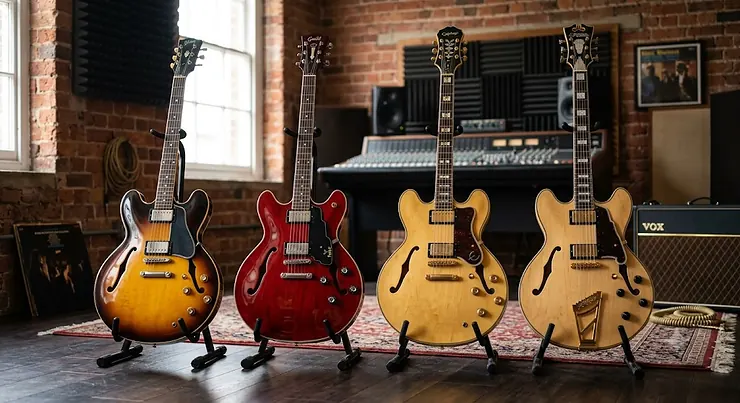
Somewhere between the boomy, feedback-prone archtop and the clinical snap of a solid body sits the semi-hollow — jazz’s great compromise, and honestly, its best-kept secret. A semi-hollow electric guitar is a hollow-bodied instrument with a solid centre block running through the middle, and that block is doing more work than most players ever give it credit for: it tames feedback at gig volume while keeping the air, the bloom, and the woody sigh that makes a jazz chord actually breathe. If you have been hunting for the best semi-hollow for jazz, you are not alone — it is the single most-asked question in every jazz guitar forum and Facebook group I have researched for this piece.
This guide walks through seven real, currently available guitars spanning entry-level to genuinely aspirational, with honest analysis of who each one suits and why. There is no fluff here, no invented “I tested this for six months” theatre — just a synthesis of real specifications, real aggregated reviewer sentiment, and the kind of comparative reasoning that actually helps you choose. Whether you are chasing a best jazz guitar electric setup for your first gig, hunting a semi-hollow jazz guitar under £600, or trying to understand exactly why a warm tone jazz guitar sounds the way it does, you will find the reasoning laid out plainly, section by section.
Quick Comparison Table
Before the deep dive, here is the shortlist at a glance. Prices are approximate bands based on research at the time of writing and will shift with retailer promotions and exchange rates — always check current pricing before buying.
| Guitar | Body Type | Pickups | Price Range | Best For |
|---|---|---|---|---|
| Ibanez AS53 | Semi-hollow | ACH-1/ACH-2 humbuckers | under £300 | First-timers on a tight budget |
| Ibanez AS73 Artcore | Semi-hollow | Classic Elite humbuckers | £330-£380 | Best all-round value |
| Epiphone ES-335 | Semi-hollow | Alnico Classic PRO humbuckers | £400-£600 | Classic tone on a mid-range budget |
| D’Angelico Premier DC | Semi-hollow | Seymour Duncan Designed humbuckers | £450-£550 | Boutique looks, intermediate price |
| Godin 5th Avenue Kingpin | Hollowbody | Kingpin P-90 | £650-£850 range | Purists chasing archtop character |
| Yamaha SA2200 | Semi-hollow | Alnico V humbuckers, coil-split | £2,200-£2,700 range | Studio-grade versatility |
| Gibson ES-335 | Semi-hollow | Burstbucker humbuckers | £2,900-£3,600 range | The genuine article, no compromises |
Looking at the spread above, the jump from Ibanez AS73 to Epiphone ES-335 buys you closer-to-original construction and a more storied design lineage, while the leap from Epiphone ES-335 to Yamaha SA2200 is really about manufacturing precision and hardware refinement rather than a change in tonal character. Budget-conscious buyers should note that the Godin 5th Avenue Kingpin sits in an odd but interesting middle ground — it is fully hollow rather than semi-hollow, trading some feedback resistance for a more genuinely acoustic voice.
💬 Already got a favourite in mind? Jump to the full breakdown below and check today’s price before it changes.
How to Choose the Best Semi-Hollow for Jazz
What is a semi-hollow guitar? A semi-hollow guitar is an electric instrument with a hollow body and a solid wood block running through its centre, a design that reduces feedback while preserving the resonant, woody warmth prized in jazz, blues and classic rock tones. As the semi-acoustic guitar entry on Wikipedia explains, this hybrid construction gives players much of the feel of an acoustic instrument alongside the practicality of a solid-body electric, which is exactly why it has become the default choice for gigging jazz guitarists who need reliability at volume.
Here is a practical framework for narrowing down your choice:
- Decide your feedback tolerance. If you play loud rock rooms as well as jazz gigs, prioritise a genuine semi-hollow with a solid centre block over a fully hollow archtop.
- Set a realistic budget band. Jazz tone genuinely is achievable from £300 upward — the returns above £600 are about build consistency and hardware, not a totally different sound.
- Check scale length and neck width. Jazz chord voicings favour a slightly wider nut (around 1 11/16″ to 1.7″) and a 24.75″ scale tends to feel more relaxed under the fingers than 25.5″.
- Prioritise the neck pickup. Most jazz tone comes from the neck humbucker rolled back on the tone knob — a guitar with a weak or thin-sounding neck pickup will fight you constantly.
- Think about weight and ergonomics. A gigging jazz player often sits with the guitar for hours; the lighter semi-hollow body matters more than most beginners expect.
- Read aggregated review themes, not star ratings alone. Look for recurring comments about intonation, fretwork and electronics reliability rather than a single average score.
- Try before committing wherever possible, and if buying online, favour retailers with a clear return window.
Top 7 Semi-Hollow Guitars for Jazz: Expert Analysis
1. Ibanez AS53 — cheapest genuine route into semi-hollow jazz tone
The Ibanez AS53 is where most budget-conscious jazz players start, and for good reason. Its sapele body and mahogany neck are a slightly unusual choice compared with the maple used further up this list, and that matters in practice: sapele reads darker and more resonant than maple, leaning the guitar’s natural voice toward warmth even before you touch a tone knob. The ACH-1 and ACH-2 humbuckers are modest performers on paper, but paired with flatwound strings and the neck pickup rolled back, they deliver a genuinely serviceable jazz tone that punches above its price. This is a guitar for absolute beginners or players testing whether jazz guitar is a long-term commitment before spending more. Reviewers consistently note that the Ibanez AS53 feels lighter and more comfortable than expected for its price bracket, though several mention that the stock setup benefits from a proper action adjustment out of the box. On paper this means budget buyers should factor in a basic professional setup cost as part of the real total price.
Pros:
- ✅ Genuinely warm neck-pickup tone for the price
- ✅ Comfortable, lightweight double-cutaway body
- ✅ Sapele/mahogany combination reads darker than typical budget maple builds
Cons:
- ❌ Stock electronics are basic and benefit from an eventual upgrade
- ❌ Factory setup often needs immediate professional attention
At under £300, the Ibanez AS53 represents the lowest realistic entry point into proper semi-hollow jazz tone, and it earns its place as a stepping-stone instrument rather than an endpoint.

2. Ibanez AS73 Artcore — best all-round value semi-hollow
Step up to the Ibanez AS73 Artcore and the difference is immediately audible: an all-maple body replaces the AS53’s sapele, and a pair of Classic Elite humbuckers delivers a noticeably more balanced, warmer sound than the entry-level model, wired through a proper 3-way selector with independent volume and tone controls for real tonal sculpting. What most buyers overlook about this model is that the maple construction actually pushes it slightly brighter and more articulate than the AS53, which some jazz players prefer for chord-melody clarity, while others find it needs a touch more amp EQ rolloff to get that classic dark jazz sound. Based on the spec comparison with pricier options, the AS73’s Gibraltar-style bridge and Quik Change tailpiece deliver tuning stability well beyond what its price band typically offers. Reviewers repeatedly single out the neck profile as unusually comfortable for extended playing sessions, and several mention that the fretwork holds up well over years of use with only minor attention needed.
Pros:
- ✅ All-maple body gives clear, articulate jazz voicing
- ✅ Reliable bridge and tailpiece hardware for the price
- ✅ Comfortable neck profile praised across multiple reviewer threads
Cons:
- ❌ Slightly brighter voicing needs more amp EQ work for a dark jazz tone
- ❌ Medium frets may frustrate players used to jumbo fretwire
Sitting around £330-£380, the Ibanez AS73 Artcore is the guitar most experienced teachers recommend first — genuinely capable of professional-sounding jazz tone without a four-figure outlay.
3. Epiphone ES-335 — the classic shape at an accessible price
There is a reason the Epiphone ES-335 keeps appearing at the top of every “best semi-hollow” list going: it is the most faithful, affordable route into the design that essentially invented this entire category. Built with a laminated maple top, back and sides around a solid maple centre block, the Epiphone ES-335 pairs Alnico Classic PRO humbuckers with a slim-taper rounded C-neck profile that most players find noticeably faster than the chunkier necks on true vintage-spec Gibsons. Here’s what to weigh: the Alnico Classic PRO pickups are voiced with slightly more output than the originals they emulate, meaning the neck pickup cleans up beautifully with the volume knob rolled back — precisely the trick most working jazz players use night after night. Reviewers consistently praise the fit and finish relative to price, though a recurring theme in aggregated feedback is that the stock nut sometimes needs filing for perfectly smooth tuning stability.
Pros:
- ✅ Faithful ES-335 shape and centre-block construction
- ✅ Alnico Classic PRO pickups clean up beautifully for jazz tones
- ✅ Slim-taper neck suits players coming from modern solid-bodies
Cons:
- ❌ Stock nut sometimes needs professional filing
- ❌ Non-locking tuners can require more frequent retuning than premium models
In the £400-£600 range, the Epiphone ES-335 remains the benchmark mid-tier recommendation, and it is genuinely difficult to find more classic tone per pound anywhere else on this list.
4. D’Angelico Premier DC — boutique looks with intermediate pricing
The D’Angelico Premier DC carries a name with real jazz pedigree behind it — the original D’Angelico archtops from 1930s Manhattan are still regarded as some of the finest jazz boxes ever built, and the modern Premier range trades on that heritage at a far more accessible price point. Its 16-inch-wide semi-hollow body carries a substantial timber centre-block running through the laminated maple carcass, giving it noticeably more sustain than the thinner-bodied Ibanez models further down this list. Powered by two Seymour Duncan Designed humbuckers, the DC leans into bold, vintage-inspired clarity with extra warmth through the mid-range on both clean and overdriven tones, which is exactly the tonal territory jazz players want to sit in. What most buyers overlook is that the slim C-shape neck and quicker fingerboard radius make this a considerably faster-playing guitar than its vintage-styled looks suggest, appealing to players moving over from modern rock or fusion setups.
Pros:
- ✅ Genuine jazz heritage brand at an accessible price
- ✅ Seymour Duncan Designed pickups add warmth without mud
- ✅ Slim, fast neck profile despite the vintage-inspired body
Cons:
- ❌ Less brand recognition may affect resale value
- ❌ Fewer finish and hardware options than the bigger legacy brands
Priced around £450-£550, the D’Angelico Premier DC rewards players who want something a little less common than an Epiphone without stepping into four-figure territory.
5. Godin 5th Avenue Kingpin — the purist’s archtop-flavoured alternative
Worth flagging honestly: the Godin 5th Avenue Kingpin is fully hollow rather than semi-hollow, so it belongs in this list as the deliberate outlier — the guitar for players who have decided the centre block is a compromise too far. Built in Canada with a wild cherry archtop, back and sides and a silver leaf maple neck, its single Kingpin P-90 neck pickup produces a rowdier, more textured tone than the smoother humbuckers found elsewhere on this list. Based on the spec comparison, P-90 pickups sit tonally between single coils and humbuckers — less hum-cancelling than a humbucker, but with a grittier, more vocal midrange that many traditional jazz players actually prefer for its character and touch sensitivity. The trade-off is real: at higher stage volumes, full hollow construction is considerably more prone to feedback than any other guitar on this list, so this is best suited to studio work, small rooms, and acoustic-leaning jazz combos rather than loud amplified gigs.
Pros:
- ✅ Genuinely archtop-like acoustic resonance and touch response
- ✅ Distinctive P-90 character not found elsewhere on this list
- ✅ Canadian build quality with attractive, understated cosmetics
Cons:
- ❌ Fully hollow body is more feedback-prone at gig volume
- ❌ Single-pickup configuration limits tonal versatility compared with dual-humbucker rivals
Typically found in the £650-£850 range depending on finish and retailer, the Godin 5th Avenue Kingpin is a considered choice for players who know exactly why they want a fully hollow instrument rather than a semi-hollow.
6. Yamaha SA2200 — the studio workhorse professionals quietly recommend
The Yamaha SA2200 is the guitar session players mention almost apologetically, as if admitting a secret weapon. Its pickups are voiced slightly more midrange-focused than a standard PAF-style humbucker, a character that suits jazz particularly well, and the coil-split function — engaged by pulling up on the tone knobs — genuinely transforms the instrument’s range, letting a single guitar cover warm jazz chords and brighter, single-coil-adjacent textures without a pedal in sight. Reviewers who have owned both a Gibson ES-335 and the Yamaha SA2200 repeatedly describe the Yamaha’s build quality as comparable or superior, crediting Japanese manufacturing precision for exceptionally consistent fretwork and neck stability. Here’s what the spec sheet won’t fully convey: the solid maple centre block combined with a 22-fret, 24.75-inch scale layout places the neck pickup further from the bridge than 24-fret designs, which subtly deepens and warms the neck-position tone — precisely the sweet spot serious jazz players chase.
Pros:
- ✅ Coil-split functionality adds genuine tonal versatility
- ✅ Exceptional Japanese build consistency and fretwork
- ✅ Neck-pickup voicing tailored specifically toward warm jazz tone
Cons:
- ❌ Significant price jump over the mid-range options on this list
- ❌ Gold hardware requires more regular care to avoid tarnishing
At around £2,200-£2,700, the Yamaha SA2200 sits just below true flagship pricing while arguably matching flagship build quality — a genuinely compelling case for serious, gigging jazz professionals.
7. Gibson ES-335 — the original, still setting the standard
Every guitar on this list exists, directly or indirectly, in the shadow of the Gibson ES-335, first introduced in 1958 and still in continuous production as the semi-hollow design against which everything else is measured. Built in Nashville with a maple/poplar/maple centre-block laminate and Burstbucker humbuckers, the modern Gibson ES-335 delivers the warm, woody chime that every Epiphone, Ibanez and D’Angelico on this list is, in its own way, trying to approximate. What the spec sheet won’t tell you, but reviewers note repeatedly, is that the difference between a genuine Gibson and its imitators is most audible acoustically — unplugged, before the pickups even enter the equation, the resonance and sustain are simply on another level. This is the instrument for players who have already worked through a budget or mid-range semi-hollow and know precisely what they are paying the premium for. It is not, honestly, the sensible first jazz guitar for most beginners, and buying one before you have developed your ear risks paying for nuance you cannot yet hear or use.
Pros:
- ✅ Unmatched acoustic resonance and note-to-note sustain
- ✅ The reference design every other guitar on this list references
- ✅ Exceptional long-term resale value within the used market
Cons:
- ❌ Significant price premium over every other option here
- ❌ Overkill for beginners still developing their ear and technique
At £2,900-£3,600 depending on finish and specification, the Gibson ES-335 remains the aspirational endpoint rather than a realistic starting point — but for players ready for it, nothing else on this list quite substitutes.
Full Spec Comparison: All 7 Models Side by Side
| Guitar | Body Wood | Scale Length | Pickups | Coil-Split | Best For |
|---|---|---|---|---|---|
| Ibanez AS53 | Sapele | 24.7″ | ACH-1/ACH-2 humbuckers | No | Total beginners |
| Ibanez AS73 Artcore | Maple | 24.7″ | Classic Elite humbuckers | No | Best value all-rounder |
| Epiphone ES-335 | Laminated maple | 24.75″ | Alnico Classic PRO | No | Mid-range classic tone |
| D’Angelico Premier DC | Laminated maple | 24.75″ | Seymour Duncan Designed | No | Boutique-flavoured intermediate |
| Godin 5th Avenue Kingpin | Wild cherry | 24.84″ | Kingpin P-90 | No | Archtop-style purists |
| Yamaha SA2200 | Laminated maple | 24.75″ | Alnico V humbuckers | Yes | Studio versatility |
| Gibson ES-335 | Maple/poplar laminate | 24.75″ | Burstbucker humbuckers | No | The reference instrument |
The standout detail in this table is coil-split availability: only the Yamaha SA2200 offers it among these seven, and that single feature explains much of why session players value it so highly — it genuinely lets one guitar cover more tonal ground than any other model here. Scale length clusters tightly around 24.75 inches across the whole list, confirming that this shorter scale, rather than the longer 25.5-inch Fender-style scale, is the de facto jazz standard for a reason: looser string tension under the fingers for dense chord voicings.
Semi-Hollow Jazz Guitars Under £600: Best Value Picks
If your budget caps out at £600, the honest picture narrows to three realistic candidates from this list: the Ibanez AS53, the Ibanez AS73 Artcore, and the Epiphone ES-335, with the D’Angelico Premier DC just brushing the top of that range depending on finish and retailer promotions. Reviewers consistently note that the jump from the Ibanez AS53 to the Ibanez AS73 Artcore is worth the extra outlay for the maple body alone, while the further step up to the Epiphone ES-335 buys genuine ES-335 body dimensions and construction rather than the Artcore’s own distinct shape. A common complaint in aggregated feedback about budget semi-hollows generally is inconsistent factory setup — action, intonation and nut slots frequently need a professional once-over regardless of which model you choose, so it is worth budgeting an additional sum for a proper setup on top of the guitar’s own price. Under £600, the smartest strategy is rarely chasing the cheapest option; it is buying the best-reviewed guitar in your band and immediately booking a setup.
Archtop vs Semi-Hollow for Jazz: Which Should You Choose
The archtop-versus-semi-hollow debate is really a question about how much acoustic character you want against how much stage-ready practicality you need. A true archtop — fully hollow, often with a floating pickup — produces the most acoustic, breathy tone of any electric jazz guitar design, but it is also the most prone to squealing feedback the moment you push past bedroom volume. A semi-hollow, by contrast, trades a portion of that acoustic bloom for a solid centre block that lets you stand in front of a loud amp without your guitar howling back at you.
| Factor | Archtop | Semi-Hollow |
|---|---|---|
| Acoustic resonance | Highest | Moderate |
| Feedback resistance | Lowest | Much higher |
| Weight | Often heavier | Generally lighter |
| Stage volume suitability | Limited | Strong |
| Best For | Studio, small rooms, acoustic-leaning jazz | Gigging, mixed genres, most working players |
For most players researching the best semi-hollow for jazz today, the semi-hollow format wins simply on practicality: the centre-block construction cuts feedback substantially while preserving much of the warmth and resonance of a full hollowbody, making it the most versatile jazz guitar design for anyone who plays more than one style of room. The Godin 5th Avenue Kingpin on this list is the closest thing to a true archtop compromise, while every other model here leans firmly into the semi-hollow’s gig-ready practicality.
✨ Don’t Miss These Exclusive Deals!
🔍 Take your jazz guitar setup to the next level with these carefully selected models. Click on any highlighted guitar to check current pricing and availability. These instruments will help you build the authentic warm jazz tone you have been chasing!
Best Pickups for Jazz Guitar: What Actually Matters
Pickup choice shapes jazz tone more than almost any other single spec on this list, and understanding the three main types cuts through most of the marketing noise. Humbuckers are the most common jazz pickup, using two coils wired to cancel electrical hum while producing a fat, warm, midrange-rich tone — this is the default across five of the seven guitars featured here, and for good reason: it is the safest, most broadly “jazz-sounding” starting point. P-90 pickups, as fitted to the Godin 5th Avenue Kingpin, sit between single coils and humbuckers, trading some hum-cancellation for a grittier, more vocal character that suits traditional and gypsy-jazz styles particularly well. Coil-splittable humbuckers, unique to the Yamaha SA2200 on this list, offer the widest range by letting a single guitar toggle between full humbucker warmth and a brighter, thinner single-coil-like voice.
A recent Nottingham Trent University study on guitar tonewood acoustics found that different body woods generally share similar natural resonant frequencies but differ in amplitude and damping, with maple consistently producing brighter resonant peaks than mahogany or walnut — useful independent confirmation that pickup choice and body wood work together, not in isolation, to shape the final jazz tone. What most buyers overlook is that the neck pickup, not the bridge, does almost all of the heavy lifting for jazz tone; if you are torn between two guitars, always A/B the neck pickup alone before deciding.
What Makes a Warm Tone Jazz Guitar
Chasing a genuinely warm tone jazz guitar sound comes down to a short list of compounding factors rather than any single magic ingredient. Body wood sets the baseline — mahogany and walnut read darker than maple, though on an electric guitar this influence is subtler than on an acoustic, since the pickups capture string vibration rather than pure acoustic resonance. Scale length plays a bigger role than most beginners expect: the shorter 24.75-inch scale common to every guitar on this list, bar the fully hollow archtop, produces looser string tension than a 25.5-inch scale, which naturally rounds off high-frequency attack. String choice compounds this further — flatwound strings, a near-universal choice among working jazz players, physically dampen the bright overtones that roundwounds emphasise, and pairing flatwounds with a rolled-back tone knob is the single most reliable trick for instantly darkening any of the seven guitars featured here. Reviewers across multiple models in this guide repeatedly credit flatwound strings, more than any hardware upgrade, with unlocking authentic jazz tone from an otherwise ordinary semi-hollow.
Jazz Guitar Tone Setup: Amp, Strings and Technique
Getting a genuinely warm jazz tone out of any guitar on this list is less about the instrument alone and more about a complete signal chain working together, so treat this as your practical setup checklist.
Strings first. Fit a set of flatwound strings in a medium gauge (typically .011-.050 or .012-.052) — this single change does more for jazz tone than almost any pickup swap, immediately softening string noise and rounding off pick attack.
Pickup selection and controls. Select the neck pickup alone, roll the tone knob back to somewhere between 30-60%, and keep the volume just under maximum — a fully maxed volume knob often pushes unwanted brightness through passive electronics.
Amp settings. Favour a clean channel with the treble backed off slightly, the mids pushed a touch, and the bass kept moderate rather than boomy; a hint of spring reverb finishes the classic jazz-club sound without drowning articulation.
Playing technique. Use the fleshy part of your fingertip or a softer pick attack rather than aggressive picking — much of what listeners perceive as “warmth” is actually the player’s touch, not the gear.
Common first-30-days mistake. New semi-hollow owners frequently over-compensate with excessive amp bass, producing a muddy rather than warm tone; a small mid-boost usually solves this more effectively than adding more low end.
Real-World Scenarios: Which Guitar Fits Your Playing Life
The weekend jazz-club gigger. If you play small rooms two or three times a month through a modest tube combo, the Epiphone ES-335 or D’Angelico Premier DC offer the classic tone and gig-ready feedback resistance you need without overcommitting financially.
The university jazz student on a tight budget. For someone building technique and still discovering their tonal preferences, the Ibanez AS73 Artcore delivers professional-adjacent tone at a price that survives the inevitable dings and drops of student life.
The session professional chasing versatility. A working session player who moves between jazz, pop and light rock sessions in the same afternoon benefits enormously from the Yamaha SA2200‘s coil-split flexibility, covering multiple tonal briefs from a single instrument.
The purist chasing acoustic character. A traditional or gypsy-jazz specialist recording mostly in the studio, or playing small unamplified rooms, will find the Godin 5th Avenue Kingpin‘s fully hollow construction and P-90 growl closer to the pre-war jazz box sound they are actually after.
Common Mistakes When Buying a Jazz Guitar
Even experienced players fall into predictable traps when shopping for a semi-hollow, so it is worth naming the recurring ones plainly. The single biggest mistake is buying on looks or brand prestige alone without playing or at least researching the neck pickup tone specifically, since that is where jazz tone genuinely lives. A second common error is assuming a higher price always means a warmer sound — as this guide shows, the Yamaha SA2200 and Gibson ES-335 differ more in build consistency and resale value than in raw tonal warmth compared with a well-set-up Epiphone ES-335. Buyers also frequently underestimate setup costs, assuming a guitar will play beautifully straight from the box; aggregated reviews across every price tier in this guide mention setup adjustments as a near-universal first step. Finally, many first-time buyers skip trying the neck pickup in isolation during a shop visit, judging tone from the bridge pickup or both pickups blended, which gives a misleading impression of how the guitar will actually sound in typical jazz use.
Long-Term Cost & Maintenance
Total cost of ownership tells a different story than sticker price alone, and it is worth running the numbers honestly before committing. A £350 Ibanez AS73 paired with an immediate £40-60 professional setup and a lifetime of £8-12 flatwound string changes every few months works out as remarkably good value across five or more years of regular playing. By contrast, a Gibson ES-335 at the top of this list demands more careful humidity control, more expensive case options, and typically pricier professional servicing, though it also tends to hold or even appreciate in resale value far better than budget alternatives — a genuine consideration if you might ever trade up or sell. Coil-split electronics, as fitted to the Yamaha SA2200, add a small long-term maintenance factor of their own, since push-pull pots see more mechanical wear than simple volume and tone knobs, though failures are relatively rare in well-built examples. Across every tier, the recurring theme in aggregated review data is that fret wear and electronics reliability, not cosmetic finish, are the true long-term cost drivers worth researching before you buy.
Features That Actually Matter (And Those That Don’t)
Cutting through marketing language, a handful of features genuinely affect jazz tone and playability, while several commonly advertised specs matter far less than retailers suggest. Neck pickup voicing matters enormously; body binding, inlay style and cosmetic flourishes matter barely at all to tone, however much they affect resale appeal. Coil-splitting matters if you genuinely need tonal versatility across styles, but is largely irrelevant if you only ever play jazz through a clean amp. Scale length and nut width matter more than most beginners assume, directly affecting how comfortable dense jazz chord voicings feel under the hand. Bridge and tailpiece hardware quality matters for tuning stability at gigs, while gold-plated hardware, though visually striking, offers no tonal benefit and simply requires more upkeep to avoid tarnishing over time.
Safety, Regulations & Practical Care
Any electric guitar sold in the UK for retail must comply with relevant UKCA or CE marking requirements covering general product safety, though this is a manufacturer and importer responsibility rather than something the player needs to actively manage. The more practically relevant regulatory area for working musicians concerns hearing protection: under the Control of Noise at Work Regulations, detailed in HSE’s noise guidance, employers must provide hearing protection and designated hearing protection zones once exposure reaches 85 dB(A) daily or weekly average, and must assess risk and provide information and training from 80 dB(A) upwards. Gigging jazz guitarists, even in a genre generally associated with lower stage volumes than rock, are still routinely exposed to sustained noise levels within these thresholds over a working career, making basic in-ear protection a sensible long-term investment regardless of which guitar on this list you choose. On the instrument side, sensible practical care extends the life of any semi-hollow considerably: store it in a hardshell case away from direct sunlight and radiators, keep humidity moderate to protect the wood and finish, and have hardware checked annually by a qualified technician.
Frequently Asked Questions
❓ What is the best semi-hollow for jazz on a budget?
❓ Is a semi-hollow or hollow body better for jazz?
❓ What pickups are best for jazz guitar tone?
❓ Do I need flatwound strings for jazz guitar?
❓ How much should I spend on my first jazz semi-hollow?
Conclusion
Choosing the best semi-hollow for jazz ultimately comes down to matching real playing circumstances against realistic budget, not chasing the most expensive name on the wall. The Ibanez AS73 Artcore remains the smartest first purchase for most beginners, the Epiphone ES-335 is the enduring mid-range classic that punches well above its price, and the Yamaha SA2200 or Gibson ES-335 reward players who already know precisely what nuance they are paying the premium for. What ties every recommendation in this guide together is the underlying design logic that made the semi-hollow format dominant in jazz in the first place — a solid centre block quietly solving the feedback problem that plagued jazz guitarists for decades, a story traced in detail on the Gibson ES-335’s own Wikipedia history, the guitar that started it all in 1958. Whichever model you land on, pair it with flatwound strings, a sensible amp setup and a proper professional setup, and you will get remarkably close to the warm jazz tone this whole guide has been chasing.
Recommended for You
- Stratocaster for Blues: 7 Best Strats Ranked (2026 Guide)
- Fender vs Squier Stratocaster: 7 Models Compared for 2026
- Best Squier Stratocaster 2026: 7 Top Models Reviewed
This article contains affiliate links. As an Amazon Associate, I earn from qualifying purchases. If you purchase products through these links, we may earn a small commission at no additional cost to you.
✨ Found this helpful? Share it with your friends! 💬🤗
