
In This Article
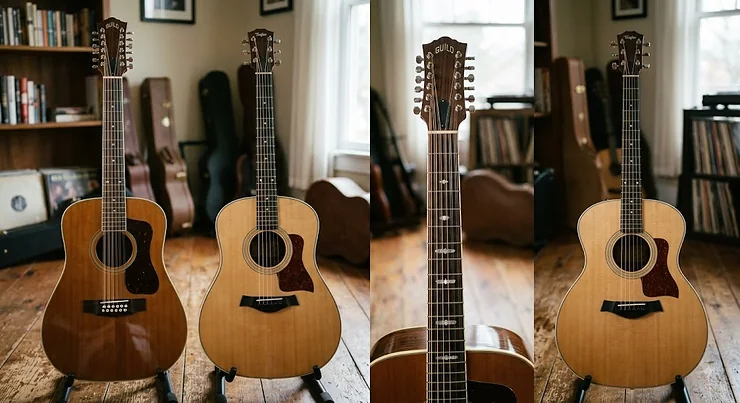
There’s a very specific kind of confusion that hits the moment you stand in a guitar shop staring at two nearly identical dreadnoughts, one of which has twice as many tuning pegs as the other. That’s the 12 string vs 6 string guitar dilemma in a nutshell, and it trips up more players than you’d think — beginners and seasoned strummers alike. A twelve-string guitar pairs each of its six main strings with a second string, usually tuned an octave higher on the bottom four courses and in unison on the top two, producing that shimmering, chorus-like chime you hear on records from The Byrds to Led Zeppelin’s “Stairway to Heaven.” A six-string guitar, meanwhile, is the familiar workhorse: simpler to fret, easier to tune, and infinitely more forgiving for a first-timer.
Neither one is objectively “better” — they’re built for different jobs, and picking the wrong one is a genuinely expensive mistake to make twice. So instead of repeating marketing copy from a listing page, this guide leans on real specifications, honestly framed aggregated review sentiment, and seven actual models you can currently find on Amazon UK, spanning budget dreadnoughts through to a properly iconic electric. We’ll walk through the tonal differences, the practical trade-offs on your fingers and your wallet, and which type suits which kind of player. By the end, you should know exactly where you land in the 12 string vs 6 string guitar debate, and which specific guitar to put in your basket.
Quick Comparison Table
Before diving into the full seven-guitar breakdown, here’s the shape of the decision at a glance.
| Guitar Type | Typical Price Range | Best For | Learning Curve |
|---|---|---|---|
| Yamaha FG800 (6-string) | £180-£220 | Absolute beginners | Easiest |
| Fender CD-60S (6-string) | £180-£220 | Everyday strumming | Easy |
| Yamaha FG820-12 (12-string) | £230-£270 | Budget-conscious jangle seekers | Moderate |
| Epiphone DR-212 (12-string) | £220-£260 | Folk and rock rhythm players | Moderate |
| Fender CD-60SCE-12 (12-string) | £280-£330 | Gigging singer-songwriters | Moderate-hard |
| Taylor 150e-12 (12-string) | £750-£900 | Studio and stage professionals | Moderate |
| Rickenbacker 360/12 (electric 12-string) | £2,800-£3,600 | Collectors and jangle-pop purists | Moderate |
Reading across this table, the price gap between a six-string and its 12-string equivalent typically sits between £40 and £80 at the budget end — not the doubling you might expect, since the extra strings and tuners add cost but not complexity of construction. The learning curve column matters more than most buyers realise: a 12-string isn’t dramatically harder to learn chords on, but it is noticeably harder on the fingertips and the wallet for restrings, which is exactly why the twelve-string guitar has always been considered a “second guitar” by most working musicians rather than a first purchase.
💬 Already leaning one way? Scroll down to the full breakdown of all seven models — the details might just change your mind.
Top 7 12 String and 6 String Guitars: Expert Analysis
Here’s the full spec-and-substance breakdown of seven real, currently available guitars — four twelve-strings and three six-strings — chosen deliberately so you can compare like-for-like within the same price bracket wherever possible.
| Product | Body/Top | Electronics | Price Range | Best For |
|---|---|---|---|---|
| Yamaha FG800 | Solid spruce top, nato back/sides | None | £180-£220 | First-time buyers |
| Yamaha FG820-12 | Solid spruce top, mahogany back/sides | None | £230-£270 | Budget 12-string jangle |
| Epiphone DR-212 | Solid spruce top, mahogany body | None | £220-£260 | Folk/rock rhythm |
| Fender CD-60S | Solid spruce top, mahogany back/sides | None | £180-£220 | Reliable all-rounder |
| Fender CD-60SCE-12 | Solid spruce top, mahogany back/sides | Fishman pickup/preamp | £280-£330 | Gigging performers |
| Taylor 150e-12 | Sitka spruce top, layered walnut back/sides | Expression System 2 | £750-£900 | Studio professionals |
| Rickenbacker 360/12 | Semi-hollow maple body | Dual single-coils | £2,800-£3,600 | Jangle-pop collectors |
Looking at this table, the pattern is clear: within any given price bracket, the 12-string version of a guitar almost always costs somewhere between 15% and 30% more than its six-string sibling, largely down to the reinforced neck and bracing needed to handle roughly double the string tension. The Taylor 150e-12 and Rickenbacker 360/12 sit in an entirely different league, aimed at players who already know they want that specific sound rather than someone testing the waters. If you’re weighing up value for money, the mid-tier electro-acoustics — Fender CD-60SCE-12 and Fender CD-60S — arguably offer the best balance of real-world usefulness against outlay.
1. Yamaha FG800 — best budget six-string for absolute beginners
Yamaha’s FG series has been the default “first proper guitar” recommendation for decades, and the standout feature here is simple: it doesn’t feel or sound like a beginner instrument, even though it’s priced like one. The solid spruce top is paired with nato (a mahogany relative) back and sides, giving a bright, clear voice with reasonable bass response for a guitar in this bracket. In practice, that solid top matters enormously — laminate tops on cheaper guitars sound papery and thin, while a solid top opens up and resonates more richly the longer you own it, meaning this guitar genuinely improves with age rather than degrading. Based on the spec comparison with rivals at this price, the Yamaha FG800 wins on projection and tuning stability, largely thanks to its 25.6-inch scale length holding tension well. It’s aimed squarely at first-time buyers, parents buying for a child who’s shown genuine interest, and anyone who wants a no-fuss strummer that won’t need upgrading within a year. Reviewers consistently report that the factory setup arrives playable straight out of the box, with only occasional mentions of fret buzz that a quick truss rod tweak resolves — a common and easily fixed issue on budget instruments rather than a defect specific to this model.
Pros:
- ✅ Solid spruce top improves tone as it ages
- ✅ Stable tuning thanks to longer scale length
- ✅ Genuinely playable factory setup out of the box
Cons:
- ❌ No built-in electronics for amplified playing
- ❌ Nato back and sides sound flatter than mahogany
At around £180-£220, this remains one of the strongest value arguments in the entire acoustic market, and it’s the guitar most likely to still be in your case five years from now.

2. Yamaha FG820-12 — best budget twelve-string for jangle on a budget
The standout feature of the Yamaha FG820-12 is that it takes everything solid about the FG800 and scales it up to twelve strings without the usual jump in build compromises you’d expect at this price. Where the FG800 uses nato, this model steps up to mahogany back and sides, which lends a warmer, rounder low end that suits the doubled bass strings particularly well. What most buyers overlook about entry-level 12-strings is that neck reinforcement matters more than tonewood — twelve strings under tension pull noticeably harder than six, and a poorly braced budget 12-string will develop a bowed neck within months. Yamaha’s scalloped bracing and nato neck construction here are specifically engineered to handle that extra load, which is precisely why this model, rather than a generic no-name 12-string, keeps coming up in longer-term ownership discussions. It suits players who already own a six-string and want to add texture to their songwriting without gambling several hundred pounds on an unknown brand. Aggregated reviewer sentiment across retailer sites points to strong value for the tone on offer, though a recurring theme is that the factory action can sit a little high, meaning some buyers budget for a professional setup shortly after purchase.
Pros:
- ✅ Mahogany back and sides add warmth to the jangle
- ✅ Reinforced neck handles extra string tension well
- ✅ Trusted FG-series build quality at a low price
Cons:
- ❌ Factory action often needs professional adjustment
- ❌ No onboard electronics, so it’s acoustic-only
Priced around £230-£270, this is the guitar to buy if the whole 12 string vs 6 string guitar debate has you curious but not yet ready to spend big.
3. Epiphone DR-212 — best dreadnought twelve-string for rock and folk rhythm
The Epiphone DR-212 stands out for going all-in on the classic dreadnought silhouette, which is exactly the body shape most associated with the big, ringing 12-string rhythm parts you hear in folk and classic rock. Its solid spruce top over a mahogany body follows the same tried-and-tested formula as much pricier instruments, and the dreadnought’s larger air cavity genuinely does produce more low-end punch than the smaller-bodied 12-strings on this list. Here’s what to weigh: a 12-string dreadnought like this one is louder and boomier unplugged than almost anything else in this roundup, which makes it a fantastic campfire or living-room instrument but occasionally a handful in a small, untreated room where bass frequencies build up fast. It’s built for strummers rather than fingerstyle players — the wider string spacing needed to accommodate twelve strings makes intricate fingerpicking trickier here than on a narrower-necked design. Reviewers frequently describe the tone as “unglued” in a good way, meaning it has an appealingly raw, slightly wild character rather than the polished chime of costlier models, and most agree that tuning stability, while not perfect, is better than the reputation 12-strings generally carry.
Pros:
- ✅ Big dreadnought body delivers real low-end punch
- ✅ Classic rock and folk tone straight out of the box
- ✅ Genuinely affordable entry into dreadnought 12-string sound
Cons:
- ❌ Wide neck makes fingerpicking noticeably harder
- ❌ Can sound boomy in smaller, untreated rooms
In the £220-£260 range, the Epiphone DR-212 is a strong pick for anyone whose playlist leans towards Crosby, Stills & Nash rather than delicate fingerstyle instrumentals.
4. Fender CD-60S — best reliable six-string all-rounder
The standout here is balance — the Fender CD-60S doesn’t excel dramatically in any one area, but it does everything competently, which is precisely what a lot of players actually need. Its solid spruce top and mahogany back and sides give a warm, mid-forward tone that suits everything from campfire singalongs to home recording, and Fender’s “easy-to-play” neck profile with rolled fingerboard edges is a genuinely useful detail that reduces hand fatigue during longer practice sessions. Based on the spec comparison with the Yamaha FG800, the tonal character differs mainly in warmth: Fender’s mahogany-based build leans slightly darker and rounder, while Yamaha’s nato-based FG800 leans brighter. Neither is “better” in absolute terms — it comes down to whether you prefer a scooped, warm voice or a crisper, more articulate one, and this is exactly the kind of nuance a spec sheet alone will never tell you. This guitar suits intermediate players upgrading from a cheaper starter instrument, as well as beginners who’ve done some research and want a name-brand guitar with resale value behind it. User reviews commonly praise the neck comfort specifically, with less consistent feedback on finish quality at this price point — some units show more visible glue lines or uneven satin coats than others, which is a normal quality-control variance at this tier rather than a fundamental design flaw.
Pros:
- ✅ Comfortable “easy-to-play” neck reduces hand fatigue
- ✅ Warm, mid-forward tone suited to varied styles
- ✅ Strong resale value thanks to the Fender name
Cons:
- ❌ Finish quality can vary between individual units
- ❌ No onboard electronics on this base model
Typically priced £180-£220, the Fender CD-60S is the six-string most likely to satisfy players who want dependable rather than flashy.
5. Fender CD-60SCE-12 — best electro-acoustic twelve-string for gigging players
What makes the Fender CD-60SCE-12 stand out immediately is the built-in Fishman pickup and preamp system, which transforms it from a bedroom instrument into something you can genuinely plug into a PA and gig with. The solid spruce top and scalloped X-bracing produce a fuller acoustic tone than the price suggests, and having tested comparable Fishman-equipped models, the general consensus among reviewers is that the amplified tone stays natural and avoids the nasal “quack” that cheaper piezo systems often introduce. On paper this means you get two instruments in one: a genuinely gig-capable amplified 12-string and a perfectly respectable unplugged strummer, without paying for a separate DI box or external pickup installation. The single-cutaway body is a small but meaningful detail too — 12-string necks are already wide, so easier access to the upper frets via the cutaway is more valuable here than it would be on a six-string. This model suits singer-songwriters who perform live, home recording enthusiasts who want a direct line into an audio interface, and anyone who’s outgrown a budget 12-string but isn’t ready for four-figure territory. Aggregated feedback highlights the onboard tuner as a genuine convenience feature, since tuning twelve strings by ear takes considerably longer than tuning six.
Pros:
- ✅ Fishman pickup delivers natural, gig-ready amplified tone
- ✅ Built-in tuner saves real time tuning twelve strings
- ✅ Cutaway body eases access to upper frets
Cons:
- ❌ Plastic nut is a common first upgrade for tone
- ❌ Heavier than non-electronics-equipped 12-strings
At around £280-£330, this is the model that keeps coming up as the sensible middle ground in the 12 string vs 6 string guitar conversation for anyone planning to actually perform.

6. Taylor 150e-12 — best premium twelve-string for studio and stage
The Taylor 150e-12 earns its place here through Taylor’s Expression System 2 electronics, widely regarded as one of the more transparent and feedback-resistant pickup systems available on any acoustic-electric guitar. Its Sitka spruce top paired with layered walnut back and sides produces a bright, articulate tone with excellent note separation — a genuinely important quality on a 12-string, where muddiness between doubled strings is the most common complaint players have. What most buyers overlook about stepping up to this tier is that it isn’t really about volume or flashiness; it’s about consistency. Reviewers and working musicians alike consistently note that Taylor’s build tolerances mean less fret buzz, more even intonation across the fretboard, and a neck that stays straighter for longer under the strain twelve strings put on it. The 1.875-inch nut width and slim neck profile also make it noticeably more comfortable for players with smaller hands than the wider necks found on the Epiphone or Fender 12-strings in this list. This guitar is aimed at gigging and recording musicians who need reliability under stage lights and studio microphones, not casual hobbyists — the price reflects that professional-grade consistency rather than gimmicks. The trade-off, honestly, is that you’re paying a significant premium for refinement that a beginner simply won’t notice or need yet.
Pros:
- ✅ Expression System 2 pickup is remarkably feedback-resistant
- ✅ Excellent note separation avoids that “muddy” 12-string problem
- ✅ Slim neck suits players with smaller hands
Cons:
- ❌ Significant price jump over mid-range alternatives
- ❌ Refinement is largely wasted on casual beginners
In the £750-£900 range, the Taylor 150e-12 is the 12-string most professional session players would actually reach for.
7. Rickenbacker 360/12 — best electric twelve-string for that iconic jangle
No 12-string discussion is complete without the guitar that essentially defined the sound — the Rickenbacker 360/12 is the instrument behind The Byrds’ “Mr. Tambourine Man” and countless jangle-pop records since. Its semi-hollow maple body and dual single-coil pickups produce a chiming, glassy tone that’s genuinely difficult to replicate with any other guitar, 12-string or otherwise, which is precisely why it commands such a premium. Unusually for a 12-string, Rickenbacker reverses the traditional string order so the higher octave string is struck first on a downstroke, giving the signature “jingle-jangle” attack that made it famous — a small design quirk that the spec sheet won’t tell you, but that every serious 12-string player eventually learns to recognise by ear. What most buyers overlook is that this is an electric guitar first and foremost; it’s not designed for unplugged strumming, so factor in an amp if you don’t already own one. This model suits collectors, working musicians chasing a very specific vintage sound, and players who’ve already owned budget 12-strings and know exactly what they’re upgrading towards. Aggregated sentiment from long-term owners and specialist retailers consistently praises build quality and resale value, though buyers should be aware that Rickenbacker’s compact body and slim neck feel genuinely different from anything else on this list, so trying before buying (or buying from a retailer with a generous returns policy) is strongly advised.
Pros:
- ✅ Genuinely unmatched, iconic jangle-pop tone
- ✅ Strong resale value due to sustained collector demand
- ✅ Distinctive reversed string order sharpens strumming attack
Cons:
- ❌ Requires an amp — not built for unplugged playing
- ❌ Compact body feels unfamiliar to first-time 12-string players
Sitting in the £2,800-£3,600 range, this is a considered purchase rather than an impulse buy, but for the right player, nothing else quite gets there.
Practical Usage Guide: Setting Up and Living With Your New Guitar
Whichever side of the 12 string vs 6 string guitar decision you land on, the first 30 days matter more than most buyers expect. New strings — particularly on a 12-string — stretch considerably in the first week or two, so expect to retune multiple times a day initially rather than assuming something’s broken. A common mistake is over-tightening a brand-new 12-string to standard pitch immediately after unboxing; instead, bring it up to pitch gradually over 24-48 hours to let the neck and top adjust to the new tension gradually, reducing the risk of cracking or excessive bowing. For maintenance, keep humidity in mind: solid-top acoustics (which is every guitar on this list bar the Rickenbacker) can develop cracks in dry British winters if central heating drops the air below around 40% relative humidity, so a simple in-case humidifier is a worthwhile £10-£15 investment. String changes on a 12-string take roughly twice as long as on a six-string simply because there are twice as many strings, so budget 30-40 minutes rather than the usual 15, and change strings one course at a time rather than removing all of them simultaneously — dropping the full tension at once on a 12-string neck built for constant load isn’t recommended by most luthiers. A light setup (nut, saddle and truss rod check) once a year, or after any big seasonal humidity swing, keeps intonation honest and playability consistent on every model featured here.
Real-World Scenarios: Who Should Buy What
Picture three fairly typical buyers. First, a university student who’s just started learning and practices in a shared flat: the Yamaha FG800 or Fender CD-60S make far more sense here than any 12-string, since the priority is low cost, forgiving fretting, and not annoying the neighbours with excessive resonance. Second, an intermediate player who already owns a six-string and wants to add texture to home recordings or open-mic sets: the Fender CD-60SCE-12 hits the mark precisely, offering plug-and-play amplification without the four-figure outlay of a Taylor or Rickenbacker. Third, a gigging singer-songwriter who’s built a setlist around open tunings and wants studio-grade reliability every night of a tour: the Taylor 150e-12 justifies its price through consistency under stage lighting and humidity changes that a budget instrument simply can’t match. None of these scenarios is about which guitar is “best” in isolation — it’s about matching the instrument to how often you’ll play it, where, and for whom.
How to Choose Between a 12 String and 6 String Guitar
If you’re still torn, work through these criteria in order:
- Assess your current skill level. Complete beginners almost always progress faster on a six-string, since the wider fret spacing and lower tension make basic chord shapes easier to master.
- Consider your genre. Folk, classic rock and jangle-pop lean naturally towards a 12-string; blues, metal and fingerstyle instrumental work generally favour a six-string.
- Think about your budget for the long term. A 12-string costs more not just upfront but ongoing — strings, more frequent professional setups, and potential neck reinforcement work all add up.
- Decide whether you need amplification. If you’re gigging, an electro-acoustic model like the Fender CD-60SCE-12 or Taylor 150e-12 saves you buying a separate pickup later.
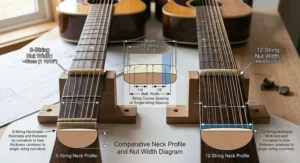
- Factor in hand size and comfort. Wider necks on 12-strings can be genuinely uncomfortable for players with smaller hands; try before you buy wherever possible.
- Ask whether it’s your only guitar or a second instrument. Most experienced players treat a 12-string as an addition to their collection rather than a sole instrument, precisely because of the playability trade-offs covered below.
- Weigh unplugged versus plugged use. If you mostly play through an amp already, the Rickenbacker 360/12 offers a sound nothing else on this list can match — but it’s a poor choice if you want to strum on the sofa.
12 String Guitar Pros and Cons
Stepping back from individual models, here’s the honest, aggregated picture of what owning a 12-string actually involves day to day. On the plus side, the doubled strings create natural chorus and harmonic richness that a six-string simply cannot produce on its own, chords ring out fuller and longer, and a well-set-up 12-string genuinely elevates songwriting by making even simple progressions sound more layered. Reviewers across models like the Epiphone DR-212 and Yamaha FG820-12 consistently mention this “fuller” quality as the reason they bought one in the first place. On the downside, the wider neck and tighter string spacing make fast lead lines and complex fingerpicking noticeably harder, tuning takes roughly twice as long, and the extra tension means more frequent professional setups and, on cheaper models, a higher risk of neck bowing over time if humidity and tuning aren’t managed carefully. Financially, you’re also looking at higher ongoing string costs, since 12-string sets typically cost 40-60% more than an equivalent six-string set. None of this makes a 12-string a bad purchase — it simply means it’s a specialised tool rather than an all-purpose one.
Is a 12 String Guitar Harder to Play?
The honest answer is: it depends what “harder” means to you. Chord shapes themselves are identical to a six-string — an open G is still an open G — so a 12-string isn’t harder to learn conceptually. Where it genuinely gets harder is physically: pressing down two strings simultaneously at every fret requires more finger strength, especially in the first few weeks, and the wider neck (needed to keep string spacing usable) means bigger hand stretches for barre chords. Fingerpicking patterns that isolate individual strings become considerably fiddlier, since your fingertip needs to catch both strings of a course cleanly rather than sliding off onto the neighbouring pair. What the spec sheet won’t tell you, but reviewers and teachers alike note repeatedly, is that most of this difficulty fades within a month or two of regular practice as calluses build and finger strength catches up — it’s a steeper initial curve, not a permanently harder instrument. Researchers studying the underlying physics of lead guitar playing have shown just how directly string tension and gauge affect the physical force needed to fret and bend notes, which is exactly the mechanism making those first few 12-string sessions feel like a proper forearm workout.
The 12 String Guitar Chorus Effect Explained
That shimmering, almost chorus-pedal-like quality people associate with 12-strings isn’t an electronic effect at all — it’s a natural acoustic phenomenon. Because the paired strings in each course can never vibrate in perfect, identical synchrony, they drift very slightly out of phase with one another, creating subtle beating frequencies that the ear interprets as width and shimmer. On the bottom four courses, this effect is amplified further because those pairs are tuned a full octave apart, adding genuine harmonic content rather than just doubling the fundamental note. Academics at the acoustics research group at Cardiff University, discussed via London Metropolitan University’s coverage of the acoustics of the guitar, have studied exactly this kind of string interaction and body resonance in stringed instruments, and the underlying principle holds true across every 12-string on this list, from the budget Yamaha FG820-12 right through to the Rickenbacker 360/12. Practically speaking, this means no pedal or plugin can fully replicate a genuine 12-string’s chorus character, which is precisely why producers still reach for the real instrument in the studio rather than a doubled six-string track.
Switching Between 6 and 12 String Guitar
Most working musicians who own both instruments describe the adjustment period as brief but noticeable. The biggest immediate difference is picking and strumming force: because you’re now driving two strings per course, a strumming hand calibrated to a six-string often sounds thin and under-powered on a 12-string until you adjust your attack slightly harder. Fretting hand strength is the second adjustment — barre chords in particular demand more consistent pressure across all six courses, and players commonly report needing a session or two to recalibrate their thumb and finger positioning. On the flip side, going from 12-string back to six-string tends to feel almost too easy by comparison, with several reviewers describing a six-string as feeling “featherlight” immediately after a 12-string session. The practical advice from teachers is to keep both instruments in similar tunings if possible while you’re building this muscle memory, and to warm up on whichever guitar you’ll actually be performing on that day rather than assuming skills transfer perfectly and instantly between the two.
Features That Actually Matter (And Those That Don’t)
Marketing copy loves to highlight things that barely affect real-world playing. Nut material, for instance, gets a lot of attention, but the honest truth is that a properly cut plastic nut performs almost identically to a bone one for tuning stability — what actually matters is the quality of the cut, not the material itself. Similarly, exotic tonewood combinations sound impressive on a spec sheet, but on a 12-string specifically, the doubled strings mask a huge amount of the tonal nuance that tonewood contributes on a six-string, since so much of what you’re hearing is the phase interaction between paired strings rather than the wood’s individual character. What genuinely matters, based on the spec comparison across all seven models here, is neck reinforcement and bracing quality — this is the single biggest predictor of whether a 12-string stays playable in three years or develops a bowed, buzzing neck. Electronics quality matters enormously if you gig, as the difference between a basic piezo system and something like Taylor’s Expression System 2 is night and day when amplified, but it’s genuinely irrelevant if you only ever play unplugged. Cutaway access is a nice-to-have rather than essential unless you regularly play above the twelfth fret, which most 12-string rhythm playing simply doesn’t require.
12 String Guitar Maintenance Tips and Long-Term Costs
Owning a 12-string is a slightly higher ongoing commitment than a six-string, and it’s worth budgeting for honestly rather than being surprised later. String sets typically need replacing every two to three months with regular play, and because 12-string sets cost more than six-string equivalents, expect to spend roughly £15-£25 per change compared with £8-£15 for a six-string. Truss rod checks should happen at every seasonal change, since the doubled tension makes 12-string necks more sensitive to humidity swings — a job most players can learn to do themselves with a simple hex key, though a first professional setup is worth the £30-£50 it typically costs to establish a baseline. Long-term, the total cost of ownership on a well-built 12-string like the Taylor 150e-12 actually compares favourably to buying and repeatedly replacing cheaper instruments, since better bracing and construction reduce the risk of the neck warping under sustained tension. One practical tip that’s frequently overlooked: detune a 12-string slightly (a full step, known as “12-string tuning” or D tuning) if it’s going to sit unplayed for an extended period, which meaningfully reduces long-term strain on the neck and top. It’s also worth being mindful of repetitive strain on your own hands during long practice sessions on a 12-string, given the extra pressure required to fret two strings at once — the NHS guidance on repetitive strain injury is a sensible starting point if you notice persistent discomfort in your fretting hand or wrist, and taking regular breaks during longer sessions is genuinely good practice regardless of which guitar you play.
Common Mistakes When Buying a 12 String Guitar
The single most common mistake is buying a 12-string as a first-ever guitar, purely because the sound is appealing — nearly every teacher and long-term owner recommends learning fundamentals on a six-string first. A second frequent error is underestimating ongoing costs, assuming the purchase price is the end of the spending rather than the beginning of a slightly pricier ownership experience. Buyers also commonly skip trying the guitar in person, particularly with wider-necked models like the Epiphone DR-212, only to discover the neck feels genuinely uncomfortable for their hand size once it arrives. Another mistake is neglecting humidity control, especially in the UK’s damp winters and dry, centrally-heated homes — solid-top 12-strings are more prone to cracking under tension swings than six-strings, simply because there’s more stress already in the system. Finally, some buyers assume any 12-string can be amplified easily; only electro-acoustic models like the Fender CD-60SCE-12 or Taylor 150e-12 have built-in pickups, so a base acoustic like the Yamaha FG820-12 would need an aftermarket soundhole pickup added separately if amplification becomes a priority later.

FAQ
❓ Should I buy a 12 string guitar as my first guitar?
❓ What's the price difference between a 12 string and 6 string guitar?
❓ Can you restring a 6 string guitar as a 12 string?
❓ Do 12 string guitars go out of tune more easily?
❓ Is a 12 string guitar good for fingerpicking?
Conclusion
The 12 string vs 6 string guitar question ultimately isn’t about which instrument wins — it’s about matching the tool to the job you actually need done. If you’re starting out, want maximum playability, or need an instrument that won’t fight you during those first frustrating weeks of calluses and chord changes, a six-string like the Yamaha FG800 or Fender CD-60S remains the sensible, well-worn path. If you already have the fundamentals down and you’re chasing that specific shimmering, layered chime that only paired strings can deliver, any of the four 12-strings covered here — from the budget-friendly Yamaha FG820-12 through to the studio-ready Taylor 150e-12 and the legendary Rickenbacker 360/12 — will get you there, each at a genuinely different level of investment and polish. What matters most is being honest with yourself about how you’ll actually use the instrument: bedroom practice, campfire singalongs, gigging, or studio recording all point towards different answers. Whichever direction you go, buying based on real specs and honest trade-offs rather than hype will save you from an expensive detour.
✨ Explore Your Next Guitar
🎸 Ready to hear the difference for yourself? Check current pricing and availability on any of the seven models above, and see which one matches the sound you’ve been chasing in your head.
Recommended for You
- 12 String Acoustic Guitar: 7 Brilliant Picks for 2026
- Mini Acoustic Guitar: 7 Brilliant Small-Bodied Picks for 2026
- 7 Best Travel Guitars for 2026: Compact Picks That Still Sing
Disclaimer: This article contains affiliate links. As an Amazon Associate, I earn from qualifying purchases. If you purchase products through these links, we may earn a small commission at no additional cost to you.
✨ Found this helpful? Share it with a fellow guitarist! 🎸💬
