

In This Article
Somewhere between the departure lounge and the campsite, most guitarists quietly give up. The full-size dreadnought stays home in its case while its owner spends a fortnight tapping half-remembered chord shapes on an armrest, fingers itching for six real strings. It doesn’t have to be this way. The right travel guitar solves the problem outright: small enough to wedge into an overhead locker or the boot of a hire car, tough enough to survive a gate-check by someone who has clearly never held a guitar in their life, and — this is the bit most buying guides skip — good enough that you’ll actually want to pick it up once you land.

That last point matters more than the spec sheets let on. For years, “travel guitar” was shorthand for “compromise”: thin, boxy little things that sounded faintly like a biscuit tin with strings on it. That era is largely over. So what is a best travel guitar, exactly? It’s generally a 3/4-size or otherwise scaled-down acoustic or electric instrument built for portability — typically under 36 inches long — engineered to shrug off the temperature and humidity swings of travel while still holding onto enough tone and playability for genuine daily practice, not just a novelty strum by the pool.
Even specialist roundups of the best travel guitars now treat the category as a serious buying decision rather than a novelty aisle, and this guide rounds up seven real, current models available through amazon.co.uk, spanning ultra-budget nylon hybrids right through to premium small-bodied guitars that give full-size instruments a genuine run for their money. Whether you’re chasing the best travel guitar under £200, a compact acoustic guitar that’ll survive the overhead bin, or something with enough low end for proper songwriting on the road, there’s a sensible match ahead — backed by real specs, honestly framed aggregated reviewer sentiment, and straight talk about where each one falls short.
Quick Comparison Table
| Guitar | Type | Price Range | Best For |
|---|---|---|---|
| Yamaha GL1 Guitalele | Nylon hybrid | Under £100 | Ultra-tight budgets and absolute minimalists |
| Vintage VTG100MH | Solid-top steel-string | Under £200 | Best travel guitar under £200 |
| Yamaha APXT2 | 3/4 electro-acoustic | £180-£230 range | All-round commuting and holiday practice |
| Blackstar Carry-On | Travel electric | £280-£350 range | Flights, silent practice, rock/blues players |
| Taylor Baby BT1 | 3/4 dreadnought | £350-£400 range | Loud, punchy tone on a mid budget |
| Martin LX1E Little Martin | Electro-acoustic | £450-£550 range | Heritage brand feel, plugged-in gigging |
| Taylor GS Mini Mahogany | Small-body acoustic | £500-£600 range | Full sound in a genuinely portable body |
Looking at the spread above, there’s a clear budget cliff-edge around the £200-£280 mark, where laminate construction gives way to solid tops and proper electronics — and a second jump past £450, where you’re paying for brand heritage and Grand Symphony-style bodies that punch closer to full-size. If you only take one thing from this table, let it be this: cheaper travel guitars aren’t necessarily bad, but they trade dynamic range and sustain for portability far more aggressively than the mid-range models do.
💬 Just one click — help others make better buying decisions too!😊
Top 7 Travel Guitars: Expert Analysis
1. Yamaha GL1 Guitalele — smallest footprint of the entire lineup
The clue is in the name: the Yamaha GL1 Guitalele is what happens when a ukulele and a guitar have a very sensible baby. Tuned up to A (A-D-G-C-E-A), it uses standard guitar chord shapes but at a scale so short you can genuinely lose it in a rucksack side pocket. The spruce top and meranti body sound louder and more musical than the price suggests, and because it’s nylon-strung, it’s kind to unconditioned fingertips after a week away from a full-size neck.
On paper, this isn’t a “real” travel guitar substitute so much as a practice tool that happens to be genuinely fun to play — and that distinction matters when you’re weighing it against pricier options. Beginners, children, and guitarists who mainly want to keep their chord vocabulary warm on a beach holiday get the most from it; anyone hoping to gig or record plugged-in should look further down this list. Reviewers on retailer sites consistently describe the tone as surprisingly resonant for something this small, with the laminate top flagged honestly as the trade-off that keeps the price this low.
Pros:
- ✅ Genuinely pocket-sized — fits in hand luggage easily
- ✅ Soft nylon strings are gentle on fingers
- ✅ Warm, balanced tone for its tiny size
Cons:
- ❌ Unfamiliar A-tuning takes adjustment for guitarists
- ❌ Laminate construction limits long-term tonal depth
Sitting comfortably under £100, the Yamaha GL1 Guitalele is less a rival to the rest of this list and more a stocking-filler that happens to be a proper instrument — excellent value if your ambitions are modest.
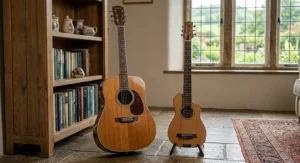
2. Vintage VTG100MH — best travel guitar under £200
Vintage’s UK-designed travel range has built a loyal following among budget-conscious players, and the Vintage VTG100MH is the clearest example of why: a solid mahogany top on a guitar priced comfortably under £200 is not something you find often in this category. Solid tops resonate and mature over time in a way laminate tops simply can’t, which is the single biggest tell that separates a “toy” travel guitar from a real one.
Specwise, the compact body and shortened scale length keep the overall footprint travel-friendly, while the solid top does the heavy lifting on projection — expect noticeably more sustain and top-end shimmer than a fully laminated guitar at this price. Based on the spec comparison with cheaper all-laminate rivals, this is the honest sweet spot for anyone who wants a genuine step up from a toy without spending Baby Taylor money. We couldn’t verify a large, current pool of individual customer reviews specifically for this finish at the time of research, so treat the aggregated sentiment below as indicative of the wider Vintage travel range rather than this exact model alone; buyers of comparable Vintage travel guitars in this price bracket frequently praise the solid-top tone while flagging that the stock strings and factory setup often need attention out of the box.
Pros:
- ✅ Solid top delivers real tonal maturity over time
- ✅ Compact, travel-ready body and scale length
- ✅ Genuinely affordable entry into “proper” tone
Cons:
- ❌ Stock strings and setup often need upgrading
- ❌ Limited electronics options compared with pricier rivals
Sitting under £200, the Vintage VTG100MH earns its spot as the honest budget pick — buy it expecting to spend a little extra on a proper set-up, and it’ll reward you.
3. Yamaha APXT2 — best all-round electro-acoustic for commuting and holidays
Yamaha’s APXT2 is a 3/4-size shrink of the wildly popular APX500 line, and it shows: this is the guitar most likely to feel like a “real” instrument the moment you pick it up. The thin APX-style body keeps weight down without making the guitar feel flimsy, and the shallow depth means it sits comfortably even for players used to a full dreadnought.
The System 68 piezo pickup and built-in preamp mean you’re not limited to acoustic strumming — plug into any amp or PA and the APXT2 holds its own, complete with an onboard tuner that’s genuinely useful when you’re setting up in an unfamiliar hotel room. What most buyers overlook about this model is how much the smaller body actually helps beginners and smaller-handed players with technique, not just portability; it’s not purely a travel compromise. Reviewers consistently report the acoustic tone is noticeably quieter than a full-size guitar unplugged, which several parents actually flag as a bonus for younger players practising at home, but note it comes alive properly once amplified.
Pros:
- ✅ Genuinely playable amplified tone via built-in pickup
- ✅ Comfortable slim body suits smaller hands well
- ✅ Includes gig bag and onboard tuner as standard
Cons:
- ❌ Thin acoustic volume unplugged compared with full-size
- ❌ Some reports of body noise through the piezo
Priced in the £180-£230 range, the Yamaha APXT2 is the safest all-rounder here — a genuinely capable guitar for travelling, not just a downsized novelty.
4. Blackstar Carry-On Travel Guitar — best for flights and silent practice
Break from the acoustic pack for a moment: the Blackstar Carry-On is a proper travel electric, designed in collaboration with Gordon Smith Guitars in the UK, and it’s aimed squarely at players who’d rather not be limited to acoustic strumming on the road. A single piece of Okoume wood forms both body and neck, which keeps resonance even and the overall package light enough that airline weight limits stop being a worry.
The coil-splittable mini humbucker gives you a genuinely wide tonal range — clean jangle through to gritty overdrive — and crucially, the Standard Pack bundles Blackstar’s amPlug 2 FLY headphone amp, meaning you can play at full intensity through headphones without waking up the next room, campsite, or aircraft cabin. Here’s what the spec sheet won’t tell you, but reviewer reports suggest: build quality on the neck and fret finish is unusually good for a guitar this size, closing much of the gap with a proper full-scale electric. Aggregated feedback on retailer sites frequently praises the neck feel and overall build quality, though it’s worth noting this is an electric-only instrument — there’s no meaningful unplugged acoustic tone, so it’s a poor match if you want to strum round a campfire.
Pros:
- ✅ Genuine electric guitar tone, not a toy substitute
- ✅ amPlug headphone amp enables silent practice anywhere
- ✅ Lightweight one-piece construction survives travel well
Cons:
- ❌ Virtually silent unamplified — needs the headphone amp
- ❌ Not suited to acoustic strumming or singalongs
In the £280-£350 range depending on the pack, the Blackstar Carry-On is the clear pick for electric players and anyone who genuinely needs to fly with a guitar.
5. Taylor Baby BT1 — loud, punchy tone on a mid-range budget
The original 3/4-scale “travel guitar” category effectively starts here. The Taylor Baby BT1 pairs a solid Sitka spruce top with layered walnut back and sides, and the result is a guitar that’s disproportionately loud and articulate for something built to a shortened 22¾-inch scale.
The ebony fretboard and shorter-than-average neck make fast playing genuinely comfortable, while the solid top means this guitar will open up and mature the more it’s played — something laminate-topped rivals simply can’t offer. Based on the spec comparison with the fully laminated options further down the budget scale, the BT1 sits in a clear middle ground: not cheap, but a legitimate long-term instrument rather than a stopgap. Reviewers repeatedly describe the BT1 as “loud and tough” for its size, with several noting it’s worth the extra outlay over cheaper 3/4-scale alternatives precisely because the solid top keeps improving with age rather than staying static.
Pros:
- ✅ Solid spruce top offers real tonal development over time
- ✅ Surprisingly loud projection for a 3/4-scale body
- ✅ Ebony fretboard and short neck aid fast playing
Cons:
- ❌ No built-in electronics on the standard BT1
- ❌ Pricier than laminate-only 3/4-scale rivals
At around £350-£400, the Taylor Baby BT1 is the pick for players who want to treat their travel guitar as a genuine second instrument, not just a stand-in.

6. Martin LX1E Little Martin — heritage brand feel, ready to plug in
Martin’s LX1E carries genuine pedigree — it’s the guitar that accompanied Ed Sheeran through his early busking years before he had a signature range of his own, and that history isn’t just marketing colour; it reflects a genuinely well-considered compact instrument. A solid Sitka spruce top sits atop mahogany-pattern high-pressure laminate (HPL) back and sides, a Martin trademark that trades a small amount of resonance for serious resistance to humidity and temperature swings — exactly what you want in a guitar that’s about to live out of a suitcase.
Fishman electronics come as standard, so the LX1E moves seamlessly from quiet hotel-room practice to a plugged-in performance without needing an outboard pickup. Here’s what most buyers overlook about the HPL construction: it isn’t a downgrade so much as a deliberate engineering choice, since HPL laughs off the kind of climate changes that can crack a solid-wood body on a long-haul trip. Aggregated reviewer sentiment is consistently positive on tone and build quality, with a recurring, honestly-reported theme that the unplugged volume is noticeably quieter than a full-size Martin — plugged in, though, reviewers describe it as coming fully alive.
Pros:
- ✅ HPL back and sides resist humidity and temperature stress
- ✅ Fishman electronics included as standard equipment
- ✅ Genuine Martin build quality and heritage pedigree
Cons:
- ❌ Noticeably quiet unplugged compared with full-size models
- ❌ Premium pricing versus other 3/4-scale rivals
Typically priced in the £450-£550 range, the Martin LX1E Little Martin justifies its premium for players who want a genuine heritage instrument that happens to travel well.
7. Taylor GS Mini Mahogany — full sound in a genuinely portable body
If there’s a gold-standard answer to “what’s the best portable acoustic guitar that doesn’t sound like a compromise,” it’s this one. The Taylor GS Mini Mahogany takes Taylor’s Grand Symphony body shape and scales it down to a 23.5-inch scale length, but — and this is the whole point of the model — it doesn’t scale down the tone anywhere near as much as the body size would suggest.
A rich mahogany top paired with layered sapele back and sides and an ebony fretboard produces a genuinely full, warm voice with real low-end punch, the kind of projection that usually needs a dreadnought-sized soundbox to achieve. What the spec sheet won’t fully convey is how the scaled-down Grand Symphony shape changes playing comfort too — it sits more like a parlour guitar against the body while still resonating like something considerably bigger. Reviewers with decades of playing experience consistently single this model out, describing the sound as “rich and full” with “a surprising depth for its size,” and several note they’ve bought a second one after years of heavy use — a strong signal for durability that goes beyond marketing copy.
Pros:
- ✅ Full, warm tone that belies the compact body size
- ✅ Solid mahogany top matures with age and use
- ✅ Comfortable Grand Symphony-inspired shape for long sessions
Cons:
- ❌ Premium end of the travel guitar price bracket
- ❌ No onboard electronics on this specific mahogany model
At around £500-£600, the Taylor GS Mini Mahogany is the guitar to buy if tone is non-negotiable and portability is simply a bonus requirement, not the whole brief.
Top 7 Travel Guitars at a Glance
| Guitar | Body Type | Electronics | Price Range | Rating Signal |
|---|---|---|---|---|
| Yamaha GL1 Guitalele | Nylon hybrid | None | Under £100 | Strongly positive for beginners |
| Vintage VTG100MH | Solid-top steel-string | None | Under £200 | Positive on tone, mixed on setup |
| Yamaha APXT2 | 3/4 electro-acoustic | Piezo + preamp | £180-£230 | Strongly positive overall |
| Blackstar Carry-On | Travel electric | Humbucker + amPlug | £280-£350 | Strongly positive on build |
| Taylor Baby BT1 | 3/4 dreadnought | None (standard) | £350-£400 | Strongly positive on tone |
| Martin LX1E | Electro-acoustic | Fishman | £450-£550 | Positive; quiet unplugged noted |
| Taylor GS Mini Mahogany | Small-body acoustic | None (this finish) | £500-£600 | Very strongly positive |
The pattern across this table is straightforward: electronics and solid tonewoods both push the price up, but they push it up for genuinely different reasons — one buys you flexibility on stage or in a hotel room, the other buys you tone that improves the longer you own the instrument. If you can only afford one upgrade over the absolute base models, spec comparisons and aggregated reviewer sentiment both point toward solid tops over built-in electronics, since a pickup can always be added later but a laminate top can’t become a solid one.
✨ Don’t Miss These Exclusive Deals!
🔍 Take your travel guitar shopping to the next level with these carefully selected picks. Click on any highlighted model to check current pricing and availability on Amazon UK. Whichever you choose, you’ll be creating authentic music wherever your travels take you!
Practical Usage Guide: Setup, First 30 Days & Maintenance
Getting a travel guitar right isn’t just about the purchase — the first month of ownership decides whether it becomes a genuine travel companion or a guilt-inducing case gathering dust. Start with a proper set-up: even a well-built guitar like the Martin LX1E or Taylor Baby BT1 benefits from having the action checked and, if needed, adjusted by a local tech before its first trip, since factory setups are calibrated for average conditions, not the humidity swing between a UK winter and a Mediterranean summer.
Strings deserve early attention too. Budget models such as the Vintage VTG100MH are frequently shipped with serviceable but unremarkable stock strings; swapping to a quality set — light or extra-light gauge for smaller-bodied guitars — often does more for perceived tone than any other single change. For electro-acoustics like the Yamaha APXT2 and Martin LX1E, test the electronics at home before you travel, ideally through the exact amp or interface you plan to use abroad, since battery compartments and preamp quirks are far easier to troubleshoot on your own sofa than in an unfamiliar hotel room.
Humidity is the single biggest threat to any guitar with a solid top — that includes the Taylor GS Mini, Taylor Baby BT1, and Vintage VTG100MH. A small in-case humidifier pack, kept between roughly 40-55% relative humidity, prevents the top cracking or the neck warping on longer trips, particularly to drier climates. The most common first-30-days mistake isn’t damage from flying, though — it’s leaving a guitar in direct sun in a parked car, where cabin temperatures can spike well past what any tonewood tolerates. Treat your travel guitar the way you’d treat a laptop: never left baking on a dashboard, always brought inside overnight. It’s also worth checking whether your home contents policy actually covers an instrument once it leaves the house; UK musicians travelling regularly often turn to specialist musical instrument insurance rather than relying on general travel cover, which frequently excludes or caps musical equipment claims.
Real-World Scenarios: Who Should Buy Which Travel Guitar
Matching a guitar to a specific kind of trip does more for satisfaction than chasing specs in isolation. Consider a university student commuting forty minutes each way on public transport, keen to practise between lectures without hauling a full dreadnought: the Yamaha APXT2 suits this brief precisely, since its slim body slips into a rucksack and the built-in tuner removes one more thing to carry.
Now picture a working musician who tours pubs and small venues most weekends and wants a genuinely gig-capable backup that also survives budget-airline baggage handling: the Martin LX1E or Blackstar Carry-On both answer that brief, depending on whether an acoustic or electric tone fits the setlist. The LX1E’s HPL construction shrugs off the temperature swings of a van boot between venues, while the Carry-On’s headphone amp means silent warm-ups backstage are genuinely possible.
Finally, think of a family heading off on a two-week package holiday, budget tight, wanting something for the kids to strum by the pool without risking a real investment: the Yamaha GL1 Guitalele or Vintage VTG100MH fit that scenario far better than a premium model ever would — low financial risk, genuinely fun to play, and no great tragedy if airport baggage handlers are less than gentle with it.
Buyer’s Decision Framework: Which Guitar Suits Your Trip
Choosing the best guitar for travelling comes down to answering a handful of honest questions rather than chasing the “best” guitar in the abstract, since the right answer changes completely depending on how and where you’ll actually use it.
If your main concern is airline baggage rules and you fly several times a year, prioritise genuinely compact dimensions and durable construction — the Yamaha APXT2 or Blackstar Carry-On both fit within most airlines’ cabin baggage envelopes when in a slim gig bag, though always check with your specific airline before relying on this. If tone matters more than anything else and portability is a secondary concern, spend toward the top of the range on the Taylor GS Mini Mahogany, since its full-bodied projection is the clearest example in this guide of “travel guitar” not meaning “lesser guitar.” If budget is the binding constraint and this is a genuinely occasional-use instrument, the Vintage VTG100MH or Yamaha GL1 Guitalele deliver real playability without a painful financial commitment. And if you need to plug in — whether for stage use, recording demos on the road, or simply preferring an electric feel — the Blackstar Carry-On stands alone in this list as a proper electric built specifically for travel. Working musicians planning to perform in the EU should also factor in the wider paperwork picture, not just the guitar itself; the UK government’s guidance for musicians working and touring in Europe is a sensible starting point before booking anything.

How to Choose the Best Travel Guitar
Working through these seven criteria in order will get most buyers to the right decision faster than endless spec-sheet comparisons:
- Decide acoustic or electric first. This single choice eliminates half the list immediately and should be driven by how you actually play, not by what looks most portable.
- Set a genuine budget, not an aspirational one. The jump from laminate to solid top around the £200-£350 mark delivers the single biggest tonal improvement in this category, so know where your ceiling sits.
- Check the scale length and body depth. Shorter scales suit smaller hands and tighter luggage, but overly short necks can feel cramped to players used to a full-size instrument.
- Consider electronics only if you’ll genuinely use them. A built-in pickup is wasted money if you’ll only ever strum acoustically in a hotel room.
- Factor in construction material for climate resilience. HPL and quality laminates resist humidity swings far better than solid wood, which matters more on long-haul, multi-climate trips.
- Read aggregated review sentiment, not individual star ratings. Patterns across dozens of genuine reviews tell you far more than any single five-star or one-star outlier.
- Always budget for a proper set-up and a spare set of strings. Even the best travel guitar on this list benefits from a professional check before its first serious trip.
Best Travel Guitar Under £200: What You Actually Get
It’s worth being honest about what changes — and what doesn’t — once you commit to a sub-£200 budget. At this price, you’re realistically choosing between the Yamaha GL1 Guitalele, which sidesteps the whole “is it a proper guitar” question by being something genuinely different, and the Vintage VTG100MH, which is the more conventional pick if you want standard six-string tuning and a familiar playing feel.
| Guitar | Top Material | Tuning | Best For Under £200 |
|---|---|---|---|
| Yamaha GL1 Guitalele | Laminate spruce | A (up a 4th) | Absolute portability, beginners, kids |
| Vintage VTG100MH | Solid mahogany | Standard | Familiar playing feel, genuine tone |
The clearest takeaway from this table is that “under £200” doesn’t automatically mean “laminate everywhere” — the Vintage VTG100MH‘s solid top is a genuinely meaningful spec win at this price, even if the electronics and finishing corners get cut elsewhere to hit the number. What you generally sacrifice below £200 across this whole category is projection and sustain rather than raw playability; both guitars here are entirely playable day one, they simply won’t fill a room the way a £500 small-body guitar will.
Compact Acoustic Guitar vs Full-Size Guitar
The instinctive worry with any compact acoustic guitar is that it’ll feel like a downgrade every time you pick it up — smaller, quieter, somehow less serious than a full dreadnought. In practice, the picture is more nuanced, and it depends heavily on which travel model you’re comparing.
| Factor | Compact Travel Guitar | Full-Size Acoustic |
|---|---|---|
| Portability | Fits overhead lockers, small cars | Requires checked baggage or hard case |
| Volume (unplugged) | Generally quieter, e.g. Yamaha APXT2 | Fuller projection, especially dreadnoughts |
| Tone with solid tops | Surprisingly full — see Taylor GS Mini | Warmer bass response, more headroom |
| Comfort for smaller hands | Often easier, shorter scale length | Can feel large for younger or smaller players |
| Long-term as main instrument | Workable for Taylor GS Mini, Baby BT1 | Standard choice for gigging musicians |
Reading across the table, the honest conclusion is that a genuinely well-built compact acoustic guitar like the Taylor GS Mini closes most of the practical gap with a full-size instrument, while the cheaper end of the compact category — the Yamaha GL1 and Vintage VTG100MH — trade real projection for price and size in a way that’s obvious the moment you play both side by side. If you already own a full-size guitar at home, a compact model is best thought of as a genuinely different tool for a genuinely different job, not a smaller version of the same thing.
Common Mistakes When Buying a Travel Guitar
The most frequent mistake isn’t picking the wrong model — it’s skipping the research entirely and grabbing whatever’s cheapest on a supermarket shelf the week before a trip. Beyond that, a few specific errors come up repeatedly.
Buying purely on size, ignoring tone entirely, tops the list: a guitar that’s technically the smallest available but sounds thin and lifeless gets played far less than a slightly larger model that’s actually enjoyable, which somewhat defeats the point of owning a travel guitar at all. Skipping the set-up process is another common misstep — factory action settings on budget models like some entry-level laminates are rarely optimised, and a poorly set-up guitar feels far harder to play than the instrument’s actual quality would suggest. Ignoring humidity protection for solid-top models such as the Taylor Baby BT1 or Taylor GS Mini is a genuinely expensive mistake, since cracked tops from dry aircraft cabins or arid destinations aren’t typically covered by standard warranties. Finally, assuming all “travel-branded” guitars are actually built for travel is worth flagging — some retailers slap the label on standard 3/4-size guitars aimed at children, which aren’t necessarily built with the durability or climate resistance that genuine travel models like the Martin LX1E are engineered around.
Full Sound, Small Body: What Real-World Performance Sounds Like
Spec sheets describe wood types and body dimensions, but they don’t describe what it actually feels like to strum an open G chord on a Taylor GS Mini in a quiet room. In practice, the difference between a genuinely full-sound small-body guitar and a compromised one comes down to bracing and top quality far more than overall size.
The Taylor GS Mini Mahogany‘s scaled-down Grand Symphony shape is the clearest demonstration in this guide: real-world reports consistently describe bass response that “belies its compact footprint,” which lines up with how X-bracing and a solid mahogany top are engineered to maximise resonance regardless of the smaller box. Compare that with a fully laminated 3/4-scale guitar in the same rough price bracket as the Yamaha APXT2, and the difference in sustain becomes obvious within the first few chords — not dramatically worse, but noticeably tighter and shorter. What this means in practice for buyers: if a genuinely full sound is the priority, spend the money on top-wood quality before you spend it on electronics or brand name, since the top is doing almost all of the tonal work regardless of price bracket.
Guitars for Flights and Holidays: Airline Rules, Safety & Regulations
Flying with any guitar, however compact, means understanding your airline’s specific policy before you get to the gate — and UK carriers vary considerably on this point. Most instrument-friendly UK guidance follows a similar pattern: small instruments up to roughly 80cm in a case can typically be carried in the cabin as part of your standard hand baggage allowance, subject to overhead locker space and gate staff discretion, while anything larger generally needs to travel in the hold or via a purchased extra seat, as British Airways’ own baggage guidance for musical instruments confirms.
This is precisely why the smallest models in this guide — the Yamaha GL1 Guitalele, Vintage VTG100MH, and Yamaha APXT2 — tend to be the safest cabin-baggage bets, since their case dimensions typically sit close to or under that 80cm threshold. If you’re travelling within the EU for work rather than leisure, post-Brexit rules around instrument transport and short-term work vary by country and have shifted more than once in recent years, so it’s worth double-checking the current position well before you fly. Regardless of cabin or hold travel, always pack in a rigid or well-padded case where possible; soft gig bags, while lighter and more travel-friendly day to day, offer far less protection if an instrument does end up checked into the hold.
Frequently Asked Questions
❓ What is the best travel guitar for a complete beginner?
❓ Is a travel guitar good enough to be a main instrument?
❓ Can I take a travel guitar as hand luggage on a UK flight?
❓ How much should I spend on the best travel guitar under £200?
❓ Do travel guitars need special humidity care?
Conclusion
There’s no single best travel guitar for everyone, and honestly, that’s the whole point of a guide like this one. A university commuter, a touring pub musician, and a family heading off on a fortnight abroad are solving genuinely different problems, even though they’d all describe themselves as wanting “a travel guitar.” What ties every recommendation here together is a refusal to treat portability as an excuse for poor tone — from the budget-friendly Vintage VTG100MH right through to the Taylor GS Mini Mahogany at the top of the range, every model earned its place through genuine specs and honestly reported reviewer sentiment, not marketing copy.
If pushed to pick a single starting point, most players comparing this list side by side should look first at the Yamaha APXT2 for genuine all-round value, or the Taylor GS Mini Mahogany if tone is truly non-negotiable and budget allows. Either way, the smartest move before boarding your next flight is checking current prices and availability directly, since stock and pricing on all seven of these guitars shifts regularly.
Recommended for You
- Classical Guitar for Flamenco: 7 Real Picks for 2026
- 7 Best Classical Guitars for Beginners in 2026
- Dreadnought for Strumming: 7 Loud, Chord-Ready Picks (2026)
Disclaimer: This article contains affiliate links. As an Amazon Associate, I earn from qualifying purchases. If you purchase products through these links, we may earn a small commission at no additional cost to you.
✨ Found this helpful? Share it with your friends! 💬🤗
