

In This Article
So, you’ve decided to learn the electric guitar. Brilliant. Welcome to what might very well become the most rewarding — and occasionally frustrating — hobby of your life. Whether you’re drawn to the brooding atmosphere of a Radiohead chord progression, the bluesy swagger of Gary Moore, or simply the idea of looking effortlessly cool in your living room, choosing the right beginner electric guitar is the single most important step you’ll take.
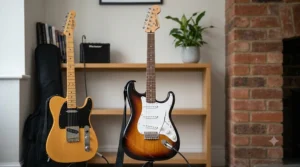
Here’s the thing: the British market for beginner electric guitars has never been better stocked, nor more confusing. Walk through any music shop on the high street — or spend twenty minutes scrolling Amazon.co.uk — and you’ll encounter hundreds of options, from respectable instruments carrying legendary brand names to suspiciously cheap kits that claim to include everything from an amplifier to a spare set of feelings. Not all of them deserve your money.
What is a beginner electric guitar, exactly? In practical terms, it’s an instrument designed to be genuinely playable out of the box, forgiving to learn on, and robust enough to survive the daily encounters of someone who hasn’t yet mastered the art of careful handling. The best beginner electric guitars sit within the £100–£500 range, offer consistent build quality, and crucially — make you want to pick them up every single day.
In this guide, I’ve researched and reviewed seven real products currently available on Amazon.co.uk — covering budget, mid-range, and premium tiers — so you can make a confident, informed decision. I’ve also factored in the realities of British life: our notoriously damp climate (those open-pore finishes won’t thank you for a Devon winter), our modestly sized flats and terraced houses (storage and portability matter more here than in a sprawling American suburb), and the typical UK commuter who’d like to practise after work without waking the neighbours.
Quick Comparison Table: Best Beginner Electric Guitars UK 2026
| Guitar | Body | Pickups | Scale | Best For | Price Range |
|---|---|---|---|---|---|
| Yamaha Pacifica PAC112V | Alder | HSS (Alnico V + coil-split) | 25.5″ | Overall best all-rounder | £220–£280 |
| Squier Sonic Stratocaster HT | Poplar | H (single humbucker) | 25.5″ | Budget rock & simplicity | £160–£200 |
| Squier Affinity Telecaster | Alder | SS (single-coil x2) | 25.5″ | Indie, country & clean tones | £170–£220 |
| Squier Classic Vibe ’50s Stratocaster | Alder | SSS (Alnico) | 25.5″ | Serious beginners / long-term | £340–£400 |
| Epiphone Les Paul Standard | Mahogany | HH (humbuckers) | 24.75″ | Rock, blues, warm tones | £280–£380 |
| Donner DST-100S Beginner Kit | Basswood | HSS | 25.5″ | Complete starter kit on a budget | £100–£150 |
| Ibanez miKro GRGM21M | Mahogany | HH | 22.2″ | Young players & smaller hands | £130–£180 |
From the comparison above, the Yamaha Pacifica PAC112V stands out as the most comprehensively capable guitar in this field — it’s the rare instrument that suits an absolute beginner today and a competent intermediate player in two years’ time. If budget is the primary concern, the Donner DST-100S kit offers remarkable value as a complete package, though you will likely want to upgrade the guitar itself within eighteen months. Those after long-term quality without breaking the £400 mark should look seriously at the Squier Classic Vibe ’50s Stratocaster.
💬 Just one click — help others make better buying decisions too! 😊
✨ Don’t Miss These Exclusive Deals!
🔍 Take your musical journey to the next level with these carefully selected instruments. Click on any highlighted product to check current pricing and availability on Amazon.co.uk. These picks will help you find exactly the right beginner electric guitar for your needs and budget!
Top 7 Beginner Electric Guitars UK: Expert Analysis 🎸
1. Yamaha Pacifica PAC112V — The All-Rounder That Teachers Have Been Recommending for Thirty Years
If there is one beginner electric guitar that comes up time and again in UK guitar communities, in music teacher recommendations, and in “which guitar should I buy?” threads on every forum from r/Guitar to Mumsnet, it is the Yamaha Pacifica PAC112V. And for very good reason.
Specs in practice: The alder body paired with a maple neck gives you a bright, clear, well-balanced tone — neither too muddy nor too glassy. The 25.5″ scale length (identical to a Fender Stratocaster) is standard for most electric playing styles, and the 22-fret rosewood fingerboard feels immediately comfortable for beginners. But here is what genuinely sets the 112V apart from its rivals at this price: the HSS pickup configuration featuring a coil-split humbucker. That humbucker at the bridge gives you fat, warm tones for rock and blues; engage the coil-split and you unlock single-coil clarity for everything from Nile Rodgers-style funk to glassy clean arpeggios. Most guitars at this price give you one tonal world; the Pacifica gives you three.
Expert commentary: This guitar suits the UK buyer who doesn’t yet know what kind of music they want to play — which is, frankly, most beginners. Rather than locking you into a single sound, it keeps your options open while you figure out whether you’re a Radiohead fan or secretly destined for classic rock. Yamaha’s build quality and consistency are second to none at this price point; unlike some competitors, these instruments typically arrive in excellent condition straight from the box, which matters enormously for someone who doesn’t yet know how to adjust truss rods.
UK customer feedback: British buyers consistently praise the tuning stability and the quality of the out-of-box setup, with several Amazon.co.uk reviewers noting it was “ready to play immediately.” A small number report the blue finishes occasionally show minor blemishes under certain lighting.
✅ HSS with coil-split for massive tonal range
✅ Exceptional Yamaha build quality and consistency
✅ Stays in tune reliably — crucial for new players building ear training
❌ Doesn’t carry the iconic brand cachet of Fender or Gibson
❌ Headstock design divides opinion (more futuristic than classic)
Price range: around the £220–£280 range | Prime-eligible with fast delivery on Amazon.co.uk | Verdict: the safest, smartest choice for most UK beginners.
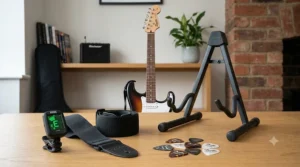
2. Squier Sonic Stratocaster HT H — The Legendary Shape, Stripped Back to Its Brilliance
There is a reason the Stratocaster silhouette has remained unchanged since 1954: it works. The Squier Sonic Stratocaster HT H takes that iconic double-cutaway shape, pairs it with a single humbucker in the bridge and a hardtail bridge (the HT in the name), and delivers a guitar that is, in some respects, more beginner-friendly than its more complex siblings.
Specs in practice: The hardtail bridge is the masterstroke here. Standard tremolo bridges — those whammy bar-equipped designs so common on Strat-style guitars — are notorious for causing tuning headaches until you learn to use them correctly. A hardtail removes that variable entirely, meaning your guitar stays in tune while you focus on actually learning to play. The single humbucker offers fat, warm tones ideal for rock rhythms, power chords, and anything with a bit of drive behind it. The poplar body is lightweight, which matters more than you might think: if you’re practising for thirty minutes every evening after work, a heavy guitar becomes genuinely uncomfortable.
Expert commentary: This is the guitar I’d recommend to any British teenager who wants to learn through rock music — someone whose first priority is power chords to Oasis or Arctic Monkeys rather than fingerpicked jazz. It’s simple to operate (one pickup, less fiddling), robust, and carries the Fender/Squier name, which provides genuine psychological motivation. The hardtail design also makes restringing easier, a not-insignificant bonus when you’re learning the basics.
Customer feedback: Amazon.co.uk reviews highlight excellent finish quality and surprisingly decent factory setup. A minority note the single humbucker limits tonal variety compared to SSS or HSS configurations.
✅ Hardtail bridge ensures tuning stability for beginners
✅ Lightweight body — comfortable for extended practice sessions
✅ Iconic Strat styling with authentic Fender/Squier heritage
❌ Single humbucker limits tonal range
❌ Less versatile than HSS-configured alternatives
Price range: £160–£200 | Prime-eligible | Verdict: an excellent no-fuss rock beginner guitar at a very honest price.
3. Squier Affinity Series Telecaster — Britain’s Favourite Indie Guitar in Beginner Form
If the Stratocaster is rock’s guitar, the Telecaster is indie music’s. And in a country that has given the world bands from The Clash to Blur to The Strokes’ British tour-dates-that-felt-like-ours, the Tele carries a particular cultural resonance on this side of the Atlantic. The Squier Affinity Series Telecaster makes that sound and feel accessible for the price of a decent meal out for two in central London.
Specs in practice: Two single-coil pickups through a three-way selector gives you bright, cutting, glassy tones — the Tele’s trademark sonic signature. The string-through-body bridge construction increases sustain and body resonance, which is a genuinely meaningful feature at this price point (most budget guitars skip it). The alder body is tonally superior to the basswood you’ll find on some cheaper alternatives, and the “C”-shape neck profile is widely regarded as the most comfortable shape for adult beginners.
Expert commentary: The Affinity Tele rewards the UK beginner who gravitates towards indie, country, or classic rock — the player who wants a guitar that sounds immediately distinctive rather than neutral. It also has a certain honesty to it: fewer controls means fewer decisions, and fewer decisions means more playing. The Telecaster’s inherent simplicity makes it easier to focus on technique rather than endlessly tweaking knobs.
UK customer feedback: Consistently positive reviews on Amazon.co.uk, with buyers particularly praising the out-of-box playability and the brightness of the neck pickup for clean jazz and indie tones.
✅ String-through-body bridge for enhanced resonance and sustain
✅ Alder body — tonally superior at this price
✅ Classic Telecaster tone ideal for indie, country, and clean styles
❌ Single-coil pickups can hum in certain electrical environments (common in older UK housing)
❌ Less versatile than humbucker-equipped alternatives for rock/metal
Price range: £170–£220 | Prime-eligible | Verdict: the best beginner guitar for the indie or country-inclined UK player.
4. Squier Classic Vibe ’50s Stratocaster — The Guitar You Won’t Outgrow
Most beginner guitars have a quiet expiry date. You learn on them, improve beyond their limitations, and eventually replace them. The Squier Classic Vibe ’50s Stratocaster is a happy exception to that pattern — an instrument good enough that many players keep it alongside much more expensive guitars years later.
Specs in practice: The three Alnico single-coil pickups are a genuine step above what you’ll find on the Affinity or Sonic series. Alnico magnets — a blend of aluminium, nickel, and cobalt — produce a warmer, rounder, more musical tone than cheaper ceramic alternatives. The vintage-tinted maple neck adds to the classic 1950s Fender aesthetic, and the 5-way pickup selector offers genuine tonal breadth: from bright, glassy neck pickup jazz tones to the famously “quacky” middle positions beloved by funk players.
Expert commentary: This is the guitar for the serious beginner — someone who has thought about this decision, has a budget around £350–£400, and wants an instrument that won’t embarrass them in a year’s time when they’ve actually become quite good. The Classic Vibe series sits in an interesting position: it’s technically a “beginner” guitar by virtue of the Squier name, but the build quality and component choices are genuinely competitive with instruments costing significantly more. For a UK buyer in a modest flat in Manchester or Bristol who wants to grow into their guitar rather than through it, this is the one.
Customer feedback: Amazon.co.uk reviewers frequently comment that the Classic Vibe outperforms its price point by a considerable margin, with several noting they had no intention of buying anything more expensive after playing it.
✅ Alnico pickups — a meaningful tonal upgrade over most beginner guitars
✅ Vintage styling that ages beautifully and looks genuinely impressive
✅ A guitar you will likely keep for years — excellent long-term value in GBP
❌ Higher initial investment than some alternatives
❌ Tremolo bridge requires more setup knowledge to use effectively
Price range: £340–£400 | Prime-eligible | Verdict: the premium beginner guitar that refuses to act like one.
5. Epiphone Les Paul Standard — Gibson’s Iconic Sound at a Price That Won’t Require Remortgaging
The Les Paul is one of music’s great instruments. Thick sustain, warm humbucker tone, elegant curves — it’s the guitar that powered Led Zeppelin, defined classic rock, and still sounds relevant on stages from the O2 Arena to village pub gigs. The Epiphone Les Paul Standard brings that sound into reach for UK beginners at a price that is, by any reasonable measure, rather extraordinary.
Specs in practice: The mahogany body and neck combination is key here — mahogany produces inherently warmer, richer tones with excellent sustain, which is the sonic fingerprint of the Les Paul design. The twin humbucker pickups deliver that characteristic fat, smooth sound: powerful rhythm tones, singing lead lines, and a responsiveness to guitar overdrive that single-coil instruments simply cannot match. The 24.75″ scale length (slightly shorter than the 25.5″ Fender-style guitars above) makes chord stretches marginally easier for players with smaller hands.
Expert commentary: The Epiphone Les Paul Standard is the guitar for the UK beginner who knows exactly what kind of music they want to play: blues-rock, classic rock, heavier alternative. If your heroes are Slash, Gary Moore, or Joe Bonamassa, this is your instrument. What most beginners overlook is that the slightly shorter scale length can make the learning curve a touch gentler — fingers don’t need to stretch quite as far in the early weeks. Worth noting for UK buyers: at this price point, the Epiphone occupies an excellent value position, especially given the 2-year warranty and the UK Consumer Rights Act 2015 providing additional protection on online purchases.
Customer feedback: UK buyers on Amazon.co.uk are consistently impressed with the neck profile and the warm humbucker tone, with some noting it compares favourably to Epiphone models costing considerably more a decade ago.
✅ Mahogany construction delivers warm, sustain-rich tones ideal for blues and rock
✅ Twin humbuckers — no single-coil hum in older UK electrical setups
✅ Shorter scale length can be more comfortable for adult beginners
❌ Heavier than Strat-style guitars — something to consider for younger players
❌ Less tonal versatility than HSS-configured competitors
Price range: £280–£380 | Prime-eligible | Verdict: the essential guitar for UK beginners drawn to rock and blues.
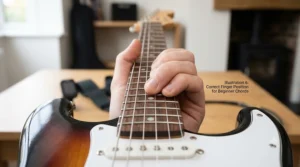
6. Donner DST-100S Electric Guitar Beginner Kit — The Complete Package for the Budget-Conscious Starter
There is a subset of UK buyers — sensible, pragmatic, perhaps buying for a child who has expressed an interest in guitar but may also have previously expressed enthusiastic but short-lived interests in football, chess, and competitive baking — who simply need a complete, functional starter kit at the lowest possible sensible price. For those buyers, the Donner DST-100S Beginner Kit makes a compelling case for itself.
Specs in practice: The HSS pickup configuration (humbucker at the bridge, two single-coils in the middle and neck positions) gives this guitar surprising tonal range for its price bracket. The “C”-shaped Canadian maple neck is comfortable, the 22-fret design covers all beginner requirements, and crucially — the kit includes an amplifier, gig bag, tuner, capo, strap, strings, cable, and picks. You open the box and you play. No additional purchases required. For Amazon Prime members, the entire kit can be at your door the next day.
Expert commentary: Let me be direct: the Donner DST-100S is not the best guitar in this list, and it never pretended to be. What it is, is a complete, functional setup that will absolutely suffice for the first twelve to eighteen months of learning. The quality has improved considerably in recent years, and for UK buyers on a genuinely limited budget — or those buying for a child who may or may not stick with it — this kit represents a reasonable investment. If the player commits and progresses, they’ll want to upgrade the guitar; the accessories (bag, strap, picks, cable) can all be kept.
UK customer feedback: Amazon.co.uk reviews are broadly positive for the price point, with buyers appreciating the complete-kit value. Some note the included amplifier is basic (it is), and the initial setup may benefit from a quick adjustment at a local music shop.
✅ Complete kit — nothing else to buy to start playing
✅ HSS configuration offers genuine tonal variety
✅ Prime-eligible for next-day UK delivery
❌ Guitar itself is an upgrade candidate after 12–18 months of serious playing
❌ Included amplifier is functional but limited in quality
Price range: £100–£150 for the full kit | Prime-eligible | Verdict: the most practical choice for the genuinely budget-conscious UK buyer or cautious parent.
7. Ibanez miKro GRGM21M — The Proper Guitar for Younger Players and Smaller Hands
The final entry on this list addresses a specific need that many “top 7″ guides overlook: the fact that a standard 25.5” scale-length electric guitar is simply too physically demanding for a young child or an adult with notably smaller hands. The Ibanez miKro GRGM21M solves that problem without resorting to a toy.
Specs in practice: The 22.2″ scale length — meaningfully shorter than full-size instruments — reduces the physical reach required between frets, making chord shapes achievable for hands that would otherwise struggle. Despite the compact dimensions, this is a genuine guitar: the mahogany body provides decent resonance and sustain, the twin humbucker pickup configuration delivers fat, punchy tones, and Ibanez’s build quality is consistent and reliable. The short scale also reduces string tension, which means lighter touch required for fretting — an important comfort consideration for younger players whose fingertips haven’t yet toughened up.
Expert commentary: This is the guitar I would recommend for any child between five and twelve, or any adult who has tried a full-size electric and found the stretch physically uncomfortable. It’s worth noting that the “miKro” is not a toy guitar or a gimmick — Ibanez has a serious reputation in the guitar world, and this instrument reflects that heritage at a genuinely modest price. For UK parents considering whether to buy their child a miKro, the relevant comparison is this: a cheap, unplayable full-size guitar will discourage learning; a comfortable, well-built 3/4-size guitar will encourage it. The miKro encourages it.
Customer feedback: Amazon.co.uk reviewers — many of them parents — consistently report that children who struggled on full-size instruments immediately improved in comfort and engagement with the miKro.
✅ Short scale — ideal for children and adults with smaller hands
✅ Genuine Ibanez quality — not a toy, despite the compact size
✅ Twin humbuckers deliver punchy, age-appropriately exciting tones
❌ Too small for adult players with standard-sized hands
❌ Will be outgrown physically as the player develops (a success problem, admittedly)
Price range: £130–£180 | Prime-eligible | Verdict: the obvious choice for younger UK players or anyone who has found full-size guitars physically uncomfortable.
How to Set Up Your First Electric Guitar: A UK Beginner’s Practical Guide 🇬🇧
Unboxing and First Steps
Your new guitar has arrived. Before you plug it in and attempt “Smoke on the Water,” there are a few minutes of setup that will make an enormous difference to your experience. First, let the instrument acclimatise to room temperature for thirty minutes — guitars are made of wood, which reacts to the change from a cold delivery van (all too common in a British winter) to a warm flat.
Dealing with the British Climate
This is something American guitar guides rarely mention: humidity and temperature fluctuation matter enormously in the UK. Our damp autumn and winter months, combined with the drying effect of central heating, create conditions that can cause guitar necks to shift and strings to rust faster than you’d expect. A few practical tips:
- Store your guitar in a case or gigbag when not in use — this protects against humidity changes and the accidental encounters with doorframes that seem inevitable in smaller homes.
- Wipe down strings after every session with a cloth. British finger sweat combined with UK humidity will corrode your strings within weeks if left unchecked.
- Check tuning frequently in the first month. New strings stretch and settle; this is normal. A clip-on tuner (available for under £10 on Amazon.co.uk) is your best friend.
Amplifier Setup in UK Homes
All UK mains power runs at 230V/50Hz with Type G plugs — all guitars and amplifiers sold on Amazon.co.uk should be UK-compatible by default, but it’s worth double-checking the packaging if you’re buying from a third-party seller. For flat or terraced house dwellers, headphone outputs on your amplifier are worth their weight in gold for late-evening practice without neighbourly complaints. The Donner kit’s included amplifier features an aux input for playing along with your phone — genuinely useful for beginner learning.
Common Mistakes in the First 30 Days
Don’t try to learn every technique simultaneously. Don’t buy accessories you don’t need yet (effects pedals can wait). Do establish a consistent daily practice routine — even fifteen minutes every day will outperform two hours on a Sunday followed by three days of forgetting the guitar exists.
Real-World UK Buyer Profiles: Which Guitar Suits You? 🎯
Profile 1: The London Commuter, Age 28 — Budget Around £250, Lives in a One-Bedroom Flat
You’ve always wanted to play guitar but never quite got around to it. You have limited storage space, thin walls shared with neighbours, and you want to practise in the evenings without causing a diplomatic incident. Recommendation: Yamaha Pacifica PAC112V with a small practice amplifier that has a headphone output. The Pacifica’s versatility means you won’t feel the urge to upgrade for years, and its compact body shape stores reasonably well against a flat wall or in a slim corner stand.
Profile 2: The Parent in Birmingham Suburbs — Budget Around £150, Buying for a 9-Year-Old
Your child has been asking for a guitar for three months. You want something that won’t be abandoned by February, won’t cost a fortune if it is, and will actually be comfortable for a child to play. Recommendation: Ibanez miKro GRGM21M if your child is on the smaller side, or the Donner DST-100S complete kit if they’re closer to ten and can manage a full-size instrument. Both represent minimal financial risk while offering a genuine playing experience.
Profile 3: The Retired Music Fan in the Yorkshire Dales — Budget Around £400, Wants to Finally Learn Properly
You’ve been listening to Eric Clapton, Gary Moore, and BB King for forty years and decided the time has come. Storage isn’t an issue; neither is the budget. You want an instrument you’ll be proud to own and that will reward the investment of proper tuition. Recommendation: Squier Classic Vibe ’50s Stratocaster for the Fender blues-rock experience, or the Epiphone Les Paul Standard if your musical heroes skew more towards Les Paul’s warm, thick tone. Either guitar will serve you remarkably well.
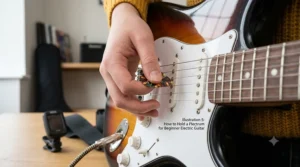
How to Choose a Beginner Electric Guitar in the UK: A Numbered Decision Framework
Choosing the right beginner electric guitar doesn’t need to be overwhelming. Work through these five steps in order:
1. Set a realistic budget in GBP. Entry-level quality begins reliably around £150–£200 for a guitar alone; below that, build quality and playability become lottery tickets. A complete kit (guitar, amp, accessories) can be assembled from the £100–£150 range with brands like Donner.
2. Consider the player’s physical size. Adults and teenagers will manage full-size (4/4) guitars comfortably. Children under ten, and some adults with smaller hands, should seriously consider short-scale options like the Ibanez miKro.
3. Decide on musical direction — or don’t. If you know you want to play rock and metal, humbuckers (Epiphone Les Paul, Ibanez miKro) are the correct choice. If you want versatility while you explore, an HSS configuration (Yamaha Pacifica) covers the most ground. If indie, folk-rock, or country appeals, the Telecaster’s single-coil brightness is hard to beat.
4. Decide whether to buy a complete kit or just the guitar. Complete kits offer immediate value; standalone guitars generally offer better instrument quality for the same price. If you have any existing equipment — even a borrowed amplifier — buying the guitar alone is usually better value.
5. Check Amazon.co.uk Prime eligibility. For UK buyers, Prime next-day delivery is a significant practical benefit — particularly if you’re buying as a gift with a specific date in mind. All seven guitars in this guide are Prime-eligible on Amazon.co.uk.
Common Mistakes When Buying a Beginner Electric Guitar in the UK
Mistake 1: Buying US-Voltage Equipment from Third-Party Sellers
This is less common than it once was, but worth mentioning post-Brexit: some third-party Amazon sellers ship US-specification amplifiers (110V/60Hz) to UK buyers. These will not work safely on UK mains power without a transformer. Always verify that any amplifier is described as “UK plug” or “230V compatible.” Major brands sold through Amazon’s own listings are invariably UK-compatible, but third-party sellers warrant a second look at the specifications.
Mistake 2: Buying the Cheapest Possible Guitar and Then Abandoning Learning
The most common reason beginners give up the guitar isn’t lack of talent — it’s physical discomfort caused by a poorly set-up instrument. Very cheap guitars often arrive with high action (the distance between strings and fretboard), making them genuinely painful to play. Spending a modest additional amount — even the difference between £80 and £150 — dramatically improves the learning experience. It’s worth it.
Mistake 3: Ignoring the Amazon.co.uk Reviews for UK-Specific Context
US-centric reviews may rate a guitar highly without accounting for differences that matter to UK buyers: delivery condition through cold British winters, the impact of UK humidity on cheaper wood constructions, or the reality that some accessory bundles include US-standard picks unsuitable for certain playing styles popular in Britain. Filter for UK reviewers where possible.
Mistake 4: Overcomplicating the Accessories Purchase
You do not need a multi-effects pedal, a metronome watch, a guitar stand and a wall mount, a capo and a slide, and four different sets of strings in your first month. You need a guitar, an amplifier (or headphone-equipped practice amp), a tuner, and a pick. Everything else can wait until you know what you actually need.
Mistake 5: Underestimating the Value of the UK Consumer Rights Act 2015
This is one of the genuine advantages of buying on Amazon.co.uk as a British consumer. The Consumer Rights Act 2015 provides 30 days for a full refund if the product is faulty, and up to six years for claims if defects emerge later. Combined with Amazon’s own 30-day return window and the additional warranty from manufacturers like Yamaha and Epiphone, UK buyers are well protected. Don’t be afraid to return a guitar that doesn’t meet expectations — it’s your legal right.
Electric Guitar vs Acoustic Guitar: The UK Beginner’s Decision
This is a question that comes up constantly in British guitar communities, and the honest answer is: it depends on what music you want to play.
The argument for acoustic first — that it “builds finger strength” — is largely a myth. Acoustic guitars are typically harder to play due to heavier string gauges and higher action, which can actually discourage learning rather than build resilience. If you want to play amplified music, starting on an acoustic is rather like learning to drive in a lorry before moving to a car.
Electric guitars are generally easier to learn on because string action can be set lower, strings are thinner and lighter, and chord shapes require less physical force. They also sound immediately exciting, which matters more than most tutorials will admit: motivation is ninety percent of success in learning any instrument.
The practical UK consideration is volume. Electric guitars played clean through a small practice amplifier — or silent through a headphone output — are actually quieter than an acoustic strummed enthusiastically in a semi-detached. For flat dwellers and city-centre residents, this is not an insignificant point.
According to Ofcom’s media use research, music remains one of the most common leisure pursuits across all UK age groups, with a significant proportion of adults expressing interest in learning an instrument — electric guitar consistently among the most aspirational.
For a deeper understanding of how the electric guitar has shaped British music — from the Merseybeat era to Britpop — Wikipedia’s overview of British rock music provides useful cultural context.
Features That Actually Matter (And Those That Don’t) for UK Beginners
Features That Matter
🎸 Action (String Height): This is arguably the single most important factor in how comfortable a guitar is to play. Low action = easier fretting. Most reputable brands set this acceptably at the factory; budget guitars often don’t. A local music shop can adjust action for around £20–£40 if needed.
🎸 Tuning Machine Quality: Cheap tuners slip, causing constant retuning that destroys the learning experience. All seven guitars in this guide feature sealed die-cast tuning machines, which are reliably stable.
🎸 Neck Profile: The “C-shape” neck is the most comfortable for the widest variety of hands. Most beginner guitars use it for that reason.
🎸 Pickup Quality: Better pickups produce better tone. The Alnico magnets in the Yamaha Pacifica and Squier Classic Vibe represent genuine quality upgrades over the ceramic pickups in cheaper instruments.
Features That Don’t Matter (Yet)
❌ Locking Tuners: Useful for professionals; irrelevant for beginners.
❌ Floating Tremolo Systems: Complicated to set up, causes tuning instability while you’re still learning. The hardtail options (Squier Sonic HT) actively avoid this problem.
❌ Boutique Tonewoods: The difference between alder, basswood, and paulownia bodies matters at professional levels; at beginner level, setup quality has ten times the impact on tone.
❌ More Than 22 Frets: Beginners will not be playing above the 14th fret for many months. 24-fret guitars offer no practical advantage at this stage.
For further reading on the science behind guitar acoustics, the University of New South Wales’s physics of musical instruments pages provide an accessible, authoritative overview.
Long-Term Costs and UK Maintenance Guide 💷
Ongoing Running Costs
Owning an electric guitar in the UK involves predictable ongoing costs worth budgeting for:
- Replacement strings: Expect to change strings every 1–3 months depending on playing frequency. Quality sets from brands like D’Addario or Ernie Ball typically cost £5–£10 per set on Amazon.co.uk. Annual cost: roughly £20–£60.
- Picks/plectrums: Inexpensive and mostly included with beginner kits; budget £5–£10 per year.
- Professional setup: An annual setup from a guitar technician (checking neck relief, adjusting intonation, cleaning) costs roughly £30–£60 at most UK music shops and noticeably improves playability.
- Guitar lessons: The most significant ongoing cost if you choose formal tuition. UK guitar teachers typically charge £20–£50 per hour for in-person lessons; online platforms like Fender Play offer subscription-based learning from around £9.99 per month.
UK Warranty and Returns Context
Most guitars in this guide carry manufacturer warranties of one to two years. Combined with the UK Consumer Rights Act 2015 protections mentioned earlier, UK buyers are in an enviable position compared to many international buyers — particularly relevant post-Brexit, as Consumer Contracts Regulations provide 14-day cooling-off periods on all online purchases.
As Which? (the UK’s most trusted consumer watchdog) consistently advises, buying from established sellers on Amazon.co.uk ensures clear recourse if products arrive damaged or develop faults early in ownership.
FAQ: Beginner Electric Guitar UK ❓
❓ What is the best beginner electric guitar under £200 in the UK?
❓ Do I need an amplifier to learn electric guitar in the UK?
❓ Are beginner electric guitars on Amazon.co.uk compatible with UK plug sockets?
❓ Which beginner electric guitar is best for a child aged 8–10 in the UK?
❓ Can I return a beginner electric guitar bought on Amazon.co.uk if it's not right?
Conclusion: Your First Beginner Electric Guitar Awaits 🎸
The best beginner electric guitar is, ultimately, the one that makes you want to pick it up. That sounds simple, but it’s the truest advice in this entire article.
For most UK beginners, the Yamaha Pacifica PAC112V remains the safest, most comprehensively capable choice — a guitar that won’t limit you as you improve, sounds genuinely good from day one, and arrives in excellent condition. If budget is the primary concern, the Donner DST-100S kit provides everything you need to start without spending more than necessary. For younger players, the Ibanez miKro is in a class of its own.
What matters most isn’t which guitar you choose from this list — they’re all genuinely recommendable on Amazon.co.uk — but that you choose one and start playing. Progress on the guitar is slow at first, then suddenly rapid, then deeply satisfying. Every guitarist you’ve ever admired started exactly where you are: holding a new instrument, wondering how on earth the fingers are supposed to reach that chord shape.
The answer, it turns out, is practice. And the right beginner electric guitar makes that practice considerably more enjoyable.
✨ Don’t Miss These Exclusive Deals!
🔍 Check current pricing and availability for all seven guitars recommended in this guide on Amazon.co.uk. Click on any highlighted product above to see the latest deals — and remember, Prime members benefit from next-day delivery across most of the UK. Your guitar journey is one click away!
Recommended for You 📖
- Title: Intermediate Electric Guitar: 7 Best Upgrades for 2026
- Electric Guitar Under £150: 7 Best Picks Worth Buying in 2026
- Best Electric Guitar Starter Pack UK 2026: 7 Top Kits Reviewed
Disclaimer: This article contains affiliate links. As an Amazon Associate, I earn from qualifying purchases. If you purchase products through these links, we may earn a small commission at no additional cost to you.
✨ Found this helpful? Share it with your mates! 💬🤗
