
In This Article
Somewhere between “I’d love to learn guitar” and actually owning one sits a genuinely confusing shop window full of nylon strings, wonky pricing, and marketing copy that promises the earth. If you’re searching for a classical guitar for beginners, you’ve probably already noticed that half the listings look identical and the other half are wildly overpriced for what they offer. That’s the gap this guide is here to close.

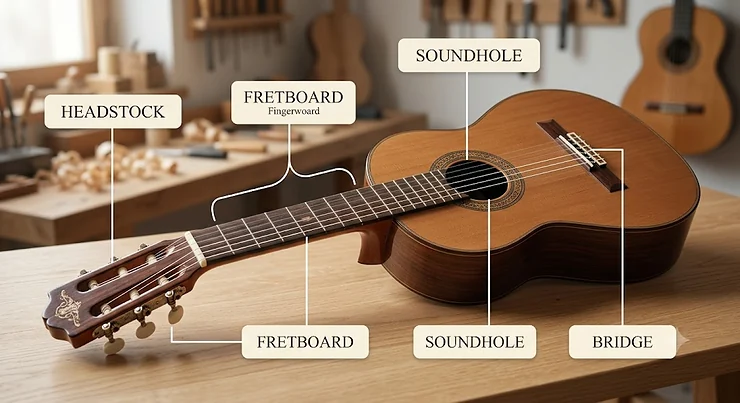
A classical guitar for beginners is, in short, a nylon-string acoustic instrument with a wide neck and soft strings, purpose-built to be gentle on untrained fingers while teaching correct technique from day one. Unlike a steel-string acoustic, there’s no fighting against string tension or nursing sore fingertips through your first fortnight. That gentler learning curve is precisely why classical guitars remain the instrument of choice for music teachers, ABRSM examiners, and anyone starting from absolute zero.
Across this guide, we’ve researched seven real, currently available classical guitars for beginners, spanning bargain-basement starter packs through to solid-top instruments that’ll still sound good in five years’ time. Whether you’re after a beginner nylon string guitar for a curious eight-year-old, a proper classical guitar starter for yourself, or you’ve specifically been hunting for the best classical guitar under £100, there’s a pick here that fits. We’ll also walk through how to start learning classical guitar, the classic mistakes new buyers make, and how a classical guitar vs acoustic for beginners debate usually shakes out. Let’s get into it.
Quick Comparison Table
Before the deep dive, here’s the short version for anyone in a hurry.
| Guitar | Price Range | Best For |
|---|---|---|
| Yamaha C40II | £100-£140 range | Best all-round beginner pick |
| Valencia Series 100 | Under £100 | Best classical guitar under £100 |
| 3rd Avenue Classical Guitar Bundle | Under £70 | Cheapest complete starter kit |
| Ashton SPCG44 Starter Pack | £70-£110 range | Best value all-in-one bundle |
| Admira Alba | £110-£160 range | Best step-up for serious learners |
| Fender FC-1 | £150-£200 range | Best recognisable brand name |
| Cordoba C5 | £220-£290 range | Best solid-top for committed beginners |
Looking across the seven, there’s a clear budget-to-premium ladder rather than a random scatter of similar products, which matters because your first guitar should match your actual commitment level, not your optimism. The Yamaha C40II anchors the middle as the closest thing this category has to a default recommendation, while the Valencia Series 100 and 3rd Avenue Classical Guitar Bundle cover buyers who want to test the water before spending more. At the top end, the Cordoba C5 earns its higher price range through a solid cedar top, something none of the laminate-bodied budget guitars can match.
💬 Bookmark this table — you’ll want to compare it against the full breakdown below before you commit!
Top 7 Classical Guitars for Beginners: Expert Analysis
1. Yamaha C40II — the benchmark budget classical every teacher recommends
Yamaha didn’t invent the beginner classical guitar category, but the C40II has become its unofficial standard, and there’s a good reason so many music teachers point students towards it first. It uses Yamaha’s dedicated “CG” classical body shape, which sits comfortably on the lap without the bulk of a dreadnought, and pairs a laminated spruce top with meranti back and sides. In practical terms, that laminate construction means it won’t crack as easily in a draughty British living room during winter, trading a touch of resonance for genuine durability, which is exactly the trade-off a nervous first-time buyer should want.
Where the C40II earns its reputation is consistency. Reviewers repeatedly note that Yamaha’s factory quality control means you’re very unlikely to receive a warped neck or badly seated frets, a real risk with unbranded budget guitars. It suits an absolute beginner of any age who wants one guitar to grow into for at least a couple of years, rather than a toy they’ll outgrow in six months.
Aggregated customer reviews are consistently positive, with buyers frequently highlighting the smooth neck action and the surprisingly warm tone for the price bracket; a smaller number mention that the stock strings could be upgraded after a few months of regular playing.
Pros:
- ✅ Trusted brand with excellent factory quality control
- ✅ Comfortable slim-shouldered classical body shape
- ✅ Rosewood fingerboard and bridge at this price point
Cons:
- ❌ Laminate top limits long-term tonal development
- ❌ No case included as standard on most listings
Typically found in the £100-£140 range on amazon.co.uk, the Yamaha C40II represents close to the ceiling of what laminate construction can deliver, making it strong value for anyone serious enough to commit beyond a few weeks.

2. Valencia Series 100 — best classical guitar under £100
If your search brought you here specifically hunting for the best classical guitar under £100, the Valencia Series 100 is the most credible answer currently on amazon.co.uk. Valencia has built its entire brand around genuinely playable entry-level instruments, and the Series 100 uses a linden top with an ABS-bound body, which sounds unglamorous on paper but translates into a guitar that resists the warping and cracking that plagues cheaper unbranded alternatives.
The true classical scale length is worth dwelling on, since it’s the detail that separates a real beginner instrument from a toy-shop lookalike. It means your hands are learning correct finger spacing from the first lesson, rather than adapting to a shrunken neck you’ll have to unlearn later. Size options run from 1/4 up to full 4/4, so this is genuinely one guitar family rather than a single fixed size, making it a sound pick for a family with more than one learner.
Aggregated review sentiment across retailers is notably strong for the price bracket, with buyers regularly praising the low action and comfortable neck for small or inexperienced hands, and describing the tone as clearer than expected given the cost.
Pros:
- ✅ True classical scale length teaches correct technique
- ✅ Available across five sizes for different ages
- ✅ Clear, resonant tone well above its price class
Cons:
- ❌ Basic nickel tuning machines can need retuning often
- ❌ No padded case bundled with the base model
Sitting comfortably under £100 on amazon.co.uk, the Valencia Series 100 is the pick if budget is the deciding factor and you’re not yet certain the habit will stick.
3. 3rd Avenue Classical Guitar Bundle — cheapest complete starter kit
For buyers who want everything sorted in one purchase, the 3rd Avenue Classical Guitar Bundle takes a completely different approach to the rest of this list. Rather than selling a bare instrument, 3rd Avenue packages the guitar with a gig bag, spare strings, a clip-on tuner, and picks, which genuinely matters when you’re buying for a total beginner who has no accessories at all. The guitar itself uses a poplar top with basswood back and sides and scalloped X-bracing, aiming for a warm, rounded tone rather than volume or projection.
What most buyers overlook about bundle guitars like this one is that the real value isn’t the instrument alone, it’s avoiding the £30-£50 you’d otherwise spend piecing together a tuner, bag, and spare strings separately. That makes it a sensible choice for a gift purchase, where the recipient needs to be playing within minutes of unboxing rather than making a second trip to a music shop.
Aggregated reviews are mixed but broadly positive for the price point; several buyers note the bundled strings can stretch and slip out of tune for the first week or two, a known characteristic of budget nylon strings that settles with regular playing and a few manual retunes.
Pros:
- ✅ Complete kit including bag, tuner and spare strings
- ✅ Available in 1/4, 1/2, 3/4 and full sizes
- ✅ Genuinely low entry price for a full bundle
Cons:
- ❌ Stock strings need frequent retuning early on
- ❌ Basswood back and sides limit long-term tonal depth
Priced under £70 on amazon.co.uk for most sizes, the 3rd Avenue Classical Guitar Bundle is the pragmatic choice for a first-ever guitar, particularly as a birthday or Christmas gift.
4. Ashton SPCG44 Starter Pack — best value all-in-one kit for older beginners
The Ashton SPCG44 Starter Pack occupies similar territory to the 3rd Avenue bundle but leans towards teenage and adult beginners rather than younger children. Ashton pairs a spruce top with basswood back and sides, and bundles the guitar with a padded ARM300 gig bag, a strap, and a code for online lessons, aiming the whole package at someone who wants structured guidance alongside the instrument itself.
Here’s what the spec sheet won’t tell you: the included online lesson access is genuinely useful for a beginner who doesn’t yet have a teacher lined up, effectively front-loading a few weeks of structured practice into the guitar’s price. That’s a meaningful transformation-focused extra that a bare instrument from a specialist boutique brand simply doesn’t offer at this price bracket. Colour options are unusually broad for a starter pack, which appeals to teenagers who want their first instrument to look distinctive rather than purely functional.
Real customer feedback aggregated from retailer reviews is respectable rather than glowing, hovering around the high 3-star mark; several reviewers mention encountering minor cosmetic scuffs on arrival, alongside consistent praise for the softness of the stock strings.
Pros:
- ✅ Bundled bag, strap and free online lessons
- ✅ Wide range of finishes and colourways available
- ✅ Spruce top gives brighter tone than pure basswood builds
Cons:
- ❌ Occasional reports of cosmetic finish scuffs
- ❌ Reviews are more mixed than higher-rated rivals
Generally priced in the £70-£110 range on amazon.co.uk depending on colour and stock, the Ashton SPCG44 Starter Pack rewards buyers who value the lesson access as much as the guitar itself.
5. Admira Alba — best step-up for serious adult learners
Stepping up a tier, the Admira Alba brings genuine Spanish design pedigree, having descended directly from Admira’s Almeria model, with manufacturing quality-controlled by Spanish-trained luthiers. It uses an Oregon pine top with sapele back and sides and a mahogany neck, a materials upgrade over every budget option on this list, and one that shows up clearly in sustain and warmth once you move past open chords into fingerstyle playing.
Based on the spec comparison with the entry-level bundles above, the Admira Alba’s wider 52mm nut width is the detail worth flagging for adult beginners specifically. A narrow nut, common on cheaper guitars scaled down for children, forces adult fingers into cramped positions that actively slow down technique development. This is a guitar built for someone who has already decided classical guitar is their instrument, not one being trialled on a whim.
Aggregated reviews from UK retailers are consistently strong, with buyers repeatedly describing the tone as “surprisingly resonant” for an all-laminate build, and multiple parents and adult learners noting it as a natural second guitar after outgrowing a starter bundle.
Pros:
- ✅ Genuine Spanish-designed build quality
- ✅ Wider nut width suits adult hand positioning
- ✅ Warm, resonant tone above its laminate-build peers
Cons:
- ❌ No solid tonewood, so a ceiling on tonal growth
- ❌ Fewer bundled accessories than starter-pack rivals
Typically priced in the £110-£160 range on amazon.co.uk, the Admira Alba is the guitar to buy once you’ve already decided this isn’t a passing hobby.
6. Fender FC-1 — best recognisable brand name at a mid-range price
Fender is a name every beginner already half-recognises, which counts for something when you’re nervous about spending money on an instrument you’re not yet confident you’ll stick with. The Fender FC-1 uses a laminated spruce top with laminated basswood back and sides, alongside Fender’s signature “U”-shaped neck profile, designed specifically to feel familiar and unintimidating to someone who has never picked up a guitar before.
What most buyers overlook is that the FC-1’s flat fingerboard radius and 2-inch nut width are genuinely classical-spec details, not a steel-string guitar wearing nylon strings for marketing purposes. Reviewers who’ve played it alongside dedicated classical specialists note it holds up acoustically at low-to-moderate volume, though it can start to struggle for projection once you’re playing alongside louder instruments or in a larger room.
Aggregated review sentiment is broadly positive but not uniformly glowing; several players mention fret edges needing a light file-down out of the box, a common quality-control quirk on guitars built to a tight price point, alongside consistent praise for the neck comfort.
Pros:
- ✅ Genuinely classical-spec neck and fingerboard geometry
- ✅ Familiar, confidence-inspiring brand name
- ✅ Comfortable “U”-shaped neck profile for beginners
Cons:
- ❌ Occasional sharp fret edges reported out of the box
- ❌ Limited projection compared with solid-top rivals
Sitting in the £150-£200 range on amazon.co.uk, the Fender FC-1 suits a buyer who wants brand reassurance alongside genuinely usable classical specifications.
7. Cordoba C5 — best solid-top guitar for committed beginners
At the top of this list, the Cordoba C5 is the guitar to buy if you’re confident classical guitar is going to stick, and you’d rather invest once than upgrade twice. Its solid cedar top is the headline feature, paired with laminated mahogany back and sides, a natural bone nut and saddle, and a hand-carved headstock. Solid tops open up and mature over years of playing in a way laminate simply can’t replicate, which is the entire reason this guitar costs meaningfully more than everything else on this list.
Here’s what the spec sheet won’t tell you, but reviewers consistently note: the C5’s adjustable truss rod is unusual at this price bracket, and it matters more than it sounds. As a beginner’s technique develops, they typically want lower action than a guitar ships with from the factory; being able to adjust that without a trip to a luthier is a genuine long-term convenience most budget guitars simply don’t offer.
Aggregated customer sentiment across major retailers is strongly positive, with reviewers frequently comparing its tone favourably against guitars costing considerably more, while a handful note the natural finish shows fingerprints and light marks more readily than a gloss lacquer.
Pros:
- ✅ Solid cedar top with genuine tonal maturation potential
- ✅ Adjustable truss rod for long-term action tweaks
- ✅ Bone nut and saddle improve sustain and tuning stability
Cons:
- ❌ Meaningfully pricier than every other pick here
- ❌ Natural finish shows fingerprints and light marks
Generally found in the £220-£290 range on amazon.co.uk, the Cordoba C5 is best suited to an adult learner or parent buying for a child who has already proven their commitment on a cheaper first instrument.
Top 7 Products: Specs & Value Comparison
| Guitar | Top Material | Price Range | Best For |
|---|---|---|---|
| Yamaha C40II | Laminated spruce | £100-£140 | All-round durability |
| Valencia Series 100 | Linden (laminate) | Under £100 | Tightest budget |
| 3rd Avenue Classical Guitar Bundle | Poplar (laminate) | Under £70 | Complete kit, low cost |
| Ashton SPCG44 Starter Pack | Spruce (laminate) | £70-£110 | Bundle with free lessons |
| Admira Alba | Oregon pine (laminate) | £110-£160 | Serious adult beginners |
| Fender FC-1 | Laminated spruce | £150-£200 | Familiar brand, classical spec |
| Cordoba C5 | Solid cedar | £220-£290 | Long-term tonal growth |
Read across this table and a pattern emerges: price rises broadly in step with top-wood quality, moving from laminate builds designed to survive rough handling towards the Cordoba C5‘s solid cedar top built for tone. If you’re weighing up spending an extra £50 or so, the jump from the Ashton SPCG44 Starter Pack to the Admira Alba buys you a genuinely wider nut and Spanish-pedigree design, which matters more for adult hands than for a child’s. The biggest single leap in the table, though, is the gap between the Fender FC-1 and the Cordoba C5, where you’re paying specifically for solid-top tonal development rather than any bundled extras.
✨ Ready to Find Your Perfect First Guitar? 🎸 Compare current prices and availability on any of the models above before you decide — stock and colour options shift regularly on amazon.co.uk.
How to Start Learning Classical Guitar
Buying the guitar is genuinely the easy part; the first thirty days are where most beginners either build a habit or quietly give up. Set the guitar up somewhere visible, on a stand rather than in its case, since research on habit formation consistently shows that visible cues drive far more consistent behaviour than items tucked away out of sight.
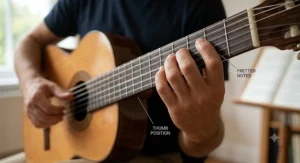
Your first task before playing a single note should be tuning, ideally with a clip-on tuner, since nylon strings on a new guitar stretch considerably and will need retuning multiple times a day for the first week or two; this is completely normal and not a fault with the instrument. From there, spend your first few sessions purely on posture and right-hand technique: classical guitar is traditionally played with the guitar resting on the left leg (raised slightly with a footstool or guitar support), which puts the fretting hand in a naturally better position than the casual slouch you’ll see with steel-string players.
A common early mistake is chasing full chords too quickly. Instead, spend the first fortnight on single-note exercises across all six strings using the fingers of your right hand (rest-stroke technique), building the muscle memory that everything else depends on. Aim for short, focused fifteen to twenty-minute sessions most days, rather than one long weekend session; consistency beats duration for building any physical skill, and guitar is very much a physical skill before it’s a musical one.
Who Should Buy Which Guitar: Real-World Scenarios
Matching a guitar to a person is more useful than matching it to a spec sheet, so here are three realistic profiles.
A university student on a tight budget, living in shared accommodation, wants to learn a few songs and doesn’t yet know if it’ll stick beyond the first term. The Valencia Series 100 or 3rd Avenue Classical Guitar Bundle make the most sense here: low financial risk, portable enough for a shared flat, and genuinely playable rather than a false economy that fights back against every chord.
A parent buying for an eight-year-old who’s shown interest after school music lessons needs a properly sized instrument rather than a scaled-down toy. A 1/2 or 3/4 size Valencia Series 100 fits the bill, since the true classical scale length teaches correct technique from the very first lesson rather than building habits that need correcting later on a full-size guitar.
An adult returning to music after years away, perhaps having played piano as a child, usually has more disposable income and a clearer sense of commitment. The Admira Alba or Cordoba C5 suit this buyer well: wider nut width for adult hands, and tone that rewards the more developed listening ear an older beginner typically brings to the instrument.
Common Problems New Classical Guitar Owners Face (And How to Fix Them)
Sore fingertips in the first fortnight are near-universal and not a sign you’re doing anything wrong; the skin on your fingertips needs roughly two to three weeks of regular playing to callus over. Short daily sessions actually build calluses faster than occasional long ones, since the skin needs repeated, moderate exposure rather than one punishing session.
A guitar that won’t stay in tune is almost always down to fresh strings stretching rather than a faulty machine head; retune after every session for the first week, and it typically settles down considerably by week two. If it’s still slipping after that, check whether the strings have been wound correctly around the tuning post, since too few wraps is a common factory oversight on budget instruments.
Buzzing strings usually point to action that’s set slightly too low for a beginner’s still-developing left-hand pressure, or occasionally a truss rod that needs a small adjustment; guitars like the Cordoba C5 with an adjustable truss rod make this a five-minute fix, while laminate budget guitars usually need a trip to a local shop for a proper setup.
Finally, humidity-related cracking is a genuine risk for solid-top guitars like the Cordoba C5 in centrally heated British homes over winter; a simple in-case humidifier or keeping the guitar away from radiators solves this before it becomes expensive.
How to Choose a Classical Guitar for Beginners
- Confirm the size fits the player. A guitar sized for an adult overwhelms a child’s reach, and a 3/4 or 1/2 size on an adult limits long-term technique development; check age and height guidance against actual arm length before buying.
- Prioritise neck comfort over cosmetics. A wide, flat classical neck like the ones on the Yamaha C40II or Valencia Series 100 teaches correct hand position, while a narrow neck borrowed from steel-string design habits works against you.
- Decide your realistic budget band first. Spending under £100 on a Valencia Series 100 to test commitment is completely reasonable; so is investing in a Cordoba C5 if you already know this is sticking.
- Check what’s actually included. Bundles like the 3rd Avenue Classical Guitar Bundle or Ashton SPCG44 Starter Pack save real money on accessories versus buying separately, but only if you actually need everything in the box.
- Read aggregated review themes, not star ratings alone. A 4.3-star guitar with recurring complaints about tuning stability tells you more than a headline number.
- Consider solid versus laminate tops honestly. Laminate is genuinely fine, even preferable, for a first guitar that might get knocked around; solid tops like the Cordoba C5‘s only pay off if you’re playing regularly enough to hear the difference.
- Factor in whether you’ll need lessons or a tutor book alongside it, since the guitar is only half the equation for actually learning to play.
Classical Guitar vs Acoustic Guitar for Beginners
This is one of the most searched comparisons for good reason, and the honest answer is that it depends more on your fingers and your musical taste than most articles admit. Classical guitars use nylon strings under considerably lower tension than a steel-string acoustic, which means less finger pain in the crucial early weeks and a wider, flatter neck that makes individual string separation easier for uncoordinated beginner hands.
Steel-string acoustics, by contrast, produce a brighter, louder sound that suits strumming pop and folk songs, and their narrower neck can actually be an advantage once your fingers have some strength, since it demands less of a stretch for barre chords. The trade-off is real finger discomfort in the early weeks that puts a meaningful number of beginners off entirely before they’ve built up calluses.
Guitars like the Yamaha C40II and Admira Alba sit firmly on the classical side of this divide and are the better starting point for anyone unsure which genre they’ll gravitate towards, precisely because the lower barrier to entry means you’re more likely to still be playing in six months. If you already know you want to strum along to chart songs around a campfire, a steel-string acoustic is arguably the more direct route; if you’re not sure yet, or you’re drawn to fingerstyle, Spanish, or classical repertoire specifically, nylon strings are the sensible starting point.
What to Expect: Real-World Performance in Your First Months
Specs on a page don’t translate directly into what your first few months actually feel like, so here’s the honest version. Week one is largely about frustration with fretting clean notes and getting used to a completely unfamiliar hand position; this is universal and not a sign the guitar is wrong for you. By week three or four, most beginners on a guitar like the Yamaha C40II or Valencia Series 100 can hold down basic open chords cleanly, even if changing between them smoothly still takes real concentration.
Around the two-month mark, right-hand fingerstyle technique starts to separate from strumming, and this is typically where a guitar’s tonal quality starts to actually matter to the player, rather than being an abstract spec-sheet consideration. A laminate-top budget guitar will sound noticeably flatter and less resonant once your ear develops this far, which is exactly why guides like this one exist: buying appropriately for where you’ll be in three months, not just where you are on day one, saves money in the long run.
Classical Guitar for Adult Learners
Adult beginners face a genuinely different set of challenges to children learning the same instrument, and it’s worth addressing directly given how often adults search for an easy classical guitar for adults specifically. Physically, adult hands are larger and often less naturally flexible than a child’s, which makes nut width and neck profile more important considerations than they’d be for a young learner; this is precisely why the Admira Alba‘s wider 52mm nut earns its recommendation for this audience specifically.
Psychologically, adults tend to be more self-critical and less tolerant of the “sounding bad” phase that every beginner has to pass through, which is part of why a decent-quality first instrument matters more for adults than conventional wisdom suggests; a guitar that buzzes or won’t hold tune gives an already self-conscious adult learner every excuse to quit. There’s also a genuine, evidence-backed upside worth mentioning: research summarised by the BBC’s science team has linked learning an instrument in adulthood, even starting later in life, with measurable benefits to memory and attention, adding a wellbeing case to the purely musical one.
Realistically, an adult with steady practice time and a reasonably built guitar like the Admira Alba or Fender FC-1 can expect to be playing simple pieces within two to three months, and a full grade-one syllabus, such as the one set by the Associated Board of the Royal Schools of Music, within six to twelve months of consistent practice.
Long-Term Cost & Maintenance
The guitar itself is only the opening cost. Budget roughly £15-£25 a year for a fresh set of nylon strings, changed roughly every four to six months with regular playing, since old strings lose brightness and intonation accuracy long before they physically snap. A padded case, if not already bundled, typically runs £20-£40 and is genuinely worth the outlay given how easily a guitar left loose in a wardrobe picks up dents.
Setup and maintenance costs scale roughly with guitar quality: budget laminate instruments like the 3rd Avenue Classical Guitar Bundle rarely need more than an occasional professional setup, perhaps £25-£35 once every year or two, while a solid-top guitar like the Cordoba C5 benefits from more careful humidity control to protect that investment, alongside similar periodic setup costs. Weighed against total cost of ownership over three years, a £90 Valencia Series 100 plus one professional setup still comes in meaningfully cheaper than a £250 Cordoba C5, but the latter holds its resale value considerably better if you ever decide to upgrade or move on from the hobby.

Frequently Asked Questions
❓ What is the best classical guitar for a complete beginner?
❓ Is a classical guitar easier to learn than an acoustic guitar?
❓ How much should I spend on my first classical guitar?
❓ Can adults learn classical guitar as beginners?
❓ Do classical guitars need a special case or storage?
Conclusion
Choosing among these seven options really comes down to being honest with yourself about commitment level and budget, rather than chasing the single “best” guitar in the abstract. If you’re testing the water, the Valencia Series 100 or 3rd Avenue Classical Guitar Bundle remove the financial risk entirely while still being genuinely playable instruments. If you want a dependable middle-ground pick that most teachers would nod along to, the Yamaha C40II remains the sensible default. And if you already know classical guitar is sticking around, the Admira Alba and Cordoba C5 both reward the extra spend with tone that develops as your technique does.
Whichever you choose, the guitar itself is only ever half the equation. The habit of picking it up most days, even for fifteen minutes, will do more for your progress than any spec sheet ever will. As the Wikipedia entry on the classical guitar notes, the instrument’s design has remained largely unchanged for over a century precisely because that combination of wide neck, nylon strings, and resonant body simply works for learners. Pick one of the seven above, string it up, and start putting in the minutes.
✨ Don’t Miss These Exclusive Deals!
🔍 Take your classical guitar for beginners search to the next level with these carefully researched picks. Click through on any highlighted model to check current pricing and availability before stock or colours change!
Recommended for You
- Dreadnought for Strumming: 7 Loud, Chord-Ready Picks (2026)
- Dreadnought for Fingerpicking: 7 Best Picks Tested for 2026
- Dreadnought Acoustic Guitar: 7 Best Picks for 2026
Disclaimer: This article contains affiliate links. As an Amazon Associate, I earn from qualifying purchases. If you purchase products through these links, we may earn a small commission at no additional cost to you.
✨ Found this helpful? Share it with your friends! 💬🤗
