
In This Article
Walk into any Spanish guitar shop and ask for a “classical guitar for flamenco,” and you’ll probably get a raised eyebrow and a gentle correction. The two instruments look like twins from across the room — same six nylon strings, same fan-braced top, same warm wooden curves — but up close they’re closer to cousins who took very different career paths. One grew up in the concert hall, all poise and sustain. The other grew up in a smoky bar in Jerez, learning to snap and growl on command. This guide exists because so many players start their flamenco journey on a standard classical guitar (nothing wrong with that) and eventually hit a wall: the strings sit too high, the tone won’t bite, and every golpe on the top just sounds like a dull thud instead of a crack.
So here’s the honest, no-fluff answer: a classical guitar for flamenco is really a flamenco guitar — a nylon-string instrument built with lower action, lighter bracing and often cypress or maple back and sides, engineered to respond to percussive tapping and rapid rasgueado rather than long, singing sustain. Below, we’ve researched seven real, currently available instruments spanning entry-level to professional territory, broken down what their specs actually mean in practice, and built out comparison tables, buyer frameworks and troubleshooting advice you won’t find on a standard Amazon listing.
What is a classical guitar for flamenco? It’s a nylon-string guitar adapted or purpose-built for flamenco playing — typically with a thinner body, lower string action, a tap plate (golpeador) for rhythmic tapping, and brighter tonewoods like cypress or maple instead of the rosewood favoured on concert classical guitars, all of which trade sustain for speed, attack and percussive clarity.
Quick Comparison Table
| Guitar | Body Woods | Best For | Price Range |
|---|---|---|---|
| Admira Triana EF | Spruce top, cypress back/sides | Absolute beginners on a budget | Under £250 |
| Yamaha CG172SF | Spruce top, cypress back/sides | Students wanting reliable factory build quality | £350-£450 range |
| Ortega R270F | Spruce top, maple back/sides | Traditional flamenco blanca tone at a mid price | £350-£450 range |
| Cordoba F10 Luthier Series | All-solid cypress | Intermediate players stepping up to solid wood | Mid-£600s |
| Cordoba GK Studio | Spruce top, cypress back/sides | Gigging players needing plug-in electronics | £700-£900 range |
| Alhambra 7FC | Spruce top, solid cypress back/sides | Advanced students and teachers | Around £1,100 |
| Ortega BWSM/2 (Ben Woods Signature) | Cedar top, solid walnut back/sides | Professional stage and studio players | Above £1,800 |
Looking at the spread above, the jump from the Admira Triana EF to the Yamaha CG172SF buys you a proper solid spruce top instead of an all-laminate build, which is the single biggest factor in whether a flamenco guitar “opens up” over the first year of playing. Once you cross into the Cordoba F10 Luthier Series and beyond, you’re paying for all-solid cypress construction, which genuinely changes the percussive character of the instrument rather than just the cosmetics. At the top end, the Ortega BWSM/2 shows what happens when a signature artist model swaps cypress for walnut — a warmer, bassier voice aimed at players who’ve already mastered the bright, snappy blanca sound and want something with more low-end body for solo concert work.
💬 Bookmarked this comparison? A quick share helps other flamenco beginners find it too!
What Is Flamenco Guitar? (Snippet Section)
Flamenco guitar is a style of nylon-string guitar and playing technique developed in Andalusia, Spain, purpose-built to accompany flamenco singing (cante) and dance (baile) with a bright, percussive tone. Guitar historians generally place the genre’s emergence in the late eighteenth century, growing largely out of Andalusian folk traditions as refined by Gitano professional musicians. Unlike concert classical guitar, which prioritises sustain and volume for solo repertoire, flamenco guitar is built for rhythmic attack, rapid strumming (rasgueado) and finger-and-nail tapping on the body itself (golpe).
Flamenco Guitar vs Classical Guitar: What Actually Changes
Here’s where a lot of shopping guides get lazy and just say “flamenco guitars are lighter,” then move on. Let’s actually unpack it, because the differences aren’t cosmetic — they change how the instrument behaves under your hands.
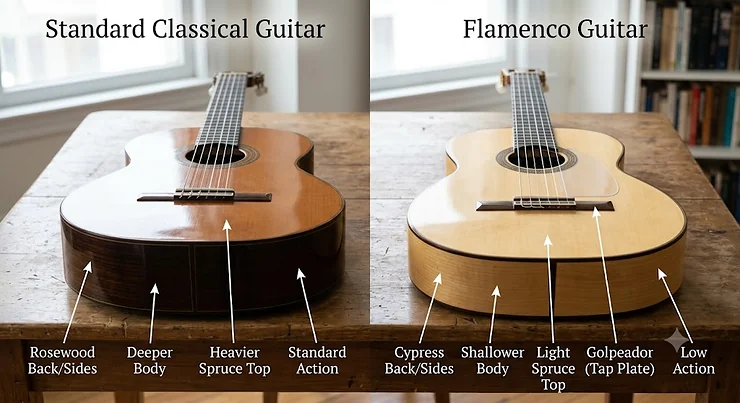
Academic surveys of the instrument’s development, such as this Cambridge Companion to the Guitar chapter on flamenco history and style, note that the guitar’s role shifted from a secondary accompaniment to an independent solo idiom over the course of the twentieth century — a shift that shaped the specific tonal demands builders eventually engineered for. Tonewood is the first big split. Traditional flamenco guitars — often called “flamenco blanca” or “negra” depending on wood choice — lean on cypress or maple for the back and sides, both of which are lighter and less dense than the rosewood or mahogany found on most classical guitars. Less density means less sustain but faster attack decay, which is exactly what you want when you’re playing sixteenth-note rasgueado patterns that would turn to mush on a boomier concert instrument. Reviewers and builders consistently describe cypress-bodied guitars as brighter, drier and more percussive, while rosewood-bodied classicals are described as warmer and longer-ringing — that’s not marketing spin, it’s basic acoustics, since lighter, less-damped tonewoods vibrate and decay faster.
Then there’s action — the gap between string and fretboard. Flamenco guitars are typically set up 1-2mm lower than a classical, which speeds up left-hand movement for rapid picado runs but increases the risk of string buzz, especially against a hard-hitting right hand. Classical guitars accept that trade-off in reverse: higher action for cleaner sustain and less buzz, at the cost of speed.
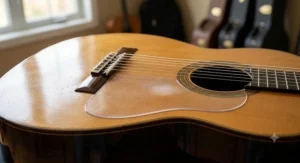
Structurally, most dedicated flamenco guitars also carry a golpeador — a clear or tortoiseshell-style tap plate glued to the top, usually below and sometimes above the soundhole — because without it, years of rhythmic finger-tapping would eventually wear straight through the spruce or cedar top’s lacquer and grain. A classical guitar has no such plate, because classical technique never asks you to strike the top at all.
Finally, weight and depth: flamenco bodies run noticeably thinner front-to-back than classical bodies (often 90-95mm versus 100-105mm), partly a historical holdover from flamenco’s origins as an accompanying instrument that needed to be light and portable for travelling musicians, and partly because a shallower body resonates faster and brighter. If you’ve ever picked up a classical guitar and felt like you were hugging a barrel, you’ll notice the difference in about four seconds.
The instrument’s own history is relatively short: flamenco guitar playing as we know it only dates back roughly 170 years, since for centuries before that flamenco existed purely as vocal music, sung a palo seco with just hand-clapping and rhythmic tapping for accompaniment. That late arrival is part of why the guitar had to adapt to an existing, highly rhythmic vocal and dance tradition rather than the other way around — hence all the percussive engineering above.
Top 7 Classical Guitars for Flamenco: Expert Analysis
1. Admira Triana EF — best true budget entry point
The Admira Triana EF is Spain’s answer to “I want to try flamenco without remortgaging anything.” It’s built with a solid spruce top, laminated cypress back and sides, a cedar neck reinforced with ebony, an ebony fingerboard and a 12-hole bridge, punching well above its price tag on paper.
The solid top matters more than most beginners realise: a laminate top vibrates like a drum skin with tape over half of it, while a solid top actually resonates and, with a year or two of playing, tends to open up and gain volume — laminated back and sides won’t do that as dramatically, but they do keep the price down and add durability for a first instrument that’s going to get knocked about. The Fishman Classic III preamp fitted to the electrified version also means you can plug straight into a small amp for group classes without buying separate pickup hardware later.
Who’s this for? Absolute beginners, parents buying for a child starting flamenco lessons, or anyone testing whether they actually enjoy the style before committing serious money. Based on the spec sheet and aggregated retailer feedback, buyers repeatedly note that the action arrives genuinely low and playable out of the box — unusual at this price point, where many competitors need a setup adjustment before they’re comfortable.
Pros:
- ✅ Genuinely low factory action, ready to play out of the box
- ✅ Solid spruce top for real tonal development over time
- ✅ Built-in Fishman preamp on electrified versions for easy amplification
Cons:
- ❌ Laminated back and sides limit long-term tonal ceiling
- ❌ Stock tuners and strings often need upgrading within the first year
At under £250, the Admira Triana EF is close to unbeatable value for a first “proper” flamenco setup rather than a generic nylon-string starter pack — just budget for a fresh set of Savarez strings on day one.
2. Yamaha CG172SF — best factory consistency for students
The Yamaha CG172SF brings Yamaha’s decades of classical-guitar manufacturing discipline to a dedicated flamenco model, pairing a solid European spruce top with cypress back and sides and a nato neck.
What stands out here isn’t flashy specs — it’s consistency. Yamaha’s CG line is built to tight quality-control tolerances, so the guitar you order online is far more likely to match its stated action, intonation and finish than a hand-varying import from a smaller workshop. That predictability is genuinely useful when you’re buying sight-unseen. The scratch plate and lower action are properly flamenco-spec, not just a rebadged classical model, and the 650mm scale length keeps string tension familiar for anyone transitioning from a standard classical guitar.
Real owner feedback, gathered from retailer review sections, is strikingly consistent: players repeatedly praise the value-for-money build quality and describe the tone as bright and punchy for the price, with the most common gripe being the satin finish looking plainer than pricier gloss models — a cosmetic complaint, not a functional one.
Pros:
- ✅ Exceptional manufacturing consistency across units
- ✅ Genuine cypress back and sides at a student-friendly price
- ✅ Lower factory action tuned specifically for flamenco technique
Cons:
- ❌ Satin finish reads as plain next to gloss competitors
- ❌ Stock nut is often plastic rather than bone, affecting sustain slightly
In the £350-£450 range, this is the guitar we’d point most conservatoire-track students towards — reliable enough that your teacher won’t spend the first lesson diagnosing setup issues.
3. Ortega R270F — best traditional “blanca” tone on a budget
The Ortega R270F is a Spanish-made traditional-series flamenco guitar with a solid spruce top, maple back and sides, and Ortega’s signature 12-hole bridge — a design detail worth explaining rather than skipping past.
A 12-hole bridge (versus the standard 6-hole tie-block) spreads string tension across a wider surface and, according to builders, produces a cleaner break angle and crisper attack — genuinely useful for flamenco’s rapid picado and alzapúa techniques where clarity between notes matters more than sustain. Maple back and sides land tonally between cypress (brighter, drier) and rosewood (warmer, longer), giving the R270F a slightly rounder character than a pure cypress blanca while still keeping the percussive snap flamenco demands.
Being handmade in Spain rather than mass-produced in a larger Asian factory, quality can vary marginally between individual units — something worth flagging honestly rather than glossing over, since it’s a genuine trade-off against the Yamaha’s tighter consistency.
Pros:
- ✅ Made in Spain with traditional flamenco construction methods
- ✅ 12-hole bridge improves attack clarity for fast technique
- ✅ Comes with a deluxe gig bag included in the price
Cons:
- ❌ Unit-to-unit consistency can vary slightly, being handmade
- ❌ Bone nut adds cost but some buyers report factory setup needs tweaking
At a similar £350-£450 range to the Yamaha, the choice between them really comes down to whether you prioritise the R270F’s more traditional Spanish-made character or the Yamaha’s factory-line consistency.
4. Cordoba F10 Luthier Series — best step-up to all-solid construction
Once you’re past the beginner stage and can genuinely hear the difference between laminate and solid tonewood, the Cordoba F10 from Cordoba’s Luthier Series is where a lot of serious students land, built with all-solid European spruce and cypress construction throughout.
The jump from laminate-and-solid-top hybrids (like most guitars below this price point) to genuinely all-solid construction is the biggest single tonal upgrade in the whole flamenco guitar market. Solid wood vibrates freely across its entire structure instead of being partially deadened by layered veneers, which translates to noticeably more volume, faster attack response, and — crucially for flamenco — a percussive “pop” on golpe taps that laminate-bodied guitars simply can’t replicate. Cordoba’s Luthier Series also benefits from more hand-finishing than their entry-level Iberia or Protégé ranges, meaning fret work and action setup tend to arrive closer to performance-ready.
Aggregated player sentiment across guitar forums and retailer reviews consistently flags this tier of Cordoba as “the guitar where flamenco actually starts to make sense” — a comment less about marketing and more about the felt difference once you can hear real cypress resonance for the first time.
Pros:
- ✅ Fully solid European spruce top and cypress back/sides
- ✅ Noticeably louder, more percussive tone than laminate models
- ✅ More refined fretwork and setup than entry-level Cordoba ranges
Cons:
- ❌ Solid wood is more sensitive to humidity changes, needing a case/humidifier
- ❌ Jump in price compared with laminate step-up guitars
Sitting in the mid-£600s, this is the sweet spot for a player who’s committed to flamenco long-term but isn’t ready for a professional-tier instrument yet.
5. Cordoba GK Studio — best for gigging players who need to plug in
Built with a solid European spruce top, cypress back and sides, a soft cutaway, and a Fishman Presys Blend preamp, the Cordoba GK Studio is one of Cordoba’s best-selling gigging instruments, constructed with a slightly thinner body depth, neck and nut width than a traditional Spanish flamenco guitar, and clearly built with the stage in mind.
That last point deserves unpacking: a thinner nut and neck profile makes the GK Studio noticeably faster under the fretting hand than a traditional-width flamenco neck, at the cost of feeling less “authentic” to purists who learned on wider Spanish necks. For gigging musicians who split time between flamenco and other styles — pop, fusion, session work — that crossover-friendly neck profile is a genuine practical advantage, not a compromise. The Fishman Presys Blend preamp combines an under-saddle pickup with an internal microphone, letting you dial in more natural tone through a PA than a pickup-only system would allow, with onboard EQ so you’re not at the mercy of a house sound engineer’s settings.
The soft cutaway is a modern touch rarely seen on traditional flamenco instruments, giving easier access to the upper frets for players who venture into more contemporary flamenco-fusion repertoire.
Pros:
- ✅ Onboard Fishman Presys Blend preamp for reliable stage amplification
- ✅ Slim neck and nut width suit players crossing over from steel-string
- ✅ Cutaway design for genuine upper-fret access
Cons:
- ❌ Narrower neck feels less traditional to purist flamenco players
- ❌ Electronics add weight and a small amount of extra maintenance risk
In the £700-£900 range, this is the clear pick for anyone who needs a flamenco guitar that can walk on stage and go straight into a mixing desk without a separate pickup retrofit.
6. Alhambra 7FC — best for advanced students and teachers
The Alhambra 7FC is a professional-tier flamenco blanca, built with a bookmatched solid cypress back and sides, solid German spruce top, mahogany neck with ebony reinforcement, and an ebony fingerboard — genuinely professional-grade materials throughout rather than solid-top-only construction.
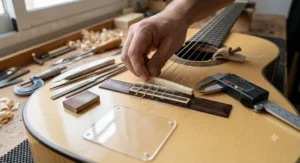
Ebony is worth flagging specifically: it’s harder and more dimensionally stable than the rosewood fingerboards found on cheaper models, resisting wear from the constant fretting pressure and fast position shifts that advanced flamenco technique demands. The narrower nut width (52mm) and lower action than a typical classical guitar, paired with MRF-B bracing (Alhambra’s own reinforced fan-bracing pattern), are engineered specifically to maximise percussive projection without sacrificing structural stability under heavy strumming.
This is also one of the few guitars in this list explicitly marketed at teachers and concert-level players rather than hobbyists, and the spec sheet backs that positioning up — gold-plated tuners, ebony neck reinforcement and a bone nut aren’t cosmetic flourishes at this tier, they’re durability choices for an instrument that’s going to be played daily for years.
Pros:
- ✅ All-solid cypress body with professional-grade ebony fingerboard
- ✅ MRF-B bracing built specifically for percussive flamenco projection
- ✅ Comes with a hard case in some bundles, protecting a serious investment
Cons:
- ❌ Significant price jump over the Cordoba F10 for incremental gains
- ❌ Narrower nut width may feel cramped for players with larger hands
At around £1,100, the Alhambra 7FC is where “hobbyist upgrade” turns into “professional tool” — the kind of guitar a working flamenco teacher would actually recommend their advanced students save up for.
7. Ortega BWSM/2 (Ben Woods Signature) — best premium studio and stage instrument
At the top of this list sits the Ortega BWSM/2, a signature model built in collaboration with flamenco-fusion guitarist Ben Woods. It features a solid red western cedar top, solid European walnut back and sides, a 650mm scale length, a thinline 80mm body, a 52mm nut width, and a Fishman/Ortega Clasica Blend preamp system with both quarter-inch jack and XLR outputs plus a built-in tuner.
Walnut instead of cypress is the headline decision here, and it’s a deliberate one: walnut sits tonally between cypress’s brightness and rosewood’s warmth, giving this guitar more low-end body and sustain than a traditional blanca while retaining enough percussive snap for flamenco technique. That makes it particularly suited to flamenco-fusion and solo concert repertoire, where you’re blending flamenco attack with more sustained, melodic passages — exactly the crossover style Ben Woods himself is known for. The thinline body (80mm, noticeably shallower than the Alhambra’s 7FC) trades a little projection for comfort during long studio or stage sessions, while the dual quarter-inch/XLR output is a genuinely professional touch, letting you run a DI signal and a mic’d internal signal simultaneously for a fuller live sound.
This is a specialist’s instrument, not a first upgrade purchase — but for a working professional whose sound depends on tonal versatility across flamenco and fusion contexts, the spec sheet justifies the price far more than most “signature model” guitars manage to.
Pros:
- ✅ Rare walnut back and sides for a warmer, fuller flamenco-fusion tone
- ✅ Dual XLR and 1/4″ outputs for professional live and studio flexibility
- ✅ Built-in tuner integrated into the Ortega Clasica Blend system
Cons:
- ❌ Above £1,800, a serious investment aimed squarely at professionals
- ❌ Walnut’s warmer tone is less “traditional” than a cypress blanca for purists
If your work spans concert flamenco and fusion projects, the Ortega BWSM/2 is a genuinely justified premium purchase rather than an expensive status symbol.
Top 7 Products: Specs & Ratings Comparison
| Guitar | Top Wood | Back/Sides | Scale Length | Best For |
|---|---|---|---|---|
| Admira Triana EF | Solid spruce | Laminated cypress | 650mm | Total beginners |
| Yamaha CG172SF | Solid spruce | Cypress | 650mm | Students |
| Ortega R270F | Solid spruce | Maple | 650mm | Traditional blanca tone |
| Cordoba F10 Luthier Series | Solid spruce | Solid cypress | 650mm | Serious hobbyists |
| Cordoba GK Studio | Solid spruce | Cypress | 650mm | Gigging musicians |
| Alhambra 7FC | Solid German spruce | Solid cypress | 650mm | Advanced students/teachers |
| Ortega BWSM/2 | Solid cedar | Solid walnut | 650mm | Professional fusion players |
Every guitar in this line-up shares the standard 650mm scale length, which is worth noting because it means string tension and fretting-hand stretch feel broadly consistent as you move up the range — the differences you’ll actually feel are in tonewood, nut width and action, not scale. The clearest dividing line in the table is solid-versus-laminate back and sides: everything from the Cordoba F10 Luthier Series upward is fully solid wood, which is the point at which most players report the tone genuinely “waking up” under a percussive right hand.
✨ Don’t Miss These Exclusive Deals!
🔍 Take your flamenco journey to the next level with these carefully researched picks. Click through on any highlighted model to check current pricing and availability on Amazon UK — the right guitar makes every practice session feel like progress, not a fight against the instrument.
Benefits vs Traditional Classical Guitar
| Factor | Flamenco-Spec Guitar | Standard Classical Guitar |
|---|---|---|
| String action | Low (fast, percussive) | Higher (cleaner sustain) |
| Typical tonewood | Cypress/maple (bright, dry) | Rosewood (warm, long ring) |
| Body depth | Thinner (~90-95mm) | Deeper (~100-105mm) |
| Tap plate (golpeador) | Standard fitment | Rarely fitted |
| Best For | Rasgueado, picado, golpe technique | Solo repertoire, sustained melodic lines |
The practical upshot of this table is that a standard classical guitar isn’t “wrong” for flamenco — plenty of beginners learn on one — but it actively works against you once you start playing genuine flamenco palos with heavy strumming and tapping, because the higher action slows your picado and the lack of a tap plate means every golpe risks scratching the lacquer. If you’re serious about the style rather than just borrowing techniques for classical repertoire, a purpose-built flamenco guitar removes friction you’d otherwise spend months fighting against.
Practical Usage Guide: Setting Up Your First Flamenco Guitar
Getting a new flamenco guitar from box to stage-ready takes more than tuning it and diving in. First, let the guitar acclimatise to your home’s humidity for 24-48 hours before playing — solid-top guitars especially can develop hairline top cracks if unpacked straight into a dry, heated room after transit through a cold delivery van. Second, restring with genuine flamenco-gauge nylon strings (Savarez Alliance or similar) rather than leaving factory strings on long-term; factory strings are often generic and don’t showcase the tonewood properly.
Within the first 30 days, the most common beginner mistake is over-tightening the strings while tuning by ear rather than using a clip-on tuner, which risks snapping a string or warping the bridge on cheaper laminate models. The second common mistake is neglecting the tap plate area — golpe technique should land cleanly on the plate itself, not the bare lacquer beside it, since even light contact repeated thousands of times will eventually wear through unprotected finish. Third, humidity control matters more than most beginners expect: aim to keep the guitar in the 45-55% relative humidity range using an inexpensive case humidifier, particularly through UK winters when centrally heated rooms can drop well below that.
For maintenance, wipe the strings and fretboard down after every session to prevent grime buildup that dulls tone over time, and have a qualified guitar technician check the action every 12-18 months, since necks can shift slightly as the wood settles — a routine, inexpensive check that prevents buzzing issues from creeping in unnoticed.
Flamenco Guitar Tapping Technique: How Golpe Actually Works
Golpe — the rhythmic finger-tap on the guitar’s top — is one of flamenco’s most recognisable percussive elements, and it’s also one of the most misunderstood by newcomers who assume it’s just “drumming on the guitar wherever feels natural.”
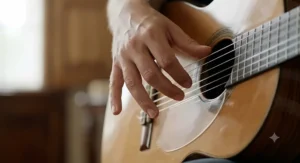
In practice, golpe is played with the ring finger (occasionally middle finger) striking the tap plate in time with the underlying rhythm (compás), most commonly on the off-beats or specific accented counts depending on the palo being played — bulerías, tangos and rumba each have distinct golpe placement conventions. The tap plate exists precisely because this technique, repeated across a practice session and multiplied over years, would otherwise wear straight through a guitar’s lacquer and eventually the top wood itself. Beginners often strike too hard, assuming volume equals authenticity, when in reality controlled, consistent tap velocity blending with the strum (rasgueado) pattern is what creates flamenco’s signature rhythmic texture rather than a loud, disconnected thud.
A useful practice method: isolate golpe on its own against a slow metronome click before layering it back into full rasgueado-and-golpe combination patterns, since trying to learn both simultaneously is the single biggest reason beginners develop inconsistent timing that takes months to unlearn later.
Cypress Back and Sides: Why This Tonewood Defines Flamenco Sound
Cypress deserves its own section because it’s arguably the single most defining material choice in traditional flamenco lutherie, and yet it’s frequently glossed over as just “the traditional wood” without explaining why it earned that status.
Mediterranean cypress is lightweight, relatively soft, and — critically — produces a bright, dry, percussive tone with fast decay rather than the long, warm sustain rosewood delivers. That fast decay is not a limitation; it’s the entire point for flamenco, where notes need to separate cleanly during rapid picado runs and rasgueado bursts rather than blur together under long ringing overtones. Builders sourcing cypress from Andalusia and neighbouring regions have historically favoured this wood partly for its acoustic properties and partly for practical, historical reasons — it grew locally and was affordable for the working-class musicians who developed the style, unlike imported tropical hardwoods.
Solid cypress, as found in the Cordoba F10 Luthier Series, Alhambra 7FC and higher-tier models on this list, differs meaningfully from laminated cypress veneers used on entry-level guitars: solid wood vibrates as a single resonant unit and continues to “open up” tonally over years of playing, while laminate stays acoustically static from day one. If cypress tone is the priority over budget, that’s the clearest signal to prioritise solid-wood construction over any other spec on the sheet.
Best Flamenco Guitar Brands: Who’s Who in Spanish Lutherie
A handful of brands dominate this market for good reason, and knowing their reputations helps contextualise a purchase beyond just the spec sheet. Cordoba, a US-headquartered company manufacturing extensively in partnership with workshops in Spain and Asia, has built its reputation on making traditionally-voiced flamenco and classical guitars accessible at a wide range of price points, from entry-level laminates through to the handcrafted Luthier Series. Alhambra, based in Muro de Alcoy, Spain, manufactures entirely in-house and is widely regarded among conservatoire teachers as a benchmark for professional-tier flamenco and classical instruments, particularly their Concert and Luthier ranges.
Yamaha brings Japanese manufacturing rigor to the category — less romantic a story than a family Spanish workshop, but genuinely valuable for consistency-conscious buyers. Ortega, a German-founded brand producing extensively in Spain, has carved out a niche blending traditional construction with modern touches like two-way truss rods and 12-hole bridges, plus a growing roster of artist signature models. Admira, another Spanish manufacturer, focuses heavily on the entry-level and student market, making it a sensible first port of call for beginners rather than advanced players.
Beyond this list’s featured models, other respected names worth researching as you progress include Manuel Rodriguez, Raimundo, and Paco Castillo — all Spanish workshops with strong reputations specifically within flamenco circles, even if they’re less prominently stocked on mainstream UK retail sites than Cordoba or Yamaha.

How to Choose a Flamenco Guitar
- Set your budget honestly first. Decide whether you’re testing the waters (under £250) or committing long-term (£600+), since that single decision eliminates most of the guesswork below.
- Prioritise solid top over solid back/sides if budget is tight. A solid spruce or cedar top with laminate back and sides still delivers meaningfully better tone than an all-laminate build, and costs far less than all-solid construction.
- Check the nut width against your hand size. Traditional flamenco necks run narrower (50-52mm) than classical (52-53mm) — try before buying if you have larger hands, or lean toward a crossover model like the Cordoba GK Studio.
- Confirm a tap plate is fitted (or budget to add one). Without it, golpe technique will damage the lacquer over time.
- Decide if you need onboard electronics now, not later. Retrofitting a quality pickup system costs more than buying a guitar with one built in, like the Cordoba GK Studio or Ortega BWSM/2.
- Factor in humidity control for UK conditions. Solid-wood guitars need a case humidifier through British winters; laminate models are more forgiving if you’re not ready for that extra care routine.
- Try before you buy wherever possible. Specs predict a lot, but action feel and tonal character still vary guitar to guitar, especially on handmade Spanish models.
Flamenco Guitar for Beginners vs Advanced Players
Beginners genuinely don’t need — and arguably shouldn’t buy — a £1,000+ instrument on day one, because early-stage technique flaws (excess string buzz from heavy-handed golpe, inconsistent rasgueado) can’t be fixed by better wood, and a cheaper guitar that gets knocked about during early lessons is far less stressful to own. The Admira Triana EF or Yamaha CG172SF cover this stage well, offering genuine flamenco-spec setup without professional-tier pricing.
Advanced players and teachers, by contrast, have technique refined enough to actually exploit what solid cypress, ebony fingerboards and precision bracing offer — faster response, cleaner articulation at speed, and tonal nuance that simply doesn’t register on an instrument still being learned on. That’s the point at which the Alhambra 7FC or Ortega BWSM/2 start paying for themselves in ways a beginner literally couldn’t perceive yet. If you’re unsure which camp you’re in, a reasonable rule of thumb is whether you can already play a full compás of bulerías or soleá cleanly at tempo — if not, save the upgrade money for another year or two of lessons instead.
Real-World Scenario: Matching Guitars to Players
Meet three hypothetical but realistic buyers. First, a university student who’s just discovered flamenco through a Spanish-culture module and wants to learn casually alongside coursework, with roughly £200 to spend and nowhere secure to store an expensive instrument in shared accommodation — the Admira Triana EF fits perfectly here, low-risk and genuinely playable.
Second, a working adult who took classical guitar lessons a decade ago, has rediscovered the instrument, and practises most evenings with genuine long-term intent — the Cordoba F10 Luthier Series or Ortega R270F suit this profile well, offering real tonal reward for consistent practice without overcommitting financially before they know if flamenco specifically (rather than guitar generally) is the passion.
Third, a semi-professional player who teaches weekend classes and occasionally performs at local tablaos, needing reliability, stage-ready electronics, and a sound that projects in a room with a cajón and singer competing for space — the Cordoba GK Studio is the obvious match, built specifically for exactly that scenario.
Common Mistakes When Buying a Flamenco Guitar
The most frequent mistake is buying based on looks rather than specs — a glossy black “negra” finish looks striking, but tonewood and construction matter far more to actual playability than cosmetic finish, and buyers sometimes overspend on aesthetics while under-spending on the wood underneath. A close second is ignoring nut width entirely; players with larger hands who buy a traditionally narrow 50mm-nut guitar sometimes struggle with cramped left-hand technique for months before realising the guitar itself is the problem, not their skill.
Another common error is assuming any nylon-string guitar will “do” for flamenco, when in fact a standard classical guitar’s higher action and lack of tap plate genuinely hinders technique development rather than just sounding slightly different. Buyers also frequently underestimate ongoing costs — strings, humidity control, periodic setup checks — treating the guitar’s purchase price as the only cost rather than budgeting for the accessories that keep it playing well. Finally, some buyers skip trying an instrument in person entirely when it’s available locally, relying purely on online specs and reviews for a decision that’s ultimately about how a specific piece of wood feels and sounds in your hands.
Long-Term Cost & Maintenance
Thinking in total cost of ownership rather than sticker price changes the value calculation considerably. A £220 laminate beginner guitar might need a full restring (£15-£20), a proper setup (£40-£60) and potentially a tuner replacement within 18 months, pushing real first-year cost closer to £300. A £700+ solid-wood guitar, by contrast, typically holds its setup longer, rarely needs tuner replacement, and — because solid tonewood improves with age rather than degrading — often retains stronger resale value if you eventually upgrade again.
Ongoing costs across the board include: strings (£10-£20 every 3-6 months depending on practice frequency), an annual or bi-annual professional setup check (£40-£70), and a case humidifier system (roughly £15-£30 one-off) for solid-wood instruments in UK climates. Electronics-equipped guitars like the Cordoba GK Studio or Ortega BWSM/2 carry a small additional long-term risk of preamp battery replacement or, rarely, pickup faults, though quality systems from Fishman are generally reliable across years of gigging use.
Features That Actually Matter (And Those That Don’t)
Genuinely important: solid top wood, correctly set low action, a well-fitted tap plate, and nut width matched to your hand. These directly affect playability and tone from the first strum. Less important than marketing suggests: exotic back-and-side woods beyond the traditional cypress/maple/walnut range (visually striking, but rarely tonally superior for flamenco specifically), elaborate rosette or purfling decoration (purely cosmetic), and headline “hand-carved” claims on guitars where the actual construction process isn’t otherwise disclosed — a genuinely hand-finished guitar should show that in fret work and setup quality, not just in marketing copy.
Onboard electronics matter enormously if you gig or record, and not at all if you play purely at home or in lessons — it’s a use-case-specific feature, not a universal quality marker. Similarly, a cutaway body (as on the Cordoba GK Studio) only matters if your repertoire genuinely uses the upper frets; traditional flamenco palos rarely venture there, so it’s a feature worth paying for only if your playing style specifically calls for it.
Safety, Regulations and Buying Compliance
If you’re buying a flamenco guitar online from outside the UK or importing a handmade Spanish instrument privately, be aware of standard customs duty and VAT rules that apply to musical instruments entering the UK — guidance is available directly from HM Revenue & Customs via the gov.uk import duty and VAT guidance. For UK-based purchases through Amazon.co.uk or established retailers, standard Consumer Rights Act protections apply, covering faulty goods and misdescribed instruments.
On the instrument itself, be cautious of any solid tropical hardwood species that may fall under CITES (Convention on International Trade in Endangered Species) restrictions — some rosewood species are regulated for international trade, though cypress, maple, spruce and cedar used across all seven guitars in this guide are not currently restricted species, so this is a genuine but narrow concern mainly relevant if you’re shopping premium rosewood-back classical-crossover models rather than traditional flamenco cypress builds.
Buyer’s Decision Framework
If you’re testing whether flamenco is right for you, choose an entry-level laminate-hybrid guitar under £300, because the financial risk is low and the guitar remains genuinely playable if you stick with it. If you’re committed and practising regularly but not yet performing publicly, choose a solid-top, solid-back guitar in the £600-£1,100 range, because that’s where tonal reward for consistent practice becomes clearly audible. If you perform live or record professionally, prioritise onboard electronics and stage-tested reliability over marginal tonal upgrades, since a slightly less “pure” tone that projects reliably through a PA beats a beautiful unplugged tone nobody in the back row can hear.
What to Expect: Real-World Performance
On paper, spec sheets promise “bright, percussive tone” and “fast action,” but here’s what that actually feels like across a practice session. A well-set-up flamenco guitar should let picado runs feel almost effortless compared with a classical guitar’s higher action — your fretting hand simply doesn’t have to work as hard to get a clean note. Rasgueado, by contrast, will feel more physically demanding than it sounds on recordings, since sustained multi-finger strumming patterns genuinely fatigue the forearm until conditioning builds up over weeks of regular practice.
Golpe technique will feel oddly quiet at first on a laminate-bodied budget guitar compared with videos of professional players, simply because laminate construction dampens percussive resonance more than solid wood — this is normal, not a fault, and it’s one of the clearest audible arguments for upgrading to solid construction once your technique catches up with your ambition.
Flamenco Guitar for Specific Audiences
For complete beginners, prioritise low action and forgiving laminate construction over tonal purity — the Admira Triana EF remains the standout here. For returning classical players adapting to flamenco technique, the narrower nut width and lower action of models like the Ortega R270F will feel unfamiliar initially; budget a genuine adjustment period rather than assuming your existing classical technique transfers instantly. For crossover musicians moving between pop, folk and flamenco styles, the Cordoba GK Studio‘s slimmer neck profile and onboard electronics offer the most forgiving transition. For dedicated flamenco students on a conservatoire or serious private-tuition track, the Alhambra 7FC represents the kind of investment teachers themselves tend to recommend once technique justifies it.

Frequently Asked Questions
❓ Can I play flamenco on a normal classical guitar?
❓ What's the difference between flamenco blanca and negra guitars?
❓ Do flamenco guitars need special strings?
❓ How much should a beginner flamenco guitar cost?
❓ Is cypress or rosewood better for flamenco?
Conclusion
Choosing between these seven guitars ultimately comes down to being honest about where you actually are in your flamenco journey, not where you’d like to imagine yourself in three years. The Admira Triana EF and Yamaha CG172SF exist to remove financial risk from the learning phase; the Ortega R270F and Cordoba F10 Luthier Series reward players who’ve committed to regular practice with genuinely audible tonal improvement; and the Cordoba GK Studio, Alhambra 7FC and Ortega BWSM/2 serve gigging musicians and advanced students whose technique can actually exploit what premium construction offers.
What matters more than any single spec is matching the guitar’s action, nut width and tonal character to your actual hands and actual playing level today — a guitar that’s technically “better” but uncomfortable to play will teach you less than a humbler instrument that fits properly. Research the real specs, try instruments in person where you can, and remember that even the most modest guitar on this list, set up correctly and played consistently, will take you a very long way into flamenco’s rhythmic, percussive world.
Recommended for You
- 7 Best Classical Guitars for Beginners in 2026
- Dreadnought for Strumming: 7 Loud, Chord-Ready Picks (2026)
- Dreadnought for Fingerpicking: 7 Best Picks Tested for 2026
Disclaimer: This article contains affiliate links. As an Amazon Associate, I earn from qualifying purchases. If you purchase products through these links, we may earn a small commission at no additional cost to you.
✨ Found this helpful? Share it with your friends! 💬🤗
