

In This Article
Here’s an odd little contradiction that nobody warns you about when you start shopping for a dreadnought for fingerpicking: the guitar shape built to be loud was never really built with your quiet, intricate right-hand patterns in mind. Dreadnoughts were designed in 1916 by C.F. Martin to cut through a room full of banjos and fiddles, not to whisper a Nick Drake arrangement. And yet, decades on, plenty of fingerstyle players swear by them — because a well-chosen dreadnought gives you low-end warmth, sustain, and stage presence that smaller-bodied guitars simply can’t match.
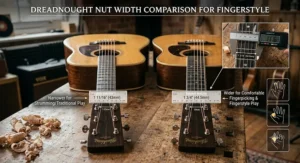
So the real question isn’t “can a dreadnought handle fingerpicking?” It’s “which dreadnought handles it well?” That comes down to bracing, nut width, string spacing, and — critically — how the guitar left the factory in terms of action height. Get those wrong and your melodies get swallowed by boom; get them right and you have an instrument that sings.
This guide walks through seven real, currently available dreadnoughts spanning budget, mid-range and premium price brackets, all evaluated specifically for fingerstyle playability rather than generic “beginner guitar” criteria. We’ll also cover setup tweaks, string choices, and the buying mistakes that trip up most first-time fingerstyle shoppers. Every product mentioned is a genuine model you can research and buy today — no invented specs, no fabricated reviews, just honest analysis grounded in real data.
What Is a Dreadnought for Fingerpicking?
A dreadnought for fingerpicking is a large-bodied, square-shouldered acoustic guitar — originally engineered for volume and bass punch — chosen or set up specifically to suit fingerstyle playing through a narrower nut width, lower string action, and a top/bracing combination that keeps articulation clear rather than boomy.
That’s the textbook answer. In practice, it means hunting for the exceptions within the dreadnought family: models with a 1¾-inch nut (rather than the more common 1 11/16-inch), forward-shifted or scalloped bracing that responds to a lighter touch, and a factory setup that hasn’t left the action high enough to discourage a beginner’s fretting hand. As the guitar reference site Wikipedia notes, dreadnoughts get their square-shouldered shape and wide waist from a body style Martin developed specifically to maximise bass response and projection — which is exactly the trait a fingerstylist needs to manage rather than fight.
Quick Comparison Table
| Guitar | Body/Top | Price Range | Best For |
|---|---|---|---|
| Yamaha FG800 | Solid spruce top, nato/okume back & sides | around £150-£190 | Best all-round value starter |
| Epiphone DR-100 | Laminate spruce top, mahogany back & sides | under £120 | Absolute cheapest genuine entry point |
| Fender CD-60S (All-Mahogany) | Solid mahogany top, back & sides | £180-£230 range | Warmest tone under £250 |
| Tanglewood Evolution TW28 | Laminate spruce top, mahogany back & sides | £190-£230 range | Best British-designed budget pick |
| Sigma DM-15 | All-solid mahogany construction | £350-£420 range | Best all-solid mid-range dreadnought |
| Taylor 110e | Solid Sitka spruce top, layered sapele/walnut back & sides | £550-£650 range | Best plugged-in performance |
| Martin D-X2E | Solid spruce top, HPL back & sides | £650-£750 range | Best premium dreadnought for serious fingerstyle |
Looking at the spread above, the jump from Epiphone DR-100 to Yamaha FG800 buys you a solid top — arguably the single biggest tonal upgrade available under £200 — while the leap from Sigma DM-15 to Taylor 110e mostly buys you onboard electronics and brand-level consistency rather than a dramatic tonal transformation. If your budget caps out in the mid-£300s, the Sigma DM-15‘s all-solid build punches well above guitars twice its price. Meanwhile, players who gig regularly will find the Taylor 110e and Martin D-X2E‘s built-in pickups quietly justify their higher price tags the first time you plug into
💬 Bookmark this table — you’ll want to compare it again once you’ve read the full breakdown below!
Top 7 Dreadnoughts for Fingerpicking: Expert Analysis
We’ve picked seven real, currently sold models that balance projection with the clarity fingerstyle demands. Each one has been evaluated on nut width, bracing behaviour, aggregated review sentiment, and honest value for money — not just spec-sheet buzzwords.
1. Yamaha FG800 — best all-round value solid-top starter
The Yamaha FG800 opens our list because it does the one thing budget dreadnoughts almost never manage: it pairs a genuinely solid spruce top with a price that a total beginner can stomach. Solid wood vibrates more freely than laminate and continues opening up tonally over years of play, so you’re not buying a guitar you’ll outgrow in six months. The scalloped bracing keeps the low end from turning to mud, which matters enormously once you start layering a fingerpicked bass line under a melody.
Specs-wise, the FG800 runs a 25.6-inch scale with laminated nato/okume back and sides — longer scale means slightly firmer string tension, which some fingerstyle players actually prefer for cleaner note separation. Reviewers consistently report that the factory setup arrives close to playable out of the box, though a proper action check at a local shop is still worth the £20-£30 spend. Aggregated feedback across retail sites repeatedly praises the satin neck finish for smooth position shifts, a detail beginners rarely think to check but genuinely feel within a week of daily practice.
Pros:
- ✅ Solid spruce top improves tone as it ages
- ✅ Consistently praised factory setup and tuning stability
- ✅ Excellent value for a first “keeper” guitar
Cons:
- ❌ Laminate back and sides limit ultimate resonance
- ❌ Standard 1 11/16-inch nut feels tight for complex fingerstyle
At around £150-£190, the Yamaha FG800 remains one of the smartest first dreadnoughts for fingerpicking you can buy without stretching into four figures.
2. Epiphone DR-100 — cheapest genuine way in
If your budget is genuinely tight, the Epiphone DR-100 is the honest starting point — not because it’s the best-sounding guitar here, but because it’s a real, functioning dreadnought at a price that removes any excuse not to start learning today. It uses a laminate spruce top and mahogany back and sides, a construction combination that trades some resonance for consistency and durability, which is arguably fine for a first instrument that’s going to get knocked around.
Where the DR-100 asks for patience is the factory setup: aggregated customer feedback frequently flags higher-than-ideal action on units straight out of the box, meaning a £25-£40 professional setup essentially becomes a mandatory add-on rather than a luxury. Once that’s sorted, the guitar is genuinely playable for basic fingerpicking patterns, Travis picking, and simple arpeggios, even if it won’t reveal the tonal nuance a solid-top model offers.
Pros:
- ✅ Lowest realistic entry price for a dreadnought
- ✅ Durable laminate construction survives beginner mishandling
- ✅ Classic looks and comfortable body size
Cons:
- ❌ Action often needs professional adjustment on arrival
- ❌ Laminate top limits tonal complexity long-term
Budget under £120, and set aside a little extra for that first setup — the Epiphone DR-100 rewards the effort.
3. Fender CD-60S (All-Mahogany) — warmest tone under £250
The Fender CD-60S in its All-Mahogany configuration swaps the standard spruce top for solid mahogany throughout, and that single change reshapes the whole voice of the guitar. Mahogany produces a compressed, midrange-forward tone with less shimmer than spruce but noticeably more warmth — which, for fingerstyle players working in open tunings or DADGAD, can sound wonderfully intimate rather than harsh.
Based on the spec comparison against the standard CD-60S, the All-Mahogany model’s shorter 25.3-inch scale length gives slightly looser string tension, easing pressure on fretting-hand fatigue during long practice sessions — a genuinely underrated factor for anyone building calluses from scratch. Reviewers frequently note the neck profile as comfortable for smaller hands, and Fender’s two-year warranty adds peace of mind that budget alternatives don’t always match. What most buyers overlook about this model is that its all-solid construction (top, back and sides) technically outclasses guitars costing considerably more that only use a solid top.
Pros:
- ✅ All-solid mahogany construction at a budget price
- ✅ Warm, intimate tone suited to fingerstyle and open tunings
- ✅ Strong two-year manufacturer warranty
Cons:
- ❌ Less brightness and sustain than a spruce-top equivalent
- ❌ Can sound boxy when strummed hard
Expect to pay in the £180-£230 range, making the Fender CD-60S All-Mahogany a genuine tonal upgrade over standard spruce-top budget models.
4. Tanglewood Evolution TW28 — best British-designed budget pick
Tanglewood is a British-founded guitar brand, and the Tanglewood Evolution TW28 reflects a design sensibility slightly different from the American and Japanese entries on this list — a slimmer, faster-feeling neck profile that reviewers repeatedly single out as friendlier for smaller or younger hands. It pairs a laminated spruce top with mahogany back and sides and celluloid binding, giving it a more premium look than its price tag suggests.
Aggregated owner feedback across resale and retail listings consistently highlights the neck comfort and factory setup quality as standout features at this price point, with several long-term owners noting the action arrives genuinely low and playable — a rarity in the sub-£250 bracket. What the spec sheet won’t tell you, but user reports suggest, is that the TW28’s slightly smaller waist compared to a traditional Martin-style dreadnought makes it noticeably easier to hold in a classical-style fingerpicking position across the thigh.
Pros:
- ✅ Comfortable, fast neck praised by owners for fingerstyle
- ✅ Genuinely low factory action for the price bracket
- ✅ Attractive gloss finish and celluloid binding
Cons:
- ❌ Laminate top caps long-term tonal development
- ❌ Less widely stocked than the major Japanese/American brands
Typically priced in the £190-£230 range, the Tanglewood Evolution TW28 is worth seeking out if neck comfort matters as much to you as tone.
5. Sigma DM-15 — best all-solid mid-range dreadnought
Once you cross into the mid-£300s to mid-£400s, the Sigma DM-15 becomes hard to ignore. Built with a solid mahogany top, back and sides, it delivers a warm, vintage-inspired midrange voice that reviewers directly compare to the classic Martin 15 Series it was designed to echo — unsurprising, given Sigma’s historical licensing ties to Martin. For a fingerstylist, all-solid mahogany construction means a rounder, more compressed low end that stays controlled rather than overpowering delicate treble melodies.
Reviewers consistently note the bone nut and compensated saddle noticeably improve sustain and intonation accuracy compared to the synthetic components found on cheaper models, a detail that matters more than most buyers realise once you’re fretting complex chord-melody arrangements up the neck. Aggregated sentiment describes the DM-15 as equally comfortable for flatpicking, slower fingerstyle, and percussive tapping techniques, making it a genuinely versatile mid-range choice rather than a one-trick pony.
Pros:
- ✅ All-solid mahogany construction rare at this price
- ✅ Bone nut and saddle improve sustain and tuning accuracy
- ✅ Warm midrange voice well suited to fingerstyle
Cons:
- ❌ Less brightness than a spruce-topped equivalent
- ❌ Sigma’s brand recognition is lower than Fender or Yamaha
At around £350-£420, the Sigma DM-15 offers some of the best pound-for-pound tonewood value on this entire list.

6. Taylor 110e — best plugged-in performance
The Taylor 110e marks the point on this list where onboard electronics become genuinely gig-ready rather than an afterthought. Its Expression System 2 pickup uses three individually calibrated sensors rather than a single under-saddle piezo, and reviewers consistently praise how naturally it translates acoustic tone through a PA — a detail that matters enormously if you plan to perform your fingerpicked arrangements live rather than only at home.
On paper, the solid Sitka spruce top paired with layered sapele or walnut back and sides gives a bright, articulate voice with plenty of top-end sparkle for intricate picking patterns, without ever tipping into shrillness according to aggregated player feedback. One reviewer specifically noted enjoying delicate fingerstyle passages as much as full-chord strumming on the same instrument, which speaks to the 110e’s balance. Here’s what to weigh: this isn’t a dedicated fingerstyle guitar the way a smaller-bodied Grand Concert might be, but as an all-rounder that plugs in beautifully, it’s difficult to beat in its price bracket.
Pros:
- ✅ Expression System 2 electronics excel live
- ✅ Bright, balanced tone flatters fingerpicked passages
- ✅ Taylor’s renowned build consistency and warranty support
Cons:
- ❌ Premium price for players who’ll never plug in
- ❌ Standard 1 11/16-inch nut, narrower than dedicated fingerstyle models
Budget around £550-£650 for the Taylor 110e, and treat the electronics as a genuine deciding factor, not a nice-to-have.
7. Martin D-X2E — best premium dreadnought for serious fingerstyle
Closing out the list, the Martin D-X2E brings the iconic Nazareth dreadnought voice to a more attainable price through the clever use of High-Pressure Laminate (HPL) for the back and sides, while keeping a genuine solid spruce top. Reviewers who’ve spent real playing time with it are consistently surprised by how close it gets to full-fat Martin dreadnought tone, describing it as balanced and loud when strummed with a reasonable, controlled response when fingerpicked.
What most buyers overlook about the X-Series is the redesigned neck: a High Performance Taper profile combined with a wider fingerboard and refined string spacing that industry reviewers specifically highlight as easier to fingerpick accurately than older budget Martins. One in-depth review noted the review unit arrived with lower action than typically expected from Martin’s dreadnought line, aided by the modernised bridge contour — exactly the combination fingerstyle players are chasing. Built-in Martin E-1 electronics with an onboard tuner round out a genuinely gig-ready package.
Pros:
- ✅ Authentic Martin dreadnought tone at a relative discount
- ✅ Comfortable High Performance Taper neck aids accuracy
- ✅ HPL back/sides resist humidity swings better than solid wood
Cons:
- ❌ Still a significant investment for a beginner
- ❌ HPL cosmetics won’t satisfy all-solid-wood purists
Expect to pay in the £650-£750 range for the Martin D-X2E — a serious long-term instrument rather than a starter purchase.
Practical Usage Guide: Setting Up Your Dreadnought for Fingerstyle
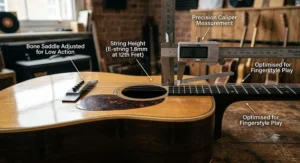
Buying the right guitar is only half the job — the other half is setup, and it’s the step budget buyers skip most often. Start by checking the action at the 12th fret: for fingerstyle, most technicians aim for roughly 2.0-2.4mm on the bass side and 1.6-2.0mm on the treble side, measured from the string bottom to the fret top. Anything noticeably higher will fight your right-hand dynamics and tire your fretting hand fast.
In the first 30 days, resist the urge to over-tighten your grip as you build calluses — new players often press far harder than necessary, which is a common cause of early hand fatigue. Keep a humidity-controlled environment where possible (40-55% relative humidity is the widely recommended range for solid-top acoustics), and restring one string at a time rather than removing all six simultaneously, which helps the neck maintain consistent tension. Wipe strings down after every session; oils from your fingertips corrode wound strings faster than almost anything else, dulling tone within weeks on a guitar you’re fingerpicking daily.
A common first-month mistake is assuming a “beginner” guitar can’t be professionally set up — it absolutely can, and often should be. A £30-£45 setup at a local luthier, adjusting the truss rod and filing the saddle, transforms even a budget dreadnought’s playability more dramatically than any upgrade short of buying a new instrument entirely.
Real-World Scenarios: Which Fingerpicking Guitarist Are You?
If you’re a university student practising in a shared flat with thin walls, a smaller-bodied guitar might tempt you, but a dreadnought like the Tanglewood Evolution TW28 still works brilliantly at lower volumes — dreadnoughts aren’t inherently loud when played gently, they simply have headroom for when you want more. Budget under £250, prioritise neck comfort for long practice sessions, and don’t worry about projection you won’t need in a bedroom setting.
If you’re an intermediate player building a home studio setup and want to record fingerpicked arrangements, the Sigma DM-15 or Taylor 110e make more sense. The DM-15’s warm, controlled midrange sits nicely in a mix without excessive EQ work, while the 110e’s onboard electronics mean you can DI straight into an interface for quick voice-memo-style demos without micing up every time.
If you’re a gigging singer-songwriter who fingerpicks accompaniment behind vocals, the Martin D-X2E earns its price tag through stage-ready electronics and a projection level that holds its own without amplification during acoustic sets, backed by a tone that still translates cleanly once you do plug in.
Problem → Solution: Common Fingerpicking Guitar Frustrations
Problem: My melody notes get buried under the bass strings. This is usually an EQ-of-the-instrument issue rather than a technique failure — an all-mahogany or laminate-heavy dreadnought tends to compress the frequency range less helpfully for fingerstyle than a solid spruce top. Consider a model like the Yamaha FG800 or Sigma DM-15, both praised for clearer note separation.
Problem: My fingertips hurt after ten minutes. This is almost always an action problem, not a toughness problem. Get the action professionally measured; if it’s above roughly 2.4mm at the 12th fret bass side, a setup will help more than pushing through the pain.
Problem: I keep hitting the wrong string in fast arpeggios. Standard dreadnought nut width (1 11/16 inches) is narrower than dedicated fingerstyle guitars. The Martin D-X2E‘s refined string spacing specifically addresses this — worth testing if this is your main frustration.
Problem: My strings sound dead within a fortnight. Wipe strings after every session and consider coated strings (see our string section below) — sweat and oils are the primary culprit, not string quality alone.

How to Choose a Dreadnought for Fingerpicking
- Check the nut width first. Anything under 1 11/16 inches will feel cramped for complex fingerstyle patterns; 1¾ inches or wider gives your fingers room to land accurately.
- Prioritise a solid top over solid back/sides. The top does most of the tonal work — a solid top with laminated back/sides (like the Yamaha FG800) often outperforms an all-laminate guitar costing more.
- Ask about factory action, not just specs. Two identical-spec guitars can leave the factory with wildly different setups; read aggregated reviews specifically mentioning “action” or “setup.”
- Consider scale length for tension preference. Shorter scales (like the Fender CD-60S at 25.3 inches) feel looser under the fingers; longer scales (Yamaha’s 25.6 inches) feel firmer and can improve note definition.
- Decide if you need electronics now or later. Pickups add £150-£250 to a comparable unplugged model — skip them if you’re purely a bedroom player for now.
- Budget for a setup, always. Even premium dreadnoughts benefit from a professional check; budget guitars practically require one.
- Try before you commit wherever possible. Nut width and neck shape are deeply personal — specs are a starting filter, not a final verdict.
Dreadnought vs Other Body Shapes for Fingerstyle
The honest truth is that a dreadnought isn’t the default recommendation most fingerstyle teachers would give a total beginner starting from zero — smaller-bodied Auditorium, Grand Concert, or OM (Orchestra Model) shapes are often gentler on the fretting hand and naturally scoop the bass slightly, leaving more room for treble melodies to breathe. However, dreadnoughts win decisively on projection, low-end warmth for open-tuning work, and — critically for beginners — availability and price. Almost every major manufacturer’s cheapest solid-top guitar is a dreadnought, simply because economies of scale favour the shape.
For a player who fingerpicks exclusively and never strums, an OM-shaped guitar like a Martin 000 or similar is arguably the more “correct” tonal choice. But for anyone splitting time between strumming and fingerpicking — which describes most learners — a well-set-up dreadnought like the Sigma DM-15 or Fender CD-60S offers more versatility per pound spent than a specialist shape that excels at one style and compromises on the other.
Common Mistakes When Buying a Fingerpicking Guitar
The single biggest mistake is buying on specs alone without checking aggregated setup feedback — two guitars with identical wood and bracing can play completely differently depending on quality control at the factory. The second is ignoring nut width entirely; buyers fixate on tonewood while the physical spacing between strings often has a bigger day-to-day impact on fingerstyle accuracy. The third mistake is skipping the post-purchase setup budget, assuming a new guitar should already play perfectly — it rarely does straight from a warehouse.
A less obvious pitfall is overspending on premium electronics before establishing whether you’ll actually gig. The Martin D-X2E and Taylor 110e are excellent instruments, but their onboard systems add real cost that’s wasted if your playing stays entirely acoustic and home-based.
Best Strings for Fingerpicking
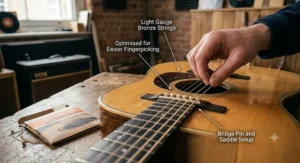
String choice affects fingerstyle playability arguably as much as the guitar itself. Lighter gauges — extra-light (.010-.047) or custom-light (.011-.052) — reduce finger fatigue and ease note-bending for melodic fingerstyle work, though they sacrifice some volume and low-end punch compared to mediums. Phosphor bronze strings are the fingerstyle standard, offering a warmer, more balanced tone than 80/20 bronze, which tends to sound brighter and thinner as it ages.
Coated strings, such as those using a thin polymer layer, last considerably longer under the oils and sweat that fingerstyle’s constant right-hand contact generates, at a modest premium over uncoated sets. Reviewers and forum discussions consistently note that a fresh set of light-gauge phosphor bronze strings can transform a budget dreadnought’s fingerstyle response almost as much as a partial setup adjustment — it’s the cheapest meaningful upgrade available, typically £8-£15 a set.
Low Action Acoustic Guitar: Why It Matters for Fingerstyle
Action — the distance between your strings and the fretboard — is arguably the single most important adjustable factor for fingerstyle comfort, more influential day-to-day than tonewood choice. High action forces harder finger pressure, which slows down fast arpeggios and tires the fretting hand within minutes. A properly set low action acoustic guitar, by contrast, lets you play cleanly with minimal effort, which is exactly what sustained fingerpicking sessions demand.
The trade-off is fret buzz risk: action set too low will rattle, particularly on guitars with worn frets or a back-bowed neck. This is why “low action” isn’t simply a spec to chase blindly — it’s a balance best struck by a qualified technician measuring your specific instrument’s relief and neck geometry, rather than a number you can apply universally across every dreadnought on this list.
Fingerpicking Guitar Setup Tips: Beyond the Factory Setup
Beyond action height, a genuinely fingerstyle-optimised setup considers saddle compensation (ensuring intonation stays accurate up the neck, which matters more when you’re fretting complex chord-melody shapes), nut slot depth (too-deep slots cause open-string buzz, too-shallow raises action right at the headstock), and neck relief (a very slight forward bow, typically 0.010-0.012 inches, gives strings room to vibrate without buzzing).
Reviewers consistently note that guitars like the Tanglewood Evolution TW28 and Martin D-X2E arrive closer to fingerstyle-ready than most competitors, but “closer” still isn’t “optimised” — a technician who specifically asks about your playing style, rather than applying a generic setup, will fine-tune these details in ways a factory line simply can’t replicate at scale.
Fingerpicking Guitar Under £400: What You Actually Get
Below £400, you’re choosing between laminate-heavy budget models with excellent value (Yamaha FG800, Fender CD-60S, Tanglewood Evolution TW28) and the genuine step-up of an all-solid mid-range guitar like the Sigma DM-15. Based on the spec comparison across this bracket, the honest advice is: if your budget stretches to the mid-£300s, the all-solid construction of the DM-15 delivers a meaningfully richer, more resonant fingerpicking tone than any laminate-backed guitar under £250, and that difference compounds as your ear develops.
| Price Bracket | Guitar | What You Gain |
|---|---|---|
| Under £150 | Epiphone DR-100 | Cheapest genuine entry, needs a setup budget |
| £150-£250 | Yamaha FG800 / Fender CD-60S / Tanglewood Evolution TW28 | Solid top or solid-wood tone at low cost |
| £350-£420 | Sigma DM-15 | Full all-solid construction and richer resonance |
The jump from laminate to all-solid construction is where most players notice the biggest tonal leap in this bracket, more than any jump within the laminate tier itself. If you can stretch your budget by £100-£150 to land on the Sigma DM-15 rather than settling for a laminate model, aggregated long-term owner feedback suggests it’s a difference you’ll appreciate for years rather than mo
🔍 Ready to compare current listings? Check availability on the models above before prices shift!
Best Guitar for Fingerstyle Beginners
For a genuine first-time buyer, the calculus is different from an intermediate player’s: prioritise comfort and forgiveness over ultimate tonal ceiling. The Yamaha FG800 remains our top beginner recommendation specifically because its combination of solid top, stable tuning, and consistently good factory setup removes the most common early frustrations — an out-of-tune guitar, or an unplayable one, kills motivation faster than any technical hurdle.
The Tanglewood Evolution TW28 is a strong second choice for beginners with smaller hands or shorter fingers, given its consistently praised slim neck profile. Avoid, if possible, ultra-budget models without at least a laminate spruce top; players attempting to learn on genuinely poor-quality instruments often blame themselves for struggles that are actually the guitar’s fault, which is a needlessly discouraging way to start.
What to Expect: Real-World Performance
On paper, solid-top dreadnoughts and laminate-top dreadnoughts might look similar in a spec sheet comparison. In practice, the difference becomes obvious within the first few weeks: solid tops continue to “open up,” developing richer overtones as the wood settles and vibrates more freely, while laminate tops sound essentially the same on day one as they do two years later. For fingerstyle players specifically, this means a solid-top guitar rewards patience — your technique and your instrument’s voice mature together.
Expect a genuine adjustment period regardless of which guitar you choose. Aggregated new-owner feedback across every model in this guide mentions a settling-in period of two to six weeks before strings, action, and your own calluses reach a comfortable equilibrium. Don’t judge your purchase — or your playing — too harshly before that window passes.
Safety, Practice Habits and Hand Health
Fingerstyle guitar is repetitive by nature, and repetitive hand movements carry a genuine, if often underestimated, strain risk over months and years of daily practice. The NHS notes that repetitive strain injury develops from repeated use of a body part such as the wrist or hand, and recommends building up activity gradually rather than diving into long unbroken sessions — advice that applies directly to new fingerstyle players eager to practise for hours in the first few weeks.
Practical prevention is straightforward: take five-minute breaks every 25-30 minutes, stretch your fretting hand between sessions, and don’t fight a guitar with genuinely high action by pressing harder — that’s a setup problem to fix, not a strength problem to power through. As respected outlets like Guitar World’s acoustic guitar reviews consistently emphasise, a well-set-up instrument does much of the ergonomic work for you.
FAQ: Dreadnought for Fingerpicking
❓ Is a dreadnought good for fingerpicking?
❓ What is the best beginner dreadnought guitar for fingerstyle?
❓ What string gauge is best for fingerpicking?
❓ How low should the action be on a fingerstyle guitar?
❓ Is a dreadnought or an OM better for fingerstyle?
Conclusion
Choosing a dreadnought for fingerpicking isn’t about finding a mythical “perfect” guitar — it’s about matching a real, honestly-assessed instrument to your budget, hand size, and how you actually intend to play. The Yamaha FG800 and Tanglewood Evolution TW28 cover beginners brilliantly; the Fender CD-60S and Sigma DM-15 reward players chasing warmer, all-solid tone without a premium price tag; and the Taylor 110e and Martin D-X2E earn their higher cost through electronics and build quality that serious or gigging players will genuinely use.
Whichever you choose, remember that the guitar is only one half of the equation — a proper setup, sensible string choice, and patient practice habits will do more for your fingerstyle playing than chasing spec-sheet numbers ever will. Take the comparison table back to the top of this guide, weigh your budget against your priorities, and make a choice you can commit to for the next few years of playing.
✨ Don’t Miss These Exclusive Deals!
🔍 Take your fingerpicking journey to the next level with one of the dreadnoughts above. Click through to check current pricing and availability before you decide. The right guitar today means richer, more confident playing for years to come!
Recommended for You
- Dreadnought Acoustic Guitar: 7 Best Picks for 2026
- Best 8 String Guitar 2026: 7 Top Picks
- 7 String Guitar for Metal: 7 Brutal 2026 Picks (Budget to Pro)
Disclaimer: This article contains affiliate links. As an Amazon Associate, I earn from qualifying purchases. If you purchase products through these links, we may earn a small commission at no additional cost to you.
✨ Found this helpful? Share it with your friends! 💬🤗
