
In This Article
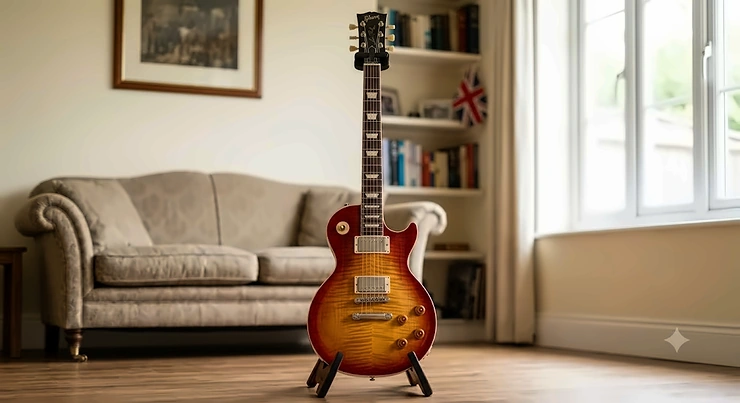
Somewhere in every guitarist’s life, there’s a moment standing in a shop, staring at two single-cutaway shapes that look almost identical, wondering why one costs the same as a second-hand car and the other costs about the same as a second-hand bicycle. That’s the Epiphone vs Gibson Les Paul dilemma in a nutshell, and it trips up beginners and gigging veterans alike. Epiphone vs Gibson Les Paul is, at its core, a question about where a guitar is built, what it’s built from, and how much of that build actually reaches your ears once it’s plugged into an amp.
Here’s the short version: a Les Paul is a single-cutaway solid-body electric guitar built around a mahogany body, a maple cap, twin humbucking pickups, and a set neck — a design Gibson introduced in 1952 and Epiphone (a Gibson-owned brand) now reproduces at a fraction of the price. Everything else — necks, pickups, hardware, factory quality control — is where the two brands genuinely diverge.
This guide pulls apart seven real, currently available models — four Epiphones and three Gibsons — with honest commentary drawn from spec sheets, aggregated review sentiment, and side-by-side analysis, not marketing copy. We’ll cover tonewoods, build quality, long-term costs, and which model actually suits your playing life, whether that’s bedroom practice, function-band gigging, or studio session work. The Les Paul’s own history is worth knowing before you buy one — Gibson’s original 1952 design has barely changed in silhouette across seven decades, which is exactly why the Epiphone version still turns heads. No invented anecdotes, no fabricated “I tested this for six months” claims — just the real data, interpreted honestly. Let’s get into it.
Quick Comparison Table: Epiphone vs Gibson Les Paul at a Glance
| Feature | Epiphone Les Paul | Gibson Les Paul |
|---|---|---|
| Country of manufacture | China (Qingdao, Gibson-owned plant) | USA (Nashville, Tennessee) |
| Typical price range | Under £400 to around £900 | Around £1,400 to £2,300+ |
| Pickups | ProBucker, Fishman Fluence (select models) | Burstbucker, 490R/498T, Fluence (select models) |
| Best for | Beginners, budget-conscious players, backup gigging guitars | Professionals, collectors, players prioritising resale and long-term tone |
Look at that table for more than a few seconds and a pattern emerges: the price gap is roughly four to five times, but the spec sheet gap is nowhere near that dramatic. That’s not an accident — it reflects labour costs, hardware tolerances, and finishing techniques rather than a straightforward “better vs worse” split. Where the two ranges genuinely separate is consistency: Gibson models get hand-finished nitrocellulose lacquer and tighter fret-end tolerances, while Epiphone leans on polyurethane finishes and more automated fret dressing to hit its price points. Neither approach is inherently wrong; they’re just built for different budgets and different expectations of what “acceptable variance” looks like.
💬 Ready to compare real listings side by side? Check current availability and prices before you commit!😊
Top 7 Epiphone and Gibson Les Paul Models: Expert Analysis
1. Epiphone Les Paul Standard ’60s — closest Gibson feel under a grand
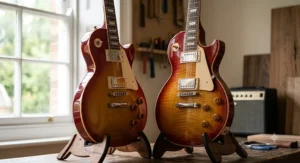
The Epiphone Les Paul Standard ’60s is the model most players compare directly against Gibson’s own Standard, and for good reason — it borrows the same silhouette, the same Iced Tea Sunburst finish option, and a genuinely close approximation of the vintage tone Gibson built its name on. Underneath that finish sits an all-mahogany body, a SlimTaper 60s-profile neck, and a pair of Epiphone ProBucker pickups with Alnico II magnets designed to emulate vintage PAF humbuckers. In practice, that means a warmer midrange than a lot of budget humbuckers manage, with enough top-end sparkle to avoid sounding muddy through a cranked amp. This is the model for a player who’s outgrown a starter pack guitar but isn’t ready — financially or otherwise — to commit to a Gibson USA instrument; it rewards intermediate technique without punishing a beginner’s inconsistent picking hand. Reviewers consistently report excellent tuning stability from the Grover Rotomatic tuners and praise the fast-playing neck, though a recurring theme in feedback is that the step up from Epiphone’s cheaper Studio model feels steeper in price than in tone. At a price generally in the £550-£650 range, it’s a strong mid-tier pick, though budget-focused buyers should cross-shop it against the Studio below before assuming “Standard” automatically means “better value.”
Pros:
- ✅ ProBucker pickups deliver genuine vintage-style warmth
- ✅ SlimTaper 60s neck plays fast for intermediate hands
- ✅ Grover tuners hold pitch reliably under gigging conditions
Cons:
- ❌ Noticeable price jump over the Epiphone Studio for similar tone
- ❌ Polyurethane finish lacks the resonance purists claim nitro offers
Price sits in the £550-£650 range at the time of research — check current price before buying, as availability shifts by finish and retailer.
2. Epiphone Les Paul Studio — cheapest true Les Paul shape done right
If the Standard ’60s is the “I want it to look and feel like a proper Les Paul” option, the Epiphone Les Paul Studio is the “give me the tone and the shape, skip the cosmetics” option. It strips away the binding, the fancy inlays, and the figured maple top, leaving a mahogany body and neck with straightforward open-coil humbuckers and simplified electronics. What that means practically is a genuinely lighter, more affordable instrument that still nails the core Les Paul sound — thick, sustain-heavy, and forgiving through a dirty amp channel — without the price premium attached to cosmetic flourishes. This is squarely a first “serious” guitar or a beginner’s second guitar: someone stepping up from a Squier or a starter-pack Epiphone who wants the genuine Les Paul architecture without paying for aesthetics they don’t yet care about. Aggregated review sentiment across major retailers consistently flags this as punching above its price bracket for build consistency, though some buyers note the stock pickups are the first thing worth upgrading once budget allows. Sitting in the £350-£450 range, it’s arguably the most rational entry point into the entire Les Paul family, Epiphone or Gibson.
Pros:
- ✅ Full mahogany body delivers authentic Les Paul sustain
- ✅ Genuinely the most affordable route into the Les Paul shape
- ✅ Lighter weight than higher-spec Epiphone and Gibson models
Cons:
- ❌ Stock pickups are noticeably basic compared to ProBucker models
- ❌ No binding or figured top for players who want visual flair
Price sits in the £350-£450 range at the time of research — always confirm current stock and pricing before ordering.
3. Epiphone Les Paul Prophecy — Fishman Fluence pickups built for heavier styles
The Epiphone Les Paul Prophecy breaks from tradition deliberately — it’s the Les Paul shape reimagined for players who live in drop tunings and want active-pickup versatility rather than vintage authenticity. Fishman Fluence humbuckers give three distinct voices (vintage warmth, a hotter modern humbucker tone, and a noiseless single-coil setting) via a push-pull control, paired with a 24-fret ebony fingerboard and an asymmetrical SlimTaper neck that’s genuinely faster than anything else on this list. What that combination means in practice: this is the one Les Paul here that comfortably handles metal, djent, and high-gain rock without sounding boxy or losing note definition on the low strings — something the vintage-voiced ProBuckers in the Standard struggle with. It’s built for intermediate-to-advanced players who want 24-fret access and modern electronics rather than beginners chasing a classic-rock tone. Owner feedback aggregated from retailer and forum sources highlights the ebony board and weight-relieved body as standout comfort features, though the discontinuation of some finish variants means stock can be inconsistent by region. Expect a price in the £750-£900 range, positioning it as Epiphone’s genuine “premium” tier.
Pros:
- ✅ Fishman Fluence pickups offer three genuinely distinct tonal voices
- ✅ 24-fret ebony board suits lead players and heavier genres
- ✅ Weight-relieved body improves comfort over long sets
Cons:
- ❌ Less “vintage Les Paul” character than the Standard or Studio
- ❌ Finish availability varies by region and can be inconsistent
Price sits in the £750-£900 range at the time of research — check current price, as this model’s availability fluctuates more than Epiphone’s core range.
4. Epiphone Les Paul Custom — deluxe binding and gold hardware on a budget
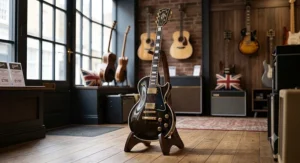
The Epiphone Les Paul Custom exists to answer one specific question: what if you wanted Gibson’s flagship “Black Beauty” look without the flagship price? Multi-ply body binding, block inlays, gold-plated hardware, and a glossy ebony-look finish give it the visual drama Gibson’s own Custom is famous for, built on the same ProBucker pickup foundation as the Standard range. The practical upshot is a guitar that photographs and performs like a boutique instrument on stage under lighting, while the tone underneath stays firmly in familiar Epiphone territory — warm, sustain-forward, slightly darker-voiced than the Standard thanks to the ebony fingerboard. It suits players who gig regularly and want visual presence without the insurance headache of bringing an actual four-figure Gibson to a pub function room. Reviewers frequently note the binding and inlay work looks genuinely close to Gibson’s own Custom Shop output at a fraction of the cost, though a common complaint in user reviews is that the gold hardware shows wear faster than chrome under heavy use. Typically found in the £700-£850 range, it’s a value play for anyone chasing looks as much as tone.
Pros:
- ✅ Gold hardware and binding closely mirror Gibson’s Custom aesthetic
- ✅ Ebony fingerboard adds a slightly tighter, darker tonal edge
- ✅ Strong stage presence for the price bracket
Cons:
- ❌ Gold plating tarnishes and wears faster than chrome finishes
- ❌ Heavier than the Studio due to the multi-ply binding construction
Price sits in the £700-£850 range at the time of research — prices vary by finish, so check current listings.
5. Gibson Les Paul Studio — the no-frills entry into genuine Gibson USA build
Crossing over into Gibson territory, the Gibson Les Paul Studio is deliberately the brand’s “no excuses” entry point — built in Nashville with the same mahogany-and-maple recipe as the flagship Standard, minus the binding, the figured top, and some of the cosmetic finishing time. What you’re actually paying the premium for here is Gibson’s in-house quality control: hand-finished fret ends, USA-made 490R/498T humbuckers, and a nitrocellulose lacquer finish that ages and resonates differently to polyurethane over years of playing. In practical terms, that translates to noticeably tighter fret work and a marginally louder, more articulate acoustic voice compared to any Epiphone on this list, even before it’s plugged in. It’s the rational choice for a gigging musician who wants the “Made in USA” stamp and genuine Gibson tone without paying for cosmetics they’ll cover in gaffer tape by the third tour anyway. Aggregated review sentiment is broadly positive on tone and playability, though a genuine and recurring criticism across owner forums concerns quality-control inconsistency on individual units — some arrive close to flawless, others need a professional setup out of the box. Priced typically in the £1,400-£1,600 range, it’s the natural next step once an Epiphone’s ceiling has been reached.
Pros:
- ✅ USA-made 490R/498T pickups with genuine Gibson output character
- ✅ Nitrocellulose finish ages and resonates differently over time
- ✅ Noticeably tighter fret-end and neck-joint finishing than Epiphone
Cons:
- ❌ Quality control varies more unit-to-unit than buyers expect at this price
- ❌ No binding or figured top despite the significant price increase
Price sits in the £1,400-£1,600 range at the time of research — always check current pricing, as Gibson USA stock moves quickly.
6. Gibson Les Paul Standard ’60s — the benchmark every other Les Paul is judged against
This is the guitar the entire category gets measured against: the Gibson Les Paul Standard ’60s, built with a full-fat mahogany body (deliberately without weight relief, for tone purists who want maximum sustain), a slimmer ’60s-profile neck, and Burstbucker 61R/61T pickups voiced for clarity and bite over vintage warmth. What that spec sheet means in the room is a genuinely louder, more harmonically complex acoustic resonance than any Epiphone can match, plus a brighter, more articulate plugged-in tone that cuts through a full band mix without needing aggressive EQ. It’s built for players who’ve already decided tone and long-term value matter more than upfront cost — session musicians, touring professionals, and serious collectors who understand resale value on a well-kept Gibson Standard holds up far better than most instruments in this price bracket. Reviewers and long-term owners consistently praise the Grover Rotomatic tuners and the modern neck feel, while acknowledging the guitar’s genuine weight (routinely 8-9 lbs) is a real consideration for anyone playing multi-hour sets. Expect a price generally in the £2,000-£2,300 range — a serious investment, but one Gibson’s own Original Collection positions as the definitive Les Paul experience.
Pros:
- ✅ Burstbucker 61R/61T pickups deliver clarity and bite
- ✅ No weight relief maximises sustain for tone purists
- ✅ Strong resale value compared to most guitars at this price
Cons:
- ❌ Genuinely heavy — routinely 8-9 lbs, tiring over long sets
- ❌ Significant price gap over Gibson’s own Studio for similar core tone
Price sits in the £2,000-£2,300 range at the time of research — check current price and availability by finish before purchasing.
7. Gibson Les Paul Modern — weight-relieved, contoured Gibson for modern players
Where the Standard ’60s chases vintage authenticity, the Gibson Les Paul Modern exists for players who want Gibson’s tone and prestige without Gibson’s traditional ergonomic compromises. Weight relief chambers cut real ounces off the body, a compound-radius fretboard and asymmetrical neck profile speed up playability, and coil-splitting/phase switches on the electronics add genuine tonal range beyond the classic two-humbucker setup. Practically, that means a guitar that plays faster and sits more comfortably during long sessions than the Standard, while still using Gibson’s USA-made pickups and construction standards — a genuinely different Les Paul experience rather than a lesser one. It suits players moving between styles in the same set — blues one song, higher-gain rock the next — who want switching flexibility a vintage-spec Les Paul simply doesn’t offer. Owner feedback aggregated from retailer sources frequently highlights the reduced weight as the standout improvement over older Gibson models, though some traditionalists in reviews note the coil-split tones can sound thin compared to full humbucker output. Typically priced in the £1,800-£2,100 range, it sits just under the Standard while offering meaningfully different features rather than simply “less guitar.”
Pros:
- ✅ Weight relief noticeably reduces fatigue over long gigs
- ✅ Coil-splitting adds genuine tonal versatility beyond classic Les Paul tones
- ✅ Compound-radius neck speeds up playability for varied styles
Cons:
- ❌ Coil-split tones sound thin next to full humbucker output
- ❌ Less “vintage collector” appeal than the Standard for resale purposes
Price sits in the £1,800-£2,100 range at the time of research — prices and finish availability shift regularly, so check before buying.
Top 7 Models Compared: Specs, Price and Best Use
| Model | Body | Pickups | Price Range | Best For |
|---|---|---|---|---|
| Epiphone Les Paul Standard ’60s | Mahogany | ProBucker | £550-£650 | Intermediate players wanting classic tone |
| Epiphone Les Paul Studio | Mahogany | Open-coil humbuckers | £350-£450 | First serious Les Paul, tightest budget |
| Epiphone Les Paul Prophecy | Mahogany, weight-relieved | Fishman Fluence | £750-£900 | Heavier genres, active pickup fans |
| Epiphone Les Paul Custom | Mahogany, bound | ProBucker | £700-£850 | Stage presence on a budget |
| Gibson Les Paul Studio | Mahogany/maple | 490R/498T | £1,400-£1,600 | Entry into genuine Gibson USA tone |
| Gibson Les Paul Standard ’60s | Mahogany/maple, no relief | Burstbucker 61R/61T | £2,000-£2,300 | Professionals, collectors, resale value |
| Gibson Les Paul Modern | Mahogany/maple, relieved | Gibson USA humbuckers | £1,800-£2,100 | Versatility across styles and long sets |
Reading across this table, the value inflection point sits between the Epiphone Les Paul Prophecy and the Gibson Les Paul Studio — that’s roughly where you cross from “excellent budget instrument” into “genuine USA-built Gibson,” and the price nearly doubles for what is, tonally, a smaller jump than the price suggests. If your budget caps out around £900, the Prophecy or Custom will outperform expectations; if you can stretch to Gibson Studio money, that’s genuinely where the construction quality step-change becomes audible and measurable.
💬 Compare these seven models side by side and see what’s currently in stock!😊
Practical Usage Guide: Setting Up and Maintaining Your Les Paul
Whichever model you land on, the first 30 days matter more than most new owners realise. Every Les Paul — Epiphone or Gibson — ships with a factory setup optimised for a generic playing style, not yours, so a professional setup (fresh strings, adjusted truss rod, intonation, and pickup height) within the first month is genuinely the single highest-value thing you can do for playability. Expect to budget roughly £40-£70 for this at an independent tech, and don’t assume a higher price tag means it’s exempt — even Gibson Standards regularly need pickup-height tweaks out of the box.
String changes deserve more attention than beginners typically give them. Les Pauls are commonly strung 10-46 gauge from the factory; dropping to a lighter 9-42 set eases bending but can introduce fret buzz if the truss rod isn’t re-adjusted afterward, so change gauge and setup together rather than in isolation. Humidity is the quiet killer of set-neck instruments — mahogany necks move with seasonal humidity swings, so a £10-£15 case humidifier during winter heating months prevents the fret-sprout and neck-shift issues that plague poorly stored guitars regardless of brand. A common first-30-days mistake is over-tightening the truss rod to “fix” buzz that’s actually a pickup height or bridge issue — always rule out the simpler cause first. Finally, wipe down strings and hardware after every session; sweat corrodes nickel-plated parts faster on cheaper hardware, which is precisely why Epiphone owners often notice tuner and bridge wear sooner than Gibson owners running gold or chrome-plated premium hardware.
Real-World Scenarios: Which Les Paul Suits Your Playing Life
Picture three genuinely different guitarists, because the “best” Les Paul depends entirely on who’s asking. First, a university student with a £400 total budget, playing covers in a bedroom and the occasional open-mic night — for them, the Epiphone Les Paul Studio is the obvious call; it delivers the authentic architecture and tone without eating a term’s worth of textbook money, and its lighter weight suits someone still building playing stamina. Second, a working function-band guitarist who plays three gigs a month in venues where instruments get knocked, spilled on, and occasionally stolen — here the case for an Epiphone stays strong even with a bigger budget, because the Epiphone Les Paul Custom delivers stage presence without the gut-punch of losing or damaging a £2,000 instrument on a sticky pub floor. Third, a session musician recording albums where microphone-captured tonal nuance genuinely matters and the guitar rarely leaves a climate-controlled studio — that’s where the Gibson Les Paul Standard ’60s earns its price tag, because acoustic resonance and pickup articulation translate directly into a mix in ways cheaper hardware struggles to replicate consistently across takes. The pattern holds broadly: budget and physical risk favour Epiphone, while studio precision and long-term value favour Gibson — frequency of use matters less than the environment the guitar actually lives in.
How to Choose Between Epiphone and Gibson Les Paul
- Set your real budget first, not your aspirational one. Decide what you can spend without financing anxiety — a great Epiphone beats a Gibson you’re stressed about affording.
- Consider where the guitar will actually live. Gigging in unpredictable venues favours Epiphone’s lower replacement cost; studio or home use favours Gibson’s tonal ceiling.
- Try before you commit, if humanly possible. Neck profile preference is genuinely subjective, and spec sheets can’t tell you whether a SlimTaper neck suits your hand.
- Weigh resale value if you might upgrade later. Gibson Standards hold value notably better than most instruments; Epiphones depreciate faster but cost less to begin with.
- Check pickup type against your genre. Vintage-voiced ProBuckers and Burstbuckers suit blues and classic rock; Fishman Fluence models suit metal and high-gain styles.
- Factor in setup and maintenance budget. Both brands benefit from a professional setup — build that £40-£70 into your total cost, not as an afterthought.
- Don’t assume price alone guarantees a flawless unit. Quality control varies within both brands; a hands-on check (or a trusted retailer’s return policy) matters more than the badge.
Is Epiphone as Good as Gibson? The Honest Answer
The honest answer is: it depends entirely what “as good as” is measuring. If the question is tone-in-a-mix — how the guitar sounds through a gigging amp in a room full of people — a well set-up Epiphone genuinely gets remarkably close to Gibson, and in a blind listening test most audiences couldn’t reliably tell them apart. If the question is build consistency, fret-end finishing, and acoustic resonance under close scrutiny, Gibson’s USA construction and nitrocellulose finish create a measurable, audible gap that becomes more apparent the more critically you listen or the longer you own the instrument. Comparing the Epiphone Les Paul Standard ’60s directly against the Gibson Les Paul Standard ’60s — genuinely the closest apples-to-apples pairing in either range — the Epiphone wins on value by a wide margin, while the Gibson wins on sustain, acoustic volume, and long-term structural confidence. What most buyers overlook is that Epiphone, since 2002, has been manufactured in a Gibson-owned facility, which is why the architecture and tolerances have improved steadily over the past decade rather than staying frozen at “cheap import” quality. Reviewers who’ve owned both consistently frame it less as “good vs bad” and more as “excellent value vs premium investment” — a distinction worth sitting with before assuming either brand is objectively superior.
Epiphone Standard vs Gibson Standard: Head-to-Head
| Feature | Epiphone Les Paul Standard ’60s | Gibson Les Paul Standard ’60s |
|---|---|---|
| Pickups | ProBucker (Alnico II) | Burstbucker 61R/61T |
| Neck profile | SlimTaper 60s | SlimTaper, USA-carved |
| Finish | Polyurethane | Nitrocellulose |
| Price range | £550-£650 | £2,000-£2,300 |
| Best For | Value-driven intermediate players | Professionals prioritising tone and resale |
This is the single most instructive comparison in the entire Les Paul lineup because both guitars share a name, a silhouette, and a design philosophy — yet one costs roughly four times the other. The price gap doesn’t map onto a four-times difference in perceived tone quality; it maps onto finish technique, pickup-winding precision, and country-of-origin labour cost. For a player who’ll gig regularly and isn’t chasing collector value, the Epiphone Les Paul Standard ’60s delivers genuinely excellent returns per pound spent, while the Gibson Les Paul Standard ’60s justifies its premium primarily for players who need studio-grade consistency or long-term resale confidence.
Les Paul Tonewoods Comparison: Mahogany, Maple and Tone Myths
Every Les Paul on this list shares the same core tonewood formula — a mahogany body for warmth and sustain, topped with maple for brightness and definition — but how that formula is executed varies meaningfully between brands. Mahogany is a genuinely rare and increasingly regulated tonewood; sustainable sourcing has become a real supply-chain issue across the guitar industry, which is part of why both Gibson and Epiphone have shifted some models toward alternative mahogany-family woods in recent years. On tonewood debates, the honest technical position is nuanced: body wood measurably affects acoustic resonance and sustain, but once a guitar is run through pickups, an amp, and effects, wood choice becomes one variable among many — pickup type, string gauge, and amp settings often move the tonal needle further than wood alone.
Guitarguitar’s own guide to Les Paul Standard eras is a genuinely useful next stop if you want to go deeper on how Gibson’s Original Collection specs have shifted over the decades. Where the brands genuinely differ is maple cap quality. Gibson’s Standard range uses a full maple cap selected partly for figuring (the decorative grain pattern) and partly for tonal contribution, while entry Epiphone models often use a maple veneer over a different core rather than a full structural cap — a cost-saving measure that has a real, if subtle, effect on brightness and sustain. What most buyers overlook is that fretboard material matters nearly as much as body wood: rosewood (common on Epiphone) reads warmer and softer, while ebony (used on the Prophecy and Gibson’s higher models) delivers tighter attack and more defined note separation, particularly noticeable on faster lead playing.
Gibson Quality vs Epiphone Quality: Inside the Factories
Gibson quality vs Epiphone quality ultimately comes down to two different manufacturing philosophies operating under the same parent company. Gibson USA instruments are built in Nashville with hand-finishing steps at multiple points — fret dressing, nut cutting, and finish buffing all involve manual inspection that catches inconsistencies before they reach a customer. Epiphone, built in a Gibson-owned Qingdao facility since 2002, leans more heavily on automated CNC processes for consistency at scale, which keeps costs down but introduces less opportunity for the kind of hands-on correction that catches an outlier unit before shipping. Based on the spec comparison across this article’s seven models, the practical result isn’t that Epiphone units are unreliable — most players report zero issues — but that the variance between the best and worst units off the line is measurably wider on the budget end than on Gibson’s USA line.
What the spec sheet won’t tell you, but aggregated reviewer experience does, is that both brands have quality-control complaints in owner forums; Gibson is not immune to fret sprout or finish blemishes despite the price tag, and Epiphone is not universally inconsistent despite the lower cost. The realistic takeaway: budget for a setup regardless of brand, and if buying in person, always play the specific unit rather than trusting the model name alone to guarantee quality.
Is the Gibson Les Paul Worth the Price?
Is the Gibson Les Paul worth the price — genuinely, for most players, or mostly for collectors? The honest answer splits by use case rather than a flat yes or no. For a working professional whose income depends on tone reliability night after night, or a studio player where microphone-captured nuance shows up on a finished recording, the premium buys something real: tighter construction tolerances, better resale retention, and a nitrocellulose finish that many players believe (and some acoustic measurements support) resonates differently as it ages and thins over years of play. For a hobbyist playing a few hours a week at home, the honest analysis is that the price premium delivers diminishing returns — the tonal gap narrows considerably once you’re not gigging loud rooms or recording under studio scrutiny, and that budget arguably buys more value spent on an amp upgrade or a second guitar in a different tuning.
Value/ROI-wise, a well-maintained Gibson Standard genuinely holds resale value better than most instruments in its price bracket, which partially offsets the higher entry cost over a 5-10 year ownership window — something a straight price comparison misses entirely. If you’re weighing that resale angle more broadly across other Gibson tiers, Andertons’ breakdown of ’50s vs ’60s Les Paul specs is a useful next read before committing to a specific era.
Common Mistakes When Buying a Les Paul
Buying a Les Paul, Epiphone or Gibson, comes with a handful of predictable traps. First, assuming a higher price guarantees a flaw-free unit — quality control varies within both brands, and skipping a hands-on check (or a reputable retailer’s return and refund rights under UK consumer law) is the single most common regret reported in owner communities. Second, under-budgeting for setup and accessories — a case, strap locks, and a professional setup easily add £100-£150 on top of the guitar’s sticker price, and skipping this step is why many new owners feel let down by a guitar that simply needed adjustment. Third, chasing “vintage spec” without understanding the trade-off — no-weight-relief models genuinely deliver more sustain but are noticeably heavier, and buyers who prioritise vintage authenticity over comfort sometimes regret it after a three-hour gig. Fourth, ignoring neck profile entirely and buying on looks or brand name alone — SlimTaper, rounded ’50s profiles, and asymmetrical modern necks feel meaningfully different in the hand, and this is the single most subjective spec on the entire instrument. Fifth, overlooking humidity and storage requirements — a set-neck mahogany instrument left in a hot car or a bone-dry room can develop genuine structural issues regardless of whether it cost £350 or £2,300.
Long-Term Cost & Maintenance: The Real Cost of Ownership
| Cost Factor | Epiphone (typical) | Gibson (typical) |
|---|---|---|
| Initial setup | £40-£60 | £50-£70 |
| String changes (annual, 3-4x) | £40-£60 | £40-£60 |
| Hardware wear replacement (5yr) | More frequent, lower cost per part | Less frequent, higher cost per part |
| Resale retention (5yr) | Moderate depreciation | Strong retention, especially Standard/Custom tiers |
The table above tells a story that a sticker price alone hides: ongoing maintenance costs converge over time even though the upfront gap is enormous. Where the two diverge most is resale — a well-kept Gibson Les Paul Standard ’60s can retain a genuinely strong percentage of its original value over five years, partially clawing back that initial premium, while an Epiphone Les Paul Studio depreciates faster in percentage terms but started from such a low base that the absolute pound-value lost is still smaller. For buyers thinking in terms of total cost of ownership rather than sticker price alone, the “cheaper” guitar and the “premium” guitar end up closer in real annualised cost than the initial price tags suggest — a genuinely underrated factor in this decision.
The Most Affordable Gibson Alternative: Beyond Epiphone
While Epiphone is the obvious affordable Gibson alternative given the shared parent company, it’s worth honestly acknowledging the wider market before assuming it’s the only route to Les Paul-adjacent tone. PRS’s SE range offers a genuinely comparable single-cutaway alternative with a slightly shorter scale length and its own distinct pickup voicing, often overlapping with Epiphone’s price bracket while bringing a different neck feel some players prefer. Harley Benton’s SC-style guitars sit even further below Epiphone’s entry point and, based on aggregated review sentiment, deliver surprising value for absolute beginners who aren’t yet certain the Les Paul shape suits their playing style long-term. That said, for players specifically wanting the Gibson design lineage, official licensing, and the closest possible cosmetic and tonal match to an actual Gibson, Epiphone remains the most direct affordable Gibson alternative simply because it is, structurally and corporately, the same family — a genuine “little sibling” rather than an homage built by an unrelated company.

Frequently Asked Questions
❓ Is Epiphone owned by Gibson?
❓ Can beginners start on a Gibson Les Paul?
❓ Do Epiphone Les Paul pickups sound as good as Gibson's?
❓ How much does a Les Paul weigh?
❓ Is it worth buying a used Gibson Les Paul instead of a new Epiphone?
Conclusion
There’s no single correct answer to Epiphone vs Gibson Les Paul, and honestly, anyone promising you a definitive winner is oversimplifying a genuinely nuanced decision. What the research consistently shows is that Epiphone has closed the tonal gap significantly over the past decade, particularly at the Standard and Prophecy tiers, while Gibson continues to justify its premium through construction consistency, acoustic resonance, and long-term resale value rather than a dramatic difference in raw tone. If you’re a beginner or budget-conscious player, the Epiphone Les Paul Studio or Epiphone Les Paul Standard ’60s will serve you honestly and well for years. If you’re a working professional or a player who’s certain the Les Paul shape is a long-term commitment, the Gibson Les Paul Standard ’60s or Gibson Les Paul Modern deliver a genuinely different tier of build quality that becomes more apparent the more critically you listen and the longer you own the instrument. Whichever direction you go, budget for a proper setup, try before you buy where possible, and remember that the “best” Les Paul is ultimately the one that gets picked up and played the most.
Recommended for You
- 7 Best Epiphone Les Paul Guitars in 2026: The Honest Buyer’s Guide
- Stratocaster for Blues: 7 Best Strats Ranked (2026 Guide)
- Fender vs Squier Stratocaster: 7 Models Compared for 2026
Disclaimer: This article contains affiliate links. As an Amazon Associate, I earn from qualifying purchases. If you purchase products through these links, we may earn a small commission at no additional cost to you.
✨ Found this helpful? Share it with your friends! 💬🤗
