
In This Article
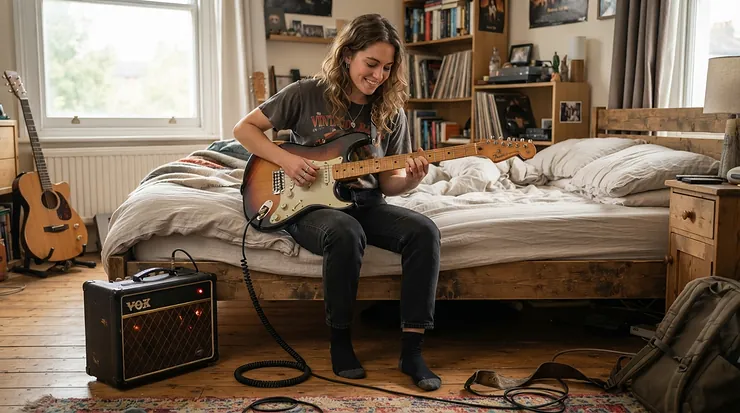
A practice amp for bedroom guitarists is a small, low-wattage guitar amplifier, or a headphone-only alternative, built to sound good at conversational volumes. It usually has a headphone jack, often an aux input for backing tracks, and a footprint that fits on a desk or shelf without annoying the people next door.
You know the moment. It’s 10:47pm, you’ve finally nailed that tricky riff, and the wall starts thumping. A 100-watt stack is a magnificent thing, but in a box room it’s like parking a lorry in a lift. The good news is that the small-amp world has never been better. Modelling chips, cabinet simulation and clever power control now deliver proper tone at volumes your flatmates will barely notice.
Rather than bolt every spec onto a list, I’ve weighed seven real models on what matters in a small room: headphone behaviour, low-volume tone quality, size, and how easily each one lets you play along to music. Guitar World’s 2025 roundup of headphone amps for guitar is a useful sanity check, and it ranks the Fender Mustang Micro Plus top overall.
A quick honesty note. Prices below are ranges, because they move constantly, so check current prices before buying. Where I couldn’t verify a meaningful pool of customer reviews, I say so rather than invent one. You’ll find a quiet practice amp, a few headphone-out guitar amp options, and at least one compact bedroom amp for every budget.
Quick Comparison Table: 7 Amps at a Glance
Start here if you want the short version. The table shows what each amp is, whether it has a headphone jack, how it handles backing tracks, and who it suits. Read the “Best For” column first, then check the aux input column, because that’s the feature people most often overlook until the first jam session.
| Amp | Type | Headphone jack | Aux input | Price range | Best For |
|---|---|---|---|---|---|
| Blackstar Fly 3 | 3W mini combo | Yes (speaker-emulated) | Yes | £50–£80 | Tight budgets and desk setups |
| Orange Crush 12 | 12W analogue combo | Yes (CabSim) | None listed | £100–£120 | Rock crunch and knob-twiddlers |
| Fender Mustang LT25 | 25W modelling combo | Yes (stereo) | Yes (stereo) | £140–£180 | Beginners wanting ready-made presets |
| Vox VX15 GT | 15W modelling combo | Yes (cab-sim) | Yes | £130–£170 | Lightweight all-rounders |
| Boss Katana:GO | Headphone amp | Yes | Bluetooth streaming | £120–£160 | Silent-only practice |
| Fender Mustang Micro Plus | Headphone amp | Yes | Bluetooth streaming | £120–£150 | Presets, recording and travel |
| Boss Katana-50 Gen 3 | 50W combo with 0.5W mode | Yes (stereo) | Yes | £250–£320 | Players who’ll outgrow the bedroom |
Looking at the table, the Blackstar Fly 3 is the clear value leader, while the Fender Mustang LT25 gives the most beginner-friendly feature set for the money. Players who’ll only ever practise on headphones should look hard at the Boss Katana:GO or the Fender Mustang Micro Plus, since they skip the speaker entirely. The Boss Katana-50 Gen 3 costs the most, but it’s the only one here that also works as a proper gigging amp.
💬 Just one click — help others make better buying decisions too!😊
Top 7 Practice Amps for Bedroom Guitarists: Expert Analysis
Each pick below follows the same pattern: what stands out, what the specs mean in a small room, who it suits, and what reviewers say. Price ranges were accurate at the time of research and may vary.
1. Blackstar Fly 3 — pocket-sized tone with a built-in delay
The Blackstar Fly 3 is basically a bookend that happens to play guitar. It weighs about 1kg and measures roughly 17.5 × 13.6 × 10.7cm. Inside are a 3W output, a 3″ speaker, two channels (clean and overdrive), a simple delay, and an aux input for phone or laptop. The headphone output is speaker-emulated, so it doesn’t sound like a raw preamp. Blackstar’s Infinite Shape Feature (ISF) sweeps one knob from American clarity to a darker British voice. That’s a smart trade, since it replaces three EQ knobs with one.
In practice, 3W is enough for a bedroom and not enough to start a neighbourhood dispute. Power comes from six AA batteries (retailer specs quote around 20 hours) or an optional mains adapter. A Bluetooth Charge variant adds a USB-C rechargeable battery. This is the sensible first buy for students, commuters’ desks and anyone who wants a compact bedroom amp without commitment.
Guitar.com’s Blackstar Fly 3 review praised its clarity and the ISF control, while noting the delay is basic for a budget amp. Retailer feedback I checked leans the same way on battery life and tone-for-size, though I couldn’t verify a large independent review pool.
Pros:
- ✅ Genuinely pocketable, around 1kg
- ✅ Aux input and emulated headphone output included
- ✅ ISF tone control is simple and useful
Cons:
- ❌ Basic delay, no reverb
- ❌ Small speaker thins out bass
Expect to pay around £50–£80 depending on variant. For a first quiet practice amp, that’s strong value.
2. Orange Crush 12 — analogue grit with a cab-simulated headphone out
If menus bore you, the Orange Crush 12 hands you real knobs. It’s a 12W solid-state analogue combo with gain, overdrive, a three-band EQ and a custom 6″ Voice of the World speaker. It weighs about 4.7kg and measures roughly 30.5 × 29 × 17.5cm. The party trick sits in the headphone socket: a CabSim circuit emulating a mic’d Orange 4×12″ cabinet.
That matters because plain amp-direct headphone sound is often fizzy. The CabSim takes the edge off, so crunchy rhythm tones feel closer to a speaker in a room. The overdrive control covers sweet breakup through to thick, vintage-British grind, which suits rock, blues-rock and punk best. One honest limitation: the front-panel layout lists no aux input, so backing tracks need another playback route. If you want to jam along to Spotify, look elsewhere.
Retailer review summaries are very positive, but one commenter noted the small speaker stops responding well when the controls are pushed to the limit. That’s a fair reminder that a 6″ driver is a practice tool.
Pros:
- ✅ Analogue signal path with real knob control
- ✅ CabSim makes headphone tone far less fizzy
- ✅ Punchy overdrive character
Cons:
- ❌ No aux input listed for backing tracks
- ❌ Single channel, no onboard effects
Around £100–£120 is typical. It’s good value if you want character over features.
3. Fender Mustang LT25 — beginner-friendly presets with stereo aux and phones
The Fender Mustang LT25 is built to get you playing in thirty seconds. A 25W digital modelling combo, it has an 8″ Fender Special Design speaker, 20 amp types, 25 effects, 30 factory presets plus extra slots, and a 1.8″ colour display. The stereo aux input and stereo headphone jack mean it covers both silent practice and play-along without extra gear. A micro-USB port handles recording and firmware updates.
Twenty-five watts is more than a bedroom needs, but a modelling amp’s master control keeps things civil, and the 8″ speaker gives fuller low-volume tone quality than the tiny mini amps. It weighs around 6.9kg and measures roughly 368 × 324 × 210mm, so it’s less of a compact bedroom amp than the others and more of a floor-or-desk combo. Beginners who get overwhelmed by blank knobs will appreciate the preset approach: scroll, play, learn.
Owner comments on retailer pages praise the variety of presets and the rounded EQ (one owner even uses theirs as a living-room speaker). The recurring complaints are the dated micro-USB connector and limited Fender Tone app downloads on this model.
Pros:
- ✅ Stereo aux input and stereo headphone jack
- ✅ Huge preset library with easy navigation
- ✅ 8″ speaker sounds fuller than mini amps
Cons:
- ❌ Micro-USB feels dated in 2026
- ❌ Heavier and bulkier than true mini amps
Expect roughly £140–£180. It’s solid value for a first modelling amp.
4. Vox VX15 GT — 15W and 11 amp models in a featherweight shell
The Vox VX15 GT is the amp for people who want modelling without the weight. It delivers up to about 15W RMS into a 6.5″ speaker, with 11 amp models (ten plus a Line mode), eight effects, an aux input and a headphone/line output with cabinet simulation. The amp models include AC30 and Brit-style voicings, and a footswitch jack is there for later.
At around 3.8kg in an ABS shell, it’s easy to carry between rooms. The preset mode recalls ready-made sounds, while manual mode makes the amp follow the physical knob positions, a nice halfway house between menu-diving and old-school control. At bedroom volumes the 6.5″ speaker keeps things articulate rather than boomy, which helps low-volume tone quality.
On review data, I couldn’t verify a large independent pool for this model, so this recommendation leans on spec analysis and retailer descriptions, which consistently highlight its low weight and headphone/aux practicality. If you buy one, treat early impressions as the real test.
Pros:
- ✅ Aux input and cab-sim headphone out
- ✅ Light enough to move around easily
- ✅ Manual mode matches physical knob positions
Cons:
- ❌ Single channel with only two user presets
- ❌ Plastic cabinet lacks the heft of wooden combos
Around £130–£170 is the typical range. For Vox character and portability, that’s good value.
5. Boss Katana:GO — Katana tones in a pocketable headphone unit
The Boss Katana:GO takes the Katana family’s sounds and shrinks them into a plug-in unit. Specs include 32-bit AD/DA at 48 kHz, 30 guitar memories (plus 30 for bass), a small OLED display, 10 guitar amp types, and a stereo headphone output rated at 30mW per channel. Bluetooth handles audio streaming and MIDI, and the Boss Tone Studio app does the editing. Battery life is roughly five hours, with about three hours to recharge over USB.
The headphone-out guitar amp format has a real advantage: zero speaker means zero noise complaints. Stage Feel adds a spatial effect that makes headphone playing feel less like a sealed box. There’s no dedicated aux jack in the spec; backing tracks come over Bluetooth instead.
Sound On Sound’s Boss Katana:Go review reported plenty of headphone level, liked the hinged jack, and found recording and playback worked well in a DAW. It also covers Bluetooth backing-track streaming and the Stage Feel feature.
Pros:
- ✅ Whole Katana sound palette in a pocket
- ✅ Bluetooth backing tracks and app editing
- ✅ Works as a USB audio interface
Cons:
- ❌ No speaker for playing out loud
- ❌ Battery lasts only around five hours
Roughly £120–£160 is the range. If you only practise on headphones, it’s excellent value.
6. Fender Mustang Micro Plus — 25 amps, 100 presets, USB-C recording
The Fender Mustang Micro Plus is the headphone amp that Guitar World crowned best overall in its 2025 roundup. It packs 25 amp models and 25 effects, 100 editable preset slots, a tuner and a small display. Bluetooth 5.1 connects to the Fender Tone app and streams audio with video sync, so YouTube lessons stay in time. The rechargeable battery reportedly lasts over four hours, and a USB-C connection handles charging and two-way recording. A rotating input plug helps it fit awkwardly shaped guitars.
For low-volume tone quality, a modelling headphone amp has a structural advantage: it models the speaker and room along with the amp. The preset count also suits the experimenter who wants a different tone for every song in the set. Just remember there’s no speaker, so you’ll need good headphones.
Retailer feedback highlights instantly usable presets, an impressive acoustic-emulation preset and smooth DAW integration. I couldn’t verify a large neutral sample, so treat these as common themes rather than scores.
Pros:
- ✅ 100 preset slots with app editing
- ✅ USB-C recording and Bluetooth streaming
- ✅ Rotating plug fits most guitars
Cons:
- ❌ No speaker, headphones essential
- ❌ Battery is limited to about four hours
Expect around £120–£150. It’s among the best-value headphone-only options on the market.
7. Boss Katana-50 Gen 3 — 0.5W power control for cranked-amp feel
The Boss Katana-50 Gen 3 is the odd one out: it’s a proper 50W 1×12″ combo that happens to shrink gracefully. A Power Control switch steps through Standby, 0.5W, 25W and 50W, so a cranked-amp feel is possible at whisper volume. It also has an aux input (3.5mm stereo), a stereo headphone output with IR-style cabinet emulation, USB-C, and an effects loop. An optional Bluetooth adapter adds wireless audio and app control.
Honestly, it isn’t a compact bedroom amp. That 12″ speaker and cabinet take up real floor space. But the 0.5W mode is the reason it earns a spot: you get the dynamics and feel of pushing a power stage, without the volume. The headphone output is reportedly a 6.3mm socket, so keep a quarter-inch adaptor or full-size headphones nearby.
One retailer reviewer said every guitar sounded great through it and that recording straight from the headphone output beat using effects pedals as preamps. The same reviewer also said 50W is plenty for practice or a small gig.
Pros:
- ✅ 0.5W mode keeps power-amp feel at low volume
- ✅ Aux input, USB-C and headphone out onboard
- ✅ Grows with you into small gigs
Cons:
- ❌ Big and mains-powered, not a compact bedroom amp
- ❌ Priciest option in this list
Around £250–£320 is typical. It’s strong value if you plan to gig eventually.
Here’s how all seven stack up in a single scan:
| Amp | Power / format | Standout | Trade-off | Best For |
|---|---|---|---|---|
| Blackstar Fly 3 | 3W, 3″ speaker | Tiny, battery-powered | Basic effects | First amp on a budget |
| Orange Crush 12 | 12W, 6″ speaker | Analogue crunch with CabSim | No aux input listed | Rock rhythm players |
| Fender Mustang LT25 | 25W, 8″ speaker | Presets plus stereo aux | Micro-USB, bulkier | Beginners |
| Vox VX15 GT | 15W, 6.5″ speaker | 11 models, light build | Plastic shell | Portable all-rounders |
| Boss Katana:GO | Headphone only | Katana tones, Bluetooth | No speaker, 5h battery | Silent practice |
| Fender Mustang Micro Plus | Headphone only | 100 presets, USB-C | No speaker, 4h battery | Recording and presets |
| Boss Katana-50 Gen 3 | 50W, 1×12″ | 0.5W Power Control | Size and price | Long-term growth |
The table shows a clear split. Combo amps (Orange Crush 12, Fender Mustang LT25, Vox VX15 GT) give you a speaker and an aux input, while the headphone amps (Boss Katana:GO, Fender Mustang Micro Plus) win on portability and tone variety. If you can afford it, the Boss Katana-50 Gen 3 is the only one that works as both.
Your First 30 Days: Setup and Maintenance Guide
Buying the amp is step one. The next thirty days decide whether it becomes a habit or a dust-collector. Start by setting your amp at ear height, on a desk or sturdy stool, because speakers aimed at your ankles make low volume sound dull. Set the master volume low before you plug in headphones, then raise it gently. Many amps pass the speaker signal differently once the headphone jack is in use, and a blast in your ears is a miserable way to start a session.
In week one, learn only three things: how to switch between clean and overdrive, how to adjust the master, and how to use the tuner. With the Fender Mustang LT25 or Vox VX15 GT, pick three presets and ignore the rest. With the Boss Katana:GO or Fender Mustang Micro Plus, spend ten minutes in the app saving your favourite sounds.
By week two, add a structured routine: five minutes of warm-up, ten of technique, fifteen of playing along to a track through the aux input or Bluetooth. Weeks three and four are about housekeeping. Remove AA batteries from the Blackstar Fly 3 if you won’t use it for a month, because leaking cells are the cheapest way to ruin a £60 amp. Charge lithium-ion units like the Boss Katana:GO before storing them, and don’t leave them flat for weeks. Wipe dust from the jacks with a dry cloth, and always plug headphones in fully, since half-seated plugs cause crackle.
Real-World Scenarios: Three Bedroom Guitarists, Three Amps
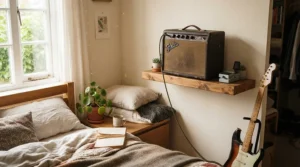
Specs only mean something when you map them to a life. Here are three typical bedroom guitarists, and the amp that fits each.
The student in halls. Budget under £100, thin walls, 45 minutes a night, mostly learning songs from YouTube. The Blackstar Fly 3 fits: it’s cheap, the aux input handles backing tracks, and the headphone output keeps the corridor happy. If your sound leans towards rock, the Orange Crush 12 is the alternative at the top of that budget, though you’ll need another route for playing along.
The shift worker in a flat-share. Practising at 11pm or midnight, four or five nights a week, with recording ambitions. A speaker is mostly irrelevant here, so the headphone-only route makes sense. The Fender Mustang Micro Plus offers 100 presets and USB-C recording, while the Boss Katana:GO offers Katana tones and app editing. Choose the Fender if you want more preset slots and the Boss if you already love the Katana sound.
The improving player with a band on the horizon. Budget £250–£320, a spare room, and nights that might include friends. The Boss Katana-50 Gen 3 handles whisper-quiet sessions with its 0.5W mode and still has the muscle for rehearsals. If space is tight, the Vox VX15 GT or Fender Mustang LT25 cost less and will serve for a good while.
Problem → Solution Guide: Fixing Common Bedroom Practice Frustrations
Problem 1: Headphone tone sounds thin and fizzy. This is common with cheaper units that send the raw preamp signal to your ears. Pick an amp with cabinet simulation, such as the Orange Crush 12 (CabSim) or Vox VX15 GT (cab-sim headphone out), and the fizz drops noticeably.
Problem 2: Backing tracks drown the guitar. If your amp has an aux input, balance the guitar and phone volumes separately. Start the phone at around half volume and adjust the amp’s master to taste. The Fender Mustang LT25 and Boss Katana-50 Gen 3 handle this well with their stereo aux inputs.
Problem 3: Bluetooth lag throws off timing. Wireless streaming can introduce slight delay. The Fender Mustang Micro Plus advertises audio/video sync for lessons, but for tight timing work a wired aux input is the safest route.
Problem 4: The room still gets complaints. Even a 3W amp can carry through plaster. Move the amp away from shared walls, put it on a thick towel or foam mat to reduce vibration, and switch to headphones after about 10pm.
Problem 5: You’ve outgrown it. Signs include wanting more power, more amp types or more recording options. This is where the Boss Katana-50 Gen 3 earns its price.
How to Choose a Practice Amp for Bedroom Guitarists
Start with the quick answer, then use these six steps to narrow it down.
- Decide where you’ll play. If speakers are off the table after 10pm, a headphone-out guitar amp or headphone-only unit is the sensible core of your decision.
- Set a realistic budget. Under £80 gets you a mini amp like the Blackstar Fly 3. Between £100 and £180 opens up combos and headphone amps. Above £250, you’re buying room to grow.
- Check the headphone jack carefully. Look for cab simulation or speaker emulation. A raw preamp signal is the main cause of fizzy headphone tone.
- Look for an aux input or Bluetooth. Playing along to songs is how most people improve fastest, so a lack of any play-along route is a real limitation.
- Judge the low-volume tone quality. Bigger speakers (8″ or more) usually give a fuller sound at low volume, while headphone amps with modelling can sound better than tiny speakers.
- Think about size and weight. A compact bedroom amp should be easy to move and store. If it’ll live on a desk, measure the space first.
If you’re torn between two models, pick the one with the better headphone behaviour. In a bedroom, that’s where you’ll spend most of your time.
Quiet Practice Amp Features: Headphone Jack and Headphone-Out Guitar Amp Explained
Not every headphone jack is equal. On the cheapest amps, plugging in headphones simply mutes the speaker and sends the raw signal out. That can sound harsh, because there’s no cabinet to round off the top end. Better designs use cab simulation, which is why the Orange Crush 12‘s CabSim and the Vox VX15 GT‘s cab-sim output make such a difference.
A true headphone-out guitar amp, like the Boss Katana:GO or Fender Mustang Micro Plus, goes further by modelling the amp, cabinet and effects together. The headphone jack is the only output, so the whole design is built around making that signal sound convincing. Many of these units also add stereo effects that give headphone playing more space.
A few practical details are worth checking. First, socket size: the Boss Katana-50 Gen 3‘s output is reported as 6.3mm, so you may need an adaptor for 3.5mm headphones. Second, output level: the Boss Katana:GO is rated at 30mW per channel, which is plenty for typical headphones but may struggle with very high-impedance studio pairs. Third, comfort: closed-back headphones give better isolation and let you play at lower levels, which also helps your ears. For a quiet practice amp, the headphone experience is the product, so don’t compromise on it.
Aux Input vs Bluetooth: Playing Along with Backing Tracks
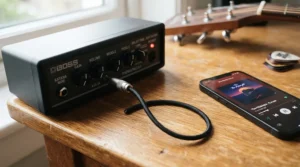
Playing along to real music is the fastest way to build timing and feel, which makes the aux input one of the most useful features on a bedroom amp. It’s a simple 3.5mm socket, no pairing and no lag. Plug in your phone, start a track, and play. The Blackstar Fly 3, Fender Mustang LT25, Vox VX15 GT and Boss Katana-50 Gen 3 all offer one.
Bluetooth, found on the Boss Katana:GO and Fender Mustang Micro Plus, trades wires for convenience. It’s brilliant for lessons and casual jamming, and it frees you from cables. The catch is a small amount of latency, which can matter for tight rhythm work. The Fender Mustang Micro Plus advertises sync for video, which helps with YouTube tutorials.
The Orange Crush 12 has no aux input listed, so it suits players who prefer practising without backing music or who have another playback device. If play-along is central to your routine, make sure your chosen amp has either a wired aux input or reliable Bluetooth.
One tip: if your amp has an aux input, set the backing track slightly quieter than your guitar. Learning to hear yourself clearly is the point, and you’ll pick up detail you’d otherwise miss.
Low-Volume Tone Quality: What to Expect From Small Amps
Low-volume tone quality is the hidden battleground in the practice amp for bedroom guitarists category. Physics is the problem. Small speakers move less air, so bass thins out, and many amps sound their best only when pushed. The question is how each design copes when you can’t push it.
Three approaches dominate. Analogue with a small speaker (the Orange Crush 12) gives responsive character but depends on the speaker size. Digital modelling with a larger speaker (the Fender Mustang LT25, Vox VX15 GT) uses processing to smooth things out. Headphone modelling (the Boss Katana:GO, Fender Mustang Micro Plus) sidesteps the speaker entirely, which is why these often sound best at tiny volumes.
Power Control, on the Boss Katana-50 Gen 3, is a fourth route. By dropping the power stage to 0.5W you keep the feel of a driven amp without the volume. It’s a clever trick, and one reason bigger amps can still earn a place in small rooms.
Realistically, don’t expect a 3W mini amp to sound like a stack. Expect it to sound pleasant, clear and useful. If low-volume tone quality is your top priority, put your budget towards modelling and cabinet simulation, rather than raw wattage.
Compact Bedroom Amp vs Headphone Amp vs Full-Size Combo
Which format fits your life? Here’s how the three main categories compare.
| Feature | Compact bedroom amp | Headphone amp | Full-size combo |
|---|---|---|---|
| Example | Blackstar Fly 3, Vox VX15 GT | Boss Katana:GO, Fender Mustang Micro Plus | Boss Katana-50 Gen 3 |
| Speaker | Yes, small | None | Yes, large |
| Silent practice | Via headphone jack | Always | Via headphone jack |
| Portability | Good | Excellent | Limited |
| Best For | Daily bedroom practice | Late-night and travel | Growth into gigs |
A compact bedroom amp suits most people because it gives you both a speaker for relaxed sessions and a headphone jack for late nights. Headphone amps are better if silence is non-negotiable or you travel with your guitar. A full-size combo like the Boss Katana-50 Gen 3 costs more and needs space, but it’s the only option that keeps up if you start playing with others.
Hearing, Neighbours and Safety: A UK Guide
Quiet practice protects more than your neighbours. NHS guidance on hearing loss notes that gradual hearing loss in both ears is often linked to ageing or damage from loud noise over many years. Headphones sit close to the eardrum, so volume matters even when nobody else can hear it. Keep levels moderate, take breaks, and stop if your ears ring afterwards.
On neighbours, there’s no single national “quiet hours” rule for domestic noise, but many councils treat roughly 11pm to 7am as night-time for noise complaints. Check your local council’s guidance. The best move is simple: use headphones late, and position speakers away from shared walls.
On electrical safety, buy mains adaptors and chargers from reputable sellers, and check for UKCA or CE marking. Cheap, unbranded power supplies are a common source of buzz and, occasionally, bigger problems. Use the power supply recommended for your amp, such as the manufacturer’s adaptor for the Blackstar Fly 3. And never use a headphone amp’s USB port with an unknown charger if the manual specifies a particular rating, as the Boss Katana:GO does for its USB supply.
Frequently Asked Questions
❓ Can I use a headphone amp instead of a practice amp for bedroom guitarists?
❓ Is a modelling amp better than analogue for a quiet practice amp?
❓ Which headphones work best with a headphone-out guitar amp?
❓ Do amps with an aux input work with Spotify and YouTube?
❓ Is a 10-watt amp too loud for a bedroom?
Conclusion
There’s no single perfect answer, but there’s a clear winner for most situations. If budget is tight, the Blackstar Fly 3 is a tiny, charming compact bedroom amp with an aux input and headphone output. If you want analogue character and don’t need play-along features, the Orange Crush 12 punches above its size. Beginners who like presets will enjoy the Fender Mustang LT25, and anyone who prizes weight savings should look at the Vox VX15 GT.
If silence is your priority, the Boss Katana:GO and Fender Mustang Micro Plus are the headphone-only picks, with the Fender offering more presets and the Boss offering Katana tones. For players who see themselves gigging one day, the Boss Katana-50 Gen 3 with its 0.5W mode is the long-term investment.
Whatever you choose, prioritise three things: a good headphone jack with cabinet simulation, a reliable way to play along to music, and low-volume tone quality you actually enjoy. A great practice amp for bedroom guitarists should make you want to pick up the guitar every single night.
✨ Ready to Find Your Perfect Bedroom Amp?
🎸 Click on any highlighted product above to check current pricing and availability. The right amp is the one you’ll actually play every day, so choose well and enjoy the practice!
Recommended for You
- Amp Head And Cabinet For Metal: 7 Brutal Picks (2026)
- Modelling Amp For Gigging: 7 Best Stage-Ready Picks (2026)
- Solid-State Amp For Beginners: 7 Proven Picks For UK Players (2026)
Disclaimer: This article contains affiliate links. As an Amazon Associate, I earn from qualifying purchases. If you purchase products through these links, we may earn a small commission at no additional cost to you.
✨ Found this helpful? Share it with your friends! 💬🤗
