
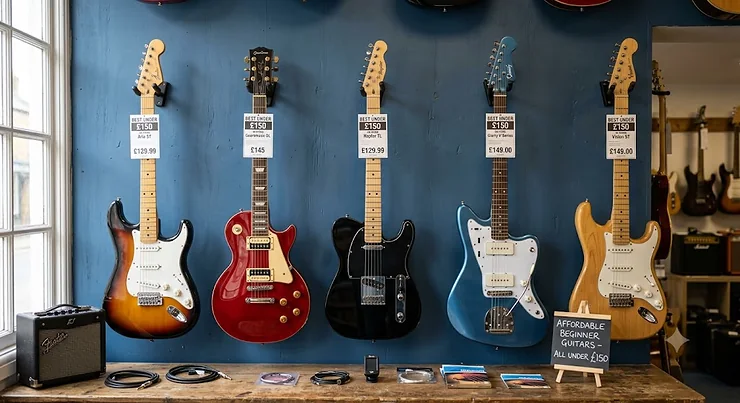
In This Article
Let’s get the awkward bit out of the way first: yes, you can get a genuinely decent electric guitar under £150. Not a toy. Not a paperweight with strings. An instrument you could realistically learn on for years, gig with in a school hall, or hand to a curious teenager without immediately regretting it. That wasn’t always true — a decade or two ago, “cheap guitar” and “good guitar” rarely occupied the same sentence. Manufacturing in Indonesia and China has closed that gap dramatically, and budget-focused brands now compete hard on fit, finish and playability rather than just price.
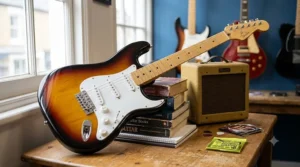
So what is an electric guitar under £150, in practical terms? It’s a solid-body or semi-solid instrument, typically from brands such as Encore, 3rd Avenue, Squier or RockJam, built with basswood or poplar bodies, bolt-on maple necks and simple single-coil or humbucker pickups, priced to get first-time and budget-conscious players playing without a big financial commitment.
This guide isn’t a rewritten Amazon listing. We’ve dug into real specs, real aggregated review sentiment and honest comparative reasoning to help you separate the genuinely good cheap electric guitar beginner options from the ones you’ll regret within a month. Whether you’re chasing an affordable electric guitar for your first riffs, hunting specifically for a budget electric guitar under £100, or just want the best value electric guitar your money can currently buy, you’re in the right place. A 2025 YouGov poll found that a quarter of UK adults can play at least one instrument, with guitar coming second only to piano in popularity, according to BBC Science Focus — which says a lot about why this price bracket gets so much attention.
Quick Comparison Table
Before the deep dive, here’s the fast version for anyone in a hurry.
| Guitar | Style | Price Range | Best For |
|---|---|---|---|
| Squier Sonic Stratocaster HT | S-type solid body | £120–£150 | Best overall / most “grown-up” tone |
| Encore E69 Blaster | S-type solid body | £90–£130 | Best all-round Strat-style budget pick |
| Encore E99 | LP-style single-cut | £100–£140 | Best for rock/blues tone on a budget |
| 3rd Avenue XF Full Size Kit | S-type + full kit | £70–£100 | Best complete beginner kit |
| RockJam Full Size Electric Guitar Kit | S-type + full kit | £60–£90 | Best budget electric guitar under £100 |
| Encore E6 | S-type solid body | £70–£95 | Best lightweight option for smaller players |
| Encore E375 3/4 Size | S-type, 3/4 scale | £70–£95 | Best for kids and travel |
Looking at the spread above, the pattern is clear: paying closer to the £150 ceiling generally buys you a recognised brand name and tighter factory setup, while the sub-£100 kits trade some of that polish for genuinely useful bundled extras like an amp and gig bag. Neither approach is “wrong” — it depends whether you value brand pedigree or bundled convenience more. If you’re specifically after a budget electric guitar under £100 with everything included, the RockJam and 3rd Avenue kits earn their place here precisely because they don’t ask you to buy an amp separately.
💬 Found the one you like already? Have a browse and check today’s price before it changes!😊
Top 7 Electric Guitars Under £150: Expert Analysis
We’ve deliberately spread this list across budget, mid-range and premium-for-the-category options, plus a couple of size variants, so there’s something here whether you’re 8 or 48.
1. Squier Sonic Stratocaster HT — closest thing to “grown-up Fender” tone at this price
The Sonic Stratocaster HT is Fender’s own budget brand doing what it does best: distilling 70 years of Stratocaster design into a genuinely playable beginner instrument. What most buyers overlook about this model is the hardtail (HT) bridge — no tremolo arm — which sounds like a compromise but actually means better tuning stability for a first-time player who hasn’t yet learned to set up a floating bridge.
Under the hood you get a poplar body, a satin-finished maple “C”-shape neck and three ceramic single-coil pickups feeding a five-way selector. In practice, that’s a genuinely versatile tonal palette — bright and glassy on the bridge pickup, warmer and rounder toward the neck — that suits indie, pop, blues and light rock equally well. Reviewers consistently note that the factory fretwork on the Sonic range is a noticeable step up from the older Bullet series it replaced, with several long-time players surprised by how little setup work was needed out of the box.
This is the pick for someone who wants the reassurance of the Fender name and doesn’t mind spending closer to the £150 ceiling to get it. Beginners who know they’re serious about sticking with the instrument, rather than just testing the water, get the most long-term value here, since resale and upgrade-part compatibility (Stratocaster parts are everywhere) are both strong.
Pros:
✅ Genuine Fender-family build quality and consistency
✅ Versatile single-coil tones suit multiple genres
✅ Excellent factory fret levelling reported by owners
Cons:
❌ Sits at the very top of the £150 budget
❌ No tremolo arm on the HT version
At around £120–£150, this is arguably the best value electric guitar in the group if brand reassurance and resale matter to you. It edges out cheaper rivals on finish quality alone.
2. Encore E69 Blaster — best all-round Strat-style budget pick
Encore has been the UK’s go-to entry-level guitar brand since the 1960s, and the E69 Blaster is the model most often recommended by teachers as a first “proper” instrument. The standout feature here is the involvement of Trev Wilkinson, the British guitar designer behind Fret-King, in shaping the Blaster Series hardware.
Specwise, you’re looking at a solid tonewood body, bolt-on neck, three single-coil pickups and a vibrato bridge — a fairly standard S-type recipe, but the difference shows up in the details. The custom-designed hardware and bridge saddles hold tuning noticeably better than unbranded alternatives at the same price, which matters enormously to a beginner who doesn’t yet know how to compensate for a guitar that won’t stay in tune. Reviewers consistently note that while the electronics (pots, switch) won’t match a £400 guitar for longevity, the neck and fretwork punch well above the price.
This is the safe, sensible choice for someone who wants a proper Stratocaster-style feel without paying Fender-adjacent prices. It’s particularly well suited to adult beginners who’ve done their research and want dependable quality over flashy extras.
Pros:
✅ Trev Wilkinson-designed hardware improves tuning stability
✅ Genuinely playable neck straight out of the box
✅ Strong reputation built over decades in the UK market
Cons:
❌ Electronics are basic and may need replacing after years of heavy use
❌ Colour range is more limited than newer competitors
Typically priced in the £90–£130 range depending on finish, the E69 represents excellent value for money according to the bulk of aggregated review sentiment, particularly among buyers comparing it directly against similarly priced unbranded imports.
3. Encore E99 — best Les Paul-style tone on a budget
If the Stratocaster shape isn’t your thing, the E99 gives you a single-cutaway, Les-Paul-inspired alternative from the same trusted stable. The standout feature is the cherry sunburst finish paired with a noticeably chunkier neck profile, which tends to suit players with larger hands or those coming from acoustic guitars.
The body shape and pickup configuration lean toward a thicker, warmer tone than the Strat-style options on this list — useful context if you’re planning to play rock, blues or classic hard rock rather than chiming indie tones. Based on the spec comparison with other single-cut budget guitars, the E99’s hardware quality is a step above generic alternatives, though it inherits some of the same long-term wear points as its Encore siblings (pickup mounting screws being a commonly cited nitpick in aggregated reviews). What most buyers overlook is that this shape distributes weight differently to an S-type — it balances well sitting down but can feel slightly neck-heavy standing with a strap, so trying that position before a gig is worth doing early.
Best suited to players specifically chasing that classic rock or blues tone who don’t want to spend £300+ on an actual Les Paul-style guitar just yet.
Pros:
✅ Warmer, thicker tone than Strat-style alternatives
✅ Comfortable neck profile for larger hands
✅ Distinctive looks that don’t scream “beginner guitar”
Cons:
❌ Slight neck-heavy balance when worn standing
❌ Some reports of loose pickup-mounting hardware over time
At roughly £100–£140, this is a smart pick for the specific tone it delivers, though it’s worth a manual setup check on arrival given the balance quirk noted above.
4. 3rd Avenue XF Full Size Electric Guitar Ultimate Kit — best complete beginner kit
This is the “everything in one box” option: guitar, 10W amp, cable, stand, gig bag, strap, spare strings, picks and a capo. The standout feature is genuinely how much is included for the price — you won’t need to buy a single accessory on day one.
The guitar itself uses a basswood-style body, bolt-on neck and three single coils in a classic S-type layout, aimed squarely at total beginners rather than intermediate players hunting for tonal nuance. Here’s what to weigh: the guitar component is perfectly serviceable but not the star of the show — the value proposition is the bundle. Aggregated review sentiment is broadly positive on build quality and finish, though there’s a consistent minority of buyers reporting that the factory action (string height) arrives too high and needs a basic setup, something any local guitar shop can sort for a small fee.
This suits parents buying for a child, or an adult who genuinely has zero existing gear and wants to avoid a dozen separate purchases before their first practice session.
Pros:
✅ Complete kit — amp, bag, stand, strings, picks all included
✅ Genuinely good value for total beginners with no existing gear
✅ Widely available with fast Amazon fulfilment
Cons:
❌ Factory setup can be inconsistent, occasionally needs adjustment
❌ Included amp is basic and will be outgrown quickly
Bundled kits like this typically sit in the £70–£100 bracket, making this one of the strongest budget electric guitar under £100 options if you need the full setup rather than just the guitar.
5. RockJam Full Size Electric Guitar Kit — cheapest genuinely usable full kit
RockJam has built a reputation in the UK market specifically around low-cost beginner music gear, and this kit is the brand’s electric guitar answer to that reputation. The standout feature is simply the price-to-inclusions ratio — a 10W amp, gig bag, strap, cable, picks and spare strings, often available for less than the guitar alone from pricier brands.
Build-wise, expect a basic S-type body, six-saddle bridge and standard single-coil pickups. This is honest, no-frills territory: the spec sheet won’t tell you this, but user reports suggest the neck action benefits from a quick truss-rod check on arrival, which is common across nearly all guitars at this exact price tier, not unique to RockJam. What most buyers overlook is that “cheapest” doesn’t have to mean “worst” — for a first six months of learning basic chords and simple riffs, the tonal and build differences between this and a £130 guitar are far less noticeable to a beginner’s ear than marketing suggests.
Best for parents testing whether a child will actually stick with lessons, or adults who want the lowest possible entry cost before committing further.
Pros:
✅ Lowest price point of any complete kit on this list
✅ Includes everything needed for a first practice session
✅ Low financial risk if the player doesn’t stick with it
Cons:
❌ Amp and hardware are entry-level even by budget standards
❌ May need a professional setup sooner than pricier alternatives
Usually priced under £100, often well under £80, this is the definitive answer if your search is specifically for a budget electric guitar under £100 and nothing more expensive.
6. Encore E6 — best lightweight pick for smaller players
The E6 is Encore’s lighter-bodied S-type model, historically fitted with lighter-gauge strings that make first chords genuinely easier on unconditioned fingers. The standout feature is the slim neck profile, specifically designed with a shorter reach in mind.
Tonally, it follows the familiar three single-coil, five-way-switch formula, giving beginners room to explore different sounds without overwhelming choice. Here’s what to weigh: aggregated review sentiment on the E6 is more mixed than on the E69 or E99, with some buyers — including those who’ve owned it second-hand — noting inconsistent body wood quality between production batches. That’s honest context worth having rather than glossing over: this is a genuinely serviceable practice guitar, but it’s the more budget-focused end of the Encore range rather than the flagship.
Best suited to younger teenagers or smaller-framed adults prioritising comfort and easy playability over long-term durability, and to anyone treating this as a genuine “starter” they may upgrade from within a year or two.
Pros:
✅ Lightweight body reduces strain during long practice sessions
✅ Slim neck suits smaller hands and shorter fingers
✅ Whammy bar included for expressive playing
Cons:
❌ Build consistency reported as more variable than other Encore models
❌ Best treated as a genuine entry point rather than a keeper
Typically found for £70–£95, the E6 remains a low cost electric guitar quality option provided expectations are set correctly — as a comfortable, playable first step, not a forever guitar.
7. Encore E375 3/4 Size — best for kids and travel
Rounding out the list is Encore’s 3/4-scale model, purpose-built for smaller players or as a secondary travel-friendly guitar. The standout feature is the reduced 484mm scale length paired with an overhung 21-fret neck, genuinely shrinking the reach required for basic chord shapes.
Three calibrated single-coil pickups and a traditional vibrato bridge round out a spec sheet that mirrors the full-size Encore models almost exactly, just scaled down. On paper this means younger players (roughly ages 8–12) or adults with smaller frames get proper guitar mechanics — real tuning machines, a genuine vibrato bridge — rather than a simplified toy-grade instrument. Reviewers consistently note that the reduced size makes a noticeable difference to how quickly children progress through basic chord shapes compared with wrestling a full-size neck too early.
This is the obvious choice for parents buying a first guitar for a child, or for any smaller adult who finds full-size necks genuinely uncomfortable to play.
Pros:
✅ Reduced scale length genuinely eases learning for smaller hands
✅ Real vibrato bridge and proper tuning hardware, not toy-grade parts
✅ Available in multiple finishes including gloss black
Cons:
❌ Will be outgrown by most players within a few years
❌ Reduced scale slightly changes string tension and feel versus full-size
Priced similarly to the full-size E6, around £70–£95, this is a smart, sensible pick when size — not budget alone — is the deciding factor.
Practical Usage Guide: Setting Up Your New Electric Guitar
Buying the guitar is step one; getting it actually playable is step two, and it’s the step Amazon listings never cover. Almost every cheap electric guitar beginner purchase arrives with the action (string height) set slightly too high at the factory, which makes basic chords feel painful and discouraging in the first week. A local guitar tech can do a full setup — truss rod, action, intonation — for roughly £30–£50, and it’s genuinely the single best £40 you can spend after the guitar itself.
In the first 30 days, three mistakes come up again and again in aggregated review commentary: skipping a proper tuner (phone apps work fine, but a clip-on tuner under £10 is faster and more reliable), leaving strings on far too long before a first change, and cranking the amp volume before learning to control unwanted string noise. It’s worth keeping practice-amp volume sensible from day one too — NHS advice on protecting your hearing applies just as much to a bedroom amp as it does to a nightclub speaker. Wipe the strings down after each session with a dry cloth to extend their life, keep the guitar in its gig bag away from radiators (heat warps necks over time), and restring one string at a time rather than removing all six at once, which helps the neck maintain consistent tension. None of this is difficult, but doing it from day one avoids the frustration that causes a lot of first guitars to end up in a cupboard.
Real-World Scenarios: Which Electric Guitar Under £150 Suits You?
Picture three different buyers. First, a university student who’s just discovered they love blues riffs on YouTube, has £120 to spend and no existing gear — the 3rd Avenue XF kit or RockJam kit makes sense here, since the bundled amp solves the “I have nowhere to plug this in” problem immediately, and the low upfront cost matches genuinely uncertain long-term commitment.
Second, a parent whose 9-year-old has been begging for guitar lessons after a school assembly — the Encore E375 3/4 size is the obvious answer, because a full-size neck at that age typically causes more frustration than progress, regardless of how enthusiastic the child currently is.
Third, an adult who played guitar as a teenager, stopped for a decade, and wants to pick it back up seriously — the Squier Sonic Stratocaster or Encore E69 both make more sense here, since existing muscle memory means the extra £30–£50 spent on build quality and tuning stability pays off faster than it would for a total beginner still learning basic chord shapes.
Problem → Solution: Fixing Common First-Guitar Issues
Problem: The guitar won’t stay in tune. This is almost always cheap tuning machines or a poorly cut nut, not a fundamentally broken instrument. Stretching new strings firmly by hand after installation and applying a small amount of graphite (pencil lead) in the nut slots solves the vast majority of cases.
Problem: Buzzing or rattling strings. Usually the action is set too low or the neck relief needs adjusting. This is exactly the kind of first-30-days issue a £30–£50 professional setup resolves quickly and permanently.
Problem: Fingers hurt after every session. Completely normal for the first few weeks as calluses form, but persistent pain can mean the action is too high. Compare against the “how to choose” criteria below before assuming it’s just you.
Problem: The amp included in a kit sounds thin or weak. Budget bundled amps (5–10W) are designed for bedroom practice only. A cheap headphone amp or a slightly larger practice amp, bought separately for £30–£40, is a common and worthwhile upgrade within the first year.
Problem: Uncertainty about whether to return the guitar. Genuine manufacturing faults — a warped neck, non-functioning electronics, missing parts — are covered under UK consumer law regardless of price. Under the Consumer Rights Act, products bought must be of satisfactory quality, fit for purpose and as described, so a faulty budget guitar is still entitled to a repair, replacement or refund.
✨ Sorted your setup plan? Check today’s price on your shortlisted pick before you commit!
How to Choose an Electric Guitar Under £150
What is the best way to choose an electric guitar under £150? Focus on neck comfort and tuning stability first, tone second, and looks last — in that order, because the first two determine whether you’ll actually enjoy practising.
- Try the neck size against your hands. A neck that’s too chunky or too thin will slow early progress far more than any pickup choice.
- Prioritise tuning stability over tone. A guitar that won’t hold tune will frustrate a beginner within days, regardless of how good it sounds when freshly tuned.
- Decide on body shape by comfort, not just looks. Single-cutaway (Les Paul-style) guitars balance differently to double-cutaway (Stratocaster-style) models when worn standing.
- Factor in whether you need a bundled kit. If you own nothing else — no amp, no cable, no strap — a kit saves both money and hassle versus buying separately.
- Check the return policy before buying. Even the best affordable electric guitar can arrive with a factory fault; knowing your rights in advance saves stress later.
- Budget an extra £30–£50 for a professional setup. This single step does more for playability than upgrading to a £50 pricier guitar would.
- Read aggregated review themes, not star ratings alone. A 4.3-star average tells you less than seeing the same specific complaint (loose hardware, high action) repeated across dozens of reviews.
Common Mistakes When Buying a Cheap Electric Guitar
The single biggest mistake is assuming price alone predicts quality within this bracket — it doesn’t, not reliably. A £140 guitar with a poor factory setup can play worse than a well-adjusted £80 one. The second common error is buying based purely on colour or looks without checking scale length and neck width against the player’s actual hand size, especially for children.
A third mistake, common among adults buying for themselves, is skipping the accessory kit to save money and then discovering they need an amp, cable, strap and tuner anyway — often costing more bought separately than a bundled kit would have. Finally, many buyers ignore aggregated review themes entirely and just check the star rating, missing patterns like “consistently reported high action out of the box,” which is genuinely useful pre-purchase information that a simple average score hides.
Electric Guitar vs Acoustic Guitar for Beginners
This comes up constantly, so it’s worth addressing directly with real comparative reasoning rather than a flat opinion.
| Factor | Electric Guitar | Acoustic Guitar |
|---|---|---|
| String tension/comfort | Lower — easier on fingers early on | Higher — steeper initial learning curve |
| Volume control | Adjustable via amp, good for shared homes | Always audible, harder to practise quietly |
| Upfront cost | Guitar + amp needed (unless bundled) | Just the guitar, generally |
| Genre flexibility | Rock, blues, pop, metal, indie | Folk, singer-songwriter, classical, pop |
The lower string tension on an electric guitar under £150 genuinely does make early practice less physically demanding, which is why many teachers now recommend electric as the first instrument even for students who eventually want to play acoustic. That said, the need for an amp — unless you buy one of the bundled kits above — is a real cost consideration acoustic guitars sidestep entirely. If shared living space or noise is a concern, an electric guitar paired with a cheap headphone amp is arguably the single most neighbour-friendly way to learn.
What to Expect: Real-World Performance at This Price Point
Specs on a page don’t tell you what a guitar actually feels like under your fingers, so here’s the honest translation. Expect a slightly heavier factory string action than you’d find on a £400+ instrument — noticeable but not crippling, and fixable with a basic setup. Expect tuning that holds reasonably well for casual practice but may drift slightly during aggressive bending or whammy bar use, particularly on models without locking tuners. Expect pickups that sound perfectly good through a practice amp or headphones but reveal their limitations if run through serious studio-grade gear — which, realistically, isn’t where a first guitar needs to shine anyway.
What genuinely surprises most new players is how close a well-set-up budget guitar can sound to a much pricier one through a basic amp, and how much of the perceived “quality gap” between a £100 guitar and a £600 guitar only becomes audible once a player’s technique has developed enough to hear the difference.
Electric Guitars Under £150 for Different Types of Players
For total beginners with no prior instrument experience, a bundled kit (3rd Avenue or RockJam) removes the most friction, since everything needed for session one is included. For returning players dusting off old skills, the Squier Sonic or Encore E69 reward the investment with noticeably better build consistency that supports faster technical progress. For children aged roughly 7–12, the 3/4-size Encore E375 avoids the discouragement that comes from wrestling an oversized neck. For budget-conscious adults specifically hunting a budget electric guitar under £100, the RockJam kit remains the most direct answer without compromising on having a genuinely usable instrument.
Long-Term Cost & Maintenance of a Budget Electric Guitar
Owning any electric guitar under £150 involves a few predictable ongoing costs worth budgeting for honestly rather than being surprised by later. A fresh set of strings costs roughly £5–£10 and typically needs replacing every 3–6 months with regular practice. A professional setup, recommended once early on and then every year or two, runs £30–£50. Amp electricity costs are negligible, but most players outgrow a bundled 5–10W practice amp within 12–18 months and upgrade to something in the £50–£100 range.
Looked at over a two-year ownership period, total cost of ownership for a £100 kit-based guitar (including strings, one setup, and an eventual amp upgrade) lands somewhere around £220–£280 — still dramatically cheaper than buying a single £400+ intermediate guitar outright, while giving a new player time to genuinely discover what they want from their next instrument. That’s worth bearing in mind alongside your statutory protections too — the full wording on satisfactory quality and fitness for purpose sits in Section 9 of the Consumer Rights Act 2015, should you ever need to fall back on it for a faulty unit. This is precisely the calculation that makes the best value electric guitar in this bracket less about the sticker price and more about total spend across the first two years of learning.
Features That Actually Matter (And Those That Don’t)
Genuinely matters: neck comfort, tuning stability, fret levelling quality, and whether a bundled kit includes an amp you’ll actually use. These directly affect whether practice feels good or frustrating on a daily basis.
Genuinely doesn’t matter much at this price point: exotic wood claims, “premium” branding on pickups that are functionally similar across budget models, and cosmetic extras like binding or fancy inlays. A low cost electric guitar quality purchase succeeds or fails on the fundamentals — neck, tuning, setup — not on marketing language describing tonewoods that make negligible audible difference through a beginner-level amp.

FAQ
❓ Is a £150 electric guitar good enough for a complete beginner?
❓ Do I need an amp with an electric guitar under £150?
❓ What's the difference between a budget electric guitar under £100 and one closer to £150?
❓ Is it better to buy a cheap electric guitar beginner kit or the guitar alone?
❓ Where can I find electric guitar deals Amazon shoppers can trust?
Conclusion
The honest truth about buying an electric guitar under £150 in 2026 is that the “budget” label doesn’t mean “compromise” the way it once did. Whether you land on the Squier Sonic Stratocaster for its Fender pedigree, an Encore model for its decades of UK reputation, or one of the complete kits from 3rd Avenue or RockJam for sheer convenience, every option covered here has a genuine, sourced case for its place on this list. What matters most isn’t chasing the single “best” guitar in the abstract — it’s matching neck size, bundle needs and budget honestly to your own situation, then spending the extra £30–£50 on a proper setup so the instrument actually rewards the time you put into it. Do that, and any of these seven will get you playing real music within weeks, not months.
Recommended for You
- Title: Intermediate Electric Guitar: 7 Best Upgrades for 2026
- Best Electric Guitar Starter Pack UK 2026: 7 Top Kits Reviewed
- 7 Best Beginner Electric Guitars UK 2026 — Expert Picks Revealed
Disclaimer: This article contains affiliate links. As an Amazon Associate, I earn from qualifying purchases. If you purchase products through these links, we may earn a small commission at no additional cost to you.
✨ Found this helpful? Share it with your friends! 💬🤗
