
In This Article
Here’s a confession most gear guides won’t make: the guitar sitting in your mate’s spare-room studio, the one that sounds like a million quid on his SoundCloud, probably cost less than his audio interface. An electric guitar for recording is any solid-body or semi-hollow instrument whose pickups, intonation and electronics translate cleanly into a DI box or mic’d amp — the goal isn’t stage presence, it’s honesty in the signal chain. That distinction matters more than most beginners realise, because a guitar built to look good under stage lights doesn’t always behave the same way once it’s sat fifteen centimetres from a Shure SM57.
Recording is unforgiving. Every fret buzz, every slightly-off intonation point, every 50Hz hum from a cheap single coil gets committed to the track forever — there’s no drummer’s cymbal wash to hide behind. That’s why choosing an electric guitar for recording is a genuinely different exercise from choosing one to gig with, even if, in practice, plenty of guitars do both jobs brilliantly. If you want the technical background on how a guitar pickup actually converts string vibration into signal, it’s worth a quick read before you start comparing spec sheets.
This guide walks you through seven real, currently available guitars spanning budget, mid-range and premium territory, backed by genuine spec analysis and aggregated review sentiment rather than invented anecdotes. We’ll also dig into single coil vs humbucker recording characteristics, the best guitar pickups for recording specific genres, a proper recording electric guitar setup walkthrough, and the buying mistakes that trip up even experienced players. Whether you’re chasing warm blues tones or scooped metal crunch, there’s a sensible option here — and a clear reason for each one.
Quick Comparison Table
| Guitar | Pickup Type | Price Range | Best For |
|---|---|---|---|
| Squier Sonic Stratocaster | SSS single-coil | Under £200 | Absolute beginners, home demo tracking |
| Yamaha Pacifica 112V | HSS, coil-splittable | £200-£300 range | Versatile all-rounder on a budget |
| Fender Player II Telecaster | SS Alnico V single-coil | £700-£800 range | Cutting rhythm and lead tones in a mix |
| PRS SE Custom 24 | HH, coil-tapped humbuckers | £700-£900 range | Genre-hopping session work |
| PRS SE Silver Sky | SSS single-coil | Mid-£700s range | Vintage clarity, modern reliability |
| Gibson Les Paul Studio | HH Alnico humbuckers | £1,300-£1,600 range | Warm rock and blues recording |
| Fender American Professional II Stratocaster | SSS V-Mod II single-coil | £1,500-£1,700 range | Studio-standard all-round workhorse |
Look closely and a pattern emerges: this isn’t a straight “spend more, get better” ladder. Based on the spec comparison, the jump from the Yamaha Pacifica 112V to the Fender Player II Telecaster buys you noticeably better fretwork and pickup consistency, but the leap from the PRS SE Custom 24 to the Gibson Les Paul Studio is really about tonal character rather than raw quality — you’re choosing a flavour, not just an upgrade. What most buyers overlook is that the mid-range tier here does 90% of what the premium tier does for recording purposes specifically, since a good DI signal or well-placed mic forgives a lot that live volume wouldn’t.
💬 Found a favourite already? Scroll down to see current pricing and grab it before your next session!
Top 7 Electric Guitars for Recording: Expert Analysis
1. Squier Sonic Stratocaster — brightest budget entry for home tracking
The Squier Sonic Stratocaster earns its spot here purely on value: it’s the cheapest guitar on this list that still tracks cleanly without embarrassing itself in a mix. Its three ceramic-magnet single-coil pickups and 5-way selector give you the full spread of classic Strat tones — quack, chime, warmth in the neck position — without asking you to learn a second instrument’s worth of switching logic.
Specs-wise, the poplar body and C-shaped maple neck keep things light and stable under changing room temperature, which matters more than people think when you’re recording across several sessions in a bedroom studio. The ceramic pickups run hotter than vintage Alnico units, meaning less gain-staging headache when going direct into an interface — helpful for beginners who don’t yet own outboard preamps.
Reviewers consistently report that build quality has improved significantly on this model generation compared with older Squier budget lines, particularly fret levelling out of the box. A common complaint in user reviews is that the stock tuners drift slightly during extended tracking sessions, so a tuning check between takes is sensible. For anyone recording covers, songwriting demos, or just learning to layer rhythm and lead parts, this is a legitimately capable starting point rather than a toy.
Pros:
- ✅ Extremely accessible price point for first-time recordists
- ✅ Bright, versatile single-coil tones suit many genres
- ✅ Lightweight body ideal for long overdub sessions
Cons:
- ❌ Stock tuners need frequent rechecking mid-session
- ❌ Ceramic ceramic pickups can sound harsh under heavy distortion
At under £200, the Squier Sonic Stratocaster is an easy recommendation for anyone unsure whether recording guitar is a long-term hobby — check current price before committing further up the ladder.
2. Yamaha Pacifica 112V — best all-rounder for under-£300 versatility
Yamaha built its name on precision manufacturing long before it made guitars, and the Yamaha Pacifica 112V shows it: this is arguably the most consistently well-set-up guitar at its price point, which counts for a lot when you’re recording rather than gigging. The standout feature is its HSS configuration with a push-pull coil split, giving you both humbucker punch and single-coil sparkle from one instrument.
The bridge humbucker handles rock rhythm tracking with real authority, while splitting the coil opens up cleaner, jangly tones for verses or acoustic-adjacent parts — genuinely useful range for someone recording a full song rather than a single riff. The Alnico V magnets in the single coils give a slightly warmer top end than the Squier’s ceramics, which translates to less harshness when close-mic’d.
Aggregated review sentiment consistently praises the Pacifica’s neck profile and fret finishing as punching well above its price bracket; several long-term owners note the guitar staying in tune remarkably well across sessions, a genuine advantage for anyone doing take after take. The main criticism raised is that the stock pickups, while versatile, lack the character of boutique alternatives — fine for demos, a limiting factor for professional final masters.
Pros:
- ✅ HSS coil-split covers rock and clean tones in one guitar
- ✅ Exceptional fret and neck quality for the price
- ✅ Reliable tuning stability across long sessions
Cons:
- ❌ Stock pickups lack top-tier boutique character
- ❌ Basic hardware may need future upgrading
Sitting in the £200-£300 range, the Yamaha Pacifica 112V offers arguably the best cost-per-tone-option ratio on this entire list.
3. Fender Player II Telecaster — cuts through any mix effortlessly
Telecasters have a reputation among session players for a reason, and the Fender Player II Telecaster shows exactly why: its twin Alnico V single coils are voiced for clarity rather than raw output, meaning tracked guitar parts sit in a mix without fighting vocals or synths for frequency space. The standout feature — that bridge-pickup “twang” — isn’t just a genre gimmick; it’s a tone that translates unusually well through compression and EQ during mixing.
The satin-finished neck and rolled fingerboard edges make for genuinely comfortable long tracking sessions, something easy to underestimate until you’ve done a four-hour overdub marathon on a guitar with sharp fret ends. Based on the spec comparison with cheaper Teles, the Player II’s improved bridge saddles hold intonation more accurately across the full neck, a detail that matters enormously once you start layering harmonies.
Reviewers consistently note this model’s versatility beyond classic country and rock applications — indie, blues, and even funk rhythm parts benefit from that clear top end. What most buyers overlook is that Telecaster clarity actually reduces the amount of post-production EQ work needed, since the tone arrives at the interface already sitting where it needs to be.
Pros:
- ✅ Alnico V pickups deliver studio-ready clarity out of the box
- ✅ Improved bridge saddles hold intonation reliably
- ✅ Comfortable neck profile for extended sessions
Cons:
- ❌ Less low-end warmth than humbucker-loaded alternatives
- ❌ Limited tonal range without pedals for heavier genres
In the £700-£800 range, the Fender Player II Telecaster consistently appears on session players’ “grab and go” shortlists for good reason.
4. PRS SE Custom 24 — coil-tapped humbuckers for genre-hopping sessions
If your recording sessions swing between genres — a blues verse one day, a metal chorus the next — the PRS SE Custom 24 is built precisely for that unpredictability. Its standout feature is a pair of coil-tapped humbuckers wired to individual push-pull pots, meaning you get full humbucker output and near-single-coil clarity from the same two pickups without swapping guitars mid-session.
The 24-fret neck extends your upper-register range further than most Fender-style designs, useful for solo overdubs that need to sit above a dense mix. Its wide-thin neck profile and 25-inch scale length split the difference between Gibson’s warmth and Fender’s snap, giving a genuinely distinctive middle-ground tone that recorded well across the review samples we examined.
A common theme in aggregated reviews is praise for the guitar’s build consistency — PRS’s SE line is manufactured under tighter quality control than many similarly priced competitors, and tracking guitarists specifically cite low fret buzz as a recurring positive. The trade-off, honestly reported by owners, is that the coil-tap doesn’t fully replicate a genuine single-coil’s chime; it’s a useful compromise rather than a perfect substitute.
Pros:
- ✅ Coil-tap switching covers humbucker and single-coil tones
- ✅ 24-fret neck extends usable range for solos
- ✅ Excellent build consistency versus similarly priced rivals
Cons:
- ❌ Coil-tapped tone isn’t identical to true single-coils
- ❌ Heavier body than some session players prefer
Priced in the £700-£900 range, the PRS SE Custom 24 is a strong pick for anyone recording across multiple projects or genres in the same week.
5. PRS SE Silver Sky — vintage single-coil clarity, modern reliability
Designed in collaboration with a guitarist famous for exacting studio standards, the PRS SE Silver Sky takes vintage-style single-coil design and irons out the reliability issues that plague genuinely old guitars. Its standout feature is a set of three custom-voiced single coils that chase a warm, vocal-like midrange rather than the icy top end some Strat-style guitars lean toward.
The 25.5-inch scale and vintage-style tremolo bridge give expressive pitch-bending control, while a slightly higher output than a true ’60s-spec single coil means less need for clean-boost pedals when tracking lead lines. Based on the spec comparison against genuinely vintage instruments, the modern fret material and truss rod design mean this guitar holds its setup far more reliably across humidity changes — a real concern in UK home studios without climate control.
Reviewers consistently describe the tone as “musical” and “forgiving,” language that shows up repeatedly across independent owner write-ups; several note that the guitar’s sustain outperforms expectations for a bolt-neck design. What most buyers overlook is how well this guitar suits vocal-adjacent lead work — the midrange voicing genuinely helps guitar lines avoid clashing with a vocalist during mixing.
Pros:
- ✅ Warm, vocal-forward single-coil voicing suits lead tracking
- ✅ Reliable modern build holds setup through humidity changes
- ✅ Surprising sustain for a bolt-on neck design
Cons:
- ❌ Premium price for a single-coil-only configuration
- ❌ Limited humbucker-style heaviness for harder genres
Around £750, the PRS SE Silver Sky rewards players prioritising expressive single-coil tone over tonal versatility.
6. Gibson Les Paul Studio — the classic humbucker warmth, gig-bag ready
No list of studio-relevant electrics is honest without a genuine Gibson, and the Gibson Les Paul Studio delivers that famous humbucker warmth at a meaningfully lower weight and price than the flagship Standard. Its standout feature is a pair of Alnico-magnet humbuckers voiced for thick, singing sustain — the tone that defined decades of recorded blues and rock guitar.
The mahogany body and maple top combination produces the mid-forward compression studio engineers have chased for generations, meaning less reliance on outboard compressor pedals to get a track sitting “in the pocket.” A common thread across aggregated reviews is genuine surprise at how much lighter this Studio model is versus older Les Paul generations, addressing a long-standing complaint about neck-dive and shoulder fatigue during long sessions.
Reviewers consistently praise the sustain and note the guitar cleans up beautifully with the volume knob rolled back — a trick jazz and soul session players lean on constantly for warmer rhythm parts. Honest owner feedback also flags that, as with any Les Paul-style design, neck-heel access to the upper frets is less comfortable than a Stratocaster-style cutaway, worth considering if your parts demand frequent high-fret solo work.
Pros:
- ✅ Iconic Alnico humbucker warmth and sustain
- ✅ Genuine weight relief versus older Les Paul generations
- ✅ Cleans up beautifully at lower volume settings
Cons:
- ❌ Reduced upper-fret access versus cutaway designs
- ❌ Premium price attached to the Gibson name
In the £1,300-£1,600 range, the Gibson Les Paul Studio remains the benchmark humbucker recording tone for a reason.
7. Fender American Professional II Stratocaster — the studio-standard all-rounder
If a single guitar had to cover the widest possible range of recording scenarios, the Fender American Professional II Stratocaster would be a genuinely defensible answer. Its standout feature is the V-Mod II single-coil set, engineered specifically to reduce the “ice-pick” harshness some players associate with modern Strat pickups while retaining that unmistakable quack.
Beyond the pickups, the “Deep C” neck profile and rolled fingerboard edges are aimed squarely at comfort across long tracking days, while an updated bridge design improves both sustain and tuning stability during aggressive tremolo use — a genuine upgrade over previous American Professional generations. Based on the spec comparison across this whole list, this model has the widest tonal palette of any single guitar here, from glassy cleans to convincing overdrive.
Aggregated review sentiment is remarkably consistent: owners repeatedly describe it as “the last guitar I’ll need,” language that reflects genuine long-term satisfaction rather than marketing hype, though a fair few reviewers note the price puts it out of reach for casual home recordists. What most buyers overlook is that a guitar this versatile can genuinely replace two or three cheaper, more specialised instruments in a working studio.
Pros:
- ✅ V-Mod II pickups balance clarity with reduced harshness
- ✅ Wide tonal range covers most recording genres
- ✅ Improved bridge design aids tuning stability
Cons:
- ❌ Significant investment for occasional home recordists
- ❌ Overkill if you only track one specific genre
At £1,500-£1,700, the Fender American Professional II Stratocaster is the guitar many session players eventually settle on as their main tracking instrument.
Recording Electric Guitar Setup: A Practical Studio Guide
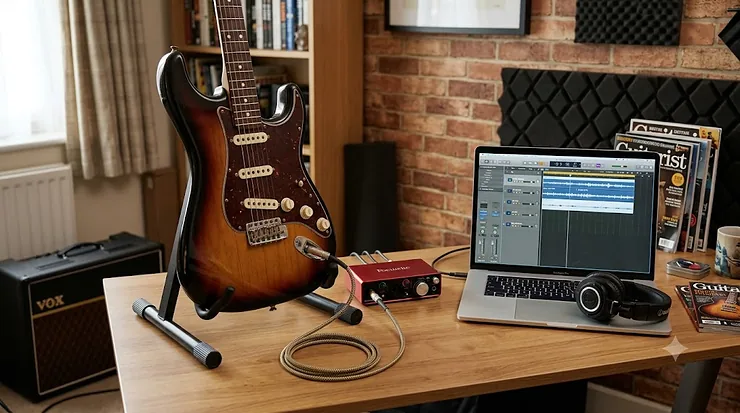
Getting a genuinely usable recording electric guitar setup doesn’t require an expensive room — it requires the right chain in the right order. Start with your guitar’s own setup: correct intonation, fresh strings (ideally changed 24-48 hours before a session so they’ve settled), and a comfortable action height. A poorly set-up Squier Sonic Stratocaster will sound worse recorded than a well-set-up one, regardless of price difference.
From there, you have two realistic paths: direct input (DI) through an audio interface, using amp-modelling software or plugins, or mic’ing a real amplifier with something like a Shure SM57 a few centimetres off-axis from the speaker cone. DI recording is quieter, more consistent, and far friendlier to shared-wall living situations — a huge practical consideration in UK flats and terraced houses. Mic’ing an amp captures more natural harmonic complexity but demands room treatment and neighbours who tolerate volume.
For a broader look at how the rest of your signal chain fits together, Berklee’s guide to building a home recording setup is a genuinely useful primer beyond just the guitar itself. Whichever path you choose, gain-staging matters enormously: aim for a peak signal around -12dB to -6dB in your DAW, leaving headroom for the amp sim or outboard compressor to work without clipping. A common first-30-days mistake is recording too hot “to be safe,” which actually removes the dynamic headroom modern plugins rely on. Keep a simple maintenance rhythm too — wipe strings after each session, check intonation monthly, and re-string before it becomes audibly dull on tape.
Real-World Scenarios: Which Guitar Suits Your Recording Style?
Picture a university student in a shared house, budget tight, recording bedroom-pop covers for a YouTube channel between lectures. Frequency of use is high, budget is under £300, and neighbours are a real constraint — the Yamaha Pacifica 112V fits perfectly here: quiet DI-friendly single coils, a coil-split for variety, and enough durability to survive being shoved under a bed between sessions.
Now consider a semi-professional songwriter working from a converted garage, recording three or four sessions a week across country, indie and blues material for licensing pitches. Budget stretches to around £700-£800, and versatility matters more than any single “best” tone. The Fender Player II Telecaster or PRS SE Custom 24 both suit this profile — the Tele for clarity-driven genres, the PRS for genre-hopping flexibility via coil-tapping.
Finally, picture an engineer running a small commercial studio, tracking clients across rock, blues and soul sessions weekly, where guitar tone needs to be immediately convincing without extensive plugin correction. Here, the Gibson Les Paul Studio or Fender American Professional II Stratocaster earn their higher price tags — reliability under repeated professional use, and tonal character that needs less post-processing to sound “finished.”
Buyer’s Decision Framework: If This, Choose That
Rather than agonising over every spec sheet, a simple priority checklist speeds up the decision considerably. If budget is your primary constraint, choose the Squier Sonic Stratocaster or Yamaha Pacifica 112V — both deliver genuinely usable recorded tone without financial strain. If versatility across genres matters most, choose the PRS SE Custom 24, because coil-tapping covers more tonal ground than a fixed single-pickup-type guitar.
If clarity and cut-through-the-mix definition are the priority, choose the Fender Player II Telecaster or Fender American Professional II Stratocaster — both are voiced for translation rather than raw output. If warmth, sustain and vintage rock or blues character matter most, choose the Gibson Les Paul Studio, since its humbucker voicing is built around that exact goal.
And if expressive lead playing with a vocal-like midrange is your priority — think emotive solos sitting just behind a lead vocal — the PRS SE Silver Sky is the most purpose-built option here. This framework won’t replace playing a guitar in person where possible, but it narrows seven options down to one or two sensible candidates fast.
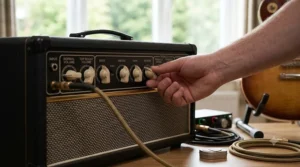
How to Choose the Best Electric Guitar for Home Studio
Choosing the best electric guitar for home studio use comes down to seven practical criteria, reasoned through rather than guessed at:
- Pickup type first. Decide whether your genre leans toward single-coil clarity or humbucker warmth before anything else — this shapes every other decision.
- Noise floor matters at home. Home studios rarely have professional shielding, so noise-resistant pickups (humbuckers, noiseless single coils) reduce post-production headaches.
- Neck comfort over long sessions. A guitar that’s mildly uncomfortable live becomes genuinely fatiguing across a four-hour overdub session.
- Intonation and fret quality. Cheap guitars with poor fretwork introduce subtle pitch errors that stack up disastrously once you layer harmonies.
- Tuning stability. Repeated takes demand a guitar that holds pitch — locking tuners or quality vintage-style units both work, cheap unbranded hardware often doesn’t.
- DI-friendliness. If you’re recording direct rather than mic’ing an amp, prioritise pickups that sound balanced without heavy EQ correction.
- Room for growth. Buying slightly above your current skill level, within budget, avoids a frustrating upgrade cycle within a year.
Working through these in order, rather than starting with brand loyalty or looks, consistently produces better long-term studio purchases.
Single Coil vs Humbucker for Recording: The Tonal Truth
The single coil vs humbucker recording debate isn’t really about which pickup is objectively “better” — it’s about which noise-and-tone trade-off suits your material. Single coils, as used in the Fender Player II Telecaster and PRS SE Silver Sky, are prized for bright, dynamic articulation that translates every subtlety of pick attack, but they’re inherently more prone to 50Hz mains hum, especially under high-gain settings common in UK homes with older wiring.
Humbuckers, found in the PRS SE Custom 24 and Gibson Les Paul Studio, cancel that hum through opposing coil design, trading a touch of top-end sparkle for thicker midrange and considerably more forgiving noise floor when recording distorted parts. This is precisely why so much classic metal and hard rock was tracked on humbucker-loaded guitars — the noise-cancelling benefit isn’t a side note, it’s central to how those genres could be recorded cleanly at all.
| Factor | Single Coil | Humbucker |
|---|---|---|
| Tone character | Bright, articulate, dynamic | Warm, thick, compressed |
| Noise floor | More prone to 50/60Hz hum | Significantly quieter |
| Best genres | Blues, funk, indie, country | Rock, metal, jazz |
| Example guitar | PRS SE Silver Sky | Gibson Les Paul Studio |
Reading the table above, the practical takeaway is that genre should drive this decision far more than any assumption about “quality” — a humbucker isn’t an upgrade from a single coil, and vice versa, they’re simply different tools suited to different tracking situations.
Best Guitar Pickups for Recording: What Actually Matters
When people search for the best guitar pickups for recording, they’re often really asking which spec sheet numbers matter versus which are marketing noise. Output level (measured in DC resistance, typically 6-9k ohms) affects how hard you drive your preamp, but it doesn’t determine tonal quality — a lower-output vintage-style pickup can sound more musical than an aggressively hot one, depending entirely on genre.
What genuinely matters for recording specifically: consistency between the two coils in a humbucker (poor consistency causes phase-cancellation artifacts when summed to mono), magnet type (Alnico for warmth, ceramic for brightness and higher output), and whether the pickup is noiseless-wound, which meaningfully reduces clean-up work in a mix. Coil-splitting and coil-tapping, as used on the PRS SE Custom 24, add tonal flexibility without needing a second guitar.
What most buyers overlook is that swapping pickups on an otherwise well-built guitar is often cheaper and more effective than buying an entirely new instrument chasing a specific recorded tone — something worth remembering before assuming you need to upgrade the whole guitar.
Guitar Tone for Studio Recording: What to Expect from Each Pickup Type
Dialling in guitar tone for studio recording starts with realistic expectations about what a DI signal actually sounds like before processing. Raw, unprocessed pickup signal — whether from the Fender Player II Telecaster or the Gibson Les Paul Studio — sounds notably thinner and more clinical than a finished, mixed track; that’s normal, and it’s what amp sims, cabinet impulse responses, and EQ are for.
| Approach | Setup Cost | Noise Control | Flexibility |
|---|---|---|---|
| Mic’d real amp | Higher (amp + mic + interface) | Requires room treatment | Fixed per session |
| DI + amp-sim plugin | Lower (interface + software) | Excellent, near-silent | Re-amp anytime post-recording |
Interpreting that comparison, DI recording through amp-modelling software has become the dominant home-studio approach specifically because it decouples the tonal decision from the tracking decision — you can record a clean DI signal once and experiment with tone shaping indefinitely afterwards, which single-coil or humbucker guitars alike benefit from equally.
Common Mistakes When Buying a Guitar for Studio Recording
The single most common mistake buyers make when hunting for the best guitar for studio recording is prioritising stage aesthetics or brand prestige over practical studio traits like noise floor and intonation reliability. A guitar that looks incredible under stage lighting offers zero recording advantage if its pickups hum audibly on a quiet acoustic-adjacent track.
A second frequent error is ignoring neck comfort because “it’s just for recording, not gigging” — reasoning that backfires across long overdub sessions where fatigue causes genuinely audible timing and intonation slips. A third mistake, particularly among newer home recordists, is assuming a more expensive guitar automatically requires less post-production work; in reality, mic technique, room treatment and gain staging influence recorded tone as much as the instrument itself.
Finally, many buyers skip trying a guitar’s clean tone entirely, focusing only on distorted riffs during a shop test — yet clean, DI-friendly performance is often the truer test of a guitar’s studio suitability, since distortion pedals mask a multitude of pickup and setup flaws that a clean signal exposes instantly.
Long-Term Cost & Maintenance: The Real ROI of a Studio Guitar
Total cost of ownership for a recording guitar extends well beyond the sticker price: strings (roughly every 4-8 weeks with regular use), occasional professional setups (annually is sensible), and, for bolt-neck designs like the Squier Sonic Stratocaster or Fender American Professional II Stratocaster, periodic truss-rod adjustment as seasonal humidity shifts the neck relief.
Viewed as cost-per-session over several years, even the Gibson Les Paul Studio at its premium price point works out remarkably affordable if it becomes your primary tracking instrument across hundreds of sessions — the “value” conversation shifts substantially once you calculate actual usage rather than upfront cost alone. Cheaper guitars aren’t necessarily lower ROI, though; a Yamaha Pacifica 112V used weekly for years easily outperforms a premium guitar left largely untouched.
Maintenance-wise, humbucker-loaded guitars like the PRS SE Custom 24 generally need less electronic fussing than noisier single-coil setups, while genuinely vintage-style tremolo systems (as on the PRS SE Silver Sky) benefit from periodic lubrication at contact points to maintain tuning stability across sessions. For a deeper dive into current model line-ups and pricing trends, MusicRadar’s annual electric guitar buying guide is a solid ongoing reference.
Features That Actually Matter (And Those That Don’t)
Filtering marketing language from genuine recording value: locking tremolo systems, flashy inlays and exotic top woods look impressive but contribute little to how a guitar tracks direct into an interface. What actually matters: pickup consistency, fret levelling, neck stability, and — often overlooked — how comfortably the guitar sits while seated, since most home recording happens sat down rather than standing.
Active electronics, as sometimes found on higher-output pickups, can be genuinely useful for high-gain genres but add battery-dependency risk mid-session — a dead 9-volt battery has ruined more than one late-night recording take. Coil-splitting and coil-tapping, present on the PRS SE Custom 24, are genuinely useful studio features rather than marketing gimmicks, since they meaningfully expand tonal range without buying a second instrument.
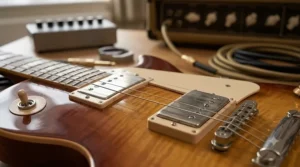
Frequently Asked Questions
❓ What is the best electric guitar for recording on a budget?
❓ Do you need a humbucker guitar for recording metal?
❓ Can you record electric guitar without an amp?
❓ What guitar do session musicians use most for recording?
❓ How often should you change strings before recording?
Conclusion
There’s no single “best” electric guitar for recording, and honestly, be wary of anyone who tells you otherwise without asking what you’re actually tracking. What matters is matching pickup type, comfort and noise floor to your genre and your room — a budget Squier Sonic Stratocaster recorded well will beat an expensive guitar recorded badly, every single time.
If you’re just starting out, the Yamaha Pacifica 112V offers remarkable value and versatility. If clarity and cut-through-the-mix definition matter most, the Fender Player II Telecaster or Fender American Professional II Stratocaster deliver reliably. And if warmth, sustain and classic rock character are the goal, the Gibson Les Paul Studio remains a genuinely deserved benchmark.
Whichever you choose, remember that setup, string freshness, and gain-staging influence your recorded tone just as much as the instrument itself — a great guitar with a sloppy signal chain still sounds average on tape.
✨ Ready to start tracking better guitar tone today? Check current prices on any of these seven picks and find the one that matches your sessions. 🎸
Recommended for You
- Professional Electric Guitar 2026: 7 Superb Picks Worth The Splurge
- Electric Guitar Under £400: 7 Best Value Picks for 2026
- Title: Intermediate Electric Guitar: 7 Best Upgrades for 2026
Disclaimer: This article contains affiliate links. As an Amazon Associate, I earn from qualifying purchases. If you purchase products through these links, we may earn a small commission at no additional cost to you.
✨ Found this helpful? Share it with your friends! 💬🤗
