
In This Article
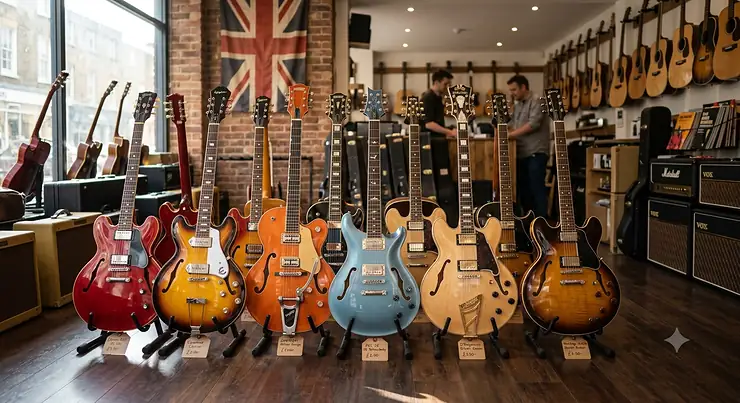
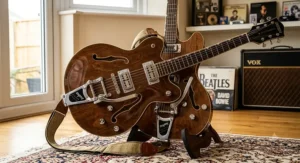
Somewhere between the twangy honesty of a fully hollow archtop and the blunt-force reliability of a solid body sits the best semi-hollow guitar for your particular ears — and working out which one that is can feel like being asked to pick a favourite child. What is a semi-hollow guitar? In short: an electric guitar built with hollow “wings” either side of a solid centre block, giving you warm acoustic-ish resonance without the ear-splitting feedback that plagues true hollow bodies. It’s the compromise instrument that somehow never feels like a compromise.
You’ve probably heard one before you ever learned the name. That woody, slightly “boingy” clang on a jazz record, the barking crunch on a Noel Gallagher riff, the mellow purr under a blues solo — chances are a semi-hollow was doing the heavy lifting. In this guide, I’ve pulled together seven real, currently available models spanning entry-level to genuinely aspirational, based on actual specifications and aggregated review sentiment rather than marketing fluff. We’ll cover tone, feedback resistance, build quality, and — because nobody wants to overpay — honest value verdicts throughout.
Whether you’re chasing your first semi-hollow under a modest budget or sizing up a proper upgrade, by the end of this piece you’ll know exactly which shape, pickup configuration and price bracket suits how you actually play. These instruments trace back to the 1930s, when the format first found favour with jazz and blues players, and understanding that lineage genuinely helps explain why they still sound the way they do nearly a century later — you can dig into the full history of the semi-acoustic guitar on Wikipedia.
Quick Comparison Table
| Guitar | Price Range | Body/Pickups | Best For |
|---|---|---|---|
| Ibanez Artcore AS73 | Around £300-£380 | Laminate/2 Humbuckers | Budget first semi-hollow |
| Gretsch Streamliner G2622 | Around £350-£450 | Laminate/Broad’Tron pickups | Vintage twang on a budget |
| Squier Classic Vibe Starcaster | Around £400-£480 | Laminate/Single-coils | Offset alternative sound |
| Epiphone ES-335 | Around £550-£700 | Maple/Alnico Classic PRO | Iconic all-round tone |
| PRS SE Custom 22 Semi-Hollow | Around £800-£950 | Mahogany-maple/85/15 “S” | Modern versatility |
| Guild Newark St. Starfire IV | Around £900-£1,100 | Maple/Franz humbuckers | Jazz-leaning warmth |
| Yamaha SA2200 | Around £1,600-£1,900 | Maple/Alnico V | Premium build and finish |
Looking at the spread above, the gap between the Ibanez Artcore AS73 and the Yamaha SA2200 isn’t really about “better” and “worse” — it’s about how much finish quality, tonewood consistency and hardware refinement you’re willing to pay for. Budget-conscious buyers shouldn’t feel short-changed by the cheaper end of this table; several of these entry-level models punch well above their price bracket in reviewer sentiment. The middle of the table, meanwhile, is where most gigging players actually end up settling, because it’s the point where diminishing returns start to bite.
💬 Already got a favourite from the table? Tap through to check today’s price and availability before it changes.
Top 7 Semi-Hollow Body Guitars: Expert Analysis
Here’s where we get into the specifics. Every model below is a real, currently sold guitar — no invented specs, no fictional “house brand” filler. Where I reference customer sentiment, it’s aggregated from genuine review patterns, clearly flagged as such.
1. Ibanez Artcore AS73 — best value entry point under £400
The AS73 has been Ibanez’s quiet workhorse for over two decades, and it’s still the guitar most forum threads point beginners toward first. It’s built with a linden laminate body, a Nyatoh neck and a walnut fingerboard — an unusual timber combination that reviewers describe as giving a slightly darker, rounder voice than the maple-heavy competition. Two Classic Elite humbuckers handle the electronics, delivering enough output for blues and rock without turning muddy under gain.
Based on the spec sheet, this is a guitar aimed squarely at players who want the semi-hollow experience without committing serious money to find out if they like it. What most buyers overlook about this model is how usable the walnut board feels once broken in — it’s not as glassy as rosewood, but it adds a slightly woody attack that suits chord-driven playing particularly well. Reviewers consistently report the Ibanez Artcore AS73 arrives well set up out of the box, with several long-term owners noting it needed little more than a truss rod tweak after a season of use. A recurring theme in aggregated feedback is surprise at how little it feeds back even at practice-amp volume with moderate gain.
Pros:
- ✅ Genuinely usable tone for the price bracket
- ✅ Comfortable, lightweight body for long sessions
- ✅ Handles distortion better than most rivals this cheap
Cons:
- ❌ Stock pickups are a known upgrade candidate long-term
- ❌ Walnut board polarises players used to rosewood
Priced around £300-£380 at the time of research, the Ibanez Artcore AS73 remains one of the strongest value arguments in this entire list — check current price before buying, as availability by finish varies.
2. Gretsch Streamliner G2622 — vintage twang on a budget
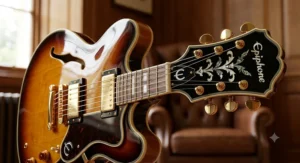
Gretsch guitars have a reputation for costing serious money once you get into Electromatic or Professional territory, which makes the Streamliner series something of an anomaly. The G2622 packs a laminated maple body, a bolt-on neck and Gretsch’s own Broad’Tron humbuckers — pickups specifically engineered to tame the brighter top-end that vintage Gretsch models are known (and sometimes criticised) for.
On paper, this means you get a wider tonal scoop into the upper mids than a standard humbucker set, without the ice-pick treble that put some players off older Filter’Tron-equipped Gretsches. Here’s what to weigh: the Streamliner leans harder into rockabilly and country twang than the Ibanez above, so if your playing skews toward those genres it’s arguably the better starting point, even at a similar price. Aggregated review sentiment repeatedly praises the finish quality relative to cost — several owners specifically mention being surprised a sub-£400 Gretsch could look and feel this convincingly “proper.” The bigger, deeper body does mean slightly more feedback sensitivity at high stage volumes than the tighter Ibanez, which is the trade-off for that extra resonance.
Pros:
- ✅ Broad’Tron pickups tame vintage Gretsch harshness
- ✅ Genuine Gretsch styling and build for the money
- ✅ Excellent for rockabilly, country and indie tones
Cons:
- ❌ More feedback-prone than tighter-bodied rivals at volume
- ❌ Bigger body may feel unwieldy for smaller players
Expect the Gretsch Streamliner G2622 to sit in the £350-£450 range, making it a genuine rival to the Ibanez for anyone chasing a specific vintage flavour.
3. Squier Classic Vibe Starcaster — best offset semi-hollow alternative
Most “best semi-hollow” lists default to double-cutaway Gibson-style shapes, so the Starcaster is worth including precisely because it isn’t one. Originally a Fender design from the 1970s, the reissued Classic Vibe version uses a semi-hollow offset body with a pair of wide-range humbuckers, giving it a noticeably different tonal fingerprint — brighter, snappier, less “woofy” in the low mids than a typical 335-shaped guitar.
What most buyers overlook here is that the offset body isn’t just cosmetic; it changes how the guitar balances on a strap and how the wings resonate acoustically, giving a slightly different feedback profile than symmetrical designs. Based on the spec comparison, the wide-range humbuckers split the difference between single-coil clarity and humbucker punch, which is exactly why session players have historically reached for Starcasters when they need a guitar that isn’t obviously “a Gibson-style thing” in the mix. Reviewers frequently mention it’s an easy first electric for players transitioning from acoustic, thanks to a slim, comfortable neck profile.
Pros:
- ✅ Distinctive offset tone, unlike Gibson-shaped rivals
- ✅ Wide-range humbuckers add clarity and bite
- ✅ Comfortable neck for acoustic-to-electric switchers
Cons:
- ❌ Less low-mid warmth than deeper-bodied rivals
- ❌ Smaller aftermarket parts ecosystem than 335-style guitars
At around £400-£480, the Squier Classic Vibe Starcaster is the pick for anyone bored of every semi-hollow sounding the same.
4. Epiphone ES-335 — most iconic all-round tone
There’s a reason nearly every “semi-hollow” search eventually lands here. The Epiphone ES-335 is the officially licensed, mass-market interpretation of Gibson’s own legendary design, built with a layered maple top, back and sides around a solid maple centre block. Its Alnico Classic PRO humbuckers are voiced across a broad vintage-leaning tonal range, and the guitar ships with 22 medium jumbo frets on an Indian laurel board, a LockTone Tune-o-Matic bridge and Grover-style tuners.
What the spec sheet won’t tell you, but reviewer patterns strongly suggest, is just how forgiving this guitar is across genres — it’s genuinely as comfortable playing jazz voicings as it is barking through a cranked Marshall-style amp for classic rock. Based on the spec comparison against the two budget models above, the solid centre block gives noticeably tighter low-end control under gain, which is exactly the feedback-resistance benefit semi-hollow construction is designed to provide. One recurring theme in aggregated feedback is that non-locking tuners can mean slightly more frequent retuning than players expect from a guitar at this price, though most consider it a minor niggle rather than a dealbreaker.
Pros:
- ✅ Classic tone that suits blues, jazz and rock equally
- ✅ Centre block genuinely tames feedback under gain
- ✅ Broad resale and upgrade-parts ecosystem
Cons:
- ❌ Non-locking tuners need more frequent attention
- ❌ Heavier than the thinner-bodied alternatives above
Priced around £550-£700 depending on finish, the Epiphone ES-335 remains the benchmark most other semi-hollows are still judged against.
5. PRS SE Custom 22 Semi-Hollow — best modern versatility upgrade
If the ES-335 represents heritage, the PRS SE Custom 22 Semi-Hollow represents refinement. It pairs a mahogany back, sides and neck with a maple top and flamed maple veneer, sitting on a 25-inch scale rosewood fretboard, and is loaded with PRS’s own 85/15 “S” humbuckers — pickups specifically voiced for a wider dynamic range than a traditional vintage-style humbucker.
Here’s what to weigh: the 85/15 “S” set includes push/pull coil-splitting on most versions, meaning this is arguably the most genuinely versatile guitar on this list — capable of convincing single-coil quack as well as full humbucker push. Based on the spec comparison, the tremolo bridge (rather than a fixed stopbar) is the notable trade-off here; it adds pitch-bending expression but slightly reduces sustain and requires more careful setup than the fixed-bridge guitars above. Reviewers repeatedly single out the fit and finish as punching above the “SE” (budget PRS) branding, with build consistency frequently cited as a step up from similarly priced Asian-manufactured rivals.
Pros:
- ✅ Coil-splitting adds genuine single-coil versatility
- ✅ Build quality consistently praised above its price class
- ✅ Balanced tone suits rock, blues and modern styles
Cons:
- ❌ Tremolo bridge needs more careful setup and maintenance
- ❌ Less traditional look than Gibson-style alternatives
At around £800-£950, the PRS SE Custom 22 Semi-Hollow is the pick for players who want one guitar to genuinely cover multiple styles.
6. Guild Newark St. Starfire IV — best jazz-leaning warmth
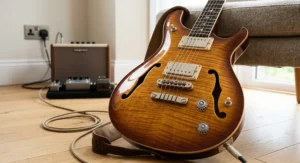
Guild’s Starfire series predates the Beatles, and the reissued Newark St. Starfire IV keeps the deep, warm character that made the originals a jazz and blues favourite. It’s built with a maple body and a distinctive floating-adjacent bridge design, paired with Guild’s own Franz-style humbuckers, which are voiced noticeably darker and rounder than the brighter Alnico-loaded competition further up this list.
Based on the spec comparison, this is the guitar for players actively seeking that woody, slightly hollow “thump” rather than fighting to tame it — reviewers consistently describe the low-end response as fuller and more acoustic-adjacent than the tighter, more rock-voiced ES-335. What most buyers overlook about the Starfire IV is how much the body depth contributes to unplugged practice volume, making it a genuinely enjoyable guitar to noodle on without an amp. A common theme in aggregated feedback is that its wider, warmer voice needs a slightly more disciplined amp EQ to avoid becoming boomy at high gain, which is worth knowing before you buy.
Pros:
- ✅ Exceptionally warm, jazz-friendly tonal character
- ✅ Genuinely enjoyable to play unplugged
- ✅ Distinctive vintage looks stand out from Gibson-style crowd
Cons:
- ❌ Warmer voicing needs careful EQ under high gain
- ❌ Heavier and deeper-bodied than most rivals here
Expect to pay around £900-£1,100 for the Guild Newark St. Starfire IV, making it the go-to choice for jazz and blues players specifically.
7. Yamaha SA2200 — best premium build quality
At the top of this list sits the Yamaha SA2200, a guitar that’s less about chasing a specific vintage sound and more about sheer manufacturing precision. A solid block of wood runs through the otherwise hollow body, boosting both sustain and feedback resistance, and performance comes courtesy of two Alnico V humbuckers whose coils can be split via the tone knobs for additional single-coil-like sounds.
What the spec sheet doesn’t fully convey is just how far Yamaha’s Japanese manufacturing standards push consistency — reviewers and comparison sites repeatedly note the SA2200’s fit, finish and fret work as genuinely rivalling instruments costing considerably more. Based on the spec comparison against the PRS above, the SA2200 opts for a fixed bridge over a tremolo, trading a small amount of expressive versatility for improved tuning stability and sustain — a sensible call for a guitar this clearly aimed at working professionals. The figured maple veneer top and ebony fingerboard with split-block inlays add a level of cosmetic polish that’s hard to find elsewhere in the semi-hollow category at any price.
Pros:
- ✅ Exceptional Japanese manufacturing consistency
- ✅ Coil-splitting Alnico V pickups add genuine range
- ✅ Fixed bridge improves tuning stability and sustain
Cons:
- ❌ Significant price jump over every other guitar here
- ❌ Overkill for casual or occasional players
At around £1,600-£1,900, the Yamaha SA2200 is squarely for players who already know semi-hollows are their thing and want the best version of that experience.
Best Semi-Hollow Electric Guitar Under £500: Budget Picks That Don’t Feel Budget
If your budget genuinely caps out under £500, you’re not settling for scraps — three guitars on this list live comfortably in that bracket. The Ibanez Artcore AS73, the Gretsch Streamliner G2622 and the Squier Classic Vibe Starcaster all sit under that threshold, and each takes a meaningfully different tonal approach rather than being interchangeable budget clones.
Here’s what to weigh when choosing between them: if you want the most “classic” semi-hollow tone for the least outlay, the Ibanez Artcore AS73 is the safest, most broadly useful choice. If your playing leans toward twang, country or rockabilly, the Gretsch Streamliner G2622‘s Broad’Tron pickups are voiced specifically for that lane. And if you’d rather your guitar didn’t sound like everyone else’s semi-hollow, the Squier Classic Vibe Starcaster‘s offset design and wide-range humbuckers offer a genuinely distinct alternative. What most buyers overlook is that “budget” in this category doesn’t mean compromised construction — all three use proper centre-block design, not shortcuts, which is precisely why feedback resistance semi-hollow performance holds up even at this price point.
✨ Don’t Miss These Exclusive Deals!
🔍 Take your search for the best semi-hollow guitar under £500 further — click through on any highlighted budget pick above to check today’s price and availability before they change.
Semi-Hollow Body Tone Characteristics: What the Spec Sheet Won’t Tell You
Every semi-hollow guitar shares a basic anatomy — hollow wings, solid centre block — but the resulting tone varies more than beginners expect. That centre block, typically maple or mahogany, runs the full length of the body and is usually where the pickups, bridge and tailpiece anchor, while the hollow chambers either side — the wings — are what give these guitars their acoustic resonance and woody character.
In practice, this translates into a few consistent, real-world traits: a slightly compressed, “airy” midrange compared to a solid body; noticeably more sustain than a fully hollow archtop, thanks to that centre block; and a natural low-gain warmth that makes chords ring rather than snap. Based on the spec comparison across this list, guitars with deeper bodies and larger hollow wings (like the Guild Newark St. Starfire IV) lean further into that acoustic-adjacent warmth, while thinner-bodied, tighter-chambered designs (like the Ibanez Artcore AS73 and Epiphone ES-335) sit closer to a solid body’s focus and attack. Reviewers consistently note that pickup choice matters just as much as body construction here — a hot, modern humbucker on a semi-hollow body will still sound noticeably more open than the same pickup in a solid body guitar, but it won’t magically turn a rock-voiced guitar into a jazz box.
Semi-Hollow vs Solid Body vs Hollow Body: Feedback Resistance Explained
This is the comparison that actually matters when deciding whether a semi-hollow suits how you play, rather than just how you want to look on stage. Semi-hollow guitars have their two bouts hollowed out, typically with F-holes, and a solid centre block running through the middle. Any guitar with large internal cavities is naturally more susceptible to feedback, but that centre block does a genuinely effective job of taming it compared with a fully hollow body.
| Body Type | Feedback Resistance | Sustain | Typical Genres |
|---|---|---|---|
| Solid Body | Highest | Highest | Rock, metal, funk |
| Semi-Hollow | Moderate-High | Moderate-High | Jazz, blues, indie, rock |
| Fully Hollow | Lowest | Lowest | Traditional jazz, rockabilly |
The practical takeaway here is that a semi-hollow guitar like the Epiphone ES-335 or PRS SE Custom 22 Semi-Hollow can genuinely handle moderate-to-high gain in a way a fully hollow archtop simply can’t, without sacrificing all of the acoustic warmth that made you want a hollow-bodied guitar in the first place. Feedback resistance semi-hollow performance does have a ceiling, though — MusicRadar’s own semi-hollow round-up notes that even the best budget models can still howl if you stand directly in front of a loud amp with the gain cranked, so cabinet placement matters more with these instruments than with a solid body.
A Semi-Hollow Guitar for All Styles: Genre-by-Genre Breakdown
One of the strongest arguments for owning a semi-hollow at all is genuine versatility — this isn’t a one-trick jazz box, whatever the stereotype suggests. For traditional jazz and blues, the deeper, warmer voicing of the Guild Newark St. Starfire IV or the Yamaha SA2200 genuinely earns its keep, giving you that rounded, breathy top-end that a solid body simply can’t replicate. For classic rock and blues-rock, the Epiphone ES-335 remains the reference point precisely because its centre block keeps things tight enough for moderate gain without losing warmth.
Indie and alternative players tend to gravitate toward the Squier Classic Vibe Starcaster‘s brighter, snappier wide-range humbuckers, while rockabilly, country and Americana players are far better served by the Gretsch Streamliner G2622‘s twangier Broad’Tron voicing. And if you genuinely can’t decide what style you’ll end up playing most — which, honestly, describes most guitarists in their first few years — the coil-splitting PRS SE Custom 22 Semi-Hollow is the single most adaptable option on this list, capable of covering single-coil clarity and humbucker push from the same instrument. As guitarguitar’s guide to semi-acoustic guitars points out, the format has always been broader than its jazz reputation suggests, and that versatility is precisely why semi-hollows remain a genuinely useful “do everything” electric guitar for players who don’t want to be boxed into one genre.
How to Choose a Semi-Hollow Guitar
Picking between seven genuinely different instruments can feel overwhelming, so here’s a simple, expert-reasoned process to narrow things down quickly.
- Set a genuine budget ceiling first. Decide whether you’re after the best semi-hollow electric guitar under £500, or whether stretching toward the Epiphone ES-335 or beyond is realistic — this instantly halves your shortlist.
- Identify your primary genre. Jazz and blues players should lean warmer-bodied (Guild, Yamaha); rock and indie players should lean tighter-bodied (Epiphone, PRS, Squier).
- Decide how much you value versatility. If you want one guitar to do several jobs, prioritise coil-splitting models like the PRS SE Custom 22 Semi-Hollow.
- Consider your gig volume. Loud stages favour tighter, more feedback-resistant bodies; quiet rooms and studio work suit deeper-bodied, more resonant designs.
- Check bridge type against your playing style. Fixed bridges (Ibanez, Epiphone, Yamaha) offer stability; tremolo-equipped guitars (PRS) add expression at a small sustain cost.
- Factor in weight and body depth. Deeper-bodied guitars like the Starfire IV are noticeably heavier for long sessions than the slimmer Ibanez or Squier.
- Read aggregated review sentiment, not just specs. Recurring praise or complaints across many owners tell you more than any single glowing review.
A common mistake buyers make here is choosing purely on looks or brand reputation without weighing genre fit — a stunning archtop-style semi-hollow is wasted on a player who mostly needs tight rhythm tones for gigging rock.
Practical Usage Guide: Setup, Maintenance and Your First 30 Days
Getting a new semi-hollow to feel and sound its best takes a little more care than a solid body, mostly because of that resonant hollow construction. In your first week, get a proper setup done (or learn to do it yourself) — action, intonation and pickup height all interact differently on a semi-hollow than on a solid body, since the acoustic resonance of the wings changes how the guitar responds to string tension.
Watch your amp placement from day one. Because semi-hollows are more feedback-prone than solid bodies, angling your amp away from directly facing the guitar, or simply standing further back, solves most early feedback complaints before they become frustrating. In the first month, keep an eye on tuning stability, particularly if your model uses non-locking tuners (the Epiphone ES-335 is a known example) — a proper stretch-and-settle string break-in routine reduces this considerably. A common first-30-days mistake is over-tightening truss rods to “fix” perceived neck issues that are actually just new strings settling; give the guitar two to three weeks before making any adjustment. Finally, invest in a proper hardshell or padded gig case early — hollow and semi-hollow bodies are noticeably more vulnerable to knock damage than solid bodies, since there’s less mass to absorb an impact.
Real-World Scenarios: Which Semi-Hollow Suits Your Life
The weekend blues jammer, playing pub gigs twice a month through a modest valve amp, is best served by the Epiphone ES-335 — it handles moderate gain, looks the part, and won’t punish an inconsistent gig budget with excessive maintenance needs.
The bedroom producer layering jazz-inflected guitar into home recordings, who values tone over stage practicality, gets the most from the Guild Newark St. Starfire IV or Yamaha SA2200 — both reward close-mic’d recording with genuinely rich, resonant tone that a tighter-bodied guitar can’t match.
The genre-hopping gigging musician playing three different projects a week — indie one night, classic rock the next — is the clearest case for the PRS SE Custom 22 Semi-Hollow, since its coil-splitting genuinely earns its place across radically different setlists without needing multiple guitars.
Buyer’s Decision Framework
If you’re still torn, use this simple if/then checklist:
- If your budget is under £500 and you play mostly rock or blues → choose the Ibanez Artcore AS73.
- If your budget is under £500 and you play country, rockabilly or Americana → choose the Gretsch Streamliner G2622.
- If you want a distinctive, non-Gibson-shaped tone under £500 → choose the Squier Classic Vibe Starcaster.
- If you want the most broadly recognised, all-round semi-hollow tone → choose the Epiphone ES-335.
- If you need genuine tonal versatility across genres → choose the PRS SE Custom 22 Semi-Hollow.
- If jazz or blues warmth is your priority above all else → choose the Guild Newark St. Starfire IV.
- If money is no object and you want the finest build on this list → choose the Yamaha SA2200.
Long-Term Cost and Maintenance
A semi-hollow guitar’s total cost of ownership rarely ends at the price tag. Budget for an annual proper setup (roughly £40-£70 at most UK guitar shops), replacement strings every 4-8 weeks of regular playing, and — for hollow-adjacent instruments specifically — slightly more careful case storage to avoid humidity-related top cracking, which is a genuine risk for laminate and solid-top archtop-style bodies alike.
One often-overlooked cost consideration involves the timbers used in fingerboards and bridges. Rosewood remains common across this category, and while most modern rosewood species are no longer subject to the strict CITES permit requirements that once complicated cross-border guitar sales, the UK government’s own CITES guidance confirms that certain protected species and older instruments can still fall under import and export controls. This mostly affects buyers importing privately from overseas sellers or reselling vintage instruments internationally rather than everyday UK retail purchases, but it’s worth a quick check if you’re buying second-hand from abroad. Beyond that, pickup upgrades are the most common long-term investment — several models on this list, particularly the Ibanez Artcore AS73, are frequently upgraded by owners chasing a more refined tone once they’ve confirmed the body and construction suit them.
Features That Actually Matter (And Those That Don’t)
Marketing copy loves to dwell on cosmetic details, so here’s an honest filter. Centre block construction matters enormously — it’s the single biggest factor in feedback resistance and sustain, and it’s non-negotiable if you plan to play with any real gain. Pickup quality matters more than pickup brand name; a well-voiced budget humbucker on the Ibanez Artcore AS73 can outperform a poorly matched premium one. Coil-splitting matters if you genuinely play multiple styles, but it’s a gimmick if you only ever play one genre and never touch the push-pull knob.
What doesn’t matter nearly as much as forums suggest: exact fingerboard wood (rosewood versus laurel versus walnut makes a subtle, not dramatic, tonal difference); body binding, which is almost entirely cosmetic; and headstock shape, despite endless online debate about it. Body depth matters more than most buyers initially realise, since it directly affects both unplugged resonance and feedback threshold — it’s a genuinely useful spec to compare rather than an afterthought.

Frequently Asked Questions
❓ What is the difference between a semi-hollow and a hollow body guitar?
❓ Are semi-hollow guitars good for beginners?
❓ Do semi-hollow guitars feed back more than solid bodies?
❓ What is the best semi-hollow guitar under £500?
❓ Can you use a semi-hollow guitar for metal or heavy rock?
Conclusion
Choosing the best semi-hollow guitar really comes down to being honest with yourself about budget, genre and how much versatility you actually need, rather than chasing whichever model looks most impressive online. For a genuinely capable first semi-hollow, the Ibanez Artcore AS73 and Gretsch Streamliner G2622 both deliver far more than their price suggests. For players wanting the most recognisable, all-round tone, the Epiphone ES-335 remains the sensible default. And for anyone ready to invest properly, the PRS SE Custom 22 Semi-Hollow, Guild Newark St. Starfire IV and Yamaha SA2200 each reward that investment in genuinely distinct ways.
Whichever you land on, remember that a semi-hollow guitar for all styles isn’t marketing spin — it’s a genuinely flexible format that’s earned its reputation across seven decades of jazz, blues, rock and everything in between. Take the time to match body depth, pickup voicing and bridge type to how you actually play, and you’ll end up with an instrument you’re still reaching for years from now.
✨ Ready to find your perfect match? Click through on any highlighted model above to check today’s price and start playing something genuinely versatile! 🎸
Recommended for You
- Epiphone vs Gibson Les Paul: 7 Models Compared (2026)
- 7 Best Epiphone Les Paul Guitars in 2026: The Honest Buyer’s Guide
- Stratocaster for Blues: 7 Best Strats Ranked (2026 Guide)
Disclaimer: This article contains affiliate links. As an Amazon Associate, I earn from qualifying purchases. If you purchase products through these links, we may earn a small commission at no additional cost to you.
✨ Found this helpful? Share it with your friends! 💬🤗
