
In This Article
If you’ve ever strummed an open G chord on a small-bodied guitar and felt like something was missing, you already understand why a dreadnought for strumming keeps coming up in every “what guitar should I buy” conversation. A dreadnought is the big-shouldered, wide-waisted acoustic body shape that Martin popularised over a century ago, and in plain terms it means a guitar built to be loud, bass-forward, and unapologetically built for hammering out chords rather than whispering delicate fingerstyle runs. That’s the whole point of this style, and it’s why campfire singers, worship bands, singer-songwriters and bedroom strummers alike keep gravitating toward it.

This guide isn’t a rehashed spec sheet. We’ve dug into real UK-available models on amazon.co.uk, cross-referenced genuine review sentiment from guitar publications and owner communities, and built out honest, use-case-driven analysis so you can work out which dreadnought actually suits your strumming hand, your budget, and your living room (or campsite). Whether you’re chasing the best acoustic guitar for rhythm playing, hunting for a genuinely loud acoustic guitar that can fill a room without an amp, or trying to find the best strumming guitar under £250, you’ll find a straight answer below rather than marketing fluff.
We’ll cover seven real guitars spanning entry-level to heirloom-grade, explain dreadnought projection and volume in plain English, and walk through practical set-up advice so your new guitar sounds its best from week one. Let’s get into it.
Quick Comparison Table
Before the deep dive, here’s the shape of the market at a glance. Prices fluctuate constantly on Amazon UK, so treat these as guide ranges rather than gospel, and always check current pricing before buying.
| Guitar | Price Range | Top Wood | Best For |
|---|---|---|---|
| Yamaha FG800 | around £200-£280 | Solid Sitka spruce | All-round budget strumming |
| Epiphone Songmaker DR-100 | under £150 | Laminate spruce | Absolute beginners on a tight budget |
| Fender CD-60S All-Mahogany | £220-£300 range | Solid mahogany | Warm, campfire-friendly tone |
| Tanglewood TW28 CSN CE | £280-£380 range | Solid Engelmann spruce | Plugged-in strummers, gigging beginners |
| Sigma DM-1 | £280-£350 range | Solid Sitka spruce | Traditional Martin-style tone on a budget |
| Martin D-28 | £2,300-£2,800 range | Solid Sitka spruce | Serious players who want the benchmark |
| Taylor 150e 12-String | £600-£750 range | Solid Sitka spruce | Huge, chorused strumming sound |
Looking at this spread, the pattern is clear: every price bracket has a genuinely competent strummer, but what changes as you climb the ladder isn’t really “does it work for chords” — it’s dynamic range, sustain, and how the guitar behaves when you dig in hard versus play softly. The Yamaha FG800 and Epiphone Songmaker DR-100 prove that under-£250 dreadnoughts can absolutely hold their own for rhythm playing, while the Martin D-28 shows what an extra couple of thousand pounds actually buys in terms of touch sensitivity and headroom.
💬 Spotted your favourite already? Tap through to check today’s price and stock on Amazon before you commit!
Top 7 Dreadnought Guitars for Strumming: Expert Analysis
Here’s the full spec breakdown across all seven guitars, so you can scan for the details that matter most to you before reading the individual write-ups.
| Guitar | Body/Top | Back & Sides | Price Range | Best For |
|---|---|---|---|---|
| Yamaha FG800 | Solid Sitka spruce | Nato | around £200-£280 | Reliable all-rounder |
| Epiphone Songmaker DR-100 | Laminate spruce | Mahogany | under £150 | First-time buyers |
| Fender CD-60S All-Mahogany | Solid mahogany | Laminate mahogany | £220-£300 range | Warm campfire tone |
| Tanglewood TW28 CSN CE | Solid Engelmann spruce | Mahogany | £280-£380 range | Cutaway + plug-in strumming |
| Sigma DM-1 | Solid Sitka spruce | Mahogany | £280-£350 range | Martin-style tone, budget price |
| Martin D-28 | Solid Sitka spruce | Solid East Indian rosewood | £2,300-£2,800 range | Benchmark projection and tone |
| Taylor 150e 12-String | Solid Sitka spruce | Layered sapele | £600-£750 range | Massive chorused strumming |
Two things jump out from this table. First, solid tops appear at nearly every price point now, which is a genuine shift from a decade ago when a solid spruce top typically meant spending £300-plus. Second, wood choice for the back and sides tracks almost perfectly with price: mahogany and nato dominate the budget-to-mid tiers because they’re cheaper to source and still sound punchy for strumming, while rosewood only shows up once you’re deep into premium territory, where its extra overtone complexity becomes worth paying for.
1. Yamaha FG800 — legendary budget strumming benchmark
The FG800 has become something of a rite of passage for new guitarists, and the standout feature here is Yamaha’s scalloped bracing pattern, which lets the solid top vibrate more freely than older FG-series models. Under the hood you get a solid Sitka spruce top paired with nato back, sides and neck, a rosewood fingerboard, and a 650mm scale length — nothing exotic, but a genuinely sensible spec sheet for the price. What that combination means in practice is a bright, clear top end that cuts through a strummed chord progression without the bass turning muddy, which is exactly what you want when you’re bashing out barre chords.
Based on the spec comparison with rivals at this price, the FG800 earns its reputation less from any single standout feature and more from consistency — every part of the build does its job competently rather than cutting a corner somewhere to hit a price point. This makes it a strong pick for beginners who want a guitar that won’t fight them as their strumming hand develops, and equally sensible for anyone who wants a reliable “just works” acoustic to keep by the sofa. Reviewers consistently note that the FG800 offers a deep, resonant sound with sustain, and several owner comparisons on Amazon note that the tuning pegs, headstock and fretboard feel noticeably higher quality than the Epiphone DR-100, its closest budget rival.
Pros:
- ✅ Solid spruce top at a genuinely accessible price point
- ✅ Scalloped bracing gives strong projection for its size
- ✅ Consistent build quality reported across multiple colour finishes
Cons:
- ❌ Nato back and sides lack the tonal complexity of rosewood
- ❌ No electronics, so you’ll need a separate pickup to gig with it
Typically priced around £200-£280, the FG800 remains one of the smartest value picks in this entire guide — you’re paying for tone woods and build quality, not a brand premium.

2. Epiphone Songmaker DR-100 — cheapest genuine strummer under £150
The Songmaker DR-100 opens with a laminate spruce top over mahogany back and sides, and what stands out immediately is how much dreadnought volume Epiphone squeezes out of an all-laminate build. Laminate tops are usually the first thing cut on a budget guitar because they’re cheaper to manufacture and more resistant to humidity swings, and here that trade-off pays off with a guitar that’s genuinely hard to damage while you’re still learning basic care.
What most buyers overlook about this model is that laminate construction isn’t automatically inferior for strumming specifically — solid tops matter most for nuanced dynamics and long-term tonal “opening up,” neither of which is the priority for someone learning open chords. Guitar World’s review describes the DR-100 as a full-sized dreadnought that delivers a dynamic, rich and full sound with superb playability, representing excellent value for money, and that assessment lines up with the guitar’s reputation as Epiphone’s best-selling acoustic. Aggregated owner sentiment across retailer reviews and guitar forums points to a warm, balanced tone and surprisingly confident projection outdoors, though a handful of players note the neck can feel wide for smaller hands and the factory setup occasionally needs a light action adjustment.
Pros:
- ✅ Genuinely capable dreadnought volume from an all-laminate build
- ✅ Mahogany back and sides give a warm, forgiving tone for beginners
- ✅ Extremely durable construction that tolerates rougher handling
Cons:
- ❌ Laminate top won’t develop the tonal complexity solid wood gains over time
- ❌ Some units arrive with slightly high factory action needing a quick set-up
At under £150, the DR-100 is the clearest answer if your search really is for the best strumming guitar under £250 with room to spare in the budget for a gig bag and a tuner.
3. Fender CD-60S All-Mahogany — warmest mid-budget strummer
Fender’s CD-60S All-Mahogany swaps the standard spruce-top CD-60S for a solid mahogany top, and that single wood swap is the standout here — mahogany tops emphasise midrange warmth over the bright, scooped sound spruce usually gives, which many strummers actually prefer for singing along. Paired with laminated mahogany back and sides, a rolled “Easy-to-Play” fingerboard edge, and scalloped X-bracing, the whole package leans toward comfort and tonal cohesion rather than raw sparkle.
Here’s what to weigh: an all-mahogany top means your chords come out sounding a little more compressed and “woody,” with less separation between individual notes than a spruce-topped guitar delivers, but far more forgiving warmth when you’re strumming hard with a plectrum. Fender’s own product description notes the mahogany back and sides deliver a balanced tone with plenty of volume and midrange, and that midrange presence is exactly why campfire players and singer-songwriters tend to gravitate toward this model — vocals sit more naturally over a mahogany-topped strum pattern than over a brighter spruce top. Aggregated reviewer sentiment consistently praises the rolled fingerboard edges for beginner comfort during long practice sessions.
Pros:
- ✅ Solid mahogany top gives warm, vocal-friendly midrange for strumming
- ✅ Rolled fingerboard edges reduce fatigue during long practice sessions
- ✅ Scalloped bracing keeps volume strong despite the darker tonal profile
Cons:
- ❌ Less treble sparkle than a spruce-topped dreadnought at the same price
- ❌ Laminate back and sides limit long-term tonal development
Expect to pay in the £220-£300 range, positioning this squarely alongside the FG800 as one of the smartest sub-£300 picks for anyone chasing an acoustic guitar for chords and strumming rather than intricate fingerpicking.
4. Tanglewood TW28 CSN CE — best British-favourite value dreadnought
Tanglewood has quietly built a loyal UK following, and the standout on the TW28 CSN CE is its solid Engelmann spruce top — a tonewood usually reserved for pricier instruments thanks to its lighter, more responsive vibration compared to standard Sitka spruce. Combined with mahogany back and sides, a bone nut and compensated bone saddle, and a built-in Fishman preamp system, this is a guitar clearly aimed at strummers who might eventually want to plug in at an open mic.
Based on the spec sheet, bone nuts and saddles at this price point are unusually good value — cheaper synthetic alternatives (like the plastic nuts found on some entry-level guitars) transmit string vibration less efficiently, so Tanglewood’s choice here directly benefits sustain and projection when you’re strumming. Retailer descriptions of the sibling TW28 SSN model note it delivers a rich, punchy sound with plenty of character thanks to its solid spruce top and mahogany back and sides, a description that tracks closely with the CSN CE’s own construction. What the spec sheet won’t tell you, but UK retailer and reviewer notes consistently mention, is that Tanglewood’s Evolution series punches noticeably above its price bracket for build quality — a detail worth knowing if you assumed “British value brand” meant compromised materials.
Pros:
- ✅ Solid Engelmann spruce top is unusually premium for this price bracket
- ✅ Bone nut and saddle improve sustain and projection when strumming hard
- ✅ Built-in preamp means you’re ready to plug in without extra spend
Cons:
- ❌ Less globally recognised brand name than Yamaha or Fender
- ❌ Cutaway body shape slightly reduces resonant chamber volume versus a full dreadnought
Typically found in the £280-£380 range depending on finish, the TW28 CSN CE rewards strummers who want to grow into gigging without a second guitar purchase.
5. Sigma DM-1 — best all-rounder for gigging strummers
Sigma’s DM-1 carries genuine pedigree — the brand was originally established with direct ties to Martin, and the DM-1’s dreadnought silhouette leans heavily on that heritage. The standout feature is the solid Sitka spruce top over mahogany back and sides, a tonewood pairing that’s practically the industry-standard recipe for a dreadnought built specifically to be strummed rather than fingerpicked.
What most buyers overlook about “Martin-adjacent” budget brands is that heritage alone doesn’t guarantee tone — but here the bracing and body proportions genuinely echo the full-sized dreadnought format that made strumming dreadnoughts famous in the first place. Equipboard’s aggregated analysis notes the DM-1’s dreadnought shape and spruce top provide a balanced tone that works well for fingerstyle, though it particularly excels in strumming and flatpicking thanks to its projection. Owner sentiment collected across Reverb listings and retailer pages repeatedly highlights surprising volume and headroom for the price, with several noting the guitar holds up well against much pricier rivals when it comes to raw projection, even if fine tonal detail favours the costlier competition.
Pros:
- ✅ Classic spruce-over-mahogany dreadnought recipe built for strumming
- ✅ Strong projection frequently compared favourably to pricier guitars
- ✅ Comfortable neck profile suited to long strumming sessions
Cons:
- ❌ Some variants use laminate rather than fully solid construction, so check the listing
- ❌ No onboard electronics on the standard DM-1, unlike the DM-1ST+ variant
Priced around £280-£350, the DM-1 is a genuine mid-range sweet spot for anyone whose search for the best acoustic guitar for rhythm playing keeps circling back to that classic Martin-style dreadnought voice without the Martin-style invoice.
6. Martin D-28 — the industry benchmark for projection
There’s a reason the D-28 gets mentioned in nearly every serious conversation about strumming dreadnoughts: it’s the guitar the entire category is measured against. The standout feature is Martin’s forward-shifted, scalloped X-bracing, first introduced during the brand’s “Golden Era” and now standard on the modern D-28, which allows the solid spruce top to move more freely and translates directly into more volume and dynamic range under a hard strumming hand.
Built from a solid Sitka spruce top with solid East Indian rosewood back and sides, mahogany neck and ebony fingerboard, the D-28’s construction is a masterclass in why premium tonewoods matter for strummers specifically, not just fingerstyle players. Based on the spec comparison, rosewood’s tonal complexity — more overtones, deeper bass, longer sustain — genuinely rewards dynamic strumming in a way laminate woods can’t replicate, letting a single strummed chord ring with far more harmonic detail. <cite index=”47-1″>Multiple outlets, including Guitar Center’s product analysis, describe the D-28 as producing strong projection that can soar over a band or multiple players, with expressive dynamics that let you shift immediately between aggressive strumming and soft chords or arpeggios. This is a guitar for the player who has already outgrown a budget dreadnought’s ceiling and wants headroom that simply doesn’t run out.
Pros:
- ✅ Industry-benchmark projection widely referenced across guitar publications
- ✅ Solid rosewood back and sides add exceptional harmonic complexity
- ✅ Forward-shifted scalloped bracing maximises dynamic range under a hard strum
Cons:
- ❌ Price puts it well beyond casual or beginner budgets
- ❌ Overkill for players who only ever strum quietly at home
At around £2,300-£2,800, the D-28 isn’t a rational purchase for most beginners, but for gigging musicians and serious hobbyists, the value case rests on decades of resale stability and a tone that simply doesn’t get outgrown.
7. Taylor 150e 12-String — loudest chorus-rich strumming machine
The 150e takes a different approach entirely: rather than making one set of strings louder, it doubles them. The standout feature is obvious the moment you strum a first-position chord — twelve strings ringing in octave pairs create a natural chorus effect that makes even a solo strummer sound like two guitarists playing together. Built with a solid Sitka spruce top, layered sapele back and sides, and Taylor’s Expression System 2 electronics, this is a guitar engineered specifically for big, ringing chord work.
Here’s what to weigh before buying a 12-string as your main strummer: the doubled strings add real tension and a wider neck, so barre chords take more hand strength than on a six-string dreadnought, and it’s genuinely not the guitar to learn your first open chords on. Premier Guitar’s review notes that first-position chords sound fat, alive and full of overtones, and that the big dreadnought body remains surprisingly responsive even to a light picking touch, though the same review points out the trade-off — some of the low-end push and overall projection you’d expect from a standard dreadnought body is slightly reduced by the 12-string format. In other words: it’s not louder in the raw decibel sense, but it’s fuller, and for strumming-focused singer-songwriters that fullness often matters more than sheer volume.
Pros:
- ✅ Natural chorus effect from paired strings adds huge harmonic richness
- ✅ Onboard Expression System 2 electronics make gigging straightforward
- ✅ Slim Taylor neck profile keeps a 12-string surprisingly playable
Cons:
- ❌ Wider neck and extra string tension make it harder work for beginners
- ❌ Slightly less raw low-end projection than a comparable six-string dreadnought
Typically priced £600-£750, the 150e is the pick for strummers who’ve already mastered a standard dreadnought and want a genuinely different-sounding tool for the job.
✨ Don’t Miss These Exclusive Deals!
🔍 Ready to find your perfect strumming companion? Click through on any of the guitars above to check today’s price and availability. Whichever budget you’re working with, these seven picks will help you build the big, chord-filling sound every campfire circle and living-room singalong deserves!
Setting Up Your Dreadnought for Strumming: A Practical Guide
A brand-new dreadnought rarely sounds its best straight out of the box, and this is the section most Amazon listings skip entirely. First, budget for a professional set-up within the first month of ownership, particularly on sub-£300 guitars — factory action is often set conservatively high to avoid fret buzz complaints, and lowering it slightly (without going too low) makes strumming noticeably easier on your fretting hand. Ask a local tech to check neck relief, string height at the 12th fret, and intonation; this typically costs £30-£50 and transforms how a budget dreadnought feels.
Second, change your strings within the first two weeks. Factory strings are chosen for shelf life and corrosion resistance during shipping, not tone, so swapping to a quality phosphor bronze set (light or medium gauge, depending on your finger strength) will noticeably brighten projection on any of the guitars above. Third, humidity matters more than most new owners realise: solid-top guitars like the FG800, CD-60S All-Mahogany, TW28 CSN CE, DM-1 and D-28 can develop cracks if stored somewhere too dry, so a simple soundhole humidifier is worth the £10-£15 investment, especially through UK winters when central heating dries indoor air significantly.
Finally, in your first 30 days, resist the urge to crank the action down for “easier strumming” before your calluses have developed — most beginner frustration comes from finger pain, not guitar set-up, and that resolves naturally within three to four weeks of regular practice.
Real-World Scenarios: Matching a Dreadnought to Your Strumming Life
Rather than abstract advice, here’s how three common situations map onto the guitars above.
If you’re a university student who wants to bring a guitar to shared houses and the occasional campfire, budget and durability matter more than tonal nuance. The Epiphone Songmaker DR-100 or Yamaha FG800 make sense here — both tolerate knocks, temperature swings between a cold car boot and a warm room, and neither represents a financial disaster if something goes wrong on a group trip.
If you’re a worship musician or open-mic regular who needs to strum confidently in a room with other instruments and occasionally plug into a PA, the Tanglewood TW28 CSN CE or Sigma DM-1 offer real projection without premium pricing, and the Tanglewood’s built-in preamp removes one extra purchase from your list.
If you’re a singer-songwriter building a home studio or gigging semi-regularly and strumming is your primary technique, the jump to the Martin D-28 or Taylor 150e 12-String starts to make financial sense — you’ll notice the difference in dynamic range every time you go from a gentle verse strum to a full chorus strum, something budget guitars struggle to replicate convincingly.
Common Strumming Problems, Solved
Problem: chords sound “boxy” or muddy when strummed hard. This is often an action or string-gauge issue rather than a guitar-quality issue — try a slightly lighter string gauge, or have your action checked, before assuming you need a different instrument.
Problem: the guitar sounds thin compared to guitars you’ve heard on recordings. Studio recordings are usually close-mic’d and processed; a raw acoustic dreadnought, even a great one like the Martin D-28, sounds different live than on a polished track. Try recording yourself and comparing to manage expectations realistically.
Problem: fingers hurt too much to strum comfortably. This is near-universal for new players and resolves with consistent short practice sessions rather than occasional long ones; it isn’t usually a sign you’ve bought the wrong guitar.
Problem: the guitar won’t stay in tune while strumming aggressively. Aggressive strumming puts more stress on tuning stability than gentle fingerpicking. Cheaper tuning machines, like those on entry-level guitars, can drift more; upgrading to sealed die-cast tuners (many mid-range models like the Tanglewood TW28 CSN CE already include these) solves this directly.
How to Choose a Dreadnought for Strumming
A dreadnought for strumming should combine a large, bass-responsive body with bracing and tonewoods that favour volume and sustain over fingerstyle subtlety. Here’s how to narrow down the right one for you:
- Set a realistic budget first. Decide whether you’re in the sub-£250 bracket, the £250-£600 mid-range, or ready to invest £600-plus, since this single decision eliminates most of the guesswork.
- Prioritise a solid top over a solid back and sides. The top does most of the tonal work in projection and sustain, so a solid-top, laminate-back guitar (like the FG800) outperforms an all-laminate guitar for strumming purposes.
- Check the nut width and neck profile fit your hand. A dreadnought built for strumming with wide open chords generally suits a standard 43mm nut width comfortably; if you have smaller hands, try before buying where possible.
- Consider whether you need electronics. If you’ll ever play in front of people, a built-in preamp (like on the TW28 CSN CE) saves buying a separate pickup later.
- Weigh tonewood against your genre. Spruce-topped guitars suit brighter, cutting strumming for folk and pop; mahogany-topped guitars suit warmer, vocal-forward strumming for singer-songwriter styles.
- Read aggregated review sentiment, not just star ratings. A 4.5-star average tells you little about whether a guitar suits strumming specifically versus fingerstyle; look for recurring language around “projection,” “volume” and “chords.”
- Factor in resale value if you’re at the premium end. Guitars like the Martin D-28 hold value remarkably well, which matters if you think you might upgrade again later.
Dreadnought Projection and Volume: Why This Body Shape Gets Loud
Dreadnought projection and volume come down to simple physics: a bigger, deeper soundbox moves more air than a smaller-bodied guitar, and a wider lower bout gives the top more surface area to vibrate. The <cite index=”79-1″>dreadnought’s characteristic square shoulders, relatively flat tail end, and wide waist with a large radius curve were developed by C.F. Martin & Company, and the shape has since become one of the most widely copied acoustic guitar body styles in the world — precisely because it solved the volume problem so effectively for the era before amplification was commonplace.
What most buyers overlook about projection specifically is that it isn’t the same as loudness at the source — it’s how well sound carries and fills a room. A dreadnought with scalloped bracing (like the FG800, CD-60S, or D-28) allows the top to flex more freely under string vibration, translating directly into more audible volume without needing to strum any harder. This is also precisely why loud acoustic guitar searches so often lead back to the dreadnought shape specifically, rather than smaller-bodied concert or parlour guitars, which trade volume for balance and comfort.
Worth flagging honestly: playing any acoustic guitar loudly and often, particularly close to your ears while singing along, carries the same long-term hearing considerations as any prolonged loud-sound exposure. The Health and Safety Executive notes that noise-induced hearing loss is preventable but that hearing loss caused by loud noise exposure, once it happens, does not improve or come back — sensible advice if you’re regularly strumming loudly in small, enclosed spaces like a bedroom or rehearsal room for extended periods.
Best Strumming Guitar Under £250: What You Actually Get for the Money
The good news for anyone specifically hunting for the best strumming guitar under £250 is that this bracket is genuinely competitive now, not a compromise tier. Both the Epiphone Songmaker DR-100 and Yamaha FG800 sit comfortably within or close to this budget and deliver real dreadnought volume rather than a scaled-down imitation of one.
| Guitar | Price Range | Value Verdict |
|---|---|---|
| Epiphone Songmaker DR-100 | under £150 | Best pure value; ideal first guitar |
| Yamaha FG800 | around £200-£280 | Best all-round tone-to-price ratio |
| Fender CD-60S All-Mahogany | £220-£300 range | Best for warm, vocal-friendly strumming |
What you’re sacrificing at this price point isn’t strumming capability — it’s long-term tonal development and premium tonewood complexity. Solid-top laminate-body guitars like the FG800 will genuinely improve slightly in tone as the top ages and “opens up” over years of playing, but they won’t ever match a fully solid-wood guitar’s overtone richness. For most beginners and even many intermediate strummers, that trade-off is entirely sensible; the tonal gap only becomes noticeable to trained ears in a quiet room, not around a strummed campfire singalong.
Dreadnought vs Other Body Shapes: Finding the Best Acoustic Guitar for Rhythm Playing
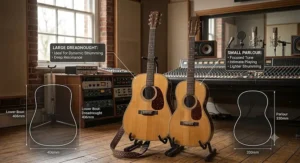
If you’re weighing up whether a dreadnought really is the best acoustic guitar for rhythm playing compared to other shapes, the honest answer depends on what “rhythm playing” means to you. Dreadnoughts excel at full, chord-driven strumming where volume and low-end punch matter — think campfire singalongs, folk and country rhythm parts, or accompanying your own singing. Smaller-bodied guitars trade that punch for balance and comfort.
| Feature | Dreadnought | Concert/Auditorium | Parlour |
|---|---|---|---|
| Bass response | Strong, dominant | Moderate, balanced | Light, focused |
| Projection/volume | Excellent | Good | Modest |
| Comfort for smaller players | Can feel bulky | More comfortable | Very comfortable |
| Best For | Chords and strumming | Fingerstyle and mixed playing | Blues and travel use |
Looking at this comparison, the practical takeaway is straightforward: a concert or auditorium-shaped guitar can absolutely handle chords and strumming, and many fingerstyle players prefer its more even frequency balance, but it won’t match a dreadnought’s raw low-end authority when you’re strumming full open chords. Larger guitar bodies produce louder, bass-rich tones, while smaller guitars offer balance and clarity instead — which is really the entire trade-off in one sentence. If your priority genuinely is an acoustic guitar for chords and strumming above all else, a dreadnought remains the more direct answer; if you split your time between strumming and fingerpicking, a concert-sized guitar is worth trying before you commit to a dreadnought by default.
Common Mistakes When Buying a Dreadnought for Strumming
The most frequent mistake is buying based on brand recognition alone rather than checking whether the specific model has a solid or laminate top — two guitars from the same brand can differ enormously in tone for this reason. Second, many first-time buyers skip trying the neck width and shape in person (or checking detailed spec listings if buying online), then discover the nut is uncomfortably wide for their hand once barre chords enter the picture.
Third, buyers sometimes assume “bigger equals better” and jump straight to a dreadnought without considering their own body size and playing posture — a dreadnought’s depth can genuinely feel unwieldy for smaller-framed players, particularly when seated. Fourth, it’s easy to underestimate ongoing costs: a case or gig bag, a humidifier, fresh strings, and an occasional professional set-up all add up, and skipping them on a budget guitar often causes more disappointment than the guitar itself deserves. Finally, some buyers chase premium models like the D-28 before they’ve developed enough technique to actually notice the difference — an honest self-assessment of your current playing level will save money that’s better spent later.
What to Expect: Real-World Strumming Performance
On paper, spec sheets tell you wood types and bracing patterns, but here’s what those numbers actually feel like under your strumming hand. A budget dreadnought like the FG800 or DR-100 responds immediately and predictably — strum harder, get more volume, in a fairly linear relationship. As you move up to guitars like the Sigma DM-1 or Tanglewood TW28 CSN CE, you start to notice more dynamic headroom: strumming softly produces a genuinely quieter, more nuanced sound rather than just “the same tone, but quieter,” and strumming hard doesn’t harshen the tone the way cheaper laminate tops sometimes do.
At the premium end, the Martin D-28 transforms the relationship between technique and sound almost completely — light strumming reveals subtle overtone complexity that budget guitars simply don’t produce, while hard strumming delivers projection that genuinely fills a room without distortion or “choking.” The Taylor 150e 12-String feels different again: the doubled strings mean your strumming hand needs slightly more deliberate technique, but the payoff is a wall of chorused sound that a six-string simply can’t replicate, regardless of price.
Best Guitar for Campfire Playing: The Portable Strummer’s Checklist
Searching for the best guitar for campfire playing brings its own priorities that differ from home or studio use. Durability against temperature and humidity swings matters more than tonal subtlety, and you’ll want something you’re not terrified to have knocked over near a firepit or thrown in a car boot.
The Epiphone Songmaker DR-100‘s all-laminate build is genuinely an advantage here — laminate wood resists cracking from rapid humidity changes far better than solid wood, making it a sensible pick for outdoor use. The Fender CD-60S All-Mahogany is a close second: its warm midrange carries well over a group singalong, and Fender itself markets this specific model with exactly this use case in mind. If you want something with a built-in tuner and don’t mind added weight, the Tanglewood TW28 CSN CE‘s onboard electronics won’t help without a battery source outdoors, but its rugged Grover-style hardware holds tuning well through a few hours of enthusiastic strumming, even as the temperature drops after sunset.
Whichever guitar you bring, pack it in a padded gig bag rather than leaving it exposed, and avoid leaving any solid-top guitar in direct sun or a hot car boot for extended periods — sudden temperature spikes are far more damaging than the cold itself.
Features That Actually Matter (And Those That Don’t)
Cutting through the marketing language: a solid top matters enormously for tone and genuinely justifies extra spend. Scalloped bracing matters and directly affects projection, as does nut and saddle material (bone outperforms plastic for sustain). A well-cut set-up matters more than almost any spec on the sheet, because even the best guitar plays poorly with bad action.
What matters far less than marketing suggests: exotic body binding and cosmetic inlays add nothing to tone or strumming performance, despite often commanding a price premium. Built-in tuners are a nice convenience but rarely worth paying extra for if you already own a clip-on tuner. Similarly, “signature series” branding tied to a famous player typically reflects cosmetic choices and marketing rather than meaningfully different construction from the base model it’s built on.

Frequently Asked Questions
❓ What is the best dreadnought guitar for strumming?
❓ Is a dreadnought good for beginners learning chords?
❓ How loud is a dreadnought acoustic guitar?
❓ What's the best acoustic guitar for campfire playing?
❓ Can I get a good strumming dreadnought under £250?
Conclusion
A dreadnought for strumming isn’t a single product decision so much as a spectrum, running from the genuinely capable Epiphone Songmaker DR-100 at under £150 through to the Martin D-28‘s benchmark projection at the premium end, with the Yamaha FG800, Fender CD-60S All-Mahogany, Tanglewood TW28 CSN CE, Sigma DM-1 and Taylor 150e 12-String filling in every meaningful step between. What matters most isn’t chasing the priciest option you can justify, but matching the guitar’s strengths — projection, tonewood character, comfort, durability — to how and where you’ll actually play it.
If you’re strumming around a campfire or learning your first chords, don’t overspend chasing tonal nuance you won’t yet hear. If you’re gigging regularly or recording your own songwriting, the jump to premium tonewoods genuinely changes what your strumming hand can express. Either way, the seven guitars above represent honest, real-world options across the entire market — check current pricing and availability before you buy, since prices shift constantly, and trust your own ears over any single review, including this one.
✨ Don’t Miss These Exclusive Deals!
🔍 Take your strumming to the next level with these carefully researched picks. Click through on any guitar above to check today’s price and availability, and start building the big, chord-filling sound your playing deserves!
Recommended for You
- Dreadnought for Fingerpicking: 7 Best Picks Tested for 2026
- Dreadnought Acoustic Guitar: 7 Best Picks for 2026
- Best 8 String Guitar 2026: 7 Top Picks
Disclaimer: This article contains affiliate links. As an Amazon Associate, I earn from qualifying purchases. If you purchase products through these links, we may earn a small commission at no additional cost to you.
✨ Found this helpful? Share it with your friends! 💬🤗
