
In This Article
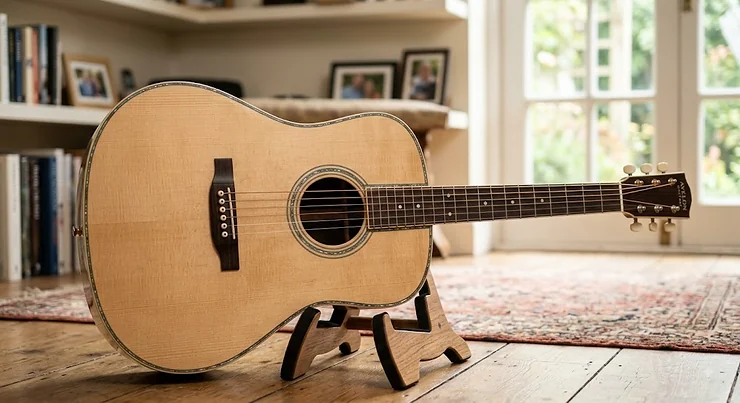
There’s a particular kind of guitar shame that comes from owning a dreadnought you never play because it lives in a case behind the sofa, too big to grab for a quick ten minutes before dinner. A mini acoustic guitar solves that problem by being genuinely small enough to keep within arm’s reach — on a stand by the sofa, wedged into a car boot, or stuffed into an overhead locker on the way to Cornwall. It is not, despite what the name suggests, a toy. The best examples pack real solid-wood tone into a body roughly two-thirds the size of a standard dreadnought, and they’ve become a legitimate second (or first) guitar for touring songwriters, nervous beginners, and anyone whose hands or hallway simply can’t cope with a full-size instrument.

This guide pulls together seven real, currently available models spanning roughly £130 to £650, drawn from actual specifications and aggregated customer and press review sentiment rather than marketing copy. You’ll get honest commentary on tone, playability, and build quality, a proper comparison of parlour-shaped guitars against dedicated travel guitars, and practical advice for adults who assumed a smaller body meant a compromise. Whether you land on a compact Taylor, a laminate Fender for a ten-year-old, or a retro Gretsch parlour, the goal here is the same: help you buy the right small guitar once, rather than the wrong one twice.
What Is a Mini Acoustic Guitar?
A mini acoustic guitar is a steel-string instrument built on a shortened body and, usually, a shorter scale length than a standard dreadnought or concert guitar — typically 22 to 24 inches versus the usual 25.4 inches. The shrunken air chamber trades some low-end depth for portability and easier fretting, which is why the category covers everything from true “3/4” travel guitars to the vintage-shaped parlour guitars that predate the modern dreadnought by decades.
Quick Comparison Table
| Guitar | Body Type | Price Range | Best For |
|---|---|---|---|
| Taylor GS Mini Mahogany | Mini Grand Symphony | £550-650 range | Fullest tone in a compact body |
| Martin LX1E Little Martin | Modified 0-size | £500-580 range | Authentic solid-top travel tone |
| Yamaha CSF1M | Parlour/travel hybrid | £450-550 range | Gigging with a plugged-in parlour sound |
| Taylor Baby Taylor BT1 | 3/4 dreadnought | £300-350 range | Smallest true Taylor for young or small hands |
| Ibanez PN12E | Parlour, electro | around £220 | Plug-and-play value parlour |
| Gretsch Jim Dandy G9500 | Parlour | £150-200 range | Vintage blues character on a budget |
| Fender FA-15 3/4 | 3/4 dreadnought | under £150 | First guitar for a child or absolute beginner |
Looking across the table, there’s a clear split between guitars built to sound like “real” acoustics in miniature — the Taylor GS Mini Mahogany, Martin LX1E Little Martin, and Yamaha CSF1M — and guitars built primarily for accessibility and price, like the Fender FA-15 3/4 and Gretsch Jim Dandy G9500. The Ibanez PN12E and Taylor Baby Taylor BT1 sit in the middle, offering real solid-wood or branded pedigree without premium pricing. If tone is your only priority, spend up for the GS Mini; if a growing child needs their first steel-string, the Fender or Gretsch will do the job without the heartbreak of an expensive guitar getting dented in a school bag.
💬 Already got a favourite in mind? Tap through to check today’s price and availability before it changes.🤗
Top 7 Mini Acoustic Guitars: Expert Analysis
Every guitar below has been assessed on real specifications, manufacturer data, and aggregated sentiment pulled from verified customer reviews and independent guitar press. Where reviewers disagree or a claim can’t be verified, that’s flagged rather than smoothed over.
1. Taylor GS Mini Mahogany — biggest tone in a mini body
The standout feature here is the Grand Symphony-derived body shape, scaled down but still delivering a surprisingly full low end for something you can carry with one hand. Specced with a solid mahogany top, layered sapele back and sides, and a 23.5-inch scale, the GS Mini punches well above a typical mini guitar because Taylor didn’t just shrink a dreadnought — it redesigned the body proportions from scratch. The GS Mini brings the pronounced bass, sweet highs, and slightly scooped midrange of the Grand Symphony shape to a smaller-scale design, which is precisely why it out-projects rivals twice its size on paper. Based on the spec comparison with cheaper laminate minis, the solid top is the real differentiator — it opens up and improves with age rather than staying static. This is the pick for gigging songwriters, hotel-room warm-ups, and anyone who wants their “spare” guitar to sound almost as good as their main one. Reviewers consistently report that the GS Mini holds up well against full-size acoustics in recordings, with several independent reviews naming it a top pick specifically for beginners who don’t want to outgrow their first “real” guitar within a year. A common thread in aggregated feedback is surprise at how little tonal compromise there is for the size — though a minority of players note it still can’t match a full dreadnought’s sub-bass in a live band mix.
Pros:
- ✅ Solid mahogany top opens up and improves with playing time
- ✅ Grand Symphony shape gives unusually full bass for its size
- ✅ Backed by Taylor’s reputation for consistent factory setup
Cons:
- ❌ Sits at the top of the mini-guitar price bracket
- ❌ Still lacks the low-end weight of a full dreadnought
At around the £550-650 range, the GS Mini Mahogany isn’t the cheapest mini on this list, but for players who’ll actually use the guitar for years, the value case is strong: check current price before buying.

2. Martin LX1E Little Martin — solid-spruce travel tone that convinces
The standout here is a genuinely solid Sitka spruce top on a guitar built specifically for travel — a spec most rivals at this size skip in favour of all-laminate construction. The Martin LX1E pairs that solid spruce top with mahogany-pattern HPL back and sides, a 23-inch scale, and Fishman Isys T electronics for plugging in on the move. In practice, what most buyers overlook about the HPL (high-pressure laminate) back and sides is that it’s a deliberate choice, not a cost-cutting shortcut — it resists humidity and temperature swings far better than solid wood, which matters if this guitar is genuinely going in a car boot or aircraft hold. Based on aggregated press reviews, the tone leans crisp and slightly boxy unplugged compared with the Taylor, but reviewers note a clear midrange presence that never tips into the boxy territory some smaller-bodied acoustics fall into, and the plugged-in voice is described as impressively natural for a piezo system. This is the guitar for players who want genuine Martin heritage and don’t mind a slightly utilitarian aesthetic in exchange for durability. A detailed independent review highlighted smooth, well-finished fretwork and an excellent factory setup, alongside a minor gripe about fine volume adjustments on the onboard pickup being fiddly.
Pros:
- ✅ Solid spruce top rare at this size and price point
- ✅ HPL back and sides shrug off temperature and humidity changes
- ✅ Comes with a genuinely usable padded gig bag
Cons:
- ❌ Unplugged tone can sound slightly boxy without EQ tweaking
- ❌ Pickup volume control is fiddly for fine adjustments
Sitting in the £500-580 range, the LX1E asks a premium price for a travel guitar — justified mainly by that solid top and the Martin name on the headstock.
3. Yamaha CSF1M — parlour looks, gig-ready electronics
The standout feature is Yamaha’s forward-shifted scalloped bracing, borrowed from full-size guitars and squeezed into a parlour-scale body to boost resonance beyond what the small chamber should allow. The CSF1M features a solid Sitka spruce top, mahogany back and sides, newly designed scalloped bracing, and a passive undersaddle piezo pickup, blending travel-guitar portability with parlour-style tonal focus. What the spec sheet won’t tell you, but user reports suggest, is that this bracing genuinely changes the character versus a basic parlour: the CSF series is designed specifically to counter the reputation compact guitars have for sounding “weak,” delivering a rich, vibrant sound that reviewers say lacks nothing compared with larger counterparts. The passive pickup is a genuine strength for anyone planning open mics or small gigs, since it needs no battery and draws on the same sensor technology found in Yamaha’s higher-end L-Series electronics. This is the pick for players who want one guitar that looks the vintage-parlour part but performs like a modern stage instrument. Aggregated feedback is consistently positive on build consistency, a hallmark of Yamaha’s factory quality control, with the main criticism being that the smaller nut width takes adjustment for players coming from wider full-size necks.
Pros:
- ✅ Scalloped bracing gives unusually rich resonance for the body size
- ✅ Battery-free piezo pickup is genuinely stage-ready
- ✅ Comes with a proper deluxe gig bag included
Cons:
- ❌ Narrower nut width needs adjustment for some players
- ❌ Colour and finish options rotate, so availability varies
Priced in the £450-550 range, the CSF1M undercuts the Martin while offering electronics most players would rate as more usable — a genuinely close call between the two.
4. Taylor Baby Taylor BT1 — smallest true Taylor for small hands
The standout feature is scale: at a genuinely tiny build, the Baby Taylor is Taylor’s smallest instrument, designed from the ground up rather than shrunk down from a bigger model. If you’re looking for something you might call a true miniature guitar, the Baby Taylor is the smallest guitar Taylor makes, built with a solid Sitka spruce top and layered sapele back and sides. Here’s what to weigh: the BT1’s tighter body genuinely suits smaller adult hands, younger teenagers, and anyone who finds even a GS Mini a stretch, but that same compact chamber means less bass output than its bigger Taylor sibling. Compared with the GS Mini, the Baby Taylor’s sound is significantly softer and warmer, described by reviewers as better suited to conventional strumming than lead acoustic work. Based on the spec comparison, this makes the BT1 the better campfire and beginner-lesson guitar, while the GS Mini pulls ahead for recording and solo performance. A common theme in aggregated review sentiment is that new players find the shorter scale genuinely easier on the fretting hand, which matters more than tone quality in the first few months of learning.
Pros:
- ✅ Shortest, most beginner-friendly scale in the Taylor range
- ✅ Solid spruce top delivers real Taylor tone at entry price
- ✅ Lightweight enough for genuinely all-day comfort
Cons:
- ❌ Noticeably less bass output than the GS Mini
- ❌ Non-electric BT1 needs a separate pickup for gigging
At around £300-350, the Baby Taylor is the accessible route into genuine Taylor build quality, and arguably the best-value guitar on this list for a first-time adult beginner.
5. Ibanez PN12E — best value plug-and-play parlour
The standout feature is an onboard preamp and tuner bundled at a genuinely low price point, making this one of the few sub-£250 parlour guitars ready to plug straight into a PA. The PN12E pairs a sapele top with nyatoh back, sides, and neck, and comes equipped with an Ibanez AEQ-2T preamp and onboard tuner for gigging. What most buyers overlook about nyatoh and sapele is that they’re genuinely close tonal cousins to mahogany, giving a warm, midrange-forward voice rather than the scooped brightness of spruce-topped guitars — good news for blues and fingerstyle players, less good for those chasing sparkle. Reviewers describe the resulting sound as a nasal, midrange-heavy voice with a “true bluesbox vibe” rather than balanced clarity, which is an honest trade-off rather than a flaw, provided you know what you’re buying. Aggregated customer sentiment is broadly positive on out-of-box setup and value, though a recurring complaint concerns tuner reliability needing occasional attention. This is the guitar for players who want to plug in without paying Yamaha or Martin prices.
Pros:
- ✅ Built-in preamp and tuner rare at this price bracket
- ✅ Warm, midrange-heavy tone suits blues and fingerstyle
- ✅ Ivory body binding gives a genuinely premium look for the money
Cons:
- ❌ Tuning stability draws occasional complaints in reviews
- ❌ No case or gig bag included as standard
At around £220, the PN12E is hard to beat for anyone wanting real electronics on a parlour body without spending Yamaha- or Martin-level money.

6. Gretsch Jim Dandy G9500 — vintage blues character on a budget
The standout feature is unmistakable retro styling paired with a genuinely playable 24-inch scale, at a price that undercuts almost everything else on this list bar the Fender. Built with a basswood top, back, and sides, a C-shaped nato neck, and a walnut fingerboard, the Jim Dandy trades the usual spruce-and-mahogany recipe for a small-bodied, retro-inspired parlour design. On paper this means a less refined tonal palette than solid-top rivals, but the spec sheet doesn’t capture the personality reviewers consistently praise. The original Jim Dandy built a reputation for impressive build quality and an authentic old-school parlour sound, finding professional admirers among blues players despite the low price. What the spec sheet won’t tell you is how much of that appeal is about feel rather than numbers: reviewers repeatedly describe the guitar as “punching above its weight” for beginners, kids, and anyone wanting a characterful second guitar to leave by the sofa. Aggregated feedback flags the stock action as occasionally high out of the box, an easy first fix at a local shop.
Pros:
- ✅ Distinctive retro looks and genuine blues-parlour voice
- ✅ Comfortable 24-inch scale suits smaller players and kids
- ✅ Consistently praised build quality for the price point
Cons:
- ❌ All-laminate basswood body limits tonal complexity
- ❌ Factory action sometimes needs a professional setup tweak
In the £150-200 range, the Jim Dandy offers more character per pound than almost anything else here, laminate construction notwithstanding.
7. Fender FA-15 3/4 — kindest first guitar for young beginners
The standout feature is a purpose-built 3/4 scale that genuinely fits smaller frames, rather than simply being a smaller-looking full-size guitar. The Fender FA-15 3/4 has a 23.3-inch scale length, shorter than a full-size acoustic for easier playability, with a laminated spruce top and laminate mahogany or sapele back and sides. Here’s what to weigh: the all-laminate build means this isn’t a guitar that will “open up” tonally over years of playing the way a solid-top instrument will, but for a first guitar bought to test commitment rather than chase tone, that trade-off is entirely sensible. Aggregated UK customer reviews are notably consistent on comfort: buyers describe it as applicable to smaller frames, with one reviewer noting their shoulders weren’t burdened by the body size, and calling it great value for money. Reviewers consistently note the factory setup is playable straight out of the box, a genuinely important factor for beginners who might otherwise blame themselves for a guitar with bad action. This is squarely the pick for parents buying a first instrument for a child aged roughly 8 to 12, or a petite adult wanting a genuinely comfortable first steel-string.
Pros:
- ✅ Purpose-built 3/4 scale, not just a smaller-looking guitar
- ✅ Consistently praised factory setup straight out the box
- ✅ Lowest price point of any guitar on this list
Cons:
- ❌ All-laminate build won’t develop tone the way solid wood does
- ❌ No onboard electronics on the standard steel-string model
At under £150, the FA-15 3/4 is the sensible, low-risk way to find out whether a child (or a curious adult) actually wants to keep playing.
Full Spec & Price Comparison
| Guitar | Top | Back/Sides | Scale Length | Electronics | Price Range |
|---|---|---|---|---|---|
| Taylor GS Mini Mahogany | Solid mahogany | Layered sapele | 23.5″ | None (GS Mini-e available) | £550-650 range |
| Martin LX1E Little Martin | Solid Sitka spruce | Mahogany HPL | 23″ | Fishman Isys T | £500-580 range |
| Yamaha CSF1M | Solid Sitka spruce | Mahogany | ~23.6″ | Undersaddle piezo | £450-550 range |
| Taylor Baby Taylor BT1 | Solid Sitka spruce | Layered sapele | 22.75″ | None | £300-350 range |
| Ibanez PN12E | Sapele | Nyatoh | 24.4″ | AEQ-2T preamp + tuner | around £220 |
| Gretsch Jim Dandy G9500 | Laminate basswood | Laminate basswood | 24″ | None on base model | £150-200 range |
| Fender FA-15 3/4 | Laminate spruce | Laminate mahogany/sapele | 23.3″ | None | under £150 |
Reading across the rows, the clearest pattern is that solid tops cluster at the top of the price range and laminate builds cluster at the bottom — with the Yamaha CSF1M standing out as the best-specced guitar under £550 thanks to its solid top and built-in electronics. If plugging in matters to you, only three guitars here come electronics-ready from the factory, which should narrow the shortlist quickly for gigging buyers.
How to Choose a Mini Acoustic Guitar: A 6-Step Framework
- Decide why you actually need “mini.” Travel, small hands, and budget all point to different guitars — a GS Mini solves tone-on-a-budget, while an FA-15 solves first-guitar risk.
- Check the top material first. Solid wood tops (spruce or mahogany) improve with age and sound fuller; laminate tops stay static but resist humidity better.
- Match scale length to hand size, not age. A 22-24 inch scale suits most adult hands better than marketing copy suggests — don’t assume “mini” means “for kids.”
- Decide if you need onboard electronics now. Retrofitting a pickup later is possible but adds £60-100; buying electro-acoustic from the start is usually cheaper overall.
- Budget for a proper gig bag or case separately if one isn’t included. A soft case adds real protection for £20-40 and prevents the most common cause of neck damage: falls.
- Try before you buy where possible, since neck profile and nut width vary more between mini guitars than full-size models — a guide like this UK beginner buying walkthrough is a useful primer before visiting a shop.
Small Acoustic Guitar for Adults: Does Size Really Matter for Grown Players?
There’s a persistent myth that a small acoustic guitar for adults is somehow a lesser or “starter” instrument, best outgrown as soon as possible. That’s simply not borne out by how these guitars are actually specced and played. A shorter scale length reduces string tension at standard tuning, which genuinely eases fretting-hand fatigue — useful for adults with smaller hands, arthritis, or anyone returning to guitar after years away. Session players and touring songwriters use guitars like the Taylor GS Mini as their main writing instrument, not a fallback. The honest caveat: a smaller body does produce less low-end projection in an unamplified room, so if you’re regularly playing to a group unplugged, factor that into your choice. For solo practice, songwriting, and recording — which covers the vast majority of adult hobbyist playing — the size difference matters far less than most buyers assume, and the ergonomic benefits often outweigh the modest tonal trade-off.
3/4 Size Acoustic Guitar vs Full-Size: What You’re Really Trading Off
A genuine 3/4 size acoustic guitar isn’t simply a full-size guitar photographed at a smaller angle — it uses a shorter scale length (typically 22-23.5 inches versus 25.4 inches standard), a narrower body depth, and often a slightly narrower nut width. What most buyers overlook is that these three changes compound: lower string tension makes bar chords noticeably easier for beginners, but it also slightly reduces sustain and volume compared with a full-size dreadnought strung to the same tuning. Based on the spec comparison across this list, a solid-top 3/4 guitar like the Baby Taylor closes most of that tonal gap, while an all-laminate 3/4 guitar like the FA-15 accepts it in exchange for a much lower price. The practical upshot for grown-up buyers: a 3/4 guitar is not automatically “for children,” but it is genuinely a compromise on projection versus a full dreadnought, which matters if you plan to play unplugged for other people rather than for yourself.
Best Parlour Guitar: Why This Old Shape Is Back in Fashion
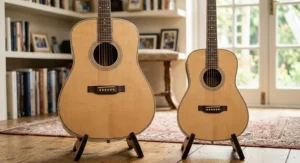
The parlour guitar predates the dreadnought by decades — a narrow-waisted, small-bodied design that was the standard American guitar shape through much of the 19th and early 20th centuries, before larger bodies took over for volume. Its return to fashion over the last decade owes more to recording and songwriting trends than nostalgia: a parlour’s tighter low end and pronounced midrange means it sits cleanly in a mix without the muddiness a dreadnought can introduce when recorded up close. What most buyers overlook when hunting for the best parlour guitar is that “parlour” describes body shape and proportions specifically, not just “small guitar” generically — a true parlour like the Gretsch Jim Dandy or Ibanez PN12E has a narrower waist and shallower body than a 3/4-scale dreadnought like the Baby Taylor, even at similar overall size. For fingerstyle blues, folk, and singer-songwriter material, the parlour shape’s forward midrange genuinely suits the material better than a boomier full-size body would.
Parlour vs Travel Guitar Comparison
| Factor | Parlour Guitar | Travel Guitar |
|---|---|---|
| Body shape | Narrow-waisted, vintage-inspired | Slim, sometimes non-traditional cutaway |
| Tone character | Midrange-forward, focused | Varies widely, often brighter |
| Best example here | Gretsch Jim Dandy G9500 | Martin LX1E Little Martin |
| Designed primarily for | Tone and character at home | Durability and portability on the move |
| Typical price range | £150-250 | £300-580 |
The core distinction most shoppers miss is intent: a parlour guitar like the Gretsch Jim Dandy is designed first for a specific tonal character, with portability as a happy side effect, while a dedicated travel guitar like the Martin LX1E Little Martin is engineered first for durability against temperature and humidity swings, with tone as a secondary (if still important) goal. Some guitars, like the Yamaha CSF1M, deliberately blur the line, borrowing parlour proportions and voicing while adding travel-guitar durability features. If you’re buying primarily to leave a guitar at home for quick practice sessions, lean parlour; if it’s genuinely going in a suitcase several times a year, lean travel-specific.
Mini Guitar Playability for Adults: What the Spec Sheet Won’t Tell You
Nut width and neck profile matter more for adult mini guitar playability than scale length alone, yet they’re the specs most often buried in a footnote. A narrower nut (under 1.65 inches) can feel cramped for players with wider fingertips, regardless of how short the scale length is — several reviewers flagged exactly this issue with the Ibanez PN12E despite its otherwise beginner-friendly credentials. Reviewers consistently note that action height out of the box varies more on budget mini guitars than on premium ones, which is why the Gretsch Jim Dandy’s occasional need for a setup tweak shows up repeatedly in aggregated feedback. Based on the spec comparison across this list, adults with average or larger hands should prioritise trying a guitar’s nut width and neck profile in person over chasing the smallest possible body — a GS Mini’s fuller neck can feel more comfortable to a bigger adult hand than a narrower parlour neck, even though the parlour looks smaller overall.
Best 3/4 Guitar for Grown-Ups: Common Buying Mistakes to Avoid
The single most common mistake adults make when shopping for the best 3/4 guitar for grown-ups is assuming “3/4 size” automatically means “cheap and low quality.” As this list shows, the Baby Taylor and Martin LX1E prove that 3/4 and short-scale guitars can carry genuine premium specifications. A second frequent mistake is buying based on looks alone without checking whether the guitar includes electronics — retrofitting a pickup later typically costs £60-100 installed, often erasing any initial saving. A third mistake is skipping a case or gig bag at checkout to save money; smaller guitars are, counterintuitively, more prone to accidental knocks precisely because owners treat them casually, grabbing them without a case for a quick play. Finally, many adult buyers overestimate how much tone they’re sacrificing versus underestimating how much comfort they’re gaining — the ergonomic benefit is usually the bigger win for a returning or first-time adult player.
✨ Ready to Find Your Perfect Small Guitar?
🎸 Compare today’s prices on any of these seven mini acoustic guitars and see which one is actually in stock near you. A guitar you’ll reach for every day beats a perfect guitar gathering dust in its case.
Setting Up and Caring for Your Mini Acoustic Guitar
Getting a mini acoustic guitar into good playing condition takes roughly twenty minutes and makes a genuine difference to how much you enjoy the first few weeks. Start by checking the action at the 12th fret — anything above about 3mm on the bass side suggests the guitar needs a professional setup, a common issue flagged in aggregated reviews of budget parlour models like the Gretsch Jim Dandy. New strings settle over the first week, so expect to retune more frequently than usual; a clip-on tuner solves most of the frustration beginners report in that early period. Humidity matters more for solid-top guitars like the Taylor GS Mini and Martin LX1E than for laminate models — a simple in-case humidifier packet, costing under £10, protects against the cracking that can occur if a solid top dries out over a UK winter with central heating running. Common first-30-days mistakes include over-tightening tuning pegs (loosen strings before long storage), leaving a guitar near a radiator, and skipping string changes entirely because a beginner doesn’t yet know how — most local guitar shops will do a first restring and basic setup for a modest fee, which is money well spent on a guitar you intend to keep.
Real-World Scenarios: Who Actually Buys a Mini Acoustic Guitar?
The commuting songwriter: Works from home two days a week, writes on the train the other three, and wants something that survives a rucksack. The Martin LX1E Little Martin or Yamaha CSF1M fits this profile well — both are built specifically to handle temperature swings and knocks, with electronics ready for a quiet plugged-in session on a delayed train. If flying is part of the routine too, it’s worth checking an airline’s musical instrument policy in advance, since even a mini guitar case can exceed standard hand-baggage dimensions.
The returning adult beginner: Played guitar at university, hasn’t touched one in fifteen years, and wants low commitment with real tone in case the habit sticks. The Taylor Baby Taylor BT1 suits this buyer nicely — solid-top tone at a price that doesn’t feel like a gamble, with a scale length that’s genuinely kinder on hands out of practice.
The parent buying for an 8-to-12-year-old: Wants to know if the interest is genuine before spending serious money, and needs something the child can physically wrap their arms around. The Fender FA-15 3/4 or Gretsch Jim Dandy G9500 are the sensible picks — both keep the financial risk low while still being genuinely playable instruments rather than toys.
Mini Acoustic Guitar Problems, Solved
Buzzing strings on a new mini guitar almost always trace back to low factory action combined with light strumming technique still being learned; a £20-30 professional setup at a local shop resolves most cases within the first month. Difficulty staying in tune is usually new strings stretching rather than a faulty guitar — stretch each string gently by hand after tuning, and expect stability within a week of regular play. A guitar that sounds thin or boxy unplugged, a complaint that surfaces in aggregated reviews of laminate-top models like the FA-15, often improves with fresh strings and a slightly heavier gauge, though it won’t fully match a solid-top instrument. Sore fingertips in the first fortnight are normal and not a sign of the wrong guitar — calluses build with roughly 15-20 minutes of daily practice, and a mini guitar’s lower string tension genuinely speeds this process versus a full-size dreadnought. Finally, players who find the neck too narrow after buying based on scale length alone should try guitars in person before their next purchase, since nut width varies independently of overall body size, as the earlier playability section explains.
Long-Term Cost and Maintenance: The True Value Picture
The purchase price is only part of the total cost of owning a mini acoustic guitar. Budget roughly £15-25 a year for strings on a well-used guitar, £30-50 every couple of years for a professional setup and fret check, and a one-off £20-40 for a proper case if one wasn’t included. Solid-top guitars like the Taylor GS Mini and Martin LX1E carry a real long-term advantage here: their tone improves with age and use, meaning the guitar you’re playing in five years’ time genuinely sounds better than the one you bought, which isn’t true of laminate-top instruments. On a cost-per-use basis, spreading a £600 GS Mini across five years of regular playing works out to roughly £2.30 a week — cheaper than a single takeaway coffee, and a useful reframe for anyone hesitating over the upfront price. Cheaper laminate guitars like the FA-15 and Jim Dandy carry lower maintenance costs but also lower resale value, so factor in whether you’re likely to want an upgrade later versus keeping this as a long-term instrument.

FAQ
❓ What size guitar is best for a small adult?
❓ Is a mini acoustic guitar good for beginners?
❓ Can you use a 3/4 guitar as your only guitar?
❓ What's the difference between a parlour and a travel guitar?
❓ Do mini acoustic guitars need different strings?
Conclusion
Choosing the right mini acoustic guitar comes down to being honest about why you want a smaller instrument in the first place. If tone is non-negotiable and budget allows, the Taylor GS Mini Mahogany remains the standout for genuinely full sound in a compact body. If durability for actual travel matters most, the Martin LX1E or Yamaha CSF1M earn their higher price tags through build quality most laminate guitars can’t match. For a first guitar bought to test genuine interest — whether for a child or a curious adult — the Fender FA-15 and Gretsch Jim Dandy prove that low price doesn’t have to mean a frustrating instrument. None of the seven guitars covered here is a “toy” version of a real guitar; each is a legitimate instrument with specific strengths, and the right one depends entirely on how, where, and how often you’ll actually play it. Whichever you choose, prioritise trying the neck and nut width in person if you can, budget for a proper case, and remember that a smaller guitar you pick up daily will always beat a bigger one gathering dust.
Recommended for You
- 7 Best Travel Guitars for 2026: Compact Picks That Still Sing
- Classical Guitar for Flamenco: 7 Real Picks for 2026
- 7 Best Classical Guitars for Beginners in 2026
Disclaimer: This article contains affiliate links. As an Amazon Associate, I earn from qualifying purchases. If you purchase products through these links, we may earn a small commission at no additional cost to you.
✨ Found this helpful? Share it with your friends! 💬🤗
